
Reviewed · OLD TOWN WALKS
Get to know Nuremberg. Highlights in the old town
Nuremberg reveals its story one street at a time. This 90-minute walking tour gives you a compact introduction to the city, linking the Pegnitz, the main market, medieval churches, craft houses, and historic bridges in one easy route. I especially like the clear old-town circuit and the way the guide explains ordinary trades alongside famous monuments. The tour is also priced at just $16.20, which makes it a sensible first look at Nuremberg.
The main thing to consider is that this is a German-speaking tour. If you do not understand German, the sights will still be enjoyable, but the historical explanations will lose much of their value. The 2 p.m. start also suits an afternoon arrival, though it may not fit every sightseeing schedule.
In This Review
- Key points at a glance
- Why this short Nuremberg walk works
- Starting beside the Pegnitz at the Henkerhaus
- The Beautiful Fountain and the main market
- St. Sebaldus Church and Nuremberg’s religious center
- Weißgerbergasse and the old craft quarter
- Kettensteg and the final bridge views
- What the guide adds to the experience
- Pace, group size, and practical value
- Who should book this Nuremberg tour?
- Should you book the 90-minute old-town walk?
- FAQ
- Where does the tour start?
- What time does the tour begin?
- How long does the walking tour last?
- What language is the tour conducted in?
- Where does the tour end?
- What sights are included?
- How much does the tour cost?
- Can I cancel for a full refund?
Key points at a glance
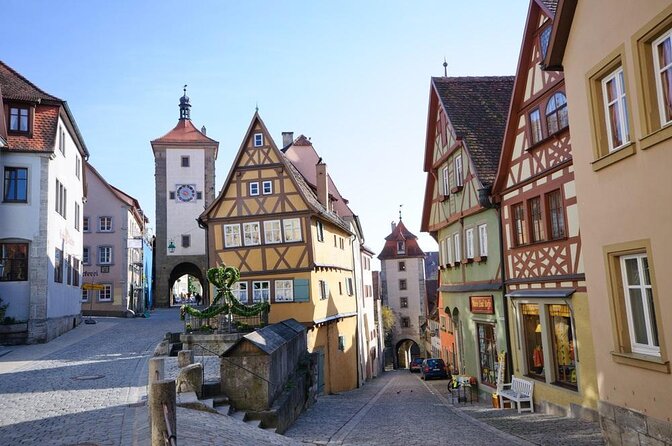
- A 90-minute route with real variety: You move from the Pegnitz and the Hangman’s House to the main market, churches, old craft houses, and historic bridges.
- The tour begins at the Henkerhaus: This 500-year-old building once housed Nuremberg’s official executioner and now contains an exhibition about law and crime.
- The Beautiful Fountain carries medieval symbolism: Its 40 painted figures represent the medieval view of history, politics, religion, and education.
- Weißgerbergasse shows old working Nuremberg: The preserved houses belonged to white tanners, who made fine leather from wild, lamb, and goat skins.
- The guide keeps the walk lively and accessible: Feedback highlights free speaking, clear explanations, and an easygoing response to questions.
- The price is strong for a first orientation: At $16.20, you get a focused introduction without committing half a day.
Why this short Nuremberg walk works
Nuremberg can seem easy to understand at first. The old town is compact, the Pegnitz cuts through it, and the major sights sit within walking distance. But a good guide helps you connect the pieces. A fountain becomes a lesson in medieval society. A row of half-timbered houses becomes evidence of vanished crafts. A bridge tells you how the city entered the industrial age.
That is the real value here. You are not simply ticking off the Beautiful Fountain, Frauenkirche, St. Sebaldus Church, and Weißgerbergasse. You are getting a short narrative about how Nuremberg worked, who lived there, and how the city changed.
The route also has a pleasant rhythm. It starts beside the river, passes through the central market, reaches major religious and civic buildings, then turns toward a quieter street and the bridges. You get grand views and smaller details without being asked to walk all over the city.
At $16.20 per person, I see this as an affordable orientation rather than a full historical study. The 90-minute length is enough to give you a framework, but not enough to enter every attraction or explore each subject at length. That limitation is useful if you want a first look, but you may want to pair it with independent visits afterward.
More Old Town Walks in Nuremberg
- Nuremberg: Old Town Guided Walking Tour
★ 4.6 · 2,416 reviews - Nuremberg Old Town and Nazi Party Rally Grounds Walking Tour in English
★ 4.5 · 504 reviews - Nuremberg Old Town and Nazi Rally Grounds Walking Tour
★ 4.7 · 377 reviews
Starting beside the Pegnitz at the Henkerhaus
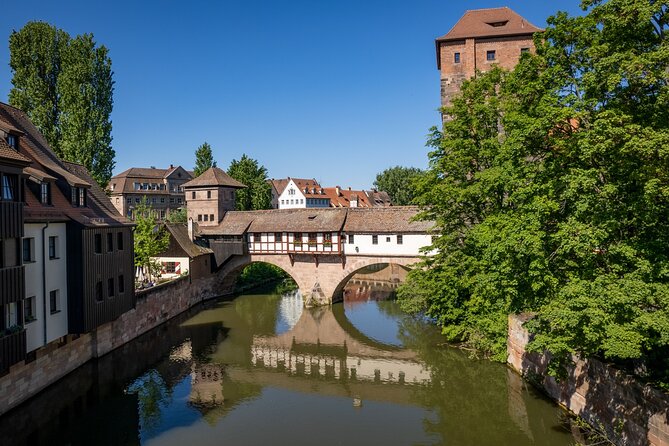
The meeting point is the Henkerhaus Museum at Trödelmarkt 58, in the old town. The building sits directly over the Pegnitz and dates back around 500 years. It is an unusual place to begin a city walk, and that is part of its appeal.
For centuries, the Henkerhaus served as the official residence of Nuremberg’s executioners and their families. That fact gives the opening stop a darker edge, but the subject is not treated as a cheap scare. The building now contains a newly designed exhibition about legal and criminal history, so the guide can use it to explain how justice operated in earlier centuries.
You have about 10 minutes here, with admission included. That is enough time for an introduction and some context, but not a full museum visit. If the Henkerhaus interests you, you may want to return on your own when you can spend more time with the exhibition.
I like this start because it avoids the usual postcard opening. Nuremberg is famous for its Christmas market and Albrecht Dürer, but its old town also has stories about work, punishment, law, and civic life. Beginning at the executioner’s former home signals that this walk will cover more than pretty façades.
From here, the route follows the Pegnitz. The river gives you an immediate sense of how the old town was shaped. It also creates some of the walk’s most attractive views, especially as you approach the central market area.
The Beautiful Fountain and the main market
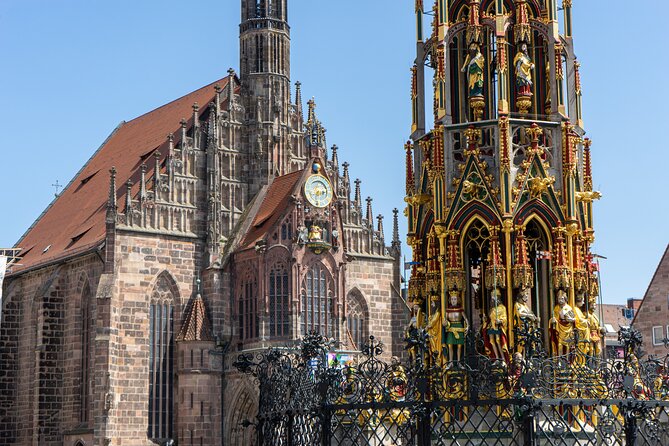
The tour continues to the main market, where the Beautiful Fountain rises about 19 meters above the square. Built between 1385 and 1396, it is one of Nuremberg’s most recognizable sights. Its 40 brightly painted figures reflect the medieval understanding of history, politics, religion, and education.
The fountain was not only decorative. In the Middle Ages, it played a practical role in the city’s water supply. Fresh water reached it through a specially installed pipe called the Schönbrunn pipe. That combination of public art and public utility gives the monument more meaning than a quick photograph suggests.
You spend around 10 minutes here, and admission is free. The stop is short, but it is well placed because the market is one of the city’s essential orientation points. From here, you can understand how religious, commercial, and civic activity came together in the center of Nuremberg.
The Frauenkirche is also located at the main market, even though the listed stop focuses on the fountain. The church helps complete the view, and the guide’s broader route includes the city’s major postcard scenes. If you want interior visits, ask about the timing, since the walk itself is designed mainly as an outdoor introduction.
The market can be especially important if you are visiting during the Christmas season, when Nuremberg’s famous market fills the square. At other times, the open space lets you study the fountain and church with less seasonal decoration competing for attention.
St. Sebaldus Church and Nuremberg’s religious center
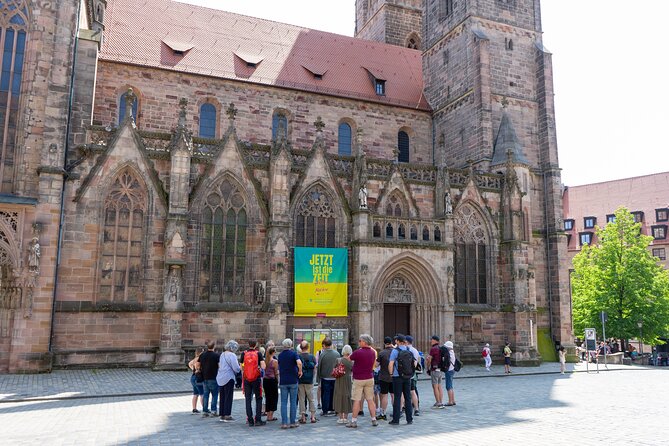
The next major stop is St. Sebaldus Church, the oldest parish church in Nuremberg. Its origins reach back to around 1230, when it was built as a late Romanesque pillar basilica. The church is dedicated to Saint Sebald, a figure connected with legends and acts of blessing.
Saint Sebald’s grave remains inside the church. That gives the building a direct link to the local religious tradition, rather than making it simply an old structure on a sightseeing route.
The tour allows about 10 minutes here, with no separate admission charge. In that time, you can expect the guide to explain why the church matters and point out the elements that help you read its age and purpose. You will not get a long church study, so anyone especially interested in architecture or religious art should plan a separate visit.
I like the contrast between this stop and the Beautiful Fountain. The fountain reflects civic life in the open market. St. Sebaldus Church turns the focus inward, toward worship, legend, and the city’s older religious identity. Together, they give you a better picture of medieval Nuremberg than either sight could provide alone.
The guide’s style matters here. The feedback describes an easy, free-speaking presentation, with clear answers to questions and no forced formality. That should suit you if you prefer a conversational walk rather than a memorized speech delivered at top speed.
Something different for another day:
- Bamberg: Guided Walking Tour
★ 4.6 · 3,202 reviews - Nuremberg: City Tour with the Bimmelbahn Train
★ 4.4 · 2,475 reviews - Nuremberg: Tunnels and Secret Passages in the City Wall Tour
★ 4.8 · 2,334 reviews - Nuremberg: Medieval Dungeons Guided Tour
★ 4.8 · 1,726 reviews
Weißgerbergasse and the old craft quarter
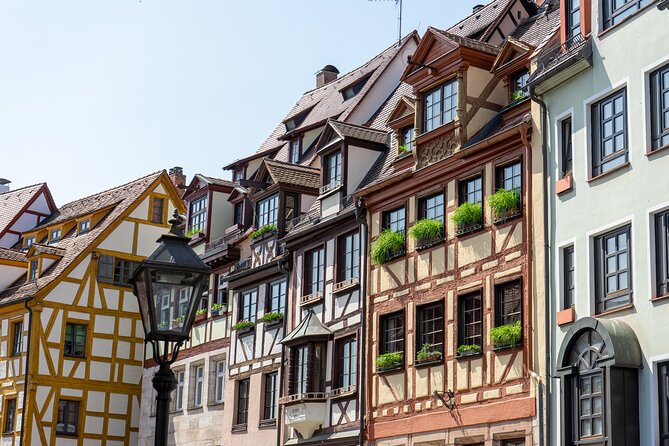
One of the most rewarding parts of the route is Weißgerbergasse. Many of its houses escaped the air raids of World War II largely intact, allowing part of the late medieval character to survive. The street offers a view of Nuremberg that is more intimate than the main market.
The name points to the white tanners who once lived and worked here. These craftspeople produced particularly fine leather from wild-animal, lamb, and goat skins. The street therefore tells you about work as much as architecture.
This is the sort of stop I value on a city tour. Famous landmarks explain a city’s public face, but craft streets reveal how people earned a living. The houses on Weißgerbergasse help you picture workshops, materials, and a trade that shaped the neighborhood.
The route gives you roughly 10 minutes here. That is enough to see the row of preserved buildings and understand its importance, though it is not a detailed architectural survey. You may find yourself wanting to pause for photographs, so keep in mind that the group will continue on schedule.
The street also adds visual variety after the large church and market. You move from monumental buildings to a closer view of domestic façades and working life. For many people, this becomes one of the most memorable parts of the walk because it feels less formal and more connected to everyday history.
Kettensteg and the final bridge views
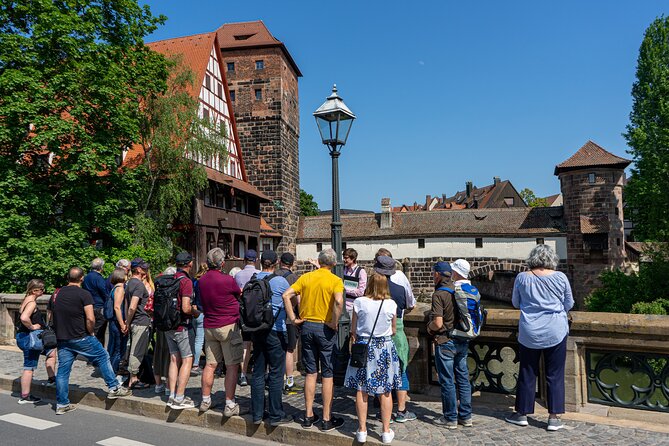
The last listed stop is Kettensteg, a chain bridge designed in 1824 by Nuremberg mechanic Georg Kuppler. It is described as the oldest surviving suspension bridge made entirely of metal in the German-speaking world.
That makes Kettensteg a useful reminder that Nuremberg’s story did not end in the Middle Ages. The bridge belongs to the early industrial age, when new engineering methods changed how people crossed rivers and moved around growing cities.
You have about 10 minutes at this stop. The bridge itself is a technical object, but it also fits the walk’s larger theme: Nuremberg developed through practical skills. The tour begins with the executioner’s house, passes the tanners’ street, and finishes with metal engineering. Different trades and professions keep appearing along the route.
The walk also passes over the Maxbrücke and returns through what is described as one of the most attractive parts of the old town. The activity ends back at the meeting point, so you are not left on the opposite side of the center trying to find your way back.
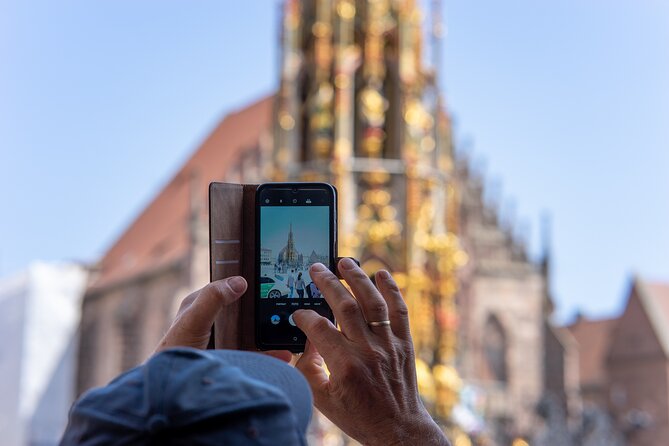
For photography, the river crossings and old-town views should be among the better opportunities on this route. The walk is not built around long photo stops, so you will need to take pictures efficiently. I would keep your camera ready as you move between the river, the bridges, and the historic façades.
What the guide adds to the experience
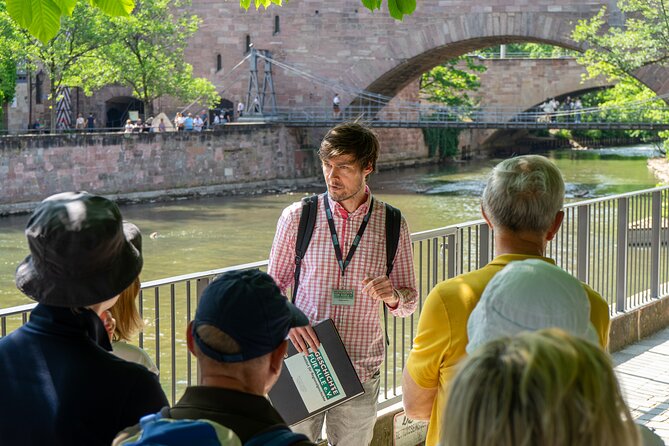
A city walk depends heavily on the person leading it. Here, the strongest praise focuses on the guide’s command of Nuremberg, clear explanations, and relaxed delivery. One particularly useful point is that the guide speaks freely and handles questions well. That suggests a flexible conversation rather than a rigid script.
The explanations are also described as simple and vivid. That matters because a 90-minute walk can become exhausting if every stop is loaded with dates and formal terminology. The best approach is to give you enough detail to understand the city without turning the tour into a classroom lecture.
The guide’s personal connection to Nuremberg also comes through in the feedback. One guide was described as loving the city, and another was noted for creating new insights even for someone born in Nuremberg. You should not expect every guide to offer the same personal story, but the experience clearly aims for local feeling rather than a generic list of monuments.
This is a German-speaking tour, so language is the biggest practical filter. You should book it if you can follow spoken German comfortably. If not, you may still enjoy the route and the views, but you will miss the central benefit: the explanations connecting the sights.
Pace, group size, and practical value
The advertised duration is about 1 hour and 30 minutes. With five stops of roughly 10 minutes each, the timing leaves room for walking between locations and short explanations along the way. That makes the route compact but not rushed on paper.
The group can include up to 25 people. That is not a private walk, but it is still a manageable size for a city-center tour. Your experience will depend on where you stand and how clearly you can hear, so staying reasonably close to the guide should help.
The activity begins at 2 p.m. and uses a mobile ticket. You receive confirmation at booking, and the meeting point is near public transportation. Most people can participate, and service animals are allowed.
At $16.20, the price is easy to justify if you want context before exploring alone. A local guide can help you avoid spending your first hour simply figuring out which buildings matter and why. The cost is less compelling if you already know Nuremberg well or plan to spend only a few minutes in the old town.
The free cancellation policy adds flexibility. You can receive a full refund if you cancel at least 24 hours before the start time. Cancellations or changes made within 24 hours are not refunded or accepted, and the cut-off follows local time.
Who should book this Nuremberg tour?
I would recommend this walk to anyone visiting Nuremberg for the first time, especially if you want a quick orientation before visiting museums or returning to favorite streets on your own. It also suits people who enjoy local crafts, city development, and lesser-known details alongside headline sights.
The route should work well for a short stay because it covers several major areas without taking up half a day. It is also a good choice if you prefer walking to a bus tour and want to stay close to the old town’s streets, river, bridges, and squares.
You may want something else if you need a tour in English or another language. You should also look for a longer specialist tour if your main interest is Albrecht Dürer, World War II history, the Nuremberg Trials, or the Christmas market. Those subjects are important to the city, but this walk gives you a broad introduction rather than a detailed focus on one theme.
Should you book the 90-minute old-town walk?
Yes, if you understand German and want an affordable first look at Nuremberg. I like its route because it connects the city’s beauty with its practical past: executioners, water systems, parish life, leatherwork, and early industrial engineering.
The best reason to book is the balance. You get the main market and famous churches, but also Weißgerbergasse, the Henkerhaus, and Kettensteg. At $16.20, that is a good deal for a compact city introduction.
Skip it if the language does not work for you, or if you already know Nuremberg’s old town well. For everyone else, this is a friendly, efficient way to get your bearings and leave with a better sense of how the city grew.
FAQ
Where does the tour start?
The tour starts at the Henkerhaus Museum, Trödelmarkt 58, 90403 Nürnberg, Germany.
What time does the tour begin?
The tour starts at 2 p.m.
How long does the walking tour last?
The tour lasts approximately 1 hour and 30 minutes.
What language is the tour conducted in?
The tour is conducted in German.
Where does the tour end?
The activity ends back at the meeting point.
What sights are included?
The route includes the Henkerhaus, the Beautiful Fountain, St. Sebaldus Church, Weißgerbergasse, Kettensteg, the Pegnitz, the main market, and the Maxbrücke area.
How much does the tour cost?
The price is $16.20 per person.
Can I cancel for a full refund?
Yes. You can cancel for a full refund at least 24 hours before the experience start time. Cancellations within 24 hours are not refunded.
Just added around Nuremberg
- Private Guided Walking Tour of Bayreuth With A Professional Guide★ 5.0 · 3 reviews
- Nuremberg Culinary Walking Tour★ 4.0 · 4 reviews
- PRIVATE – Nuremberg Combo Tour WWII + Old Town★ 5.0 · 4 reviews
- Private transfer from Nuremberg to Munich with 2h for sightseeing★ 5.0 · 4 reviews
- Nuremberg: World War 2 History Tour with Beer Tasting★ 5.0 · 4 reviews
- Discover Nuremberg’s Christmas Market Magic with a Local★ 5.0 · 5 reviews
- Airport Transfer in or to Nuremberg★ 4.5 · 5 reviews
- Bamberg PRIVATE Walking Tour★ 4.0 · 5 reviews
Old Town Walks, compared.
Old Town & Viktualienmarkt City Walk in German
Read our review →
The Night Watchman Old Town Walking Tour in German
Read our review →
Browse the lists this tour appears in