
Reviewed · HISTORICAL TOURS
Augsburg – Private Historic Tour
Augsburg rewards a guide’s eye. This private three-hour walk brings the city’s Roman, medieval, Renaissance, and baroque layers together while covering major sights such as the Fuggerei, Augsburg Cathedral, and the Golden Hall. You get a clear introduction without spending days sorting through dates and names on your own.
I especially like the private format, which gives you room to ask questions and adjust the pace. I also like the route’s range, from the red gate and Gothic basilica to grand fountains and a 16th-century social housing project. The main drawback is cost: $417.72 per group is a serious outlay for a three-hour walk, especially for one or two people, and the two key indoor admissions are extra.
Past tour arrangements have included guides such as Kristen and Stephanie. Kristen met one guest at the train station and escorted that person back afterward, while Stephanie met a group at its hotel and shaped the visit around its interests. Those details suggest a personal service style, but you should confirm meeting arrangements when booking.
In This Review
- Five useful things to know before you book
- Why a private walk works well in Augsburg
- Starting at Rotes Tor, Augsburg’s red gate
- St. Ulrich and Afra, where faith and Gothic stone meet
- Schaezlerpalais brings 18th-century style to the route
- Hercules’ Fountain and Augsburg’s famous water displays
- Inside the Golden Hall at Augsburg Town Hall
- Perlach Tower and the center of old Augsburg
- Augustusbrunnen and the public face of Augsburg
- St. Anne’s Church and a medieval monastery connection
- Augsburg Cathedral and a thousand years of changing design
- Fuggerei gives the tour its strongest human story
- What the $417.72 price really buys you
- Timing, meeting points, and practical planning
- Who should book this Augsburg tour?
- Should you book the Augsburg Private Historic Tour?
- FAQ
- How long is the Augsburg Private Historic Tour?
- Where does the tour start?
- Where does the tour end?
- How many people can join the private tour?
- Are entrance fees included?
- Is the tour near public transportation?
- Can I cancel or change the booking?
Five useful things to know before you book
- The route covers ten major stops: You see gates, churches, fountains, a palace, the town hall, a tower, the cathedral, and Fuggerei.
- It is private for up to 15 people: Your group does not share the guide with strangers.
- Two indoor sights cost extra: Schaezlerpalais is €7 per person, and the Golden Hall is €2.50 per person.
- The tour ends at Fuggerei: You finish at Fuggereib. d. Jakobskirche rather than returning to the town hall.
- The walking route crosses Augsburg’s central sights: The start is at Rathausplatz 2, by Augsburg Town Hall.
- You need to be sure before paying: The booking is non-refundable and cannot be changed.
Why a private walk works well in Augsburg
Augsburg is easy to underestimate. Its central sights sit within a walkable area, but the city’s story jumps across centuries. A Roman martyr, medieval churches, Fugger family wealth, Renaissance fountains, baroque interiors, wartime destruction, and modern reconstruction all appear within a short route.
That is where a private guide earns the fee. You are not simply ticking off buildings. You can stop and ask why a fountain is here, how Fuggerei worked, or why Augsburg’s town hall had to be rebuilt. A good guide can connect those pieces instead of leaving you with ten unrelated photo stops.
The format also suits different kinds of groups. A family can ask for shorter explanations. A history-minded group can linger over architecture. A couple arriving by train can ask about meeting at the station, as happened with Kristen. A group of up to 15 can split the price, making the per-person cost much easier to accept than it is for a solo visitor.
The published duration is about three hours. That is enough time for an overview, but not enough for long visits inside every building. The stop lengths make that clear. Several sites receive 10 or 15 minutes, while Schaezlerpalais and the Golden Hall receive about 30 minutes each.
More Historical Tours in Germany:
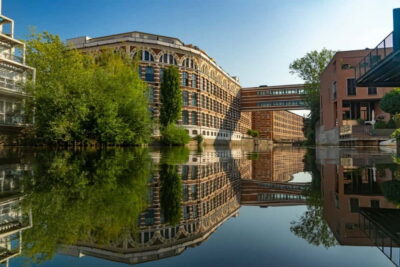
- Leipzig: City History Canal Sightseeing Tour on a Motorboat
★ 4.7 · 6,232 reviews - Berlin: Natural History Museum Entrance Ticket
★ 4.6 · 3,382 reviews - Leipzig: 1.5-Hour Historical Walking Tour in German
★ 4.7 · 2,217 reviews
Starting at Rotes Tor, Augsburg’s red gate
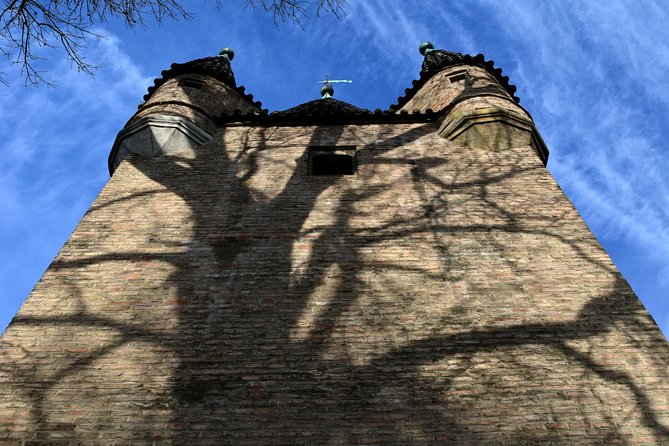
The walk begins at Rotes Tor, also called the Red Gate. You have about 15 minutes here, with no admission charge.
This is a useful opening stop because a gate tells you something practical about an old city. Augsburg was not just a collection of churches and palaces. It was a defended urban center, and Rotes Tor points to that earlier role. The tower was renovated in the 20th century, so you are seeing both an old structure and a later effort to preserve it.
Do not expect a long interior visit based on the stated timing. The value is the setting and the guide’s explanation. If you enjoy city walls, towers, and old entrances, this gives the tour a firm start.
St. Ulrich and Afra, where faith and Gothic stone meet
The next stop is the Basilica of St. Ulrich and Afra, with about 15 minutes to look around. Admission is listed as free.
The church’s story reaches back to the Roman tomb of St. Afra, who was martyred in 304. The present Catholic parish is known for Gothic architecture, giving you a direct change from the defensive character of Rotes Tor.
Fifteen minutes is a short visit, so use it wisely. Look up at the structure, note the scale, and listen for the connection between Augsburg’s late Roman Christian past and its medieval religious life. If church interiors are your main reason for booking, ask in advance how much time can be spent inside. The route includes several religious buildings, but the stated schedule keeps each visit brief.
Schaezlerpalais brings 18th-century style to the route
Schaezlerpalais is the first listed stop with a planned 30 minutes and a separate admission fee. Entry costs €7 per person.
The palace dates from 1765 and is an important historical monument with a grand baroque style. This is the point where Augsburg’s civic story shifts from towers and medieval churches to aristocratic display. The building helps explain how wealth was expressed through architecture, decoration, and formal rooms.
Unlike the free outdoor stops, this visit adds to your bill. For a group of 15, €7 per person becomes a noticeable extra cost. Still, the 30-minute allocation gives the palace more breathing room than the short church and fountain stops.
I would ask your guide how the palace visit fits the day’s timing. Since indoor access and opening arrangements can affect the route, this is one of the stops worth confirming before arrival. If the €417.72 group price already feels high, remember to add this fee and the Golden Hall admission.
A few more tours and experiences worth a look
- Berlin: Private Reichstag and Glass Dome Tour
★ 4.8 · 2,226 reviews - Berlin Private Complete History All Day Walking Tour
★ 5.0 · 474 reviews - Munich Private Tour with a Local – Highlights & Hidden Gems
★ 5.0 · 469 reviews - Private Walking Tour Berlin Third Reich Hitler and World War II
★ 5.0 · 360 reviews
Hercules’ Fountain and Augsburg’s famous water displays
The route then passes Hercules’ Fountain, another free stop lasting about 15 minutes. The fountain dates from 1597 and features a bronze Hercules killing the Hydra, the seven-headed monster from Greek mythology.
This is not just a decorative pause. The sculpture gives you a quick lesson in Renaissance public art, where classical myths appeared in prominent city spaces. Hercules is shown in action, which makes the fountain easier to remember than a quiet architectural detail.
Augsburg is also known for its historic water system and public fountains, though the supplied route focuses on the artwork itself. You will later see Augustusbrunnen, so these two stops work better together than they would separately. Ask the guide to compare them. The tour’s private setup makes that sort of question worthwhile.
Inside the Golden Hall at Augsburg Town Hall
The Golden Hall is one of the most important indoor stops. You have around 30 minutes, and admission costs €2.50 per person.
This ceremonial room is known for ceiling paintings and gold wall decoration. It was completed in 1643, then destroyed along with the town hall during an air raid in 1944. The room was reconstructed after the war, giving the visit two stories at once: the original ambition of Augsburg’s civic leaders and the city’s effort to rebuild a major symbol.
The modest entry fee is easier to absorb than the palace charge, but it still matters for a large group. For 15 people, the two listed admissions together would total €142.50, before considering the main tour price.
Allow yourself time to look above eye level. The ceiling and upper decoration are central to the room’s effect. A guide can also explain why a ceremonial hall mattered to the city, rather than leaving you to treat it as a glittering photo background.
Perlach Tower and the center of old Augsburg
Perlach Tower rises about 70 meters in Augsburg’s central district. The stop lasts about 10 minutes and has no admission charge.
The tower began as a watchtower in the 10th century. That makes it a useful link back to the city’s early defensive needs, while its central position places it close to the town hall and Augustusbrunnen.
The short visit suggests an exterior look rather than a tower climb. If you hoped to go up, ask the guide or booking contact before the tour. The tour provides historical context and a view of the building, but the supplied details do not promise interior access or a climb.
Augustusbrunnen and the public face of Augsburg
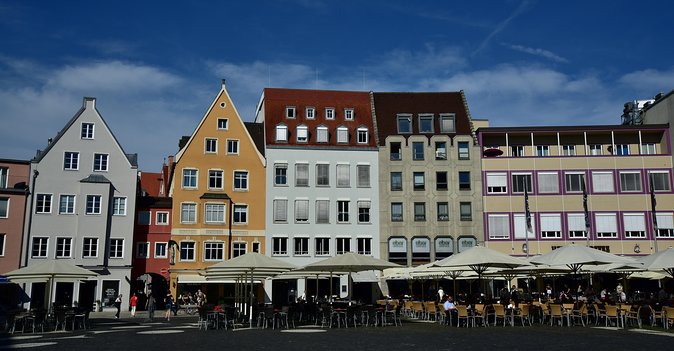
Augustusbrunnen sits in the town hall square and receives about 10 minutes. The fountain was cast between 1588 and 1594, and no admission is required.
Its location matters. You are not looking at an isolated monument in a park. You are seeing a civic fountain placed in one of Augsburg’s central public spaces, close to the town hall and Perlach Tower. That setting helps you read the square as the city’s public center.
Ten minutes is enough for a close look and a short explanation, though not a long pause. Combine this stop mentally with Hercules’ Fountain. Together, they show how Augsburg used sculpture and water to decorate public places during the late 16th century.
St. Anne’s Church and a medieval monastery connection
St. Anne’s Church follows with about 15 minutes and free admission. The church was built in 1321 and was originally part of a monastery.
Its appeal is the contrast between its medieval origins and its elaborate interior decoration. After the broad civic spaces of the town hall area, the church gives you a more intimate setting. You can see how religious institutions shaped Augsburg’s built center.
The schedule again favors a focused visit. I would pay attention to the interior rather than expecting a full service or architectural study. If your group has a particular interest in religious art, tell the guide early so the explanation can match your interests.
Augsburg Cathedral and a thousand years of changing design
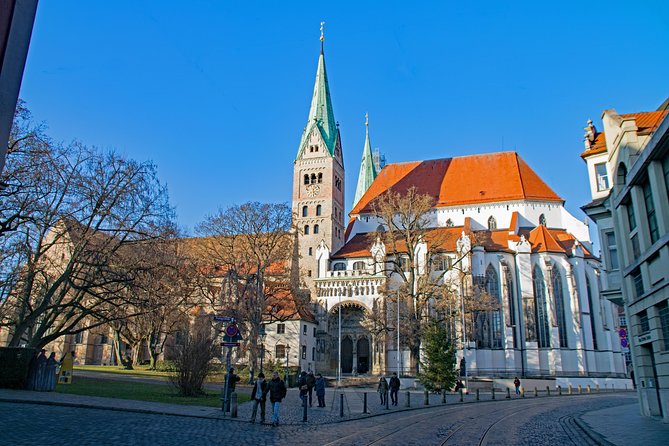
Augsburg Cathedral is the next major church stop. It was founded in the 11th century, with Gothic additions from the 14th century. Its tower reaches about 62 meters, and admission is listed as free.
This is one of the best places to see how a building changes over time. The Romanesque foundation and later Gothic work belong to different periods, yet they occupy the same church. You get a visible lesson in architectural change without leaving the city center.
The 15-minute visit will not cover every detail. Still, the cathedral works well as a concise stop because its main facts are easy to grasp: an 11th-century foundation, 14th-century additions, and a tall tower that marks its place in the city.
Fuggerei gives the tour its strongest human story
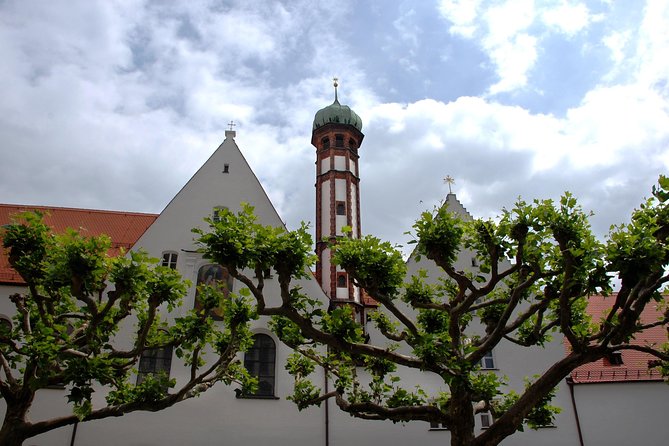
The final stop is Fuggerei, founded in 1516 by the Fugger family. It is the world’s oldest social housing complex still in use. The original purpose was to house needy citizens of Augsburg.
This is the tour’s most distinctive stop. Palaces, cathedrals, towers, and fountains appear in many European cities. Fuggerei offers a more direct look at daily life, charity, wealth, and social responsibility. It also brings the Fugger family into the story in a practical way, not simply as wealthy patrons of grand buildings.
The route ends at Fuggereib. d. Jakobskirche, in the Fuggerei area. That finish is useful if you want to continue exploring the complex afterward, but it means you do not return to Rathausplatz. Plan your next move from the endpoint.
The listed visit lasts 15 minutes, so the guided portion is brief. If Fuggerei is your main reason for booking, ask how much of the complex is included and what you can see after the tour ends. The guide can provide the context, while you may want extra independent time to take in the site.
What the $417.72 price really buys you
The price is $417.72 per group of up to 15 people, with an official guide included. For a full group, that is about $27.85 per person before the two entrance fees. For two people, it is about $208.86 each, and for one person, the price is hard to justify unless personal guiding is your priority.
The value comes from privacy and flexibility, not from the number of included attractions. Many stops are free, and the paid entries are modest. You are paying for someone to organize the route, explain Augsburg’s complicated past, answer questions, and potentially adjust the visit to your group.
The feedback attached to this experience puts strong emphasis on personal care. Kristen arranged a train station meeting and escorted a guest back afterward. Stephanie met a group at its hotel and tailored the tour to its needs. That kind of help can matter a lot on a short visit, especially if you arrive by train or have a group with mixed interests.
For a family, reunion, school group, or party of eight to 15, the math becomes more favorable. For a small party, compare the cost with a shared walking tour before booking. The private setting remains appealing, but the price difference is substantial.
Timing, meeting points, and practical planning
The official start is Augsburg Town Hall at Rathausplatz 2, 86150 Augsburg. The finish is in Fuggerei at Fuggereib. d. Jakobskirche, 86152 Augsburg. The experience is near public transportation, and most people can participate.
The route is scheduled for three hours, with stop times ranging from 10 to 30 minutes. That tells you to expect a steady overview rather than a slow architectural study. Wear comfortable shoes and keep your schedule clear after the tour in case you want more time at Fuggerei.
The booking confirmation arrives at the time of booking. Since the experience cannot be refunded or changed, check your date, group size, and meeting point carefully before paying. If you want a hotel or station meeting, ask about it ahead of time rather than assuming it is part of the standard arrangement.
Who should book this Augsburg tour?
I would recommend it most strongly to a group that values private guiding and wants a quick, organized introduction to Augsburg. It also suits people who prefer to ask questions freely rather than follow a fixed shared group.
It is a good match for:
- First-time visitors with only part of a day
- Groups of several people who can share the fixed price
- Families that need a flexible pace
- History and architecture fans
- People arriving by train who may appreciate help with meeting arrangements
I would hesitate if you are traveling alone on a tight budget. The city center can be explored independently, and many listed stops are free. I would also hesitate if you want long interior visits, a tower climb, or extensive time at every church, because the schedule moves quickly.
Should you book the Augsburg Private Historic Tour?
Book it if you want personal guidance, a clear route, and the freedom to shape the conversation around your group. The strongest parts are the private format, the wide range of sights, and the thoughtful service associated with guides such as Kristen and Stephanie.
Skip it if you are a solo visitor watching every euro or if you prefer to set your own pace. In that case, use the route as a self-guided plan and spend your saved money on the two indoor admissions.
For a larger group, this tour offers a sensible way to see Augsburg’s main historic center in three hours. Just confirm the meeting details, budget for €9.50 per person in listed entry fees, and remember that the walk ends at Fuggerei.
FAQ
How long is the Augsburg Private Historic Tour?
The tour lasts approximately three hours.
Where does the tour start?
It starts at Augsburg Town Hall, Rathausplatz 2, 86150 Augsburg, Germany.
Where does the tour end?
The tour ends in Fuggerei at Fuggereib. d. Jakobskirche, 86152 Augsburg, Germany.
How many people can join the private tour?
The price covers one private group of up to 15 people.
Are entrance fees included?
The official guide is included, but entrance fees are not. Schaezlerpalais costs €7 per person, and the Golden Hall costs €2.50 per person.
Is the tour near public transportation?
Yes. The experience is listed as being near public transportation.
Can I cancel or change the booking?
No. The experience is non-refundable and cannot be changed for any reason.
Just added around Germany
- St George’s Culinary Food Tour★ 5.0 · 3 reviews
- Castle Braunfels Day Trip from Frankfurt★ 5.0 · 3 reviews
- Discover Hamburg: Private Walking Tour★ 5.0 · 3 reviews
- Whodunnit – Interactive city walk in Düsseldorf★ 4.5 · 3 reviews
- Discover Dusseldorf’s most Photogenic Spots with a Local★ 5.0 · 3 reviews
- Kreuzberg Private Walking Tour: Immigrants, Artists & Hipsters★ 5.0 · 3 reviews
- Private Photo Tour in Kreuzberg★ 5.0 · 3 reviews
- Dusseldorf Private Walking Tour With A Professional Guide★ 4.5 · 3 reviews
Historical Tours, compared.
City History Canal Sightseeing Tour on a Motorboat
Read our review →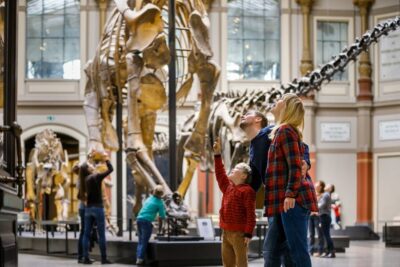

Bamberg: Guided Beer History Tour with Optional Tasting
Read our review →Browse the lists this tour appears in