
Reviewed · HISTORICAL TOURS
Where It All Began: Berlin’s Queer & Trans History Tour
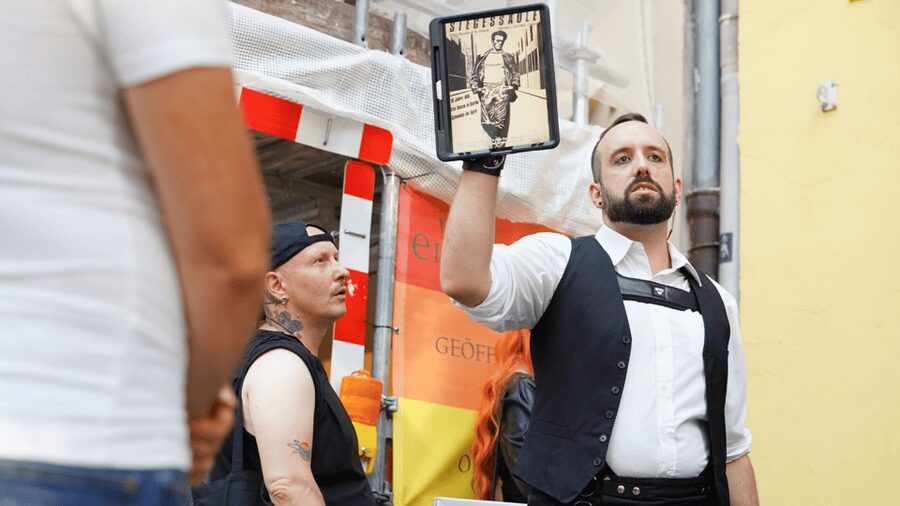
Berlin’s streets hold stories textbooks skipped. This 3.5-hour walking tour traces LGBTQ+ life from early rights campaigns to today’s clubs, protests, and community spaces. I like its small group of no more than 10 people, and I like the way an iPad, historical photographs, videos, and augmented reality connect past events with the streets around you. The main consideration is pace: ten stops and a lot of serious history make this a full afternoon, not a casual stroll.
The tour costs $83.13 per person, which is more than a basic city walk. Still, the price includes a queer activist and gender scholar as guide, 200-plus archival images and videos, AR features, and tips on current nightlife and events. Guide Jeff earned especially warm praise for making difficult material fascinating, funny, and moving. Bring comfortable shoes, an open mind, and a willingness to look beyond Berlin’s famous monuments.
In This Review
- Key points to know before booking
- Why this walking tour offers more than a nightlife crawl
- Starting at Alnatura and finding Karl-Heinrich-Ulrichs
- Nollendorfplatz and the danger of political contradiction
- Lesbian Berlin at Schwerinstraße 13
- Christopher Isherwood and the real people behind Cabaret
- Magnus Hirschfeld and the first organized rights movement
- Eldorado and Berlin’s complicated drag history
- Postwar activism, SchwuZ, and Charlotte von Mahlsdorf
- Chez Romy Haag and the trans club revolution
- The AIDS crisis in a divided city
- Metropol, SO36, Pride, and the city Berlin is still fighting for
- What the AR iPad actually adds
- Is $83.13 a fair price?
- Timing, group size, and who should book
- FAQ
- Where does the tour begin?
- What time does the tour start?
- Where does the tour end?
- How long does the tour last?
- How many people can join the tour?
- Is the tour offered in English?
- Is an iPad provided?
- Is food or drink included?
- Can I cancel for a full refund?
- What happens if the tour is canceled?
- Should you book Where It All Began?
Key points to know before booking
- Karl-Heinrich-Ulrichs begins the story before the word homosexual existed: You start with one of the earliest public voices for decriminalizing same-sex relationships.
- The 10-person limit matters: A small group gives the guide room to explain complicated subjects and show the iPad materials without turning the walk into a street lecture.
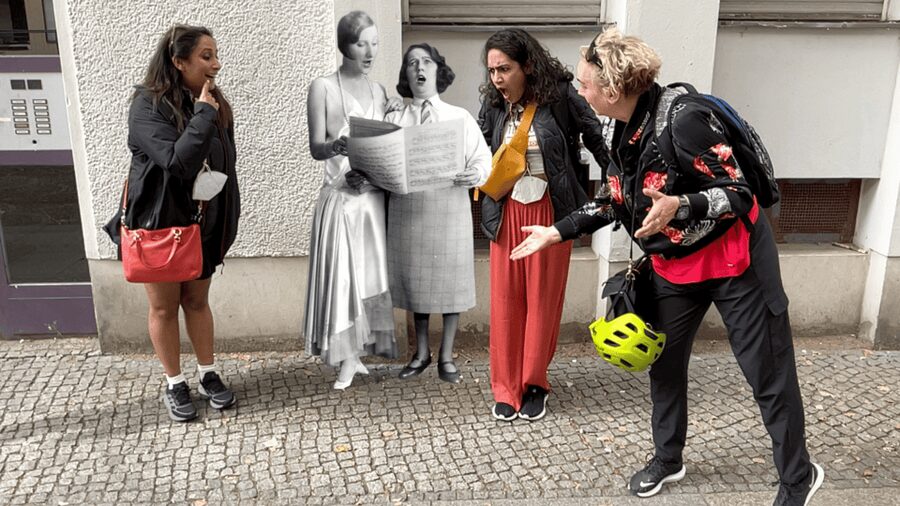
- The AR tools add real value: Historical photographs can be placed against the modern streetscape, and Mixies let you create playful group photos with digital period elements.
- The route covers both persecution and pleasure: You visit former bars, clubs, activist sites, and memorials, not only places connected with Nazi repression.
- Berlin’s divided past is part of the story: The tour links East and West Berlin, the AIDS crisis, trans-led nightlife, and postwar organizing.
- This is a history tour with modern-useful advice: It finishes with present-day clubs, festivals, Pride events, and the fight to protect affordable queer spaces.
Why this walking tour offers more than a nightlife crawl
Berlin is often sold through its clubs, but queer life here did not begin with techno, Berghain, or a late night in Kreuzberg. This tour gives you the longer story, including early activists, lesbian performers, trans pioneers, Nazi persecution, postwar organizing, and the AIDS crisis.
I like that the route does not treat LGBTQ+ history as a separate footnote to Berlin’s main story. It shows how queer people shaped the city’s politics, music, publishing, nightlife, and public life. You also see the contradictions. A famous drag bar could welcome gender-nonconforming people while also attracting a senior Nazi who belonged to a regime that later persecuted LGBTQ+ people.
The tone appears to balance painful material with humor and human detail. That balance matters. You will hear about concentration camps and the pink triangle, but you will also learn about cabaret, romance, chosen community, political courage, and the people who made room for one another when official institutions did not.
More Historical Tours in Berlin
- Berlin: Natural History Museum Entrance Ticket
★ 4.6 · 3,382 reviews - Berlin: World Heritage Cruise to Potsdam
★ 4.5 · 1,435 reviews - Berlin Historical Highlights Walking Tour
★ 4.9 · 657 reviews
Starting at Alnatura and finding Karl-Heinrich-Ulrichs
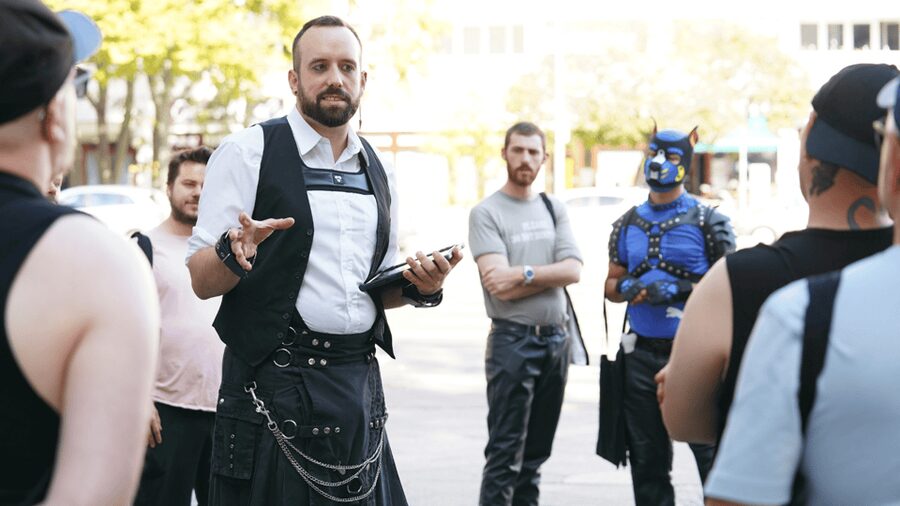
The meeting point is Alnatura Super Natur Markt at Else-Lasker-Schüler-Straße 18. The scheduled start is 2:00 pm. The first major history stop is Karl-Heinrich-Ulrichs-Straße 1, where the guide introduces Karl Heinrich Ulrichs.
Ulrichs is often called the world’s first gay rights activist. He publicly argued for the decriminalization of homosexuality at a time when there was no accepted modern vocabulary for sexual identity. His work matters because it shows that organized queer rights thinking did not suddenly appear in the twentieth century. People were naming injustice and defending identity much earlier.
This opening stop lasts only about five minutes, but it gives the rest of the afternoon a useful frame. You are not simply following a nightlife map. You are following a long argument about dignity, law, identity, and the right to live openly.
Nollendorfplatz and the danger of political contradiction
At Nollendorfplatz, the tour turns toward Nazi persecution and the complicated place of queer men in German politics. You hear about Adolf Brand, right-wing gay activists, and Ernst Röhm, an openly gay Nazi whose role in the Nazi party ended in the Night of the Long Knives.
This section requires careful attention because the history is not simple. Röhm’s sexuality did not make the Nazi movement tolerant. Hitler’s position shifted according to political need, and the regime eventually used homosexuality as a reason for mass persecution. The execution of Röhm and others during the Night of the Long Knives revealed the deadly consequences of internal power struggles.
The guide also explains the pink triangle forced on many gay prisoners in Nazi concentration camps. The point is not only to remember victims. It is to understand how the Nazi state classified, isolated, and abused people, and how queer people resisted oppression despite those conditions.
Nollendorfplatz is described as a central place in Berlin’s LGBTQ+ story, so this is one of the longer stops, at about 20 minutes. Expect a serious section with plenty of context. The AR images should help you picture a city that looked different, even when the modern buildings and traffic make the past hard to see.
Lesbian Berlin at Schwerinstraße 13
Schwerinstraße 13 shifts attention to lesbian life in the 1920s. At the former site of Toppkeller, you learn how lesbian bars created community and a measure of safety for women whose lives were often left out of accounts focused on gay men.
That correction is one of the tour’s strengths. Berlin’s queer history is not one story, and the route gives lesbian culture its own space instead of adding it as a quick afterthought. The guide also brings in Claire Waldoff, a lesbian cabaret singer whose songs became expressions of defiance.
Josephine Baker appears here too. Her bisexuality, stage persona, and appeal across gender lines show how performance could challenge ordinary ideas about sexuality. This stop should appeal to you if music and popular culture help you understand history better than dates and laws do.
The stop lasts roughly 20 minutes. Since the tour covers several names and cultural movements in a short time, the iPad images and videos are useful rather than decorative. They give faces and settings to a world that can otherwise feel distant.
Something different for another day:
- Berlin: Reichstag, Dome and Government District Guided Tour
★ 4.7 · 18,288 reviews - Berlin: 1-Hour City Tour by Boat with Guaranteed Seating
★ 4.3 · 16,993 reviews - Berlin: Boat Tour Along the River Spree
★ 4.4 · 11,252 reviews - Discover Berlin Half-Day Walking Tour
★ 5.0 · 9,624 reviews
Christopher Isherwood and the real people behind Cabaret
At Nollendorfstraße 17, the focus moves to gay male life in 1920s Berlin and the work of Christopher Isherwood. His Berlin experiences inspired the material that became the famous Cabaret musical and film.
You also hear about Isherwood’s relationship with Heinz Neddermeyer and their escape from Nazi Germany as queer refugees. This makes the stop more than a literary footnote. It connects a familiar piece of popular culture with the real risks faced by people whose lives were later reshaped by dictatorship.
The same location also introduces the homosexual department of the Berlin police force. That may sound like an odd detail, but it reveals how the state monitored and categorized queer people even before Nazi rule intensified the danger.
This is another 20-minute stop, and it should appeal to anyone who knows Cabaret but has not studied the lives behind it. The tour does not ask you to treat the film as a complete picture of Berlin. Instead, it uses the film as a doorway into a more complicated city.
Magnus Hirschfeld and the first organized rights movement
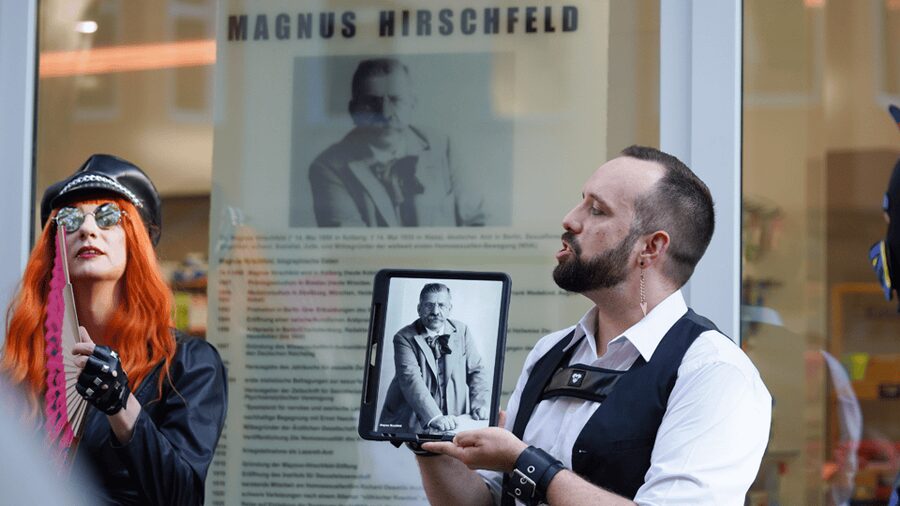
The stop at Magnus-Apotheke centers on Magnus Hirschfeld, one of the most important figures in early LGBTQ+ activism and gender studies. His Institute for Sexual Science and the Scientific-Humanitarian Committee helped create a formal home for research, advocacy, and community support.
The Scientific-Humanitarian Committee is described as the world’s first organization dedicated to queer rights and gender studies. You learn about Hirschfeld’s idea of sexual intermediaries, Berlin’s concept of a third gender, and the fight against Paragraph 175, the law that criminalized homosexuality.
The tour also discusses early gender-affirming surgeries involving Dora Richter, Lili Elbe, and Karl M. Baer. These stories need careful presentation because medical language and social attitudes have changed. The value here is seeing that trans people were seeking recognition and medical care long before current public debates.
The destruction of Hirschfeld’s institute by the Nazis is especially painful because it erased research, records, books, and evidence of queer lives. This stop explains why preserving archives is not an academic luxury. For a community repeatedly targeted by police, courts, and political regimes, lost records can mean lost identity.
Eldorado and Berlin’s complicated drag history
At the present-day Denns BioMarkt, you visit the former site of Eldorado, one of Berlin’s best-known drag bars in the 1920s. The contrast between the modern shop and the former club is exactly the kind of detail that makes a city walk work. The past is not behind a museum rope. It is under ordinary businesses and apartment buildings.
Eldorado welcomed drag performers, gender-nonconforming people, and queer customers. It also attracted high-profile Nazis such as Ernst Röhm. That contradiction deserves attention because it prevents a tidy version of history. A club could offer freedom at night while the wider political system remained dangerous and cruel.
This 20-minute stop should be one of the most memorable for readers interested in nightlife. It shows that Berlin’s reputation for experimentation did not begin with modern electronic music. The city has long offered spaces where people could test new ways of dressing, performing, and living.
Postwar activism, SchwuZ, and Charlotte von Mahlsdorf
The stop at Prinz Eisenherz turns to the years after World War II. You learn about Homosexuelle Aktion West-Berlin, one of the first queer rights groups created after the war, and the founding of SchwuZ, one of Berlin’s most important queer clubs.
The story of Charlotte von Mahlsdorf adds an East Berlin perspective. As a trans woman, she preserved queer history and created safe spaces in a part of the city where public life was shaped by a different political system. Her work reminds you that queer organizing did not stop at the Berlin Wall, even though East and West Berlin developed different networks and pressures.
This stop is shorter, about 15 minutes, so listen closely. It connects the earlier history of bars and clubs with the organized activism that helped build modern queer public life.
Chez Romy Haag and the trans club revolution
At Connection, the tour focuses on West Berlin’s trans community in the 1970s and 1980s. The key story is Chez Romy Haag, a trans-led nightclub that gave gender-diverse people a place to appear in public on their own terms.
The club’s importance was not only entertainment. A trans-led venue could offer visibility, employment, friendship, and a sense of normal daily life. It also helped shape the club culture for which Berlin later became famous.
This 15-minute section is a useful reminder that queer nightlife is political even when it looks like pure fun. The freedom to dance, dress, flirt, perform, and gather can be a form of public resistance when society says those things should remain hidden.
The AIDS crisis in a divided city
At the Internationale Stele GEGEN DAS VERGESSEN, the subject becomes the AIDS crisis and the different ways East and West Berlin responded. The community had to organize for information, care, political pressure, and survival.
You learn about Rita Süssmuth, one of the few politicians who advocated for AIDS awareness, and about the striking phrase that described the Berlin Wall as the condom of the GDR. The phrase captures how division shaped movement, public health, and access to information, though the human cost of the crisis remained on both sides.
This stop lasts around 20 minutes. It is likely one of the most emotionally demanding parts of the afternoon, but it also highlights collective action. The story is not only about fear and loss. It is about queer people insisting that governments address the crisis and that their lives mattered.
Metropol, SO36, Pride, and the city Berlin is still fighting for
The final stop is Metropol at Nollendorfplatz 5, where the tour ends. Metropol connects early gay nightlife with Berlin’s techno culture and with clubs such as Berghain and Lab.Oratory.
The discussion then widens to SO36’s queer nights, Folsom Europe, Kreuzberg Pride, and the Dyke March. These events show how queer Berlin continues to express itself through music, protest, celebration, and public space.
The final theme is gentrification. The tour points to the radical Tuntenhaus squat and the ongoing fight for an affordable city. That is an important ending because queer culture does not survive on nostalgia alone. Clubs close, rents rise, and community spaces can disappear even when a city markets itself as progressive.
Ending at Metropol also makes practical sense. You finish with current nightlife information rather than a dusty final date. The guide can offer insider tips about modern queer events, although the supplied details do not specify which clubs or events will be recommended on a particular day.
What the AR iPad actually adds
The iPad is provided as part of the tour, and the guide uses it for augmented reality rather than handing you a device and leaving you to figure it out. Historical photographs can appear in the locations where the people and events once belonged. Group photos can also be combined with AR elements through Mixies.
That feature is most useful at sites where little visible evidence remains. A supermarket, street corner, or modern club entrance may not tell you what was there in the 1920s or 1970s. Seeing an archival image against the current setting helps bridge that gap.
The technology should not replace the guide. Its value comes from timing and explanation. Jeff was praised for using photographs, videos, and AR in a way that brought the subject to life, rather than treating the gadgets as a gimmick.
Is $83.13 a fair price?
At $83.13, this is a premium walking tour. You are paying for 3.5 hours, a highly specific subject, a group capped at 10, specialist guiding, digital materials, and access to stories you would be unlikely to find by simply walking between Nollendorfplatz and Kreuzberg.
I think the price is fair if LGBTQ+ history is a main reason you want to understand Berlin. It is less convincing if you are looking for a cheap orientation walk or a general overview of the city. The tour covers ten stops, and the subject requires time and concentration.
A drink at a café may be included as a possible break, but coffee or tea is not included in the price. Plan for your own refreshment budget. The tour is offered in English, and group discounts are available.
Timing, group size, and who should book
The afternoon begins at 2:00 pm and ends at Metropol after about 3.5 hours. The start is at Alnatura Super Natur Markt, while the final stop is at Nollendorfplatz. The meeting points are near public transportation, which makes the route easier to fit into a Berlin day.
A maximum of 10 people is a major advantage. You can see the iPad screen, ask questions, and hear personal explanations without competing with a large crowd. The small size also suits a subject that can feel personal or emotionally heavy.
Most people can take part, and service animals are allowed. The activity requires good weather, so keep some flexibility in your plans. You receive confirmation when booking, and you can cancel for a full refund up to 24 hours before the start time. If poor weather or too few bookings cancel the tour, you are offered another date or a full refund.
Book this if you want context, names, places, and the political forces behind Berlin’s queer culture. It suits curious visitors, LGBTQ+ readers, students of social history, and anyone who wants more than a night out. It may not suit you if you prefer a short, light sightseeing walk or find difficult twentieth-century history tiring.
FAQ
Where does the tour begin?
The tour begins at Alnatura Super Natur Markt, Else-Lasker-Schüler-Straße 18, 10783 Berlin, Germany.
What time does the tour start?
The scheduled start time is 2:00 pm.
Where does the tour end?
The tour ends at Metropol, Nollendorfplatz 5, 10777 Berlin, Germany.
How long does the tour last?
The experience lasts approximately 3 hours and 30 minutes.
How many people can join the tour?
The tour has a maximum of 10 participants.
Is the tour offered in English?
Yes. The tour is offered in English.
Is an iPad provided?
Yes. An iPad is provided for the augmented reality elements, including historical photographs, videos, and Mixies.
Is food or drink included?
Coffee and tea are not included. The tour may visit a café for a break, but you pay for your own drink.
Can I cancel for a full refund?
Yes. You can cancel at least 24 hours before the start time for a full refund. Cancellations or changes made less than 24 hours before the start are not refunded.
What happens if the tour is canceled?
If poor weather or the minimum number of participants causes cancellation, you are offered a different date or experience, or a full refund.
Should you book Where It All Began?
I recommend this tour if you want Berlin’s LGBTQ+ story told with political context, personal lives, nightlife, and archival evidence. The most praised elements are the guide’s engaging delivery, the rare images and videos, and the clever AR feature that places old Berlin beside the modern street.
The $83.13 price makes sense for a small, specialist experience, not for a general city walk. Choose it early, since it is commonly booked well ahead of time, and keep your afternoon open. You will leave with a better understanding of why Berlin’s queer clubs and Pride events matter, and why protecting those spaces remains unfinished work.
Just added around Berlin
- Berlin: Private Guided Tour of the Main Sights★ 5.0 · 13 reviews
- Private Highlights of Berlin Bike Tour★ 5.0 · 13 reviews
- Modern Berlin Private Walking Tour: Diverse, Vibrant and Exciting German Capital★ 5.0 · 13 reviews
- Tour in Berlin from Warnemünde and Rostock Cruise Port★ 4.1 · 13 reviews
- Berlin: Stasi Museum Private Guided Tour with Entry Ticket★ 4.8 · 13 reviews
- Private Food Tour Experience with a born and bred Berliner★ 5.0 · 14 reviews
- Berlin: Rheinsberg Palace Entrance Ticket★ 4.8 · 14 reviews
- Berlin in one day – day tour with an expert guide★ 5.0 · 14 reviews
Historical Tours, compared.
City History Canal Sightseeing Tour on a Motorboat
Read our review →
Bamberg: Guided Beer History Tour with Optional Tasting
Read our review →Browse the lists this tour appears in