Reviewed · BERLIN TOURS
The porcupine anniversary program: I still have a Tesla in Berlin
Berlin can laugh at itself. At Die Stachelschweine, you get a fast, political cabaret show set in a wildly troubled 2028. The anniversary program, Ich hab’ noch einen Tesla in Berlin, mixes music, black humor, and sharp social criticism while imagining a Germany buried under debt. I like the quick pace and the way the show turns current political and economic worries into comic theater. I also like that you see Berlin’s first cabaret theater in its long-running home beneath the Europacenter.
The main drawback is clear: the performance is entirely in German, and you need a solid command of the language to follow the jokes, wordplay, and political references. The small group size is limited to six people, but this is still a live theater production rather than a guided tour, so the value depends mainly on how much you enjoy German cabaret.
In This Review
- Key points to know before booking
- What the 2028 story says about Germany
- Entering Die Stachelschweine beneath the Europacenter
- How the two-hour performance unfolds
- The performers and creative team
- Why the Berlin setting adds weight
- Language is the key decision
- Is $45 a fair price?
- Practical details that shape the evening
- Who should book this cabaret
- Final decision on Ich hab’ noch einen Tesla in Berlin
- FAQ
- Where does the performance take place?
- What is the name of the anniversary program?
- How long does the activity last?
- What language is the show in?
- How much does the ticket cost?
- Who performs in the program?
- Who wrote the show?
- Is music part of the performance?
- Can I choose my exact seat?
- Is the venue wheelchair accessible?
Key points to know before booking
- A 2028 political fantasy: Chancellor Wagenknecht and Vice Chancellor Pistorius face a Germany crushed by debt, high prices, and lost industry.
- A historic Berlin venue: Die Stachelschweine is presented as Berlin’s first cabaret theater, located in the basement of the Europacenter.
- Fast, musical satire: The two-hour program combines acting, music, black humor, and pointed political jokes.
- German is required: This is not a visual show that you can easily follow without understanding the language.
- Three named performers: Santina Maria Schrader, Mirja Henking, and Sebastian Stert carry the stage performance.
- Straightforward timing and price: The ticket costs $45 per person, lasts about two hours, and ends where it begins.
What the 2028 story says about Germany
The show begins with a future that feels only a few headlines away. In 2028, Germany is dealing with debt that keeps growing, while a cheese roll costs 14 euros. BASF and Bayer have moved their operations to Asia, and Volkswagen and BMW now belong to Tesla.
Germany’s credit rating has fallen to BB. Half of the country’s tax income goes toward interest payments. That setup gives the writers a broad target: inflation, industrial decline, international business, government spending, and the pressure placed on politicians who promise more than the state can afford.
Chancellor Wagenknecht and Vice Chancellor Pistorius sit at the center of the plot. Their government is under increasing pressure, yet the political promises keep coming. Retirement at 55, free public transport, and rent capped at 1989 levels all sound attractive. The problem is paying for them.
Pistorius proposes the Berlin secret plan. Germany will sell off its capital as its last valuable asset. A famous electric-car developer and owner of a microblogging service quickly takes interest. From there, the plan unravels.
You do not need to agree with the show’s politics to understand its target. The comedy comes from the collision between grand promises and basic arithmetic. Public debt, housing costs, privatization, and powerful technology companies all meet in one absurd plan to sell Berlin.
Other Berlin trips people book alongside this one:
- Berlin: Reichstag, Dome and Government District Guided Tour
★ 4.7 · 18,288 reviews - Berlin: 1-Hour City Tour by Boat with Guaranteed Seating
★ 4.3 · 16,993 reviews - Berlin: Boat Tour Along the River Spree
★ 4.4 · 11,252 reviews
Entering Die Stachelschweine beneath the Europacenter
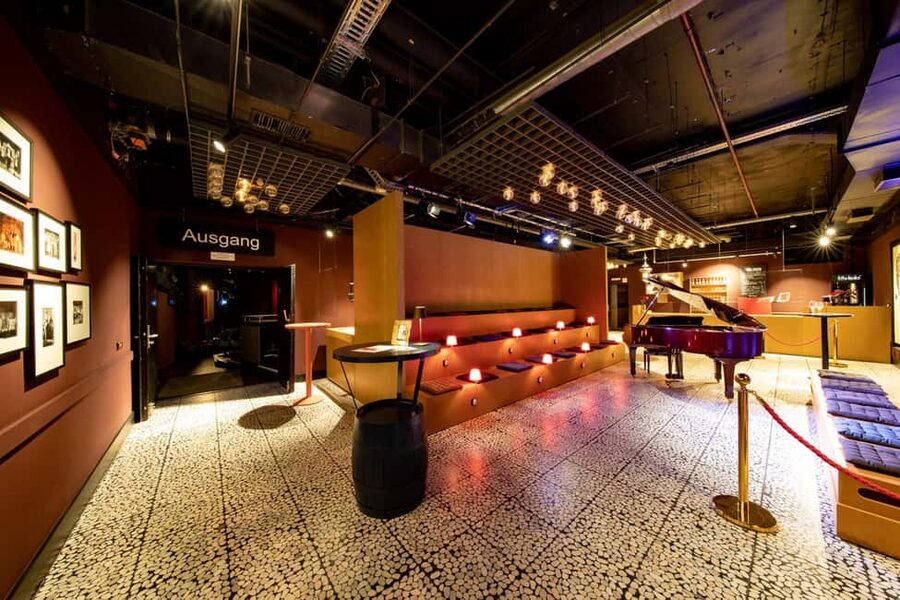
The theater entrance is in the basement of the Europacenter. That location matters. You are not heading to a grand opera house or a large concert hall. You are entering a compact cabaret venue tied closely to Berlin’s postwar theater culture.
Die Stachelschweine is described as Berlin’s first cabaret theater. The anniversary program celebrates 75 years of the company, so the venue offers more than a convenient place to sit for two hours. It gives the show a direct connection to Berlin’s tradition of political comedy.
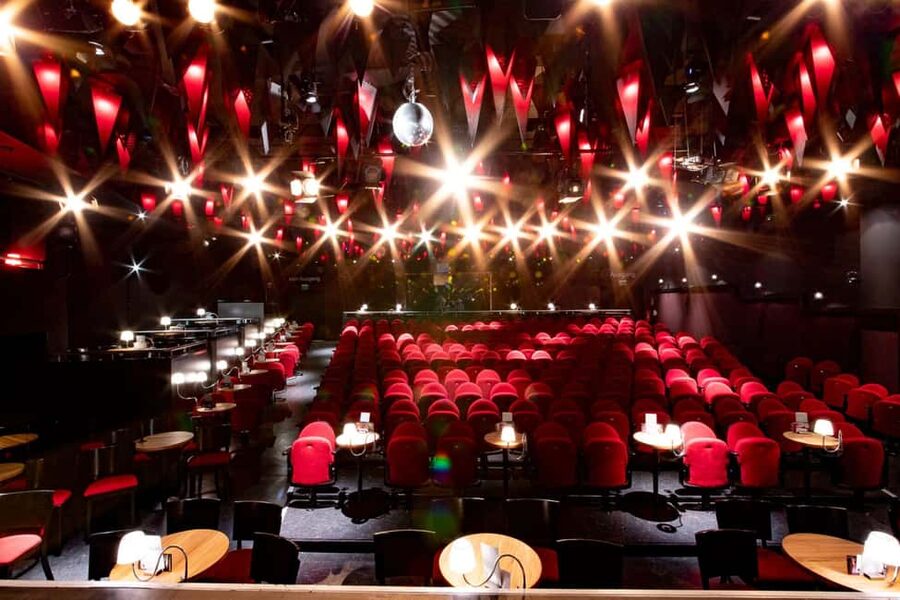
The basement setting also suits the material. The story is about a capital city under pressure, and the theater’s close quarters keep the performers near the audience. Political cabaret works best when the jokes feel aimed across the room rather than projected toward a distant balcony.
You receive a ticket for the performance and must exchange your voucher at the box office before the show begins. You can choose a seating category, but not a particular seat. If your position in the room matters to you, keep that limitation in mind before booking.
How the two-hour performance unfolds
This is a stage production, not a walking tour with several stops. The activity begins at the theater and ends back at the same meeting point after the performance. The full duration is about two hours, which gives the actors enough time to build the political situation, add musical sections, and push the central plan toward its comic collapse.
The plot supplies the structure. First, you meet a government trapped by debt and economic decline. Then the proposed solution arrives: sell Berlin to finance election promises. The deal appears to offer a way out, but the show promises that everything soon goes wrong.
The pace is an important part of the experience. The program is described as fast-moving and topical, so you should expect a steady run of jokes, scenes, and musical material rather than long stretches of quiet dialogue. That style rewards close attention, especially when a joke depends on a German political name, a current issue, or a double meaning.
The comedy also has a darker edge. The title points to Tesla, but the story reaches beyond one company or one public figure. It pokes at the transfer of German industry to overseas markets, the influence of wealthy technology owners, and the idea that a city can be treated like an item on a balance sheet.
The performers and creative team
The main cast includes Santina Maria Schrader, Mirja Henking, and Sebastian Stert. With three named actors carrying the production, the show depends on quick changes in tone and strong stage chemistry.
The program was written by Frank Lüdecke and Sören Sieg, with Lüdecke also directing. Luca Fazioli provides the music, and Martin Rosengarten handles the arrangements. Those credits help explain why the show is not simply a sequence of political speeches. Music is part of the design, adding rhythm and variety to the satire.
The combination of acting and music is useful for a cabaret show. A purely verbal performance can feel demanding after a while, especially when the subject is government finance. Musical sections give the evening a different pulse and help the production move between comic scenes and broader commentary.
The program’s black humor will not suit every mood. The jokes deal with debt, economic decline, political failure, and the possible sale of Berlin. If you prefer light entertainment with little connection to real-world arguments, this may feel too pointed. If you enjoy comedy that makes you laugh and then leaves you thinking, the tone should fit well.
Something different for another day:
- Discover Berlin Half-Day Walking Tour
★ 5.0 · 9,624 reviews - Berlin: Hop-on Hop-off Bus Tour with Live Commentary
★ 4.3 · 8,579 reviews - Berlin: Government District around the Reichstag Guided Tour
★ 4.7 · 8,447 reviews - Berlin: Reichstag, Plenary Chamber, Cupola & Government Tour
★ 4.6 · 8,422 reviews
Why the Berlin setting adds weight
Berlin is more than a backdrop here. The plot treats the city as Germany’s silverware, an asset that can be sold when everything else has been used up. That idea works because Berlin carries such a strong political identity.
The show uses Berlin serenity as part of its tone. The phrase suggests a local ability to remain calm, dry, and slightly amused even when the situation is plainly absurd. As panic spreads in the story, the humor comes from the effort to act as if everything remains under control.
The production also draws on the city’s cabaret tradition. Berlin has long supported political comedy that comments on public life from close range. The anniversary program places current political anxieties into that tradition, using a fictional near future to make today’s problems look stranger and more extreme.
You should not expect a historical tour of the Europacenter or a lecture about Berlin theater. The value of the location is theatrical and cultural. You are seeing a Berlin institution in its own setting, with a show written for an audience that understands German politics and Berlin’s particular sense of irony.
Language is the key decision
German ability is not optional for this experience. The performance is in German, and the humor depends on spoken language. Political satire often turns on phrasing, timing, names, and short references that lose their meaning in translation.
You might still appreciate the acting, music, and comic movement without fluent German, but you would miss much of the substance. This is not a pantomime or a visual comedy show. The story, political jokes, and social criticism are delivered through dialogue and songs.
I would book this only if you can follow a fast German conversation and understand references to German politics. If your German is intermediate but slow, the pace could make the show difficult. A basic reading ability alone may not be enough, since the performance happens in real time.
This language requirement is the largest factor in the decision. The price is reasonable for a two-hour theater evening, but it is not good value if you understand only isolated words. You are paying for the writing and performance, and both depend heavily on language.
Is $45 a fair price?
The ticket costs $45 per person for a two-hour performance. I see that as a fair price for a live cabaret show in a central Berlin venue, especially for an anniversary production with named performers, original writing, music, and arrangements.
The value is strongest if you already enjoy theater or political satire. You are not paying for transportation, a meal, or a long guided program. You are paying for the production itself and for the chance to spend an evening in a historic Berlin cabaret setting.
The price is less attractive if you are hoping for a broad introduction to Berlin. This experience does not take you through neighborhoods, museums, or landmarks. It gives you one focused evening of German stage comedy.
A rating of 4.6 from 159 submitted ratings suggests strong overall satisfaction, but your response will depend heavily on language and political taste. One especially positive response described the evening as both funny and thought-provoking, with the actors presenting the material skillfully. That is a useful description of the program’s purpose: it aims to entertain first, then leave a few uncomfortable ideas behind.
Practical details that shape the evening
The performance lasts two hours. Starting times vary, so check the available schedule before you plan dinner, transportation, or another event. Since the activity ends at the theater, you do not need to arrange a return transfer.
The entrance is in the basement of the Europacenter. Allow enough time to find the theater and exchange your voucher at the box office before the performance. You do not receive an exact seat, only a seating category, so arrive with the understanding that the theater assigns the specific position.
The activity is wheelchair accessible. It is also sold as a small-group experience limited to six participants, although the show itself takes place in a public theater setting. The small booking limit may make the reservation feel more personal, but it does not turn the production into a private performance.
Cancellation is free up to 24 hours before the start for a full refund. You can also reserve now and pay later, which helps if your Berlin schedule is still changing.
Who should book this cabaret
I would recommend it to you if you meet three conditions. You understand German well, you enjoy political humor, and you want an evening activity that feels tied to Berlin rather than a standard sightseeing stop.
It is particularly suitable for visitors who have already seen the main central sights and want something different after dark. The show gives you a local cultural experience without requiring a full evening of planning. You enter the Europacenter, watch a two-hour performance, and finish at the same place.
It also suits people interested in how Germany’s current concerns can be reshaped through comedy. The story deals with debt, housing, public transport, industry, technology companies, and political promises. Those subjects give the humor more substance than a simple collection of jokes.
I would not choose it for children unless they understand German and enjoy political satire. I would also skip it if you want a quiet concert, a traditional play, or an English-language event. The show is topical, verbal, and deliberately pointed.
Final decision on Ich hab’ noch einen Tesla in Berlin
Book this program if German is comfortable for you and the idea of a fictional 2028 Germany sounds funny rather than exhausting. For $45, you get a two-hour anniversary performance, live music, three named actors, and a seat in one of Berlin’s long-running cabaret venues.
The best reason to go is the mix of laughter and criticism. The show imagines Germany selling Berlin to pay for political promises, then uses that absurd idea to question real pressures already visible in public life. That gives the evening a sharper edge than a routine comedy show.
Skip it if you cannot follow fast German dialogue. In that case, the central jokes and political details will pass too quickly. For the right audience, though, Die Stachelschweine offers a compact, witty Berlin evening with plenty of bite.
FAQ
Where does the performance take place?
The theater entrance is in the basement of the Europacenter in Berlin.
What is the name of the anniversary program?
The program is called Ich hab’ noch einen Tesla in Berlin.
How long does the activity last?
The performance lasts about two hours.
What language is the show in?
The play is performed in German, and German-language ability is required.
How much does the ticket cost?
The listed price is $45 per person.
Who performs in the program?
The actors are Santina Maria Schrader, Mirja Henking, and Sebastian Stert.
Who wrote the show?
Frank Lüdecke and Sören Sieg wrote the program. Frank Lüdecke also directs it.
Is music part of the performance?
Yes. The anniversary program includes plenty of music. Luca Fazioli provides the music, with arrangements by Martin Rosengarten.
Can I choose my exact seat?
You can choose a seating category, but you cannot select a specific seat.
Is the venue wheelchair accessible?
Yes, the activity is wheelchair accessible.
Just added around Berlin
- Berlin: Private Guided Tour of the Main Sights★ 5.0 · 13 reviews
- Private Highlights of Berlin Bike Tour★ 5.0 · 13 reviews
- Modern Berlin Private Walking Tour: Diverse, Vibrant and Exciting German Capital★ 5.0 · 13 reviews
- Tour in Berlin from Warnemünde and Rostock Cruise Port★ 4.1 · 13 reviews
- Berlin: Stasi Museum Private Guided Tour with Entry Ticket★ 4.8 · 13 reviews
- Private Food Tour Experience with a born and bred Berliner★ 5.0 · 14 reviews
- Berlin: Rheinsberg Palace Entrance Ticket★ 4.8 · 14 reviews
- Berlin in one day – day tour with an expert guide★ 5.0 · 14 reviews
Berlin Tours, compared.
Reichstag, Dome and Government District Guided Tour
Read our review →
1-Hour City Tour by Boat with Guaranteed Seating
Read our review →
Government District around the Reichstag Guided Tour
Read our review →
Reichstag, Plenary Chamber, Cupola & Government Tour
Read our review →