Reviewed · PRIVATE
Private taxi tour to Potsdam and Sanssouci 6-8h
Royal palaces, vineyards, and spy bridges await. This private taxi tour takes you from Berlin to Potsdam with English-speaking guide Gunter Bauer, who combines driving, history, architecture, and local stories in one long day. I like the hotel pickup and the freedom to shape the route around your interests. I also like the personal touch: Gunter takes photographs at major sites and sends them to you afterward.
The main drawback is the cost, about $179.01 per person, before most palace admissions and food. The six-to-eight-hour schedule also covers a lot of ground, so you should expect plenty of walking and a quick look at some sights rather than a full interior visit everywhere.
In This Review
- Key points to know before booking
- Why this Potsdam tour works better than a rushed day trip
- Starting from Berlin at 10:30 am
- Entering Sanssouci Park through royal tricks and fantasy Egypt
- Sanssouci Palace and the vineyard terraces
- The windmill and the price of challenging a king
- The Chinese House, Orangery, and paintings for a king
- Friedenskirche and the long walk through the park
- The New Palace and Prussian royal theater
- Potsdam’s gates, Dutch Quarter, and rebuilt city center
- Cecilienhof and the 1945 Potsdam Conference
- Alexandrowka, Babelsberg, and Glienicke Bridge
- Price, timing, and who gets the best value
- Should you book this Potsdam taxi tour?
- FAQ
- How long does the private Potsdam tour last?
- What time does pickup begin?
- Where can pickup take place?
- Is the tour conducted in English?
- Is Sanssouci Palace admission included?
- Is access to Sanssouci Park included?
- Is this a private activity?
- What should I wear for the tour?
Key points to know before booking
- Private pickup from your Berlin accommodation: You travel in an air-conditioned vehicle with only your own party.
- Gunter Bauer leads the tour: His strength is detailed history, architecture, and lively conversation rather than a dry list of dates.
- Sanssouci Park is the heart of the day: Vineyards, fountains, palace gardens, small pavilions, and royal follies fill a large park.
- Admissions need careful checking: Park access is included, but Sanssouci Palace admission is not unless you choose the Sanssouci+ option.
- The route goes beyond Sanssouci: Expect Potsdam’s Dutch Quarter, Nauen Gate, the New Palace, Cecilienhof, Glienicke Bridge, and other royal sites.
- Good shoes matter: Paths around the palaces are often unpaved, and the tour involves substantial walking.
Why this Potsdam tour works better than a rushed day trip
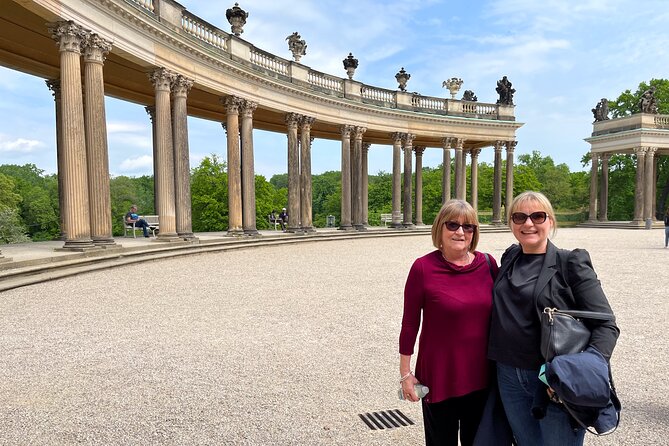
Potsdam is close to Berlin, but it is not a single sight you can check off in an hour. The royal parks spread across a wide area, and the city includes several separate palace districts, restored streets, gates, churches, and Cold War sites.
A private taxi solves the biggest problem: distance. You do not have to work out several train connections, wait for buses, or spend much of the day finding each palace on foot. Gunter drives between the far-flung sites, then gives you time to walk where the details matter.
I especially like the balance between major sights and smaller curiosities. You see Sanssouci Palace, but you also hear why a fake ruin was built over a water system, how a mill owner won a legal battle against the king, and why a mosque-shaped building hides a power plant chimney.
The guide’s approach is another reason to consider this experience. Gunter Bauer is praised for giving a running explanation of Berlin and Potsdam during the drive, then adapting the day to personal interests. He has taken one group to Alexandrowka, the Russian colony, and another to the Barberini Museum for a special exhibition. Those additions are not guaranteed, but they show how a private day can develop around your curiosity.
A few more tours and experiences worth a look
- Berlin: Private Reichstag and Glass Dome Tour
★ 4.8 · 2,226 reviews - Berlin Private Complete History All Day Walking Tour
★ 5.0 · 474 reviews - Private Walking Tour Berlin Third Reich Hitler and World War II
★ 5.0 · 360 reviews
Starting from Berlin at 10:30 am
Pickup is offered from your hotel, apartment, or other accommodation in Berlin. The stated start time is 10:30 am, and you should include a working mobile number when booking. Gunter asks you to wait inside until he sends an SMS or WhatsApp message, then come out to the street.
That small detail matters in a busy city. It avoids standing outside while trying to identify the vehicle. The drive itself becomes part of the tour, with commentary on places passed along the way.
The vehicle is air-conditioned, and parking fees are included. The taxi fare and city tour taxes are also covered, which makes the price easier to understand than a bare vehicle quote. Still, ask exactly which palace admissions you want before you book, since the base price does not cover all of them.
Entering Sanssouci Park through royal tricks and fantasy Egypt
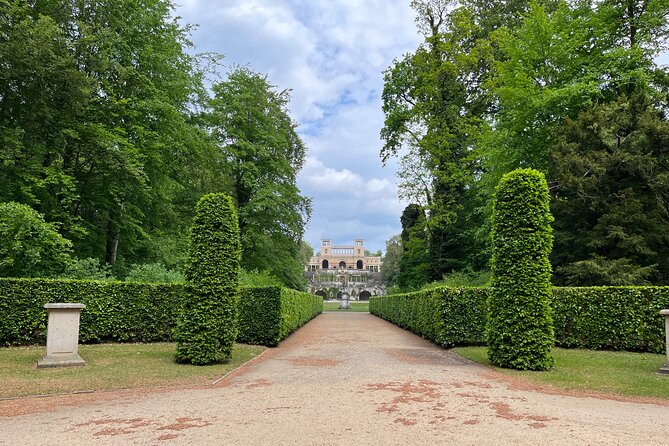
The first part of the route introduces the strange mixture of cultures that defines Potsdam. At the main entrance to Sanssouci Park, hand-built obelisks carry invented hieroglyphs. They look convincing from a distance, but nobody can translate them because the symbols were made for decoration.
This is a useful preview of Frederick the Great’s world. Potsdam was not built around one pure style. Prussian rulers borrowed from Egypt, Rome, China, Italy, Holland, England, and ancient Greece whenever a new building or garden feature could impress the eye.
The ruin on Ruinenberg has a practical purpose beneath its romantic appearance. A high pond supplied the fountain at Sanssouci Palace, and the ruined building helped conceal the engineering. The kings wanted a picturesque view, but they also needed water to move where they wanted it.
That combination of beauty and machinery appears again later in the day. Potsdam’s royal builders hid elevators, power systems, service buildings, and waterworks behind theatrical façades.
Sanssouci Palace and the vineyard terraces
Sanssouci Palace is Frederick the Great’s personal retreat, set above a vineyard and designed for private royal life. The Rococo palace is surprisingly small, with only eight rooms, and the rooms open toward the garden.
That scale helps you understand the king better than a giant state palace would. Frederick wanted a retreat for himself, his dogs, and selected male visitors. French philosopher Voltaire stayed here, and conversation took place in French. Frederick also played the flute and composed music, so the palace reflects a ruler who wanted to live as a cultured prince as much as an absolute monarch.
The visit to the palace takes about 30 minutes, but admission is not included in the standard tour. If you want to enter several palaces, compare the regular booking with the Sanssouci+ option, which includes all castle tours. Confirm the exact admission arrangement before paying, since this can change the value of the day.
Outside, the vineyard terraces form one of the most recognizable views in Potsdam. Grapevines grow behind glass panels, a clever answer to the cooler northern climate. The glass helped protect the plants through winter and early spring, while shipments from France and Italy filled the gap when local production was not enough.
The large fountain below the terraces completes the classic view. The pond above, hidden by Ruinenberg, fed the water. You get both the postcard scene and the story behind it.
Something different for another day:
- Berlin: Reichstag, Dome and Government District Guided Tour
★ 4.7 · 18,288 reviews - Berlin: 1-Hour City Tour by Boat with Guaranteed Seating
★ 4.3 · 16,993 reviews - Berlin: Boat Tour Along the River Spree
★ 4.4 · 11,252 reviews - Discover Berlin Half-Day Walking Tour
★ 5.0 · 9,624 reviews
The windmill and the price of challenging a king
The Historic Windmill offers a short stop with a good view over the park. Its survival is tied to a legal fight between its owner and the king. The miller won the first court case, a small but telling example of Prussia’s developing constitutional system.
The stop is listed at about 10 minutes, and admission is not included. If the mill is open, a visit is recommended for the view and for the chance to see grain still being ground. If it is closed, the exterior story remains worthwhile, but you should not expect a long visit.
This is exactly the kind of detail that can disappear on a standard palace tour. The windmill reminds you that Potsdam was not only a stage for royal life. Ordinary work, property rights, and local business also shaped the town.
The Chinese House, Orangery, and paintings for a king
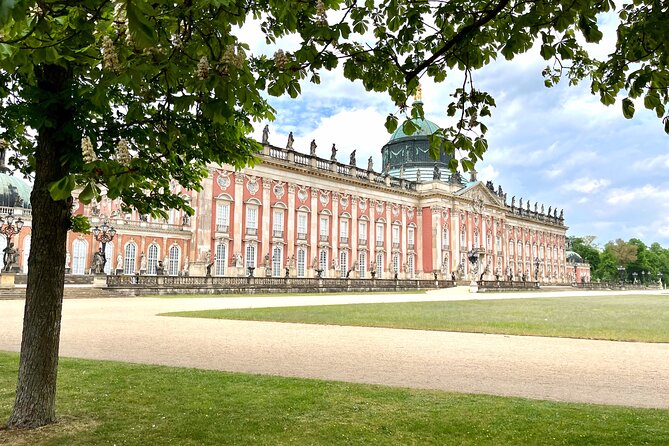
The Chinese House is one of the park’s most playful buildings. It began as a garden pavilion and now serves as a small café, but its original purpose was visual pleasure. Gold decoration, Chinese porcelain, and pagoda-style design create an elaborate version of the 18th-century European fashion for all things Chinese.
The building is not large, so do not expect a major museum interior. Its appeal comes from the contrast between the small structure and the lavish decoration. It is an easy place to appreciate how far royal spending could go for a garden ornament.
The Orangery Palace occupies a high ridge and offers a broad view across the park. Its winter role was practical: exotic plants needed protection from the cold. Its Roman-style design was also meant to catch the eye from a distance.
The Picture Gallery reflects Frederick’s love of art. Instead of placing his paintings in a normal residence, he built a separate palace for them. The result is a focused art stop within a much larger garden visit.
Friedenskirche and the long walk through the park
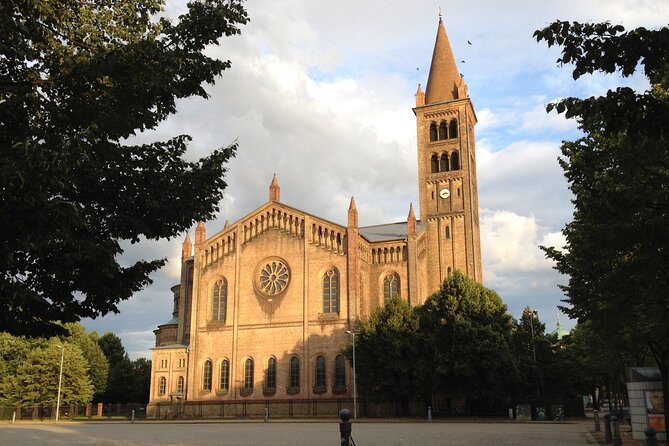
Friedenskirche shows a later ruler’s passion for Italy. Frederick William IV built the church with a separate Italian-style bell tower, or campanile, beside an artificial pond. The arrangement is carefully made for reflection, both in the water and in the mood of the place.
The church is also Frederick William IV’s burial site, away from the Hohenzollern tomb in Berlin Cathedral. That choice fits the setting: quiet, ornamental, and tied to the royal gardens rather than the city.
Sanssouci Park is the real time consumer. The main axis connecting the vineyard, fountain, and New Palace stretches about two kilometers. The tour allows roughly 45 minutes in the park, but the full area includes far more than the central path.
You may pass the Chinese House, Roman Baths, Friendship Temple, grottoes, garden terraces, and smaller royal residences. Some stops are brief photo visits, while others deserve extra time if you are especially interested in architecture or garden design.
The park is beautiful, but it is not effortless. Paths are often unpaved, and good walking shoes are specifically recommended. Sandals are a poor choice for this day.
The New Palace and Prussian royal theater
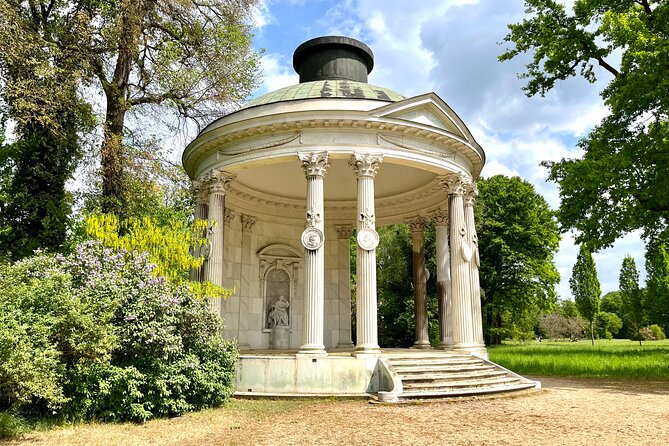
The New Palace is Frederick the Great’s grand answer to family expectations. He called its display fanfanery, meaning showy boasting. The building has about 600 rooms, with formal apartments, reception rooms, music rooms, bedrooms, writing rooms, and some early bathrooms.
Frederick did not want his relatives crowding into his small vineyard retreat. The New Palace gave visiting family members their own ceremonial holiday residence, connected to the service buildings known as the Communs.
The separation between royal apartments and kitchens was deliberate. Food was prepared away from the palace because of the smell and mess, then carried across. By the time it arrived, it was often cold. Even royal comfort had its flaws.
The Communs now house the University of Potsdam. Their arcades form a large courtyard and show how servants, kitchen workers, guards, officers, and soldiers were organized around palace life.
Another curious feature is the mosque-shaped building with a minaret. It conceals the chimney for a steam turbine that still produces electricity. The royal builders accepted modern machinery, but preferred to dress it in romantic costume.
Potsdam’s gates, Dutch Quarter, and rebuilt city center
The route leaves the park for Potsdam’s urban center. Nauen Gate is one of the city’s four surviving historic gates and perhaps the most imposing. Its medieval Romanesque style and tall form contrast with the lower buildings around the square.
The area near the gate has cafés and restaurants, making it a sensible place for a break. Food is not included, so plan to pay separately for coffee, cake, or a meal.
The Dutch Quarter began as housing for Dutch canal builders brought to Prussia in the 17th century. Red brick buildings, small shops, cafés, and craft stores give the area a strong Dutch character. It is pleasant to explore without turning the visit into a long shopping stop.
Potsdam’s main pedestrian street leads through a geometric center of town houses, Baroque buildings, and small independent shops. An Art Nouveau glass roof marks a small department store. The effect is more human than a modern shopping strip, with enough detail to reward a slow walk.
The City Palace and Garrison Church also carry difficult 20th-century stories. War damage, demolition, and later socialist planning erased much of the old center. The City Palace has since been rebuilt with a Baroque exterior and now houses Brandenburg’s state parliament.
The Garrison Church is also being recreated. Its dome rises above the surrounding streets, making it easy to spot. The rebuilding has been supported by private patrons, including Günter Jauch and Hasso Plattner, whose art collection is housed in the rebuilt Barberini Museum.
Cecilienhof and the 1945 Potsdam Conference
Cecilienhof Palace sits apart from the main Sanssouci group, so it is easy to miss without a vehicle. Built for Crown Prince Wilhelm and Cecilie of Brunswick, it was completed in the years before the First World War and designed to resemble an English country house.
Inside, modern comforts included central heating and bathrooms. A room with a ship’s cabin design reflects Cecilie’s love of sea travel. Yet the main reason many people visit is the 1945 Potsdam Conference.
The conference brought together Stalin, Truman, and Churchill. The room remains arranged as it was for the meeting, and the grounds retain the setting associated with the postwar decisions. This gives the tour a strong modern-history chapter after the earlier focus on kings and gardens.
If 20th-century politics interests you, tell Gunter early. A private guide can give this stop the attention it deserves instead of treating it as a quick drive-by.
Alexandrowka, Babelsberg, and Glienicke Bridge
Additional stops can include the Russian colony Alexandrowka, created for Russian singers and tied to the exchange of diplomatic gifts between Prussia and Russia. Its log houses and village character add another layer to Potsdam’s international past.
Babelsberg Palace is an English-style castle with turrets and battlements, built for the future Kaiser Wilhelm I and Augusta. Its tower, modeled on Frankfurt’s Eschenheim Tower, gave Wilhelm II a high study and a view over Potsdam’s royal sites.
Glienicke Bridge brings the story into the Cold War. For four decades, it marked the border between West Berlin and East Germany. Spy and prisoner exchanges took place here, and the bridge later became famous as a film location.
On the Berlin side, you may also pass Glienicke Palace, with its Italian-style design, formal courtyard, and views across the water. These extra sights make the private format useful, but the exact route depends on time, traffic, opening hours, and your interests.
Price, timing, and who gets the best value
At about $179.01 per person, this is not a budget way to reach Potsdam. It becomes more reasonable for a small group because the vehicle, parking, pickup, and private guide are shared across your party. Group discounts may also apply.
The value is strongest if you want context and flexibility. Gunter can adjust the pace, add a site such as Alexandrowka, stop for photographs, and explain places you pass between the main attractions. A public tour may cost less, but it will rarely give you the same control.
The value is weaker if you only want Sanssouci Palace and its terraces. In that case, public transport and a palace ticket may be enough. You should also budget for snacks and any palace admissions not covered by your selected option.
The tour suits couples, families, solo visitors, and small groups who prefer a private day. A baby car seat can be requested. Service animals are allowed, and medium-sized dogs can ride on the floor in the rear, though a large dog may leave no room for luggage.
Should you book this Potsdam taxi tour?
Book it if you want to see far more than Sanssouci Palace and prefer a guide who talks through architecture, royal personalities, wartime damage, and Cold War events in a conversational way. Gunter Bauer’s strongest qualities are his enthusiasm, his ability to personalize the route, and his habit of taking useful photographs for the people he guides.
Think twice if your budget is tight or if you want a slow, museum-heavy day. The route covers a lot, several admissions cost extra, and six to eight hours can feel full once walking is added.
For most visitors with limited time in Berlin, this is a practical way to understand Potsdam. Choose the palace admission option carefully, wear proper shoes, bring money for food, and tell Gunter what matters most to you before setting off.
FAQ
How long does the private Potsdam tour last?
The tour lasts approximately six to eight hours.
What time does pickup begin?
The stated start time is 10:30 am.
Where can pickup take place?
Pickup is offered from your hotel, apartment, or other accommodation in Berlin.
Is the tour conducted in English?
Yes. The experience is offered in English.
Is Sanssouci Palace admission included?
Standard Sanssouci Palace admission is not included. Admission to Sanssouci+ is included only when that option is booked.
Is access to Sanssouci Park included?
Yes. The listed park visit includes admission.
Is this a private activity?
Yes. Only your own group participates in the tour.
What should I wear for the tour?
Wear good walking shoes. Many paths in the park and around the palaces are unpaved, so sandals are not recommended.
Just added around Berlin
- Berlin: Private Guided Tour of the Main Sights★ 5.0 · 13 reviews
- Private Highlights of Berlin Bike Tour★ 5.0 · 13 reviews
- Modern Berlin Private Walking Tour: Diverse, Vibrant and Exciting German Capital★ 5.0 · 13 reviews
- Tour in Berlin from Warnemünde and Rostock Cruise Port★ 4.1 · 13 reviews
- Berlin: Stasi Museum Private Guided Tour with Entry Ticket★ 4.8 · 13 reviews
- Private Food Tour Experience with a born and bred Berliner★ 5.0 · 14 reviews
- Berlin: Rheinsberg Palace Entrance Ticket★ 4.8 · 14 reviews
- Berlin in one day – day tour with an expert guide★ 5.0 · 14 reviews
Private, compared.
Berlin Private Complete History All Day Walking Tour
Read our review →
Munich Private Tour with a Local – Highlights & Hidden Gems
Read our review →
Private Walking Tour Berlin Third Reich Hitler and World War II
Read our review →
Your private 3-hour Hamburg driving tour with a former policeman
Read our review →
Private Berlin: Iconic Sights and Hidden Gems Walking Tour
Read our review →
1.5-Hour Private Tour through Historical Old Town
Read our review →