Reviewed · PRIVATE
Private Taxi Tour of Berlin East and West and Neighbourhood approx. 4-6h
Berlin tells its story in layers. This private taxi tour links the city’s divided past with its modern neighborhoods, giving you a fast, useful introduction to both East and West Berlin. Guide Gunter Bauer brings strong personal knowledge of the city, and he contacts you before the tour to learn what interests you.
I especially like the hotel pickup within Berlin’s S-Bahn ring and the chance to see far more than you could comfortably cover on foot. I also like the mix of famous sights and neighborhood details, from the Brandenburg Gate and Reichstag to Hackesche Höfe, Kreuzberg, and the East Side Gallery.
The main consideration is pace. You will see many places from the taxi and leave the vehicle only at selected stops, so this is not the best choice if you want long museum visits or detailed walks at every monument. The vehicle can also feel tight for four adults, according to one direct experience.
In This Review
- Key points before you book
- Why a taxi works well in Berlin
- Reichstag, Brandenburg Gate, and the rebuilt center
- Potsdamer Platz and the working parliament
- Unter den Linden and the Forum Fridericianum
- Jewish Berlin, museums, and the Palace district
- Hackesche Höfe, Nikolaiviertel, and East Berlin
- West Berlin, the Tiergarten, and Kurfürstendamm
- The Wall, Checkpoint Charlie, and Berlin’s darker chapters
- Kulturforum, Kreuzberg, and the final stretch
- Who should book this Berlin taxi tour?
- Should you book it?
- FAQ
- How long does the private taxi tour last?
- What is the price of the tour?
- Is hotel pickup included?
- Is the tour private?
- Is the tour offered in English?
- Is transportation included?
- Can children join the tour?
- Is the tour suitable for people with limited mobility?
- Can I request specific sights?
- Can I cancel the booking?
Key points before you book
- A private Berlin overview in four to six hours: You travel only with your own party, which makes it easier to ask questions and shape the day.
- East and West in one outing: The route connects Brandenburg Gate, Checkpoint Charlie, Alexanderplatz, the East Side Gallery, Kurfürstendamm, the Kulturforum, and several neighborhoods.
- Gunter Bauer is the central strength: He is praised for his punctuality, careful driving, strong city knowledge, photography, and warm manner.
- Useful for limited mobility: The taxi reduces long walks and lets you stop close to many major sights. A child seat or booster can be requested.
- A history-heavy tour: Expect a great deal about Prussia, Nazism, the Berlin Wall, reunification, architecture, and the rebuilding of the city.
- Plan your priorities in advance: Traffic and time affect the route, and some optional stops may be left out unless you specifically request them.
Why a taxi works well in Berlin
Berlin is spread out. The Brandenburg Gate, Museum Island, Checkpoint Charlie, East Side Gallery, Kurfürstendamm, and the Kulturforum are not all next door to one another. Public transportation is good, but changing trains and walking between stations can eat into a short visit.
A private taxi gives you a moving introduction to the city. You can look from the window while Gunter explains how Berlin changed from royal capital to Nazi center, divided Cold War city, and reunited capital. It is especially helpful if you have only one full day, are traveling with children, or cannot walk or stand for long periods.
The tour is offered in English and includes private transportation in an air-conditioned vehicle, parking charges, onboard WiFi, and pickup from a requested address within the S-Bahn ring. The advertised price is $179.82 per person, though the value depends heavily on the size of your group. For one or two people, it is a costly half-day. For a family or small group sharing a private vehicle and guide, it can compare well with several separate sightseeing activities.
Gunter’s driving is one of the most frequently praised parts of the experience. He knows where stopping is practical, handles Berlin traffic calmly, and often takes photographs of you at the main stops. That small service matters: the person taking the group picture is usually missing from it.
A few more tours and experiences worth a look
- Berlin: Private Reichstag and Glass Dome Tour
★ 4.8 · 2,226 reviews - Berlin Private Complete History All Day Walking Tour
★ 5.0 · 474 reviews - Private Walking Tour Berlin Third Reich Hitler and World War II
★ 5.0 · 360 reviews
Reichstag, Brandenburg Gate, and the rebuilt center
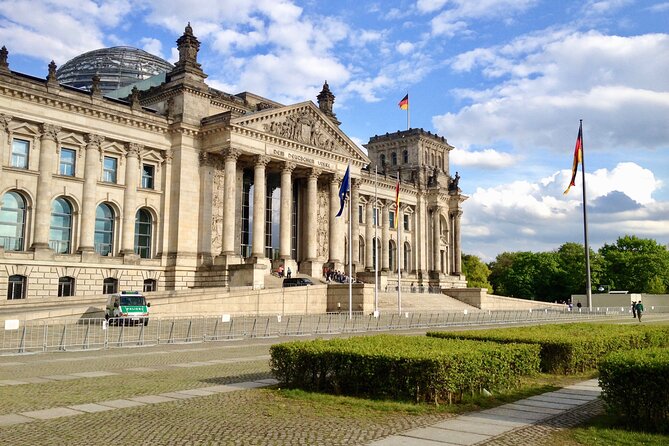
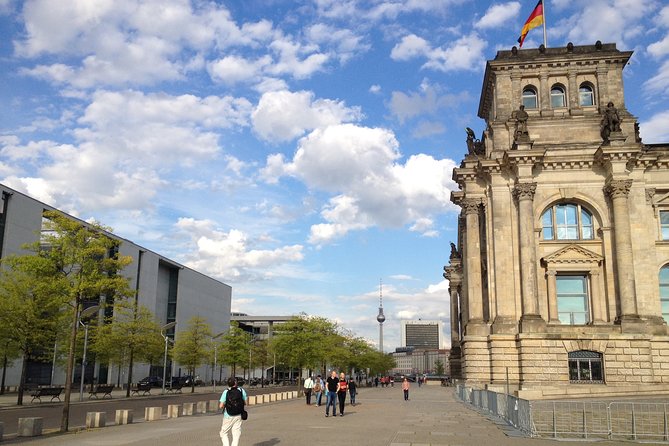
The tour usually begins around the government quarter, where Berlin’s twentieth-century story is impossible to miss. The Reichstag is a magnificent Wilhelminian building with a complicated past. Red Army soldiers raised a flag there as a symbol of victory in 1945, although the famous photograph was later recreated.
For decades, the building sat only a few meters from the Berlin Wall on the West Berlin side. East German officials objected whenever West Germany tried to use it for major federal business, so it was not used for regular Bundestag sessions. After reunification, the building was gutted and redesigned for the German parliament.
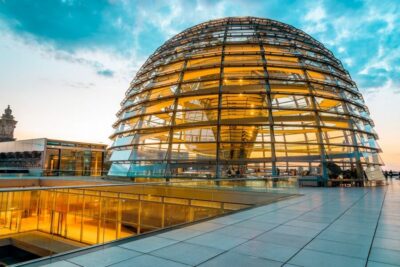
The glass dome is now one of Berlin’s best-known modern additions. The architect had originally imagined something much less ambitious, but the dome became a public symbol of the new capital. Christo’s temporary wrapping of the Reichstag also receives attention, a reminder that Berlin often turns political buildings into art.
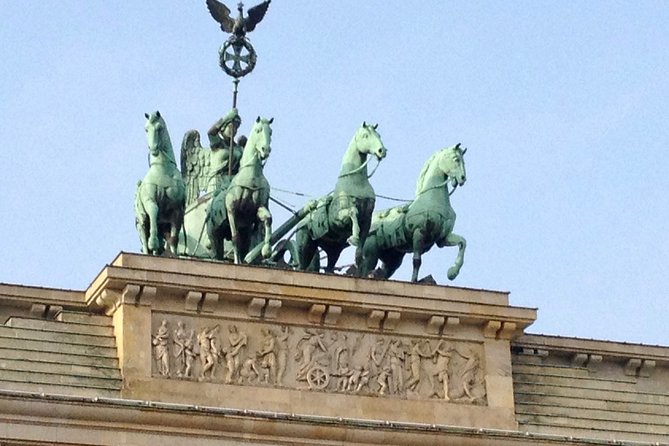
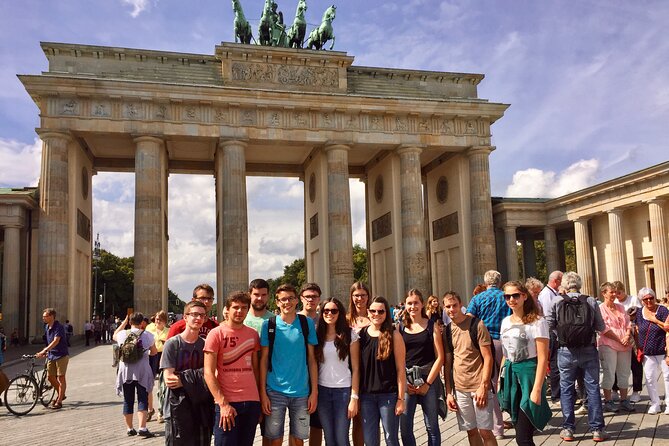
At the Brandenburg Gate, you get one of the clearest examples of how a city can change its meaning. Today it sits at the center of Pariser Platz, surrounded by the rebuilt Liebermann House, the Academy of the Arts, and the French and American embassies.
Before the Second World War, the gate formed part of a grand urban setting. After the war and later demolition, it sat in an empty zone, separated from West Berlin by a thick wall and from East Berlin by fences. The surrounding buildings have since been reconstructed with modern interiors and older street shapes.
You normally leave the vehicle here for a short look. Do not expect a full guided walk around every building, but you will have time to photograph the gate and understand why it became the city’s symbol of division and reunification.
Potsdamer Platz and the working parliament
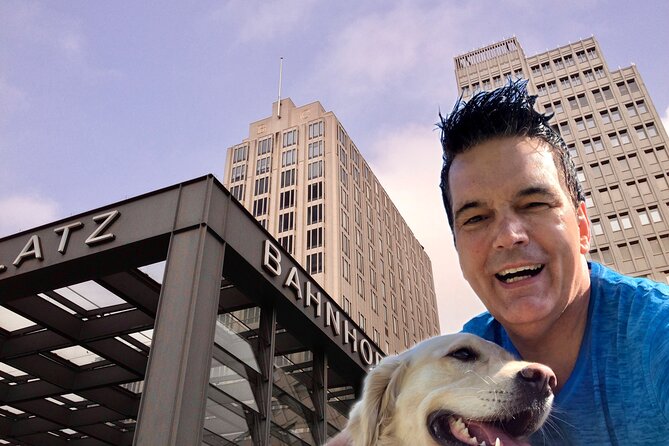
Potsdamer Platz helps explain Berlin’s taste for dramatic reconstruction. Before the Second World War, it was one of Europe’s busiest intersections, with around 100,000 vehicles passing through daily and a strong nightlife scene.
The Wall later cut across this area, leaving a large empty zone. After reunification, corporations built the Sony Center, Mercedes-Benz buildings, hotels, shops, theaters, and offices. The result is polished and architecturally striking, though it can feel planned rather than organically grown.
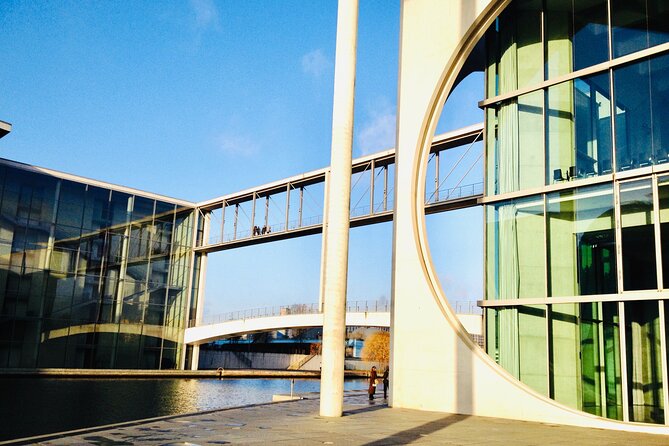
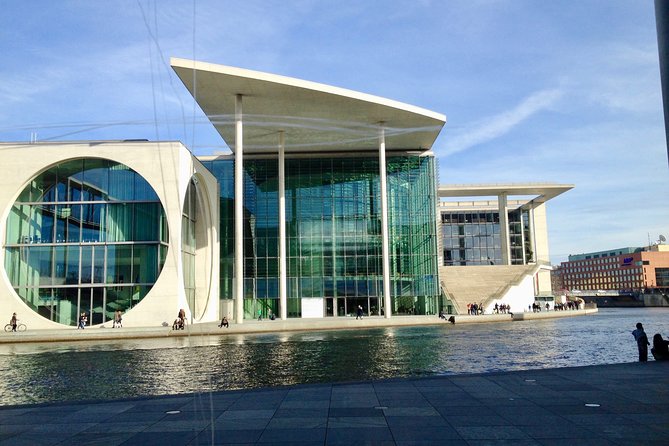
The tour also passes the Paul Löbe Building, one of the main working buildings of the Bundestag. Parliamentary debate and voting largely happen in committees rather than in the main chamber, and this long glass building contains the offices and committee rooms needed for that work.
Its glass design lets you see movement inside, at least in principle. A large rotunda facing the Spree contains restricted areas and cannot be viewed from outside. The point is less the building’s appearance than the idea of a transparent parliament, a deliberate contrast with the secrecy of earlier regimes.
The Federal Chancellery is even larger. The building has ten floors, more than 500 rooms, and offices for over 300 employees. Gunter uses details like these to make the government quarter easier to understand, rather than simply pointing out official buildings by name.
You also pass the modern press conference building, recognizable by its large central window. Accredited journalists gather behind a blue wall for regular government briefings, a detail that gives the otherwise severe facade a bit of Berlin character.
Unter den Linden and the Forum Fridericianum
Unter den Linden is Berlin’s grand historic boulevard. It began as a riding path from the royal palace toward the hunting grounds that became the Tiergarten. When Berlin expanded westward, the path grew into a ceremonial avenue lined with aristocratic buildings and state institutions.
The name refers to the linden trees planted along the route. The street now passes Humboldt University, the State Opera, the State Library, and other major buildings. The central cafes provide a pleasant place to pause, but the tour normally treats Unter den Linden as a broad historical view rather than a long walking segment.
Nearby, the Forum Fridericianum gathers several eighteenth-century buildings around Bebelplatz. The former Royal Court Library, St. Hedwig Cathedral, the State Opera, and Humboldt University reflect Frederick the Great’s ambition to make Berlin a center of learning and culture.
Look for the glass panel in the pavement. It reveals an empty underground library, recalling the Nazi book burning of May 10, 1933. The square is attractive, but the memorial is deliberately quiet and unsettling.
The New Guard House offers another sober stop. Once associated with the castle guard and later with East Berlin’s goose-stepping ceremonial soldiers, it now holds a Pietà based on Käthe Kollwitz’s sculpture of a mother mourning her dead son. It serves as a memorial to victims of war and tyranny.
The former Soviet embassy is another large political statement. Built after the war as the Soviet Union’s main foreign representation in Europe, it was designed to signal Soviet power in central Berlin. Today it serves the Commonwealth of Independent States, the group of former Soviet republics.
Something different for another day:
- Berlin: Reichstag, Dome and Government District Guided Tour
★ 4.7 · 18,288 reviews - Berlin: 1-Hour City Tour by Boat with Guaranteed Seating
★ 4.3 · 16,993 reviews - Berlin: Boat Tour Along the River Spree
★ 4.4 · 11,252 reviews - Discover Berlin Half-Day Walking Tour
★ 5.0 · 9,624 reviews
Jewish Berlin, museums, and the Palace district
The New Synagogue is easy to recognize by its Moorish details and golden dome. The main prayer hall was destroyed during the war, but the entrance structure and exhibition remain. The building recalls a period when Prussia granted Jews equal civil rights and Berlin’s Jewish community presented its culture openly.
Security is strict. You should expect airport-style checks before entering the exhibition, and the tour may only pause outside if time is short.
The German Historical Museum occupies the former armory. The building once stored weapons and military equipment, and its exterior sculptures include unsettling death-mask images of dying warriors. The museum traces German history across centuries, although a taxi visit will not replace time inside its galleries.
The Kronprinzenpalais and Kronprinzessinnenpalais are easy to overlook among the larger monuments. These royal residences housed crown princes and princesses, and the two buildings were connected by a passage. One has also served as an opera cafe and exhibition space.
The Humboldt Forum occupies the site of the former Berlin Palace. East German authorities demolished the war-damaged palace despite criticism, leaving a parking area in the heart of the city. The new building recreates much of the historic exterior and the Schlüter courtyard while placing modern interiors and non-European collections inside.
The roof terrace is a major reason to ask about a visit. One direct account praised the city view from above, and Gunter has arranged tickets for some parties. Confirm availability in advance because access and timing can affect the rest of the route.
Hackesche Höfe, Nikolaiviertel, and East Berlin
Hackesche Höfe offers a welcome change from official buildings. Built in 1908, the connected courtyards mixed homes, workshops, small factories, and printing businesses. The courtyards were designed to provide light, air, and a workable setting for both living and employment.
The complex fell into poor condition during the GDR period and was later restored. Shops now replace most workshops, but the Art Nouveau courtyards remain attractive. You may see Königliche Porzellan-Manufaktur products and the familiar East Berlin Ampelmännchen traffic-light figure.
The Nikolaiviertel presents an older-looking Berlin, though much of what you see was reconstructed during the 1980s. Only a few original buildings survived, and the Nikolaikirche had lost its roof and spire. The area was rebuilt to create a historic quarter with around 2,000 apartments in a very compact space.
Inside or near the Nikolaikirche, you can connect the district with Berlin’s earliest urban core. The Knoblauchhaus offers a free look at Biedermeier domestic life and the family of a cloth merchant. Restaurants and riverside views make this one of the better places to return after the taxi tour.
Alexanderplatz represents a different East Berlin vision. Its broad open space and surrounding modern buildings were planned in the socialist style, with room for public gatherings and large processions. The television tower remains Germany’s tallest building and a powerful symbol of GDR engineering.
Time may determine whether Alexanderplatz receives more than a drive-by explanation. If it is a priority, tell Gunter before departure.
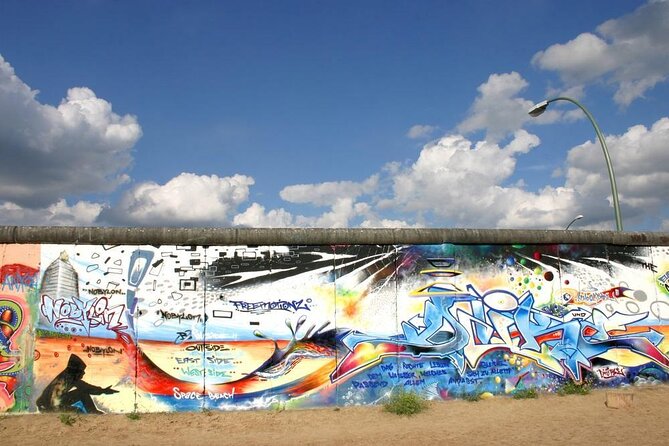
The East Side Gallery is the longest surviving section of the Berlin Wall, about 1,600 meters. Technically, the painted section was a hinterland wall rather than the main front wall, but the paintings became a major record of the mood after reunification.
The Trabant driving through the Wall and the Brezhnev-Honecker kiss are the best-known images. The paintings have been renewed more than once, and weather continues to wear them down. You get a short walking stop here, enough to see the scale of the Wall and several famous works.
The Oberbaum Bridge connects Friedrichshain and Kreuzberg. Its medieval-looking towers recall the old customs boundary, when a barrier in the Spree stopped nighttime shipping. The bridge now carries cars, bicycles, pedestrians, and the elevated subway, with the river traffic below.
West Berlin, the Tiergarten, and Kurfürstendamm
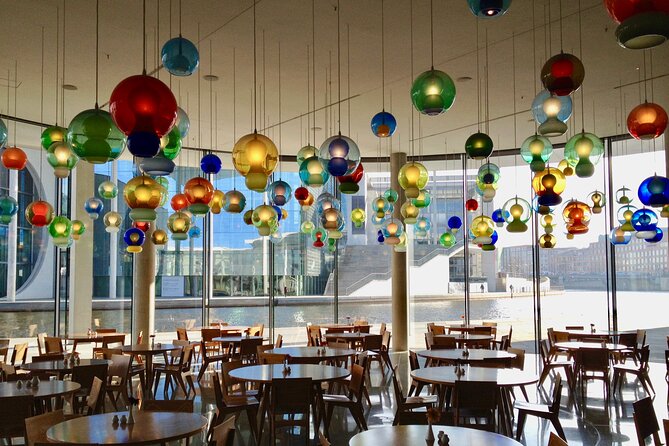
The Tiergarten began as a royal hunting ground. Frederick the Great opened it to Berliners and later landscape designer Peter Lenné reshaped it into an English-style park with paths, lakes, views, and the Landwehr Canal.
The park suffered badly in the Second World War. Trees were cut down and potatoes were planted near the Reichstag, but postwar replanting restored much of its role as central Berlin’s green heart.
The Victory Column originally stood in front of the Reichstag and had three drums celebrating victories over Denmark, Austria, and France. Hitler moved it to its present location for his grand rebuilding plans and added another drum. The gilded figure remains one of Berlin’s most visible monuments.
The tour passes the Nordic embassies, five linked buildings representing Denmark, Finland, Iceland, Norway, and Sweden. Their shared design and communal facilities make them a pleasant example of modern diplomatic architecture.
Bellevue Palace, the official Berlin residence of the Federal President, was built for August Ferdinand, the younger brother of Frederick the Great. It was restored after war damage and later rebuilt more fully for the post-reunification presidency. Its original view toward Charlottenburg Palace is now blocked by the modern city.
In West Berlin, you will pass the Zoological Garden and the Kaiser Wilhelm Memorial Church. The church’s damaged tower and west portal were preserved after a campaign against total demolition. The modern blue-glass church beside it is known for its quiet interior and unusual light.
The church’s double-wall construction helps block the noise of the busy square. It is worth returning on foot if you want to enter, since the taxi stop mainly gives you the outside story and a chance to photograph the complex.
Kurfürstendamm was modeled partly on the Champs-Élysées. It once carried grand villas, cafes, cinemas, and nightlife. Today it is chiefly a shopping boulevard, with luxury names farther west and large modern stores closer to the center.
Tauentzienstraße continues the shopping route toward KaDeWe, the huge department store known for its gourmet floor. The food hall offers champagne, oysters, chocolate, bread, cheese, and other high-end treats. If you enjoy food markets and department stores, ask for time here, but remember that every extra stop reduces time elsewhere.
The Wall, Checkpoint Charlie, and Berlin’s darker chapters
The tour may cross the former East-West boundary several times. One important point is the harbor near Invalidenfriedhof, where Günter Litfin was shot while attempting to swim across after the Wall was built. The story makes clear that the Wall was not just concrete, but a deadly system of watchtowers, checkpoints, and armed patrols.
Berlin Central Station shows the reunited city’s practical side. It has underground and elevated tracks across several levels, with shops and large glass halls. It replaced the old pattern of terminal stations and shifted long-distance rail traffic away from Bahnhof Zoo, a change that upset many residents of Charlottenburg.
Friedrichstraße Station once handled the only rail connection between East and West Berlin. East Berliners could leave from here, but many did so without a return ticket. Barriers, customs stations, and Stasi observation areas filled the building.
The nearby Palace of Tears recreates that controlled farewell setting. The name comes from the painful goodbyes between East Berlin residents and relatives who had to return west. This stop may be dropped if traffic or earlier visits use too much time, so request it if Cold War history matters to you.
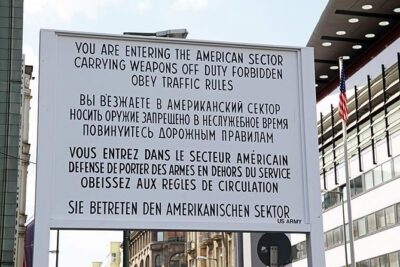
Checkpoint Charlie was the Allied crossing point known as Charlie because it was the third checkpoint in the American alphabet. In October 1961, American and Soviet tanks faced one another here, creating one of the most dangerous confrontations of the Cold War.
Today, the original checkpoint equipment is gone. A replica guardhouse remains, along with private displays and the nearby Wall Museum. The site can feel commercial and crowded, but the political importance is real. Treat it as a short history stop, not a preserved time capsule.
The Topography of Terror is more powerful. Excavations reveal the former cellars used by the Gestapo, SS, and other Nazi security organizations. The open-air displays and information hall explain how persecution and mass crimes were planned and carried out from the center of Berlin.
A surviving section of Wall runs along Niederkirchnerstraße. It is heavily damaged by Wall peckers and lacks the full death strip that appeared elsewhere, but its location beside government buildings makes the setting particularly striking. Nearby, the Berlin House of Representatives occupies the former Prussian parliament building, while the Ministry of Finance occupies a surviving Nazi-era structure.
Kulturforum, Kreuzberg, and the final stretch
The Kulturforum was planned as a West Berlin counterpart to Museum Island. Its buildings include the Philharmonie, the New State Library, the Picture Gallery, the Museum of Decorative Arts, and the Museum of Musical Instruments.
The Picture Gallery holds major old-master works, including paintings associated with Titian, Caravaggio, and Rembrandt. The New National Gallery is the architectural highlight: Ludwig Mies van der Rohe designed a glass hall with a self-supporting metal roof and no interior columns.
The gallery’s lack of permanent interior walls creates a practical problem for paintings, so changing shows occupy the upper hall while much of the display space is below. It is a quick exterior stop unless you arrange more time.
In Kreuzberg, the route shows how urban planning could have erased an entire neighborhood. Plans from the 1960s called for a major motorway through the area, including a junction near Oranienplatz. Older buildings, small restaurants, and alternative cultural spaces survived because those plans were abandoned.
The Landwehr Canal helps you understand Berlin’s geography. The city has around 200 kilometers of waterways, and the canal was used for transport, drainage, and a shortcut around the winding Spree. The Ministry of Defense is visible along the water.
The tour may also pass Nollendorfplatz, where the subway rises above ground. Berlin’s early underground lines followed different engineering choices, and wealthy Charlottenburg opposed noisy elevated trains near its villas. The area between Nollendorfplatz, Motzstraße, Wittenbergplatz, and Fuggerstraße is also known for Berlin’s large gay district and its long association with queer nightlife.
The final optional area is Karl-Marx-Allee, formerly Stalin-Allee. Its grand apartment blocks were built as workers’ palaces, but the people who lived there helped trigger the June 17, 1953 uprising after wage cuts and increased production demands. Soviet tanks crushed the revolt, and the avenue remains one of Germany’s longest protected monument zones.
Who should book this Berlin taxi tour?
This tour suits you if you want orientation, context, and maximum coverage in a short time. It is particularly useful on your first day, since Gunter can point out places to revisit later. It also works well for families, older visitors, and anyone who finds long walking tours tiring.
Gunter’s personal approach is a real advantage. He asks about your interests before the tour, answers questions, adjusts for traffic, and may take photographs along the way. His English is described as very good, though a few direct accounts found that he occasionally needed to repeat a point.
You should be clear about priorities. Some direct experiences found that Gunter followed his planned route closely, while one party wanted to skip universities and factories in favor of selected sights. Send a short list and repeat your top two or three requests at pickup.
Pickup inside the S-Bahn ring is included. Airport pickup from BER and collection outside the ring cost extra according to the Berlin taxi tariff. Free cancellation is available until 24 hours before the start time.
Should you book it?
Book this private Berlin taxi tour if you want to understand how East and West fit together without spending the day on trains and sidewalks. The strongest reasons are the broad route, Gunter’s enthusiasm, smooth driving, useful history, and the ease of seeing distant districts in one outing.
Skip it if your goal is to spend hours inside museums, take long architectural walks, or examine every monument closely. For the best result, schedule it early in your visit, prepare a short priority list, and treat the four to six hours as an intelligent introduction rather than a series of full museum visits.
FAQ
How long does the private taxi tour last?
The tour lasts approximately four to six hours. The exact length depends on traffic, weather, time spent at stops, and any optional visits included.
What is the price of the tour?
The listed price is $179.82 per person. Group discounts are available, so the value may improve when several people share the private vehicle.
Is hotel pickup included?
Pickup is included from your requested hotel, apartment, or other address within Berlin’s S-Bahn ring. Pickup from BER Airport or outside the ring costs extra.
Is the tour private?
Yes. Only your own group participates in the activity.
Is the tour offered in English?
Yes. The tour is offered in English.
Is transportation included?
Yes. The tour includes private transportation in an air-conditioned vehicle, parking fees, onboard WiFi, and the taxi ride and city tour charges.
Can children join the tour?
Yes. Most visitors can participate, and a child seat for children from six months to three years or a booster seat for older children can be requested. A Maxi-Cosi baby seat may also be brought on request.
Is the tour suitable for people with limited mobility?
It can be a good option for people who cannot walk or stand for extended periods. The taxi brings you close to many sights, although you still leave the vehicle at selected stops.
Can I request specific sights?
Yes. Gunter contacts you before the tour to ask about your interests. Tell him your highest priorities in advance, since traffic and time may require some stops to be omitted.
Can I cancel the booking?
You can cancel for a full refund up to 24 hours before the experience start time. Cancellations or changes made less than 24 hours in advance are not accepted for a refund.
Just added around Berlin
- Berlin: Private Guided Tour of the Main Sights★ 5.0 · 13 reviews
- Private Highlights of Berlin Bike Tour★ 5.0 · 13 reviews
- Modern Berlin Private Walking Tour: Diverse, Vibrant and Exciting German Capital★ 5.0 · 13 reviews
- Tour in Berlin from Warnemünde and Rostock Cruise Port★ 4.1 · 13 reviews
- Berlin: Stasi Museum Private Guided Tour with Entry Ticket★ 4.8 · 13 reviews
- Private Food Tour Experience with a born and bred Berliner★ 5.0 · 14 reviews
- Berlin: Rheinsberg Palace Entrance Ticket★ 4.8 · 14 reviews
- Berlin in one day – day tour with an expert guide★ 5.0 · 14 reviews
Private, compared.
Berlin Private Complete History All Day Walking Tour
Read our review →
Munich Private Tour with a Local – Highlights & Hidden Gems
Read our review →
Private Walking Tour Berlin Third Reich Hitler and World War II
Read our review →
Your private 3-hour Hamburg driving tour with a former policeman
Read our review →
Private Berlin: Iconic Sights and Hidden Gems Walking Tour
Read our review →
1.5-Hour Private Tour through Historical Old Town
Read our review →