
Reviewed · HISTORICAL TOURS
Private Taxi Tour City East & West History and Architecture 3-4h
Berlin makes more sense from a taxi window. This private tour links divided Berlin’s grand boulevards, Cold War checkpoints, royal squares, and modern government quarter in three to four hours. I especially like the hotel pickup within the S-Bahn ring and the chance to tailor the route with guide Gunter Bauer, who is praised for clear explanations, friendly conversation, and thoughtful help. The main drawback is simple: with so much ground to cover, many stops are brief and some sights are viewed from the car or outside.
I also like the warm, air-conditioned taxi, especially in bad weather or for older visitors who would find a long walking tour tiring. Gunter can take photos during the outing and send them afterward, adding a personal touch. At $150.18 per person, the price is harder to justify for one or two people than for a small group, but private transport, parking, WiFi, and a flexible route make it useful for a first look at Berlin.
In This Review
- Key points at a glance
- Why a private taxi works well in Berlin
- Charlottenburg begins with churches, animals, and theater
- Ku’damm and KaDeWe show West Berlin’s polished side
- Tiergarten connects royal leisure with modern government
- Reichstag and the government quarter explain reunified Berlin
- From Hackesche Höfe to the New Synagogue
- East Berlin, Unter den Linden, and the great squares
- Humboldt Forum and Alexanderplatz reveal competing visions
- Potsdamer Platz, embassies, and the Wall
- Who gets the most value from the $150.18 price
- Should you book this Berlin taxi tour?
- FAQ
- How long does the private taxi tour last?
- Is pickup included?
- Does pickup from BER Airport cost extra?
- Is the tour private?
- What languages are offered?
- Is transportation included in the price?
- Are child seats available?
Key points at a glance
- A private route through both Berlins: See Charlottenburg, Mitte, Alexanderplatz, the government quarter, Checkpoint Charlie, and more without changing trains or buses.
- Gunter Bauer guides and drives: He is praised for his English, historical detail, humor, patience, and careful driving.
- Excellent for poor weather: You spend much of the tour inside a heated, air-conditioned taxi, with short stops to stretch your legs and take photos.
- Pickup is included in central Berlin: Collection from a hotel or apartment within the S-Bahn ring is included. Airport and outer-city pickups cost extra.
- Major highlights plus lesser-known corners: The route includes the Brandenburg Gate and Reichstag, but also Hackesche Höfe, embassy streets, Nikolaiviertel, and Berlin’s old crossing points.
- Best as an orientation tour: You will see a lot quickly, but this is not the format for long museum visits or extended time at each monument.
Why a private taxi works well in Berlin
Berlin is spread out. The Brandenburg Gate, Kaiser Wilhelm Memorial Church, Charlottenburg district, East Side neighborhoods, Potsdamer Platz, and government buildings do not form one compact sightseeing circuit. Public transport is excellent, but a first visit can still involve a fair amount of map reading and platform changing.
This tour solves that problem with a private, air-conditioned vehicle. You stay with your own party, and Gunter can adjust the emphasis to your interests. One group may want royal Prussia and architecture. Another may want Hitler-era history, the Berlin Wall, and the Cold War. The route described here attempts to cover all of it.
That breadth is its strength and its limitation. You can see the shape of Berlin in a few hours, but you should not expect to enter every building or spend half an hour at every stop. Think of it as a moving history lesson with selected photo stops, not a series of full museum visits.
Gunter’s role matters. He is not only driving between points. He explains why a street matters, how Berlin changed after the war, and how the city’s eastern and western halves developed different personalities. Several people valued his personal stories and easy conversation as much as the formal facts.
More City Tours in Berlin
- Berlin: 1-Hour City Tour by Boat with Guaranteed Seating
★ 4.3 · 16,993 reviews - Berlin: City Sightseeing Hop-On Hop-Off Bus Tour
★ 4.1 · 4,233 reviews - Potsdam: City and Castles Tour
★ 4.7 · 3,721 reviews
Charlottenburg begins with churches, animals, and theater
The western section opens around Breitscheidplatz and the Kaiser Wilhelm Memorial Church. The ruined tower and preserved west portal recall Wilhelm I, not simply the war itself. That distinction is useful, since the church’s name is often misunderstood.
The surviving tower is paired with Egon Eiermann’s modern church buildings, whose blue glass blocks create a quiet interior despite the traffic outside. Berliners gave the modern structures their famously cheeky nicknames, lipstick and powder compact. You may see scaffolding because the concrete is fragile and exposed to heavy traffic fumes.
Nearby is Berlin Zoological Garden, one of Germany’s oldest zoos. Its collection includes about 16,000 animals from roughly 1,600 species. Even if you do not enter, the elephant gate and lion gate make memorable exterior views, and Gunter explains how the zoo grew from royal hunting grounds and an earlier animal collection on Pfaueninsel.
The Theater des Westens gives you a different glimpse of old western Berlin. Its ornate exterior can look like a confectioner’s creation, but the building reflects the early twentieth-century move toward the greener western districts. Inside is an imperial box, and today the theater is used for musicals.
The taxi then moves along Kantstrasse toward Kurfürstendamm, usually shortened by Berliners to Ku’damm. This transition from a more mixed urban street to the city’s famous western shopping boulevard helps explain how Charlottenburg became a center of West Berlin life.
Ku’damm and KaDeWe show West Berlin’s polished side

Kurfürstendamm runs for nearly five kilometers toward Halensee. It was modeled partly on Paris’s Champs-Élysées, with grand lighting and a broad ceremonial feel. In the eras of George Grosz and Erich Kästner, it was lined with cafés, cinemas, and nightlife.
Today, the central stretch is mainly a shopping street. Further west, luxury names such as Versace, Bulgari, and Dolce & Gabbana share space with large modern stores. The boulevard can feel surprisingly quiet at night, a reminder that fashionable shopping streets do not always remain entertainment centers after dark.
The most useful stop here is Tauentzienstrasse and Kaufhaus des Westens, better known as KaDeWe. The department store covers about 60,000 square meters and is the largest single department store in continental Europe. Its upper gourmet floor is the real attraction, with champagne, oysters, chocolates, bread, cheese, and other foods.
You receive around 15 minutes here, so plan your expectations. That is enough for a quick look, a purchase, or a ride up to the food floor, but not enough for a leisurely shopping session. The stop works best if you treat KaDeWe as a cultural snapshot of West Berlin’s consumer culture rather than simply a place to buy something.
The route also passes Wittenbergplatz, with its ornate station building. Several Underground lines meet here, and the station reflects Berlin’s early transport expansion. Gunter uses these streets to explain the old boundaries between Berlin, Schöneberg, and the once-independent city of Charlottenburg.
Tiergarten connects royal leisure with modern government
The Urania area offers an unusual mix of science, Cold War-era urban planning, and modern Berlin. Urania began as an association devoted to explaining science to a broad audience. In front is a tall curved monument representing part of a circle, a gift from France for Berlin’s 750th anniversary.
The broad green strip nearby reflects a plan for a car-friendly city, with elevated roads for through traffic. Fortunately, that plan was never carried out in the way proposed. It is a small but telling example of how postwar Berlin imagined its future.
Tiergarten itself began as an electoral hunting ground. Frederick the Great opened parts of it to Berliners and later designers transformed it into an English-style park. Peter Joseph Lenné reshaped the area, expanded the Schafgraben into the Landwehr Canal, drained wet ground, and created paths, lakes, and views.
World War II left the park badly damaged. Trees were cut or destroyed, and potatoes were grown near the Reichstag. Replanting with Allied help restored much of the park you see today. This is one of the tour’s valuable themes: Berlin’s open spaces are not merely decorative. They show how royal land, war damage, and modern city planning shaped the capital.
The House of World Cultures, once the Congress Hall, is another memorable stop. Its curved roof earned the nickname Pregnant Oyster. The roof collapsed in 1980, killing a journalist, but the building was rebuilt in its original form and now hosts non-European arts, concerts, and other programs.
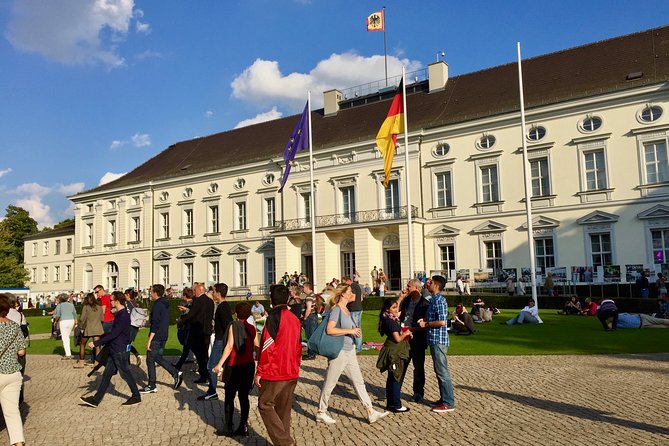
Bellevue Palace follows. This small palace was built for August Ferdinand, the youngest brother of Frederick II, and once had a view toward Charlottenburg Palace. It is now the official Berlin residence of Germany’s Federal President, though the building is more ceremonial than comfortable.
The Victory Column completes this section. It originally stood in front of the Reichstag and had three drums celebrating victories over Denmark, Austria, and France. Hitler moved it to its current location, added another drum, and changed the monument’s setting for his grand plans. The relocation helped preserve it, since the Allies later chose not to destroy it.
More Historical Tours in Berlin
- Berlin: Natural History Museum Entrance Ticket
★ 4.6 · 3,382 reviews - Berlin: World Heritage Cruise to Potsdam
★ 4.5 · 1,435 reviews - Berlin Historical Highlights Walking Tour
★ 4.9 · 657 reviews - Berlin Private Complete History All Day Walking Tour
★ 5.0 · 474 reviews
Reichstag and the government quarter explain reunified Berlin
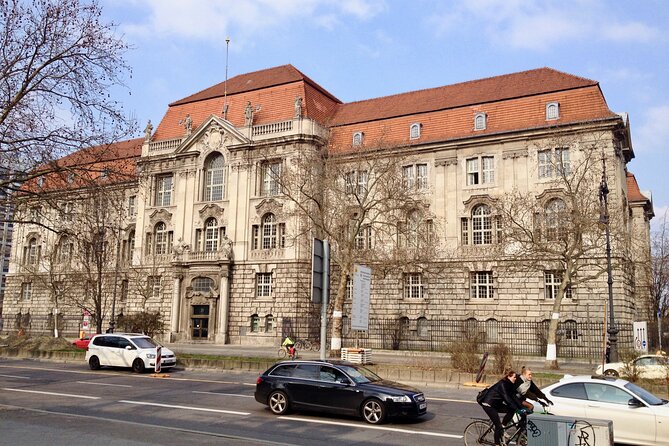
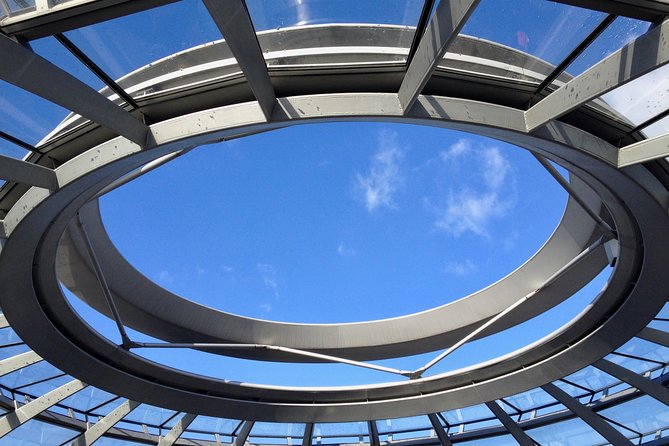
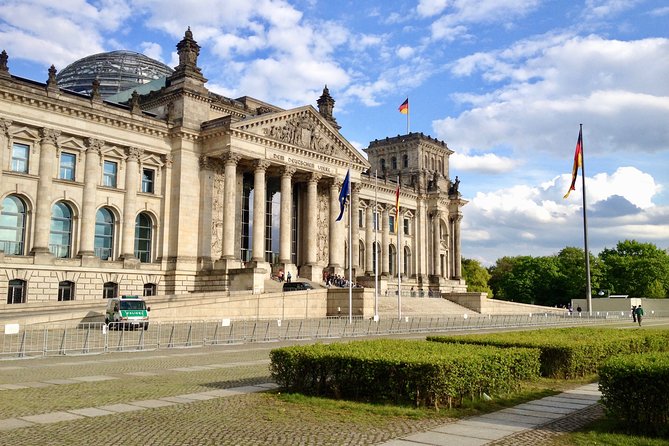
The Reichstag is one of Berlin’s essential stops. The Wilhelminian building was damaged in war, neglected during the Cold War, and nearly hidden beside the Wall. After reunification, it was gutted and redesigned for the Bundestag.
The glass dome became an image of the new political order. You may not have time to visit the dome during this taxi outing, but Gunter explains its symbolism and the building’s complicated past. The famous photograph of the Soviet flag being raised on the Reichstag was itself a staged reproduction, another reminder that Berlin’s public images often carry layers of political theater.
Across the river, the long Paul-Löbe Building houses much of the practical work of parliament. Committees meet here, and the glass design lets the public see parts of the parliamentary process. The nearby Federal Chancellery is enormous, with ten floors, about 500 offices, and space for more than 300 employees.
A government press building with a huge central window completes the view. Accredited journalists hold regular briefings behind the glass, seated before a blue wall. These details make the government quarter feel less like a collection of official facades and more like a functioning workplace.
Berlin Central Station provides a sharp contrast. It has eight underground and eight above-ground tracks, five levels, and large halls filled with shops. About 300,000 people change trains there each day, according to the railway’s figure. Its construction also changed the city’s travel patterns by reducing the importance of Bahnhof Zoo, once the key station in West Berlin.
From Hackesche Höfe to the New Synagogue
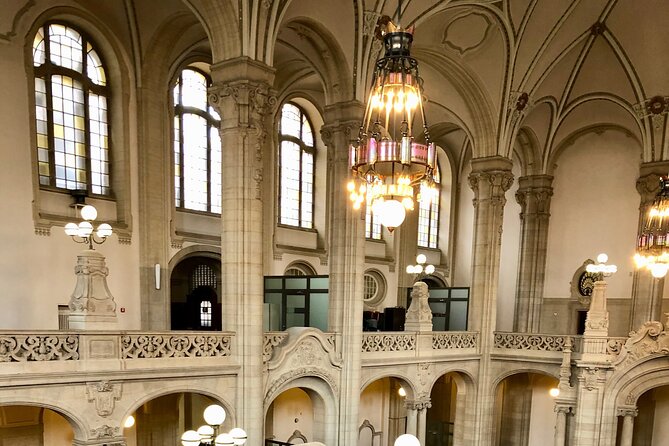
Hackesche Höfe is one of the most enjoyable short stops. Built in 1908, the courtyards mixed small factories, printing shops, workshops, and housing. The restored Art Nouveau courtyards now contain shops and displays, including Königliche Porzellan-Manufaktur products and Berlin’s famous Ampelmännchen figures.
The place is popular and polished, so do not expect a completely untouched neighborhood. Its value lies in seeing how work and home once shared the same block, and how neglected East Berlin buildings were brought back into use after reunification.
The New Synagogue on Oranienburger Strasse is easy to identify by its Moorish details and golden dome. The original synagogue held up to 3,000 worshippers and was built when Prussia granted Jews equal civil rights and Jewish communities wanted to present their culture openly.
The synagogue itself was destroyed in the war. The rebuilt front section now contains an exhibition about Jewish life in Berlin. Security is strict, similar to an airport screening, so allow patience if you visit separately after the tour.
Torstrasse and the old Spandauer Vorstadt provide more urban context. The name recalls the former city gates, and the surrounding area became an important center of Jewish settlement. Today it has late-night food, bars, small shops, and hotels, though the taxi visit gives you only a quick impression.
East Berlin, Unter den Linden, and the great squares
The route crosses the former East-West divide again near the harbor. This was a restricted area during the Wall years, and Gunter points out the location connected with Günter Litfin, one of the first people killed while trying to escape after the Wall went up.
Friedrichstrasse then leads south through a changing district. The northern end has been undergoing renewal, while nearby areas recall old shopping streets and the prewar city. At Friedrichstrasse station, East and West Berlin were connected during the Wall period, but strict controls made it a place of painful farewells. The nearby Palace of Tears preserves that story.
Unter den Linden is Berlin’s grandest historic boulevard. It began as a royal bridle path from the Berlin Palace toward the Brandenburg Gate and hunting grounds. Aristocratic palaces, the State Opera, Humboldt University, the State Library, and cafés now line the route.
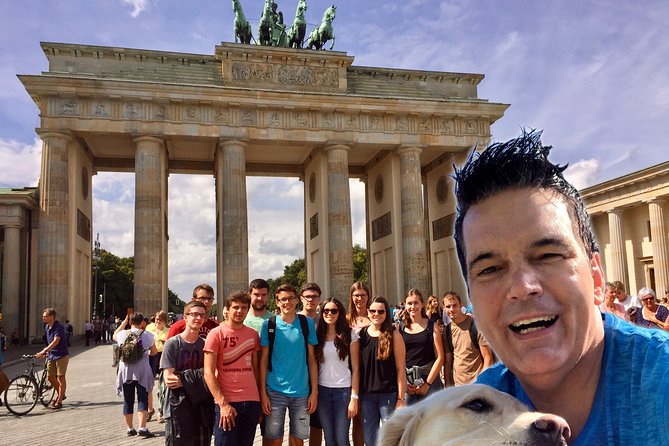
At the Brandenburg Gate, Pariser Platz functions as Berlin’s formal front room. War and the Wall left the gate isolated, but the surrounding buildings have been rebuilt in modern versions of their former shapes. The restored setting includes the Liebermann House, the Academy of the Arts, and the French and American embassies.
The nearby former Soviet embassy was designed to project Soviet power in central Berlin. Its palace-like scale and inner courtyard were deliberate political signals. The building is still used by successor states of the former Soviet Union.
Bebelplatz and Gendarmenmarkt add architecture and memory. Bebelplatz brings together the former royal library, St. Hedwig’s Cathedral, the State Opera, and Humboldt University. A glass panel in the pavement recalls the Nazi book burning of May 10, 1933.
Gendarmenmarkt contains the German Cathedral, French Cathedral, and concert hall. The two domed buildings are not true cathedrals, but meetinghouses given grand towers under Frederick II. It is a beautiful square, though the tour’s listed stop here is only about five minutes, so return on foot if you want a closer look.
The Neue Wache offers a quieter pause. Its central sculpture by Käthe Kollwitz mourns victims of war and tyranny. Nearby palaces and the former armory, now home to the German Historical Museum, fill out the royal and military story of Unter den Linden.
Humboldt Forum and Alexanderplatz reveal competing visions
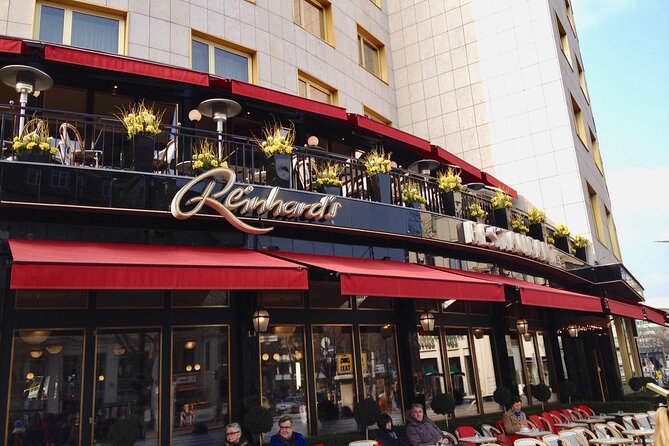
The Humboldt Forum occupies the site of the former Berlin Palace. The palace burned during the war and was later demolished by East German authorities, despite criticism from inside and outside Germany. The current building combines a modern interior with a detailed reconstruction of the exterior and the Schlüter courtyard.
The forum contains non-European collections and holdings connected with Humboldt University. About 30 minutes are allotted here, making it the longest named interior stop. It is a chance to go beyond the street view, though the building’s history and the debate over reconstruction can be as interesting as the exhibits.
Alexanderplatz presents a very different Berlin. Once called Ochsenplatz, it was redesigned in the GDR period as a broad socialist space for public gatherings and parades. The Television Tower remains the tallest building in Germany and a clear symbol of East German engineering.
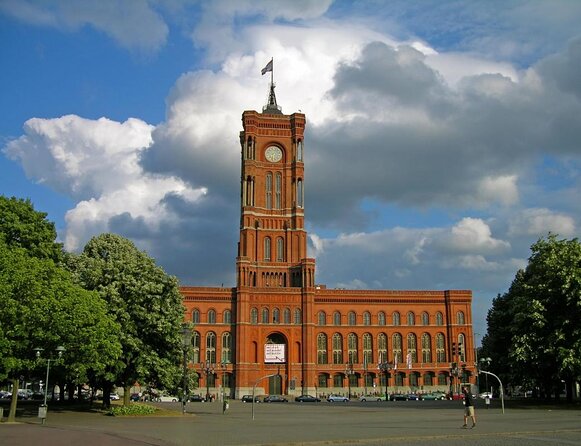
Nearby Red City Hall gets its name from its red brick, not from the political party of Berlin’s mayor. It was built in the 1870s and can be visited free of charge in part, with rooms that include plaster casts of famous sculptures.
Nikolaiviertel is a reconstructed version of old Berlin. Most of the historic quarter had vanished, leaving only a few original structures and the walls of Nikolaikirche. The GDR rebuilt the area in the 1980s, fitting about 2,000 apartments into a small district.
Nikolaikirche is Berlin’s oldest church and now part of the city museum. The original Knoblauchhaus, furnished in Biedermeier style, offers a more intimate look at family life. You can also find traditional Berlin restaurants near the Spree. This is a short stop, but one of the best places to understand the city’s medieval beginnings.
Potsdamer Platz, embassies, and the Wall
The tour continues through areas transformed after reunification. Leipziger Strasse cuts through former old-city districts such as Molkenmarkt and Spittelmarkt, where rebuilding and archaeological work are changing the streets again.
Potsdamer Platz was once one of Europe’s busiest intersections, with heavy traffic, restaurants, entertainment, and nightlife. After the Wall years, it was rebuilt with the Sony Center, Mercedes buildings, major hotels, and new attractions. Its polished architecture is impressive, though the planned energy does not always feel as natural as it did before the war.
The Kulturforum was planned as a counterpart to Museum Island. It includes the Philharmonie, New State Library, New National Gallery, museums of decorative arts and musical instruments, and a picture gallery with works by Titian, Caravaggio, and Rembrandt.
A drive along the Landwehr Canal introduces Berlin’s network of waterways. The city has about 200 kilometers of navigable water, and the canal helped shorten the Spree’s route, drain wet ground, and move building materials into new districts.
The former Reichsmarineamt and army high command bring in the darker military chapter. The Bendlerblock is associated with Claus Schenk Graf von Stauffenberg’s failed July 20, 1944 attempt to kill Hitler. It now houses part of the German Ministry of Defense.
The diplomatic quarter includes the Italian and Japanese embassies, along with Austria, India, South Africa, Turkey, Greece, Saudi Arabia, and the five Nordic countries, including Iceland. These buildings are interesting from the taxi because each uses a different architectural language.
The InterContinental Berlin is another recognizable building, with a broad driveway and checkerboard facade. It has long met strict security standards for high-profile political visitors. Nearby, the Topography of Terror provides a short but serious stop, with documentation about Nazi institutions, former torture sites, and a remaining section of the Berlin Wall.
Checkpoint Charlie closes the historical circuit. The guard hut and famous sign are replicas, not original Cold War equipment. Still, the site matters because of the 1961 tank confrontation between American and Soviet forces. The photo stop lasts about ten minutes, so visit the nearby documentation sites separately if you want a fuller account.
Who gets the most value from the $150.18 price
This tour makes the most financial sense for a group sharing the private vehicle. A solo visitor pays the full per-person rate for a highly personal experience, while a family or small group gains more from the included transport, parking, WiFi, and hotel pickup.
The price also covers both the taxi ride and guiding service, with the applicable German VAT included. Lunch is not included, and the route does not promise long meals or extended shopping time.
I would consider it particularly useful in winter, rain, or for older family members. One parent booking for elderly visitors found Gunter attentive to comfort, while another group appreciated being able to warm up in the taxi between short walks. Child seats are available for toddlers from six months to three years, booster seats are available for older children, and a Maxi-Cosi baby seat can be requested.
Pickup within the S-Bahn ring is included. Pickup from BER Airport or outside the ring costs extra under the Berlin taxi tariff, so ask about that before booking. After receiving Gunter’s message, you are asked to come outside to meet the taxi.
Free cancellation is available up to 24 hours before the start time. That matters because the tour is often booked well ahead, with average bookings made about 23 days in advance.
Should you book this Berlin taxi tour?
Book it if you want a fast, private introduction to Berlin’s geography and twentieth-century story, especially if weather, mobility, children, or limited time make a long walking route difficult. Gunter Bauer’s strongest qualities are his friendly manner, fluent English, personal attention, historical explanations, and willingness to answer questions.
Choose another format if your main goal is to spend hours inside museums, climb the Reichstag dome, or study one neighborhood slowly. The itinerary is ambitious, and several places are photo stops rather than extended visits.
For a first day in Berlin, this is a practical way to get your bearings fast. Bring water, as one visitor sensibly advised, and tell Gunter before departure which subjects matter most to you. If you want Berlin’s royal past, Nazi period, divided-city years, and reunification story in one warm taxi ride, the tour offers strong value for a shared group.
FAQ
How long does the private taxi tour last?
The tour lasts approximately three to four hours.
Is pickup included?
Pickup is included from your desired hotel, apartment, or other location within Berlin’s S-Bahn ring.
Does pickup from BER Airport cost extra?
Yes. Pickup from BER Airport or from outside the S-Bahn ring is available for an additional charge based on the Berlin taxi tariff.
Is the tour private?
Yes. Only your own group participates in the activity.
What languages are offered?
The tour is offered in English.
Is transportation included in the price?
Yes. Private transportation, an air-conditioned vehicle, WiFi onboard, parking fees, and the taxi ride and city tour taxes are included.
Are child seats available?
A toddler seat is available for children from six months to three years, and a booster seat is available for older children. A Maxi-Cosi baby seat can be brought on request.
Just added around Berlin
- Berlin: Private Guided Tour of the Main Sights★ 5.0 · 13 reviews
- Private Highlights of Berlin Bike Tour★ 5.0 · 13 reviews
- Modern Berlin Private Walking Tour: Diverse, Vibrant and Exciting German Capital★ 5.0 · 13 reviews
- Tour in Berlin from Warnemünde and Rostock Cruise Port★ 4.1 · 13 reviews
- Berlin: Stasi Museum Private Guided Tour with Entry Ticket★ 4.8 · 13 reviews
- Private Food Tour Experience with a born and bred Berliner★ 5.0 · 14 reviews
- Berlin: Rheinsberg Palace Entrance Ticket★ 4.8 · 14 reviews
- Berlin in one day – day tour with an expert guide★ 5.0 · 14 reviews
Historical Tours, compared.
City History Canal Sightseeing Tour on a Motorboat
Read our review →
Bamberg: Guided Beer History Tour with Optional Tasting
Read our review →Browse the lists this tour appears in