Reviewed · BERLIN TOURS
Path of Resistance: Berlin’s Hidden Holocaust Stories
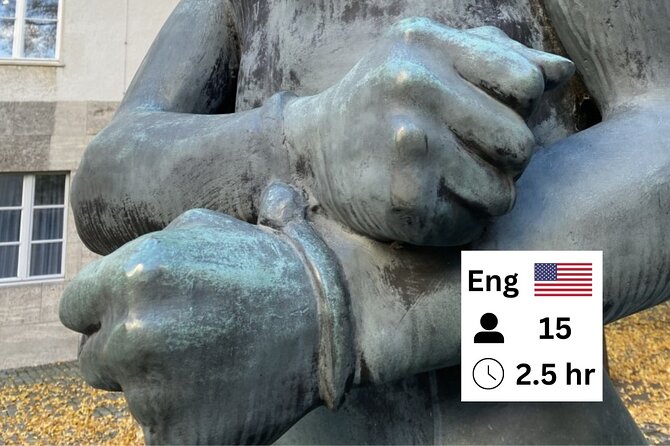
Berlin’s bravest stories hide in plain sight. Path of Resistance links Jewish sites, memorials, and wartime landmarks across central Berlin, showing how ordinary people challenged Nazi rule. The 2.5-hour walk is led in English and limited to 15 people, so it has room for questions rather than just a stream of dates.
I especially like the use of Then & Now photographs and maps, which help you picture places before war and dictatorship changed them. I also like the focus on people who resisted, from Otto Weidt protecting blind and deaf Jewish employees to the women who protested at Rosenstraße. The main drawback is simple: you will be on your feet for much of the tour, with little chance to sit.
In This Review
- Key points to know before you go
- Why this Berlin walk feels different
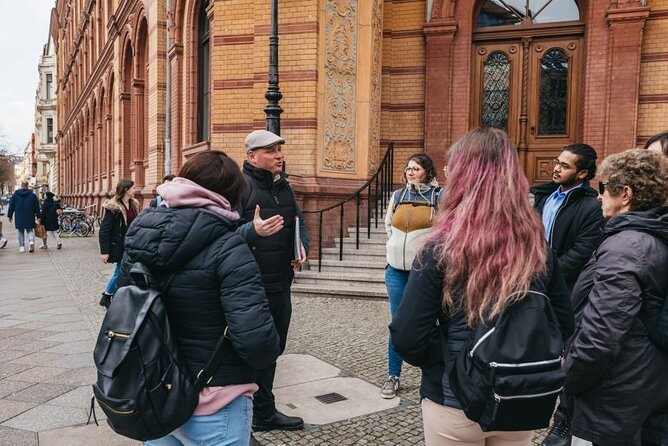
- From the New Synagogue to the Moses Mendelssohn school
- A cemetery destroyed by the Gestapo
- Otto Weidt’s workshop in a hidden courtyard
- The women of Rosenstraße
- Lustgarten and the loss of public space
- The Zeughaus and a dangerous plan against Hitler
- Neue Wache and Bebelplatz
- Trains to Life, Trains to Death
- Is $48.01 a fair price?
- Who should book this experience?
- Final recommendation
- FAQ
- How long does the tour last?
- How much does the tour cost?
- What language is the tour offered in?
- How many people can join the group?
- Where does the tour begin?
- Where does the tour end?
- Are admission tickets included?
- Is hotel pickup included?
- Can I cancel for a full refund?
Key points to know before you go
- The route covers ten significant sites: You move from the New Synagogue through Jewish schools, cemeteries, resistance locations, Nazi propaganda sites, and memorials.
- The group has a maximum of 15 people: This gives the guide a better chance to answer questions and adjust the pace.
- The stories focus on resistance: The tour looks beyond Nazi crimes to the choices made by Jewish families, German civilians, students, soldiers, and rescuers.
- The walking route ends near Friedrichstraße Station: You finish at a major transport hub with connections across Berlin.
- The price is $48.01 per person: For 2.5 hours with an expert English-speaking guide, that is a fair price if you value interpretation more than entry tickets.
- Expect standing and outdoor walking: The tour is described as accessible, but comfortable shoes and sensible weather clothing still matter.
Why this Berlin walk feels different
Many Berlin history tours concentrate on the major Nazi buildings and the broad political story. This one takes a more human route. Its subject is resistance, but not resistance in only one form.
You hear about people who hid or protected Jewish workers, women who confronted the authorities, students who helped create a climate of persecution, and a Wehrmacht officer who prepared to kill Hitler. You also visit places connected with Jewish education, deportation, destruction, rescue, and remembrance.
That range gives the tour a useful shape. It does not pretend resistance was easy or common. Instead, it shows the different risks people faced and the narrow openings they sometimes found.
The route also makes good use of central Berlin. The stops are spread through an area where grand museums, government buildings, memorials, and ordinary streets sit close together. You are not simply looking at monuments from a distance. You are moving through the spaces where these events unfolded.
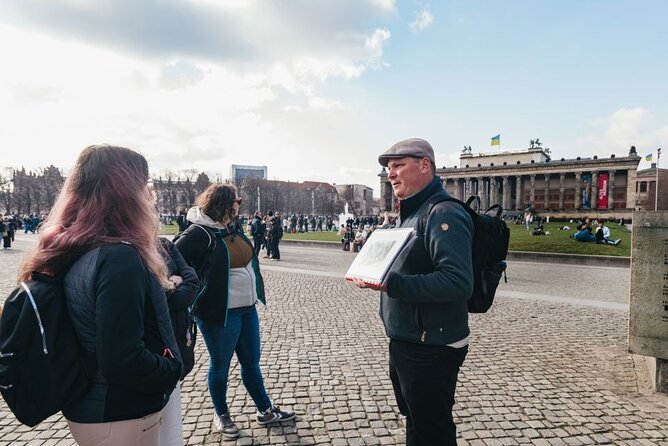
The small group matters here. With no more than 15 participants, a guide can pause at a memorial, show an old photograph, and explain what has changed. Several guides have received especially strong praise for their teaching, including Johan, Jochen, Scott, Jorg, and Benjamin. Names and assignments can change, but the important point is that the guide is expected to bring serious subject knowledge and answer questions clearly.
Other Berlin trips people book alongside this one:
- Berlin: Reichstag, Dome and Government District Guided Tour
★ 4.7 · 18,288 reviews - Berlin: 1-Hour City Tour by Boat with Guaranteed Seating
★ 4.3 · 16,993 reviews - Berlin: Boat Tour Along the River Spree
★ 4.4 · 11,252 reviews
From the New Synagogue to the Moses Mendelssohn school
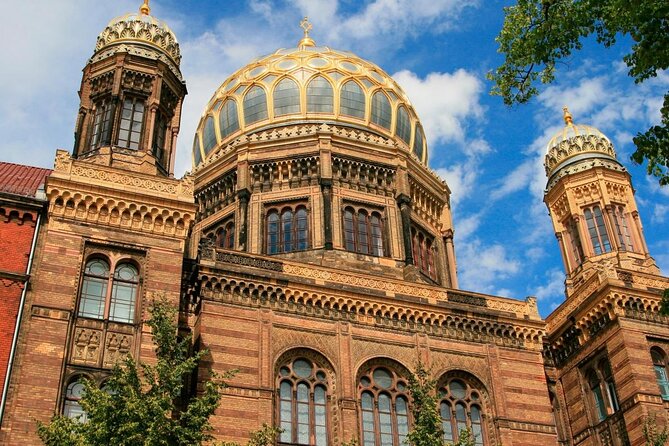
The walk begins at Oranienburger Str. 36, by the Neue Synagogue. Built in 1866, it was once Berlin’s largest and grandest synagogue, reflecting a Jewish community of about 160,000 people.
That opening is important because it places Jewish life before the Nazi period at the center of the story. You begin with a thriving community, not with its destruction. The building also carries a complicated wartime history. It was saved from vandals during Kristallnacht, remained in use until 1940, and was then confiscated by the Army for storage of military uniforms.
An Allied bombing raid in November 1943 caused severe damage. The main hall was demolished in 1958, partly rebuilt in 1988, and the synagogue officially reopened in 1995. Today, the Centrum Judaicum foundation works from the site to preserve Jewish memory and tradition.
You spend about 10 minutes here, and admission is free. Do not expect this stop alone to function as a full museum visit. The value is in the guide’s explanation of the building and its place in Berlin’s Jewish history.
The next stop is the Jewish Gymnasium Moses Mendelssohn, a short visit of about five minutes. Founded in 1779, it was the first Jewish school in Germany without fees. It welcomed students of all faiths, promoted liberal Jewish ideas, and accepted female students from 1931.
The site’s later use is chilling. In autumn 1941, Jewish schools were banned as deportations began. In 1942, the SS Reich Main Security Office turned this building into a transit camp. Windows were barred, and Jewish people were held inside before deportation to the East.
This quick stop shows how a place built for education became part of the machinery of persecution. Five minutes is not long, but it works as part of the larger route.
A cemetery destroyed by the Gestapo
The Jewish cemetery and Holocaust memorial provide one of the tour’s most difficult stops. Between 1672 and 1827, around 12,000 members of Berlin’s Jewish community were buried here.
In 1943, the Gestapo ordered the SS to destroy the cemetery. Gravestones were smashed, remains were thrown away, and the site was subjected to acts of deliberate cruelty, including soldiers playing football with skulls.
The details are brutal, and this is a place where a careful guide matters. You are not just hearing that a cemetery was destroyed. You are confronting the planned humiliation of the dead and the erasure of Jewish presence.
Burials began again in April 1945. Almost 2,500 German soldiers and Berlin civilians killed during the final fighting are buried in mass graves. That number includes civilians shot by the SS for hanging white flags from their windows.
You spend about 15 minutes here, the longest scheduled stop so far. It is also one of the places where the tour’s subject broadens. Resistance could mean armed action, rescue work, protest, or a small act such as signaling that you wanted the war to end.
Otto Weidt’s workshop in a hidden courtyard
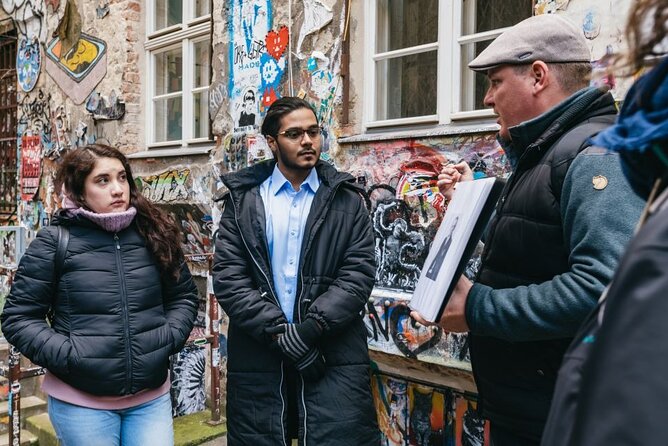
The Museum Blindenwerkstatt Otto Weidt is one of the most personal stops on the route. It sits in a courtyard that you might otherwise walk past without noticing.
Otto Weidt and his wife Else employed more than 30 blind and deaf Jewish workers between 1940 and 1945. Weidt tried to protect them as persecution tightened. He bribed Gestapo officers, falsified documents, and took other dangerous steps to delay or prevent deportation.
His actions went beyond paperwork and payments. He even traveled to Auschwitz in an attempt to bring back one of his employees.
You spend about 10 minutes at the workshop. The short time means the guide has to select the key parts of the story, but that focus can make the stop more powerful. It puts a face on the idea of resistance. You see how protection could involve persistent, practical work rather than a single dramatic gesture.
If you are interested in individual stories, this may be one of the tour’s strongest points. It also helps balance the larger memorials with a place connected to working life and personal risk.
Something different for another day:
- Discover Berlin Half-Day Walking Tour
★ 5.0 · 9,624 reviews - Berlin: Hop-on Hop-off Bus Tour with Live Commentary
★ 4.3 · 8,579 reviews - Berlin: Government District around the Reichstag Guided Tour
★ 4.7 · 8,447 reviews - Berlin: Reichstag, Plenary Chamber, Cupola & Government Tour
★ 4.6 · 8,422 reviews
The women of Rosenstraße
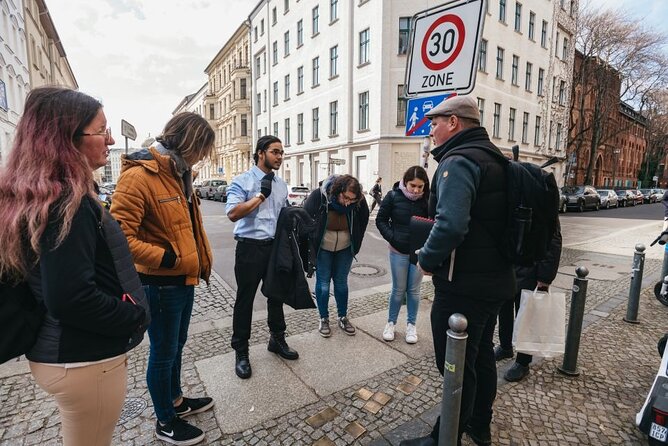
At the Rosenstraße memorial, the tour turns to one of Berlin’s clearest examples of public protest against Nazi persecution.
On February 27, 1943, the Gestapo, Waffen-SS, and Berlin Police arrested about 2,000 Jewish men married to non-Jewish German women. The wives gathered outside the place where the men were detained.
The women were threatened with being shot if they did not disperse. They moved away briefly, then returned in larger numbers. Their protest continued until Joseph Goebbels authorized the prisoners’ release.
You spend about 10 minutes here. The stop is especially valuable because it raises a difficult question: what could protest achieve under a dictatorship? The answer is not that public action always worked. It is that, in this case, sustained pressure helped force a change.
The guide’s role is crucial. The memorial itself is not large, and the meaning comes from understanding the sequence of arrest, gathering, threat, and release.
Lustgarten and the loss of public space
Lustgarten is framed by Berlin Cathedral, the Altes Museum, and the Zeughaus. Before the Nazis, it was a popular site for protests and speeches.
One week after Hitler became Chancellor, about 200,000 Berliners gathered here to protest the new government. Soon after, Nazi rules made public protest dangerous. Fines and arrests restricted the right to oppose the regime.
In 1934, the Nazis paved over the Lustgarten for propaganda rallies, military parades, and swearing-in ceremonies. The change was physical as well as political. A public space associated with civic life was reshaped for mass control.
This stop takes about 10 minutes and gives the route a wider civic frame. You are not only hearing about arrests and deportations. You are seeing how a government altered public space and public behavior.
I find this kind of stop useful because the setting remains part of daily Berlin. You can look around and understand that the same square once served very different purposes.
The Zeughaus and a dangerous plan against Hitler
The Zeughaus is the oldest building along Unter den Linden, constructed in 1730 as an artillery arsenal. On March 21, 1943, it hosted an exhibition of captured Soviet weapons.
Major General Rudolf Christoph Freiherr von Gersdorff, a member of the Wehrmacht resistance, was selected to lead the exhibition. He had witnessed 27 failed attempts to kill Hitler, yet he agreed to make his own attempt.
His plan was extreme. He intended to use two concealed British clam mines and hold Hitler in a death embrace, killing both of them. A wider coup d’état plan was also prepared.
The tour spends about 10 minutes here. The guide explains the setting, the plan, and what happened next. Because the supplied details do not give the outcome, you will need to hear that part on the walk itself.
This stop is a good reminder that opposition to Hitler did exist inside the German military, though it came late and was dangerous. It also adds tension to the route after the stories of civilian and Jewish resistance.
Neue Wache and Bebelplatz
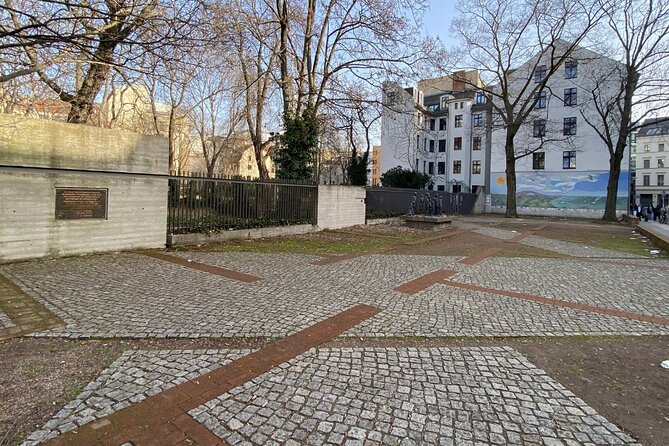
Neue Wache is a compact memorial in the center of a busy city. It serves as Germany’s central memorial for victims of war and tyranny.
The contrast between traffic and remembrance is part of the experience. You may find the stop quiet in mood even though the city continues around it. The guide gives it about 10 minutes, enough to explain its role without turning the entire visit into a long memorial service.
At Bebelplatz, the subject shifts to the destruction of ideas. On May 10, 1933, members of the Nazi German Student Union and their professors gathered beside Humboldt University for a nationwide action against what they called the un-German spirit.
Students burned more than 25,000 books judged to be un-German. The Book Burning Memorial makes the event personal and visual. It reminds you that the assault on Jewish people, political opponents, and intellectual freedom began with public campaigns, organized participation, and the removal of ideas from civic life.
These two stops work well together. Neue Wache honors people killed by war and tyranny. Bebelplatz shows how repression also attacked education, literature, and open thought.
Trains to Life, Trains to Death
The final listed stop is the sculpture Trains to Life, Trains to Death, near the end of the route. The almost life-size figures show two groups of Jewish children facing opposite directions.
One group represents children saved by the Kindertransport to England. The other represents children deported to concentration camps. The sculpture was created by Frank Meisler, who was himself rescued by a Kindertransport and traveled from Berlin to England in 1939.
This is a fitting final stop because it brings the story back to children and individual futures. The two groups make the contrast immediate: rescue for some, persecution and death for others.
After about 10 minutes here, the tour ends at S+U Friedrichstraße, a major train hub. That is practical after an emotionally heavy walk. You can continue around Berlin by public transport, and the guide can help you find your next connection.
Is $48.01 a fair price?
At $48.01 per person, this is not the cheapest way to walk central Berlin. Almost every stop listed is free to visit, so you are paying mainly for the guide, the small group, the route design, and the photographs and maps.
That can be good value if you want interpretation. Without a guide, several locations could feel disconnected: a synagogue, a school, a courtyard workshop, a square, an arsenal, and a sculpture. Together, they explain how Jewish life, resistance, propaganda, rescue, and persecution shaped the city.
The maximum group size of 15 is another part of the value. You are less likely to be lost at the back of a large crowd, and the guide can respond to questions. The tour is also offered in English, which makes complex material easier to follow if you do not read German.
I would not choose it if you want museum interiors, extensive free time at each stop, or a relaxed sightseeing walk. The schedule gives most sites only 5 to 15 minutes, and the subject matter requires attention.
Who should book this experience?
I would recommend it to anyone who wants a focused introduction to Jewish history and German resistance in Berlin. It suits first-time visitors who need a clear route, as well as people with previous Holocaust studies who want to connect facts with real places.
Families can also find it worthwhile. One guide adapted the pace and answered questions, and one family found that even their children stayed interested. Still, parents should prepare younger children for difficult subjects, especially at the cemetery, deportation sites, and Trains to Life, Trains to Death.
The tour is described as accessible, and service animals are allowed. It runs near public transportation, and most people can participate. Even so, the amount of standing makes supportive shoes important. Good weather is required, so a cancellation or date change is possible if conditions are poor.
You receive confirmation when booking. Free cancellation is available up to 24 hours before the start time. The tour may also be canceled if its minimum number is not reached, with a new date, another experience, or a full refund offered.
Final recommendation
I would book Path of Resistance if you want Berlin history told through people and places rather than a list of dates. Its best features are the small group, the strong English guidance, and the range of stories, especially Otto Weidt, the Rosenstraße protest, and the attempted military resistance at the Zeughaus.
Skip it if you dislike walking, need plenty of sitting time, or prefer to explore museums at your own speed. For most history-minded visitors, though, $48.01 buys a thoughtful route through central Berlin and a much clearer sense of how resistance could look under Nazi rule.
FAQ
How long does the tour last?
The tour lasts approximately 2 hours and 30 minutes.
How much does the tour cost?
The listed price is $48.01 per person.
What language is the tour offered in?
The tour is offered in English.
How many people can join the group?
The maximum group size is 15 travelers.
Where does the tour begin?
The meeting point is Oranienburger Str. 36, 10117 Berlin, Germany, by the Neue Synagogue.
Where does the tour end?
The tour ends at S+U Friedrichstraße, Berlin, near Friedrichstraße and Georgenstraße.
Are admission tickets included?
The listed stops have free admission. The experience includes an expert guide, a small group, Then & Now photographs and maps, and an accessible tour.
Is hotel pickup included?
No. Hotel pickup and drop-off are not included.
Can I cancel for a full refund?
Yes. You can cancel at least 24 hours before the start time for a full refund. Changes or cancellations made less than 24 hours before the start time are not accepted for a refund.
Just added around Berlin
- Berlin: Private Guided Tour of the Main Sights★ 5.0 · 13 reviews
- Private Highlights of Berlin Bike Tour★ 5.0 · 13 reviews
- Modern Berlin Private Walking Tour: Diverse, Vibrant and Exciting German Capital★ 5.0 · 13 reviews
- Tour in Berlin from Warnemünde and Rostock Cruise Port★ 4.1 · 13 reviews
- Berlin: Stasi Museum Private Guided Tour with Entry Ticket★ 4.8 · 13 reviews
- Private Food Tour Experience with a born and bred Berliner★ 5.0 · 14 reviews
- Berlin: Rheinsberg Palace Entrance Ticket★ 4.8 · 14 reviews
- Berlin in one day – day tour with an expert guide★ 5.0 · 14 reviews
Berlin Tours, compared.
Reichstag, Dome and Government District Guided Tour
Read our review →
1-Hour City Tour by Boat with Guaranteed Seating
Read our review →
Government District around the Reichstag Guided Tour
Read our review →
Reichstag, Plenary Chamber, Cupola & Government Tour
Read our review →