Reviewed · BERLIN TOURS
Karl-Marx-Allee Tour: Life and Architecture in East Berlin
East Berlin tells its story in stone. This two-hour walk along Karl-Marx-Allee connects grand socialist architecture with the daily life and political shocks behind it. I like the compact route, which covers a lot without taking half a day, and I like the small group cap of 15, which gives the guide room to answer questions. The main drawback is that the tour depends on good weather, and much of the experience takes place outdoors.
You’ll see more than monumental apartment blocks. The route explains how postwar architects, state planners, workers, and ordinary residents shaped this famous boulevard. Guide Martina receives especially warm praise for her humor, detailed preparation, and ability to make difficult political subjects clear. The walk is best for anyone who wants East German history tied directly to buildings, streets, and real human choices.
In This Review
- Key points about the Karl-Marx-Allee walk
- Why Karl-Marx-Allee is worth two hours
- Frankfurter Tor: the grand entrance to a socialist boulevard
- Laubenganghäuser: a rejected vision of postwar Berlin
- Weberwiese: the prototype apartment block
- The June 17, 1953 memorial and the workers’ uprising
- Café Sibylle and the vanished Stalin statue
- Karl Marx, ideology, and East Berlin at street level
- Strausberger Platz and the road beyond the Wall
- The guide makes the difference
- What you get for about $30
- Practical details before you go
- Who should book this walk?
- Should you book the Karl-Marx-Allee tour?
- FAQ
- How long does the Karl-Marx-Allee Tour last?
- In what language is the tour offered?
- Where does the tour begin?
- Where does the tour end?
- How large is the tour group?
- Can I cancel for a full refund?
Key points about the Karl-Marx-Allee walk
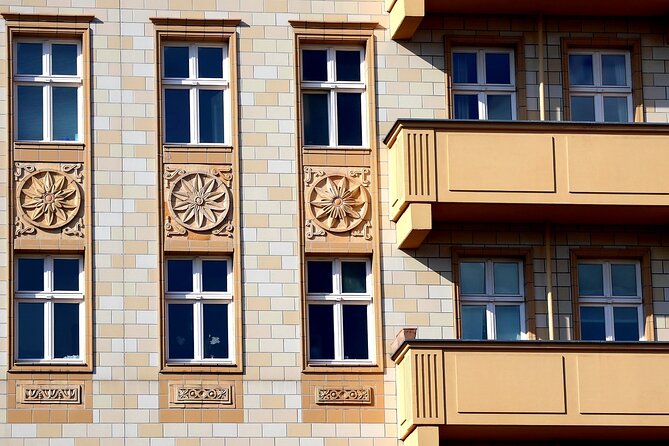
- Frankfurter Tor begins with grand socialist design: Learn how Hermann Henselmann’s twin towers helped create East Germany’s first socialist boulevard.
- Seven stops fit into about two hours: The route is useful if you have limited time but still want more than a quick look at East Berlin.
- Architecture and politics are treated together: You move from utopian postwar planning to propaganda, worker unrest, cafés, statues, and everyday life.
- The group is limited to 15 people: That makes it easier to hear the guide and ask questions than on a large city walk.
- The route ends at Strausberger Platz: From there, Alexanderplatz is about a 10-minute walk away.
- The tour costs about $30.01: For a specialist guide-led walk with no separate admission charges, the price is fair if architecture and political history matter to you.
Why Karl-Marx-Allee is worth two hours
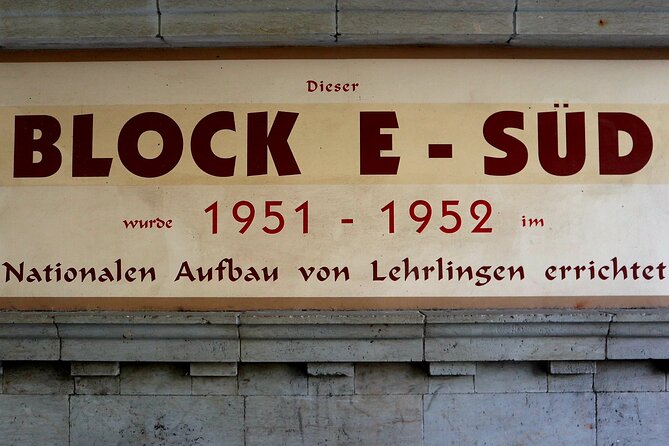
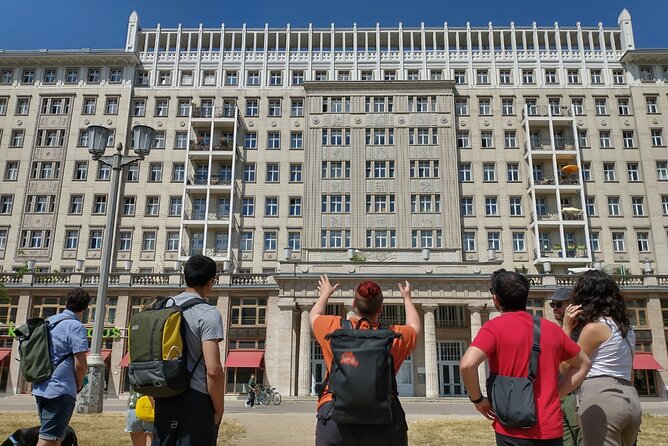
Karl-Marx-Allee is not simply a broad avenue lined with big buildings. It is a record of East Germany’s changing ambitions. The street began as Stalinallee, a showcase for the new socialist state, and later became Karl-Marx-Allee after the political climate shifted.
That change is central to the walk. You are not just shown façades and told their dates. You learn how the boulevard was meant to display a new society, how its construction became a public relations tool, and how the people who lived there experienced the promises and pressures of the system.
I find this setting especially useful because Berlin’s Cold War story can sometimes feel scattered. At Karl-Marx-Allee, the ideas are visible in one connected route. Monumental towers, experimental housing, a workers’ memorial, a former café, and a bust of Karl Marx all sit within the same story.
The tour is offered in English and lasts roughly two hours. That is enough time to discuss each stop without turning the outing into an exhausting full-day lecture. You should still expect a steady outdoor walk, with much of the value coming from listening closely while looking at buildings from the street.
Other Berlin trips people book alongside this one:
- Berlin: Reichstag, Dome and Government District Guided Tour
★ 4.7 · 18,288 reviews - Berlin: 1-Hour City Tour by Boat with Guaranteed Seating
★ 4.3 · 16,993 reviews - Berlin: Boat Tour Along the River Spree
★ 4.4 · 11,252 reviews
Frankfurter Tor: the grand entrance to a socialist boulevard
The walk begins at U Frankfurter Tor, where the twin towers create one of Karl-Marx-Allee’s most recognizable views. Their symmetry was designed by Hermann Henselmann, and the pair gives the avenue a formal gateway.
The guide explains how plans for Germany’s first socialist street took shape in the early 1950s. This is where the political purpose of the architecture becomes clear. The new boulevard was meant to show that East Germany could rebuild Berlin with order, scale, and confidence after the destruction of the Second World War.
You will also hear about the rebuilding program that brought thousands of volunteers into the effort. That detail matters because the boulevard was presented not only as a construction project but also as proof of collective action. The buildings were supposed to express what a socialist society could accomplish together.
Allow about 20 minutes here. That is enough time to admire the towers and hear the opening explanation, but not enough for a long architectural survey. I like this as a starting point because the visual drama gets your attention before the tour moves into more complicated questions about who benefited from the project and why.
Laubenganghäuser: a rejected vision of postwar Berlin
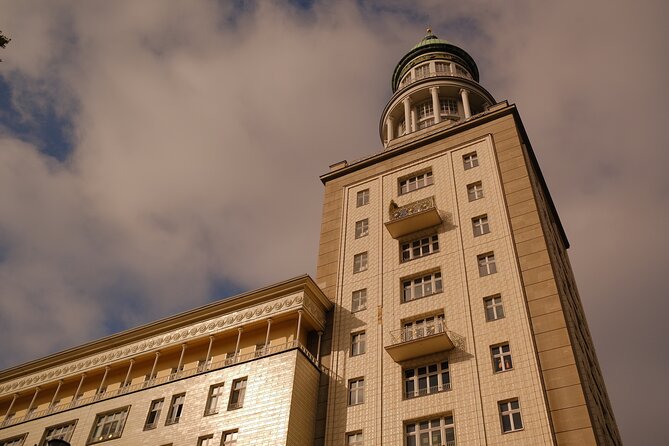
The Laubenganghäuser offer a sharp contrast to the formal grandeur of Frankfurter Tor. These buildings reflect modernist thinking from the immediate postwar years, when Berlin’s planners were trying to imagine a humane city after enormous destruction.
The architect Hans Scharoun developed utopian urban ideas for this new Berlin. His approach was soon rejected by the East German regime, which favored a more controlled and monumental style. Seeing these buildings after the towers makes that political shift easier to understand.
This stop lasts about 15 minutes. You may find the architecture less immediately dramatic than the towers, but it is one of the most important comparisons on the route. The walk asks you to look at not only what was built, but also what was discarded.
I appreciate this part because it prevents the tour from treating East German architecture as one uniform style. The avenue grew out of competing ideas about modern life. One vision valued open, human-centered planning. Another used grand architecture to communicate state power.
Weberwiese: the prototype apartment block
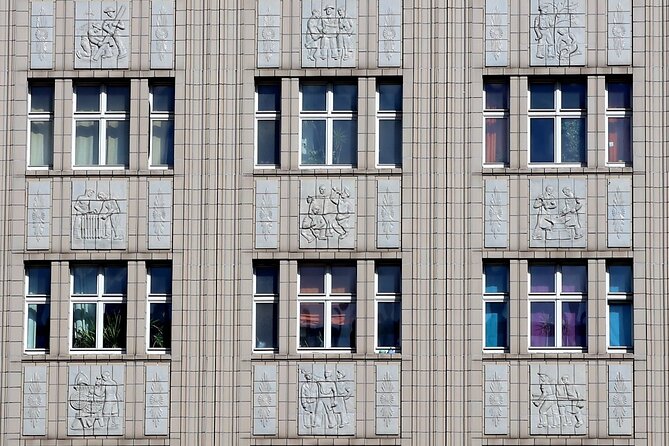
At the Hochhaus an der Weberwiese, the focus turns to the building that served as a prototype for the later Karl-Marx-Allee. Its first residents received a level of comfort that was presented as a new kind of socialist luxury.
That phrase needs some context. The building was not merely housing. It helped the state demonstrate that its political system could provide modern homes for workers. The project also became a propaganda tool and attracted attention from architects in the West.
This is one of the places where you can connect design with everyday life. The guide explains what made the apartments exceptional at the time and why the building mattered beyond its appearance. The point is not simply that the apartments were desirable, but that housing itself had become part of the political argument.
The stop takes about 20 minutes. I would pay close attention here if you are interested in urban planning or social housing. The building helps explain why Karl-Marx-Allee was taken seriously by architects outside East Germany, even as the boulevard served the interests of a tightly controlled government.
Something different for another day:
- Discover Berlin Half-Day Walking Tour
★ 5.0 · 9,624 reviews - Berlin: Hop-on Hop-off Bus Tour with Live Commentary
★ 4.3 · 8,579 reviews - Berlin: Government District around the Reichstag Guided Tour
★ 4.7 · 8,447 reviews - Berlin: Reichstag, Plenary Chamber, Cupola & Government Tour
★ 4.6 · 8,422 reviews
The June 17, 1953 memorial and the workers’ uprising
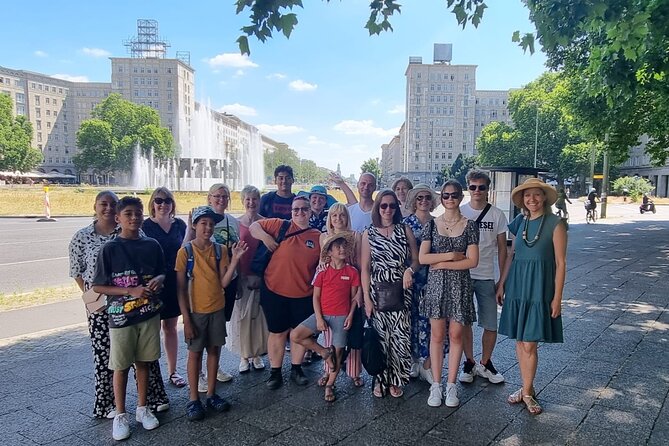
The Gedenkstätte Arbeiteraufstand 17 Juni 1953 marks the most openly political stop. In June 1953, dissatisfied workers began a mass uprising that came close to toppling East Germany’s socialist government.
The memorial is controversial, and that is part of its importance. A monument can preserve a memory, but it can also frame that memory in a particular way. The guide helps you consider how the uprising was remembered and presented after the event.
About 20 minutes are assigned here. That gives the subject room to breathe. This is not a quick mention of a date in a textbook. You learn how discontent among workers turned into a much wider challenge to the government.
For me, this stop gives the boulevard a human scale. The avenue can look polished and ceremonial, but the memorial reminds you that workers were not simply symbols in a state-building story. They could also resist the system that claimed to represent them.
Café Sibylle and the vanished Stalin statue
Café Sibylle brings the story down from public protest and state planning to social life. The café was once among the most exclusive places on Karl-Marx-Allee, and its story is tied to the statue of Joseph Stalin that stood nearby until 1961.
This connection helps explain how political symbols shaped ordinary routines. A café could be a fashionable meeting place, while a huge statue of the Soviet dictator dominated the surrounding avenue. The contrast is revealing: public ideology and private social life existed side by side.
The stop takes about 15 minutes. You will not spend the whole time inside a museum-style display, so do not expect a long indoor visit based on the information available. Instead, the guide uses the location to explain how the boulevard functioned as a social space as well as a political stage.
I like this portion because it adds texture to the usual Cold War story. Political systems are not experienced only through speeches and monuments. They also appear in cafés, status, habits, and the changing meaning of familiar places.
Karl Marx, ideology, and East Berlin at street level
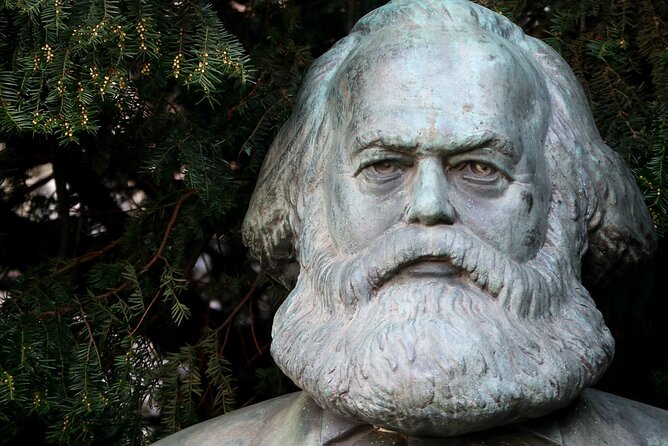
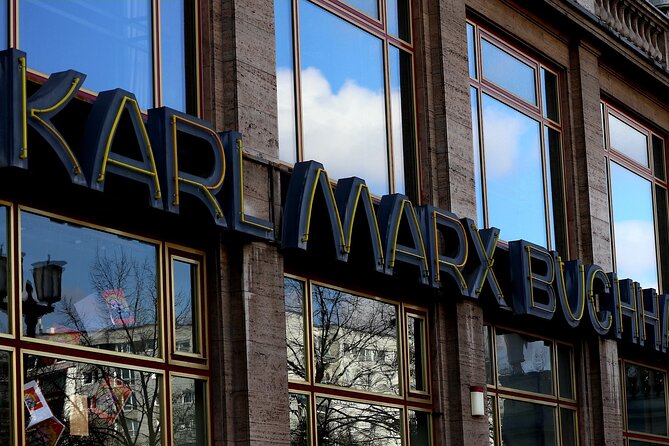
The Karl Marx bust gives the tour a chance to discuss the ideology behind the boulevard’s name and design. You meet the author of The Communist Manifesto and consider how socialist ideas affected everyday life in East Berlin.
This stop lasts about 15 minutes. It is less about the bust as an isolated work of public art and more about what Karl Marx represented in the city. The guide connects political theory with housing, work, public space, and the language used by the East German government.
That connection is useful if you know little about communist ideology. You do not need a degree in political theory to follow the discussion. The best part of a site-based explanation is that abstract ideas are tied to the avenue beneath your feet and the buildings around you.
The guide’s style matters here. Martina is praised for combining serious research with humor, which can make a dense subject easier to follow. One especially appealing detail is her use of demonstration material and original items, including material sourced from eBay, to support the explanations.
Strausberger Platz and the road beyond the Wall
The final stop is Strausberger Platz, another major example of Hermann Henselmann’s style. The roundabout gives you a second chance to see how the boulevard’s formal design works as a complete urban composition.
The discussion then moves beyond the period of East German rule. You hear how life along Karl-Marx-Allee changed after the Berlin Wall fell and how the area functions today. This prevents the tour from ending in 1989, as if the street became irrelevant once reunification arrived.
The walk ends on the eastern side of the Strausberger Platz roundabout. Alexanderplatz is about a 10-minute walk away, so the location is convenient if you plan to continue sightseeing in central Berlin.
This is a sensible ending because it leaves you with a question rather than a simple verdict. What happens to grand political architecture after the political system that built it disappears? Karl-Marx-Allee has continued life, changing residents, and a new place in Berlin’s modern identity.
The guide makes the difference
The strongest praise for this experience centers on the guide’s delivery. Martina is described as funny, organized, passionate, and exceptionally well prepared. Those qualities matter on a subject filled with dates, political changes, competing architectural theories, and unfamiliar names.
I would particularly value her firsthand connection to parts of East Germany’s communist period. One account describes her as having lived through portions of that system, which adds a personal layer to the explanation. That does not replace historical evidence, but it can help you understand how official ideals felt in daily life.
The tour also appears to work well for older teenagers. A 17-year-old was captivated by Martina’s storytelling, suggesting that the walk is not aimed only at specialists. You should still enjoy listening and looking closely, since this is not a fast photo stop at famous landmarks.
Guide assignments can vary, so Martina may not lead every departure. Still, the consistent praise for the company’s research and storytelling suggests that this is a serious subject handled with care rather than a quick script recited beside a monument.
What you get for about $30
The price is $30.01 per person. There are no admission charges at the listed stops, so your payment mainly covers the specialist guide and the organized interpretation of the route.
That is good value if you already have an interest in architecture, Cold War Berlin, or political history. You could walk along Karl-Marx-Allee for free, but you would likely miss the links between the buildings, the June 1953 uprising, the vanished Stalin statue, and the postwar planning debate.
The value is less clear if you want a general overview of Berlin. This walk concentrates on one avenue and its surrounding sites. It will not replace a broad city tour, a museum visit, or a visit to every major Cold War landmark.
The small group limit of 15 improves the price calculation. A guide can keep the pace together and respond to questions without shouting across a large crowd. That personal contact is a major part of what you are paying for.
Practical details before you go
The meeting point is U Frankfurter Tor, at 10243 Berlin. The tour ends at Strausberger Platz, also in the 10243 postal area, so you finish close to the same stretch of Karl-Marx-Allee rather than being taken across the city.
The route is near public transportation, and most people can take part. Service animals are allowed. The information provided does not specify the exact walking distance, indoor access, or seating, so you should be prepared for an outdoor walk lasting around two hours.
The experience requires good weather. You can cancel for a full refund up to 24 hours before the start time, while cancellations or changes made later are not accepted. If poor weather forces cancellation, you are offered another date or a full refund.
The tour is usually booked about 18 days ahead. That is a useful planning signal, especially if your Berlin schedule is fixed. I would reserve early if you want a particular date or hope to join a small group.
Who should book this walk?
I would recommend it most strongly to you if you enjoy architecture with a political story attached. It is also a good choice if you have already seen the Brandenburg Gate, the Berlin Wall sites, and central Berlin, and now want a more focused look at the former East.
Families with older teenagers may enjoy it, especially if the guide uses humor and visual material. The subject is serious, but the walk is not presented as a dry academic seminar.
You may want to skip it if you dislike outdoor walking, have no interest in postwar architecture, or prefer a tour built around famous sights and photo stops. Karl-Marx-Allee is the subject, not merely the backdrop.
Should you book the Karl-Marx-Allee tour?
Book this tour if you want to understand why East Berlin looked the way it did, how architecture served politics, and how residents lived within that system. The route is short, focused, and packed with useful connections, from Scharoun’s rejected modernism to Henselmann’s socialist towers and the workers’ uprising of 1953.
At about $30, it offers solid value for a small-group specialist walk. I would choose it early in a Berlin visit if you want the rest of the city’s Cold War sites to make more sense. If you only have time for one quick East Berlin photo stop, this may feel too detailed. If you want the story behind the stone, it is a smart booking.
FAQ
How long does the Karl-Marx-Allee Tour last?
The tour lasts approximately two hours.
In what language is the tour offered?
The tour is offered in English.
Where does the tour begin?
It begins at U Frankfurter Tor, 10243 Berlin, Germany.
Where does the tour end?
It ends at Strausberger Platz, on the eastern side of the roundabout. The end point is about a 10-minute walk from Alexanderplatz.
How large is the tour group?
The tour has a maximum of 15 participants.
Can I cancel for a full refund?
Yes. You can cancel at least 24 hours before the start time for a full refund. If poor weather causes the operator to cancel, you are offered another date or a full refund.
Just added around Berlin
- Berlin: Private Guided Tour of the Main Sights★ 5.0 · 13 reviews
- Private Highlights of Berlin Bike Tour★ 5.0 · 13 reviews
- Tour in Berlin from Warnemünde and Rostock Cruise Port★ 4.1 · 13 reviews
- Modern Berlin Private Walking Tour: Diverse, Vibrant and Exciting German Capital★ 5.0 · 13 reviews
- Berlin: Stasi Museum Private Guided Tour with Entry Ticket★ 4.8 · 13 reviews
- Private Food Tour Experience with a born and bred Berliner★ 5.0 · 14 reviews
- Berlin: Rheinsberg Palace Entrance Ticket★ 4.8 · 14 reviews
- Berlin in one day – day tour with an expert guide★ 5.0 · 14 reviews
Berlin Tours, compared.
Reichstag, Dome and Government District Guided Tour
Read our review →
1-Hour City Tour by Boat with Guaranteed Seating
Read our review →
Government District around the Reichstag Guided Tour
Read our review →
Reichstag, Plenary Chamber, Cupola & Government Tour
Read our review →