
Reviewed · CITY TOURS
Individual City Tour – Rickshaw Sightseeing in Berlin
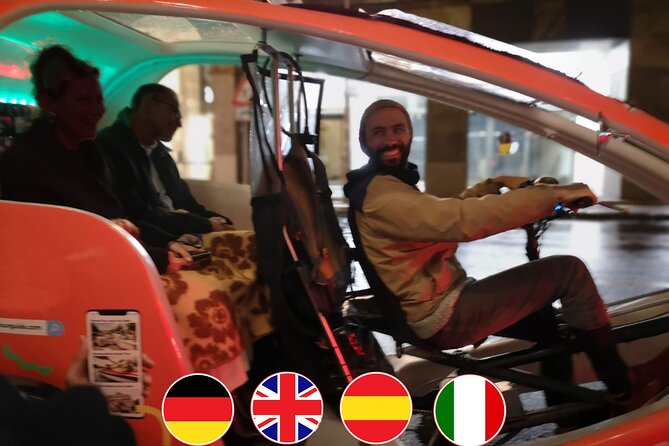
Berlin is best seen close to the street. This private rickshaw tour links Alexanderplatz, Museum Island, Checkpoint Charlie, the Tiergarten, and Brandenburg Gate without asking you to march across the city. I like the personal route and the way a small vehicle can reach places a coach cannot. I also like the human scale: your guide can stop for photos, answer questions, and adjust the pace to your group.
The main trade-off is time. A one-hour ride can only skim this long route, while the full three-hour version gives the city room to breathe. The open-sided rickshaw can also feel cold, though blankets and, in some cases, hot water bottles help. Pickup within two kilometers of Museum Island is free, but farther hotel pickups cost €5 per kilometer.
In This Review
- Key points at a glance
- Why a Berlin rickshaw makes sense
- Alexanderplatz to Museum Island: Berlin’s older center
- Courtyards and the Palace of Tears
- Bebelplatz to Checkpoint Charlie
- The Wall, Potsdamer Platz, and a divided city
- Thirty minutes through the Tiergarten
- Government district to Brandenburg Gate
- What the guide adds to the ride
- Comfort, access, and the best length
- Price, pickup, and practical value
- Who should book this experience?
- Should you book the Berlin rickshaw tour?
- FAQ
- Where does the rickshaw tour start?
- Where does the activity end?
- Is hotel pickup available?
- How long is the tour?
- Is this a private tour?
- Is the tour offered in English?
- Is a warm blanket provided?
- Are admission tickets included?
- What is the cancellation policy?
Key points at a glance
- Private from start to finish: Only your own party joins the ride, so the route and pace can respond to your interests.
- A fast first look at Berlin: You can connect central sights that are spread across a large city in one to three hours.
- Cold-weather care: A warm blanket is supplied, and guides have also provided hot water bottles on chilly rides.
- Strong guiding: Leo is repeatedly praised for clear history, good English, patience, and flexible planning.
- Small lanes and courtyards: The rickshaw can reach areas that are awkward for cars and buses, including parts of the Hackesche Höfe area.
- Useful pickup option: Hotel or location pickup is free within two kilometers of Museum Island, with an added charge beyond that range.
Why a Berlin rickshaw makes sense
Berlin is not a compact old town where every major sight sits around one square. The city’s key places spread from Alexanderplatz in the east to Potsdamer Platz and the Brandenburg Gate in the west, with the Tiergarten in between.
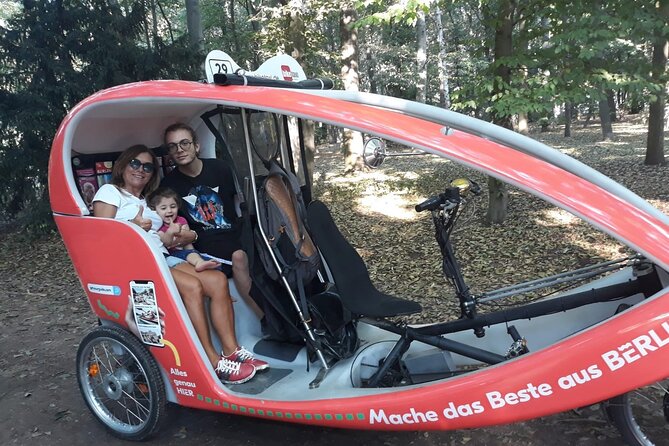
That makes a rickshaw useful. You are not simply being driven past landmarks. You can move between them with less effort than walking and with more access than a large bus. The vehicle travels in cycle lanes, according to the experience details, and can pull close to sights for explanations and photographs.
I see this as a getting-oriented ride, not a replacement for visiting Berlin’s museums and memorials from inside. The short stops are enough to understand what you are seeing and mark places for a longer return visit.
The private format matters. If your child wants more time at one stop, your parent needs help getting in and out, or your teenager would rather hear about the Cold War than Prussian kings, the guide can change the emphasis. Leo is especially praised for adapting to different ages and interests.
More City Tours in Berlin
- Berlin: 1-Hour City Tour by Boat with Guaranteed Seating
★ 4.3 · 16,993 reviews - Berlin: City Sightseeing Hop-On Hop-Off Bus Tour
★ 4.1 · 4,233 reviews - Potsdam: City and Castles Tour
★ 4.7 · 3,721 reviews
Alexanderplatz to Museum Island: Berlin’s older center
The meeting point is the Weltzeituhr, or World Time Clock, at Alexanderplatz. This is an easy place to find and a useful starting point because the square connects Berlin’s medieval roots with its former role as the center of East Berlin.
The clock itself is a popular meeting place, but the larger lesson is about layers. Alexanderplatz has been reshaped many times, and the opening stop helps place the former GDR capital within the modern city. You receive about five minutes here, so think of it as an introduction rather than a full study of the square.
The route then moves to Nikolaiviertel, the site of the oldest settlement in the Berlin-Cölln twin city. Much of this area was destroyed during the Second World War and rebuilt for Berlin’s 750th anniversary. Its lanes and historic-looking buildings offer a very different mood from Alexanderplatz.
This is one place where the rickshaw earns its keep. A car can feel clumsy in the older streets, while walking the whole route takes time. You can get a quick explanation, look around, and continue without losing the citywide flow.
Museum Island follows. The group of museums was commissioned by Prussian kings and has UNESCO World Heritage status. The Berlin Cathedral and the new Berlin Palace are nearby, so the stop gives you a strong sense of Berlin’s royal and cultural center.
The museum admission is not included. That is not a serious flaw, since the ride is a sightseeing tour rather than a museum visit, but plan a separate visit if you want to see the collections. Five minutes is enough for an outside orientation, not for the museums themselves.
Courtyards and the Palace of Tears
The Hackesche Höfe area offers a change of tone. These enclosed courtyards are part of the old Spandauer Vorstadt district and are often described as Germany’s largest connected courtyard complex. The appeal is the contrast between youthful façades and smaller, decorative backyards.
This is a good example of the route’s mix. Berlin’s famous monuments get most of the attention, but courtyards show how the city feels at street level. The short stop can point out details you might otherwise miss, although the schedule does not allow a long browse through every passage.
At the Palace of Tears, you encounter a more personal piece of divided Berlin. This former exit hall at Friedrichstraße station was a border crossing for people leaving East Berlin. The control counters remain, giving the place a direct physical link to the city’s division.
The name is not decorative. Families and friends said goodbye here under the strict rules of the border. You can walk through the control area, but the tour stop itself is brief, so return later if this part of Berlin’s story matters especially to you.
Bebelplatz to Checkpoint Charlie

Bebelplatz is one of Berlin’s most important historic squares. Its buildings express the cultural ambitions of Prussia, while the empty library memorial recalls the Nazi book burning of May 10, 1933.
The memorial is easy to overlook because it is set below ground level. Your guide’s explanation helps you understand why an empty room, rather than a statue, carries the message. The square also rewards a look at its architecture, which reflects what beauty and public culture meant about 300 years ago.
Gendarmenmarkt continues that architectural theme. The square is framed by monumental buildings, including a concert hall and churches with prominent towers. It is often regarded as one of Berlin’s most beautiful squares, and the rickshaw lets you take in the ensemble without spending much time crossing the city on foot.
Then comes Checkpoint Charlie, the best-known former border crossing between East and West Berlin. It recalls the Cold War, divided streets, and dangerous escape attempts. The modern setting can feel crowded and commercial, so the guide’s historical framing is particularly useful here.
I would not treat Checkpoint Charlie as a complete Cold War museum. It is a symbolic location, and the value lies in understanding its role within the wider story. The short stop gives you the background, then you can choose to return for a longer look.
Something different for another day:
- Berlin: Reichstag, Dome and Government District Guided Tour
★ 4.7 · 18,288 reviews - Berlin: Boat Tour Along the River Spree
★ 4.4 · 11,252 reviews - Discover Berlin Half-Day Walking Tour
★ 5.0 · 9,624 reviews - Berlin: Hop-on Hop-off Bus Tour with Live Commentary
★ 4.3 · 8,579 reviews
The Wall, Potsdamer Platz, and a divided city
The Topography of Terror brings the Nazi period and Berlin Wall era together in one area. A long remaining section of the Wall is preserved here in its original state, beside a site connected with the institutions of Nazi terror.
That combination can be sobering. It shows how Berlin’s twentieth-century history is not neatly divided into separate chapters. The stop is free, but five minutes only provides an outside introduction. You will need more time for the documentation center.
Potsdamer Platz shows the city’s modern side. Once one of Europe’s major traffic junctions, it was damaged by war and then split by the division of Berlin. Today, its tall, modern buildings create a sharp contrast with the older squares and memorial sites.
The important point is not just the architecture. Potsdamer Platz demonstrates how quickly Berlin rebuilt and changed after reunification. Old elements remain hidden among the newer construction, so listen for those traces rather than seeing the area as just a business district.
This part of the route is especially useful early in a Berlin stay. It helps you understand why the city can look modern, royal, socialist, imperial, and wounded within a few blocks.
Thirty minutes through the Tiergarten
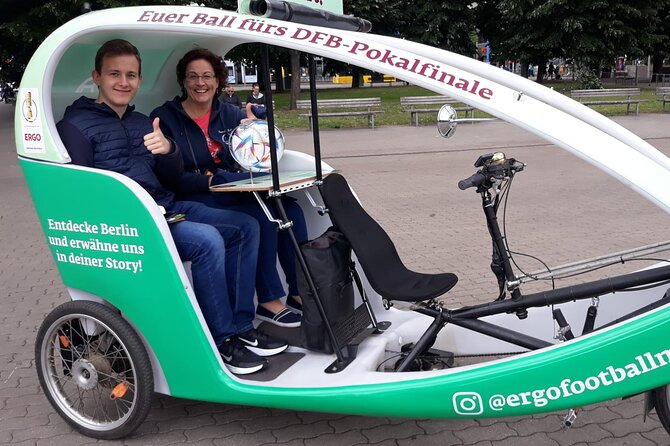
The longest stop is the Tiergarten, with about 30 minutes devoted to Berlin’s central park. That extra time is welcome. After a run of dense urban sights, the rickshaw passes through green space, bridges, and broad paths.
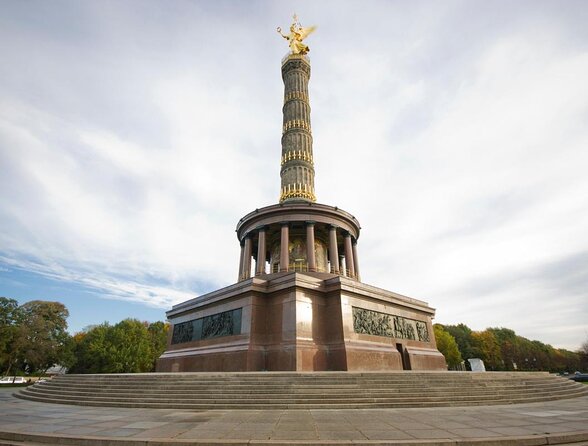
The Tiergarten is known as Berlin’s green heart, and the route includes several major points around it. You pass the Victory Column, Bellevue Palace, the House of World Cultures, the Carillon, and the Soviet Memorial.
The park section is more than a pause between monuments. It gives you a sense of Berlin’s scale and offers a calmer stretch of the ride. If you are visiting during cold weather, this is also where the blanket becomes most useful, since you spend more time outside the shelter of city buildings.
The Victory Column commemorates three Prussian victories and is topped by the golden figure of Victoria. It is also associated with Berlin’s Love Parade, an example of how one monument can carry both official history and popular memory.
The tour does not include admission to the column. You can still see its gilded cannons and the statue from nearby, but climbing up is a separate choice and would not fit into a quick sightseeing stop.
Bellevue Palace is the official residence of the German Federal President and has served in that role since 1994. Its earlier life as a prince’s residence adds another layer to the park’s history. Again, the ride is about context and exterior viewing, not a palace interior visit.
Government district to Brandenburg Gate
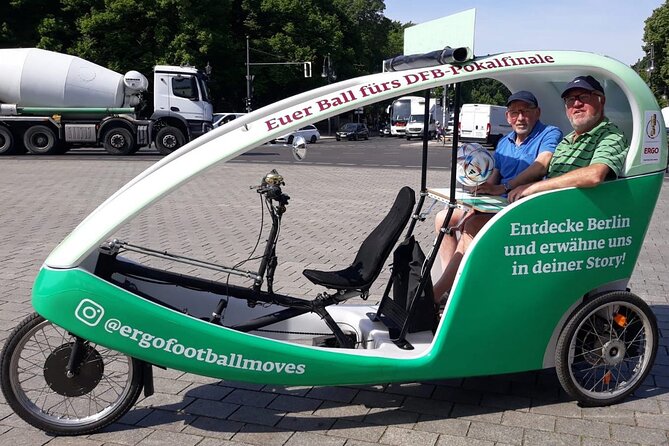
The government district sits along the Spreebogen and includes the historic Reichstag building. Much of the surrounding quarter was built around the year 2000, so this is a clear example of reunified Berlin creating a new political center.
The ride gives you a quick look at how government, public space, and modern architecture meet along the river. It also helps connect the city’s older imperial center with the institutions of today’s Germany.
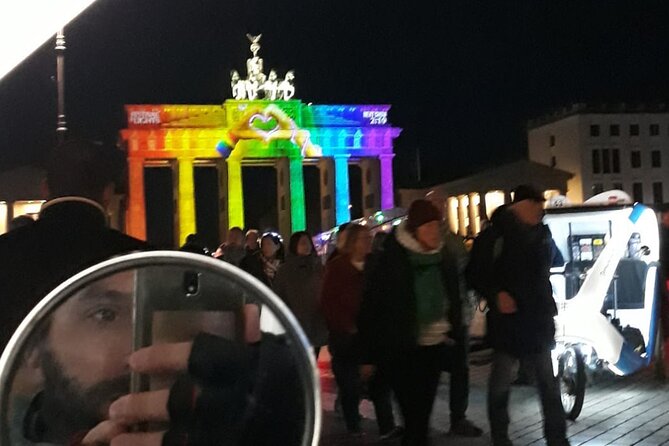
Brandenburg Gate is the natural finale. At the end of Unter den Linden, it is Berlin’s only surviving city gate and the city’s most familiar symbol. It has represented royal power, division, and reunification at different times.
The gate is free to view, but the five-minute stop is best used for photographs and a final explanation. Ask your guide to connect it to the Wall and the reunification story. The meaning of the gate changes once you know that it was once trapped in a restricted zone between East and West.
The activity returns to the World Time Clock meeting point. If you arrange pickup, confirm the return plan clearly, since the stated end point is back at the meeting place even though hotel pickup can be arranged.
What the guide adds to the ride
The strongest part of this experience is the guiding. Leo is praised for clear English, patience, quick communication, and an ability to answer detailed questions, including difficult questions about Hitler and Eva Braun.
That matters in Berlin. The city’s memorials often require explanation, and a guide who can move from Prussian victories to Nazi persecution, the Cold War, and reunification without losing the thread adds real value.
Leo also uses old photographs at times to show how streets and landmarks changed. This is a simple but effective tool. You can compare the scene in front of you with wartime damage, division, or postwar rebuilding.
The ride is not limited to a fixed speech. It can be adjusted around your next day’s plans, your child’s interests, or the places you already intend to visit. One three-hour route was changed to avoid repeating sights planned for the following day. That kind of planning is a major advantage of a private tour.
Music is available by request. Drinks can be ordered separately, but they are not included.
Comfort, access, and the best length
The rickshaw is a practical choice if you have bad knees, limited walking stamina, or a parent who needs help getting on and off. One solo rider was able to bring a walker and received assistance boarding. A two-year-old also fit comfortably into a family outing, according to the experience details.
That does not mean every mobility need is automatically covered. The vehicle is small, and you should explain your requirements when booking. Service animals are allowed, and the activity is near public transportation.
The one to three-hour range should guide your decision:
- One hour: Best for a quick orientation or a tight schedule. Expect a fast selection of highlights.
- Two hours: A sensible middle ground for major landmarks, useful explanations, and some photo stops.
- Three hours: Best if you want the full route, more flexibility, hidden courtyards, and time in the Tiergarten.
Cold is the main comfort issue. A blanket is included in cold weather, and guides have supplied hot water bottles on freezing rides. The vehicle is covered, but you remain outdoors, so dress warmly. Evening rides can produce attractive photographs, while an afternoon departure may offer easier visibility and a less chilly feel.
Price, pickup, and practical value
At $53.21 per person, the price is strongest when you have two or more hours and a full private party. You are paying not only for transport, but also for a personal guide, route planning, photo pauses, and the ability to see a wide spread of Berlin without changing trains or covering every stretch on foot.
For a solo visitor, the per-person cost is harder to justify than for a small group. For a family or three generations, it can compare well with several individual transport trips, especially if walking is tiring.
Free pickup applies within two kilometers of Museum Island. Pickup farther away costs €5 per kilometer. One booking used hotel pickup for an extra €15, so confirm the distance and total charge before the ride.
The activity is offered in English, includes a mobile ticket, and provides booking confirmation at the time of purchase. It is usually reserved well ahead, with bookings averaging 36 days in advance, so I would not leave a preferred date until the last moment.
Free cancellation is available up to 24 hours before the start time. Inside that window, the payment is not refunded, and changes are not accepted.
Who should book this experience?
I would choose this ride for a first full day in Berlin, especially if you want a map in your head before visiting museums and memorials on your own. It also suits families, older relatives, history fans, and anyone who wants less walking without giving up close views.
It is a good match for mixed-age groups because the guide can shift between serious history, architecture, parks, and lighter facts. The private format also avoids the strain of keeping up with a large group.
I would be more cautious if your main goal is detailed time inside museums. Museum Island, the Topography of Terror, and the Palace of Tears need longer visits than this route allows. Use the ride to choose where to return, not to replace those visits.
Should you book the Berlin rickshaw tour?
Book it if you want a personal, efficient introduction to Berlin and like the idea of reaching central sights by cycle lane and small side streets. The best choice is likely the two or three-hour option, particularly if you want the Tiergarten and the full east-to-west route.
Choose afternoon for clearer sightseeing, or evening for atmospheric photographs. Bring warm clothes in winter, confirm any hotel pickup fee, and tell the guide which sights you plan to visit later.
At $53.21 per person, this is a fair buy for a private group that values comfort, flexibility, and strong historical explanation. It is less useful as a museum substitute, but as a first look at Berlin, it covers a remarkable amount of ground without turning the city into a blur.
FAQ
Where does the rickshaw tour start?
The tour starts at the World Time Clock on Alexanderplatz, at Alexanderplatz 1, 10178 Berlin.
Where does the activity end?
The activity ends back at the meeting point.
Is hotel pickup available?
Yes. Pickup from hotels or other locations within two kilometers of Museum Island is free. Locations farther away are charged at €5 per kilometer.
How long is the tour?
The tour lasts approximately one to three hours, depending on the option selected.
Is this a private tour?
Yes. Only your own group participates in the activity.
Is the tour offered in English?
Yes. English is the stated tour language.
Is a warm blanket provided?
Yes. A warm blanket is provided in cold weather. Guides have also supplied hot water bottles on particularly cold rides.
Are admission tickets included?
Admission tickets are not included for Museum Island, the Victory Column, or Bellevue Palace. The other listed sightseeing stops have free admission.
What is the cancellation policy?
You can cancel at least 24 hours before the start time for a full refund. Cancellations or changes made less than 24 hours before the start time are not accepted and are not refunded.
Just added around Berlin
- Berlin: Private Guided Tour of the Main Sights★ 5.0 · 13 reviews
- Private Highlights of Berlin Bike Tour★ 5.0 · 13 reviews
- Modern Berlin Private Walking Tour: Diverse, Vibrant and Exciting German Capital★ 5.0 · 13 reviews
- Tour in Berlin from Warnemünde and Rostock Cruise Port★ 4.1 · 13 reviews
- Berlin: Stasi Museum Private Guided Tour with Entry Ticket★ 4.8 · 13 reviews
- Private Food Tour Experience with a born and bred Berliner★ 5.0 · 14 reviews
- Berlin: Rheinsberg Palace Entrance Ticket★ 4.8 · 14 reviews
- Berlin in one day – day tour with an expert guide★ 5.0 · 14 reviews
City Tours, compared.
1-Hour City Tour by Boat with Guaranteed Seating
Read our review →
City History Canal Sightseeing Tour on a Motorboat
Read our review →
Browse the lists this tour appears in