
Reviewed · HISTORICAL TOURS
Historic center of Berlin – Tour in Italian
Berlin tells its story in public. This 3.5-hour Italian walking tour links the Berlin Wall, Brandenburg Gate, Holocaust Memorial, and Museum Island in one clear route. I like the strong historical focus, and I like that guides such as Paolo, Chiara, Elena, Giulia, Fabio, and Daniele add personal stories and useful context. The main drawback is that nearly everything is viewed from outside, and the group can reach 28 people.
The $27.91 price is fair if you want a fast first look at central Berlin without arranging several separate visits. You should expect steady walking in all weather, though, with no food, drinks, hotel pickup, or transport included. Guides have been praised for being prepared, kind, attentive, and able to explain Berlin in natural Italian.
In This Review
- Key points to know before booking
- Why this Berlin walk works as a first orientation
- Starting at Potsdamer Platz and the Sony Center
- Facing Nazi history at the Topography of Terror
- Checkpoint Charlie and the former Aviation Ministry
- The Führerbunker site and the Holocaust Memorial
- Reichstag and Brandenburg Gate
- Unter den Linden and Bebelplatz
- Humboldt University, Neue Wache, and Berlin Cathedral
- Finishing on Museum Island
- Price, group size, and what you actually receive
- The guides and the Italian experience
- Who should book this walking tour
- Should you book this Berlin tour?
- FAQ
- Where does the tour begin?
- What time does the tour start?
- How long does the tour last?
- What language is the tour conducted in?
- Where does the tour end?
- Is admission to the museums included?
- Is transportation included?
- Is food or drink included?
- How large can the group be?
- Can I cancel the tour?
Key points to know before booking
- Potsdamer Platz to Museum Island: The route crosses central Berlin and finishes near the Pergamon Museum.
- Italian commentary throughout: Guides including Paolo, Chiara, Elena, and Daniele have been singled out for clear explanations and engaging anecdotes.
- History takes center stage: Nazi rule, World War II, the Berlin Wall, the Cold War, and reunification shape the walk.
- Mostly exterior sightseeing: You see major sites from public spaces, while the guide explains how to arrange visits to selected interiors.
- About 28 people maximum: This is promoted as a small-group experience, but it may feel moderately sized at full capacity.
- Practical starting point: Meet at Potsdamer Platz 10 at 10:00 a.m., near the S and U-Bahn station.
Why this Berlin walk works as a first orientation
Berlin can be confusing at first. Its main sights are spread across broad avenues and open public spaces, while the city’s story jumps from Prussian royalty to Nazi dictatorship, communist rule, and reunification. This tour gives you a useful framework before you explore museums on your own.
The route takes about three and a half hours. That is long enough to connect the major landmarks, but short enough to leave much of your day free. I like this format for a first morning in Berlin, especially if you want to understand what you are seeing instead of simply collecting photographs.
The Italian-speaking guide is the heart of the experience. The strongest praise has gone to guides who combine dates and political events with small anecdotes about daily life and the city’s changing identity. Paolo, for example, was praised for showing Berlin through its many sides, while Elena was credited with pointing out places you might otherwise miss.
This is not a museum tour with long indoor visits. It is an outdoor history lesson, delivered while you move from one important site to the next. That makes the guide’s storytelling especially important.
More Historical Tours in Berlin
- Berlin: Natural History Museum Entrance Ticket
★ 4.6 · 3,382 reviews - Berlin: World Heritage Cruise to Potsdam
★ 4.5 · 1,435 reviews - Berlin Historical Highlights Walking Tour
★ 4.9 · 657 reviews
Starting at Potsdamer Platz and the Sony Center
Meet at Potsdamer Platz 10, near the S and U-Bahn Potsdamer Platz station. The blue bicycle and Vive Berlin Tours flag identify the meeting point. The advertised start time is 10:00 a.m., so arrive with enough time to find the marker in this large transport and commercial area.
Potsdamer Platz is a fitting place to begin. Before World War II, it was one of Berlin’s key public squares. War damage and the later division of the city left it cut apart, but after reunification it became a showcase for modern construction.
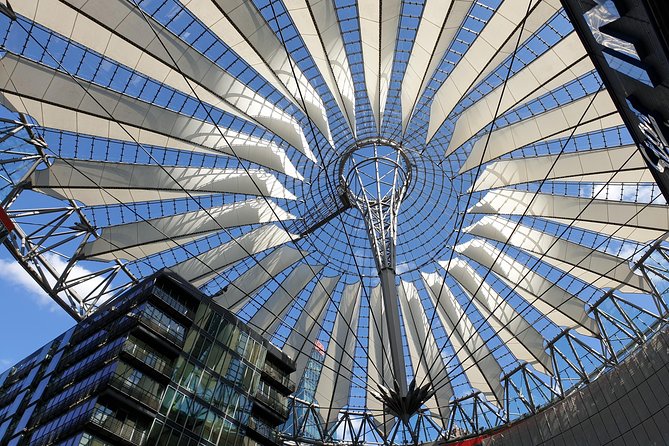
Your guide introduces Berlin’s major historical shifts here, giving you a useful timeline for the rest of the walk. You then enter the Sony Center, where surviving traces of the older square are set against contemporary architecture. It is an early example of Berlin’s habit of placing old fragments beside striking new buildings.
The stop is brief, about 10 to 15 minutes at each location. Do not expect a long architectural tour of the Sony Center. Its value is in the contrast: damaged historic Berlin, divided Berlin, and rebuilt Berlin all appear within the opening stretch.
Facing Nazi history at the Topography of Terror
The Topography of Terror is one of the most serious stops. It occupies the former site of the Gestapo and SS headquarters, so the location itself carries unusual weight. The guide explains how the Nazi dictatorship is remembered today and points out nearby buildings tied to the period.
You can also see an original section of the Berlin Wall from here. That visual connection matters. In only a few steps, the tour moves from Nazi terror to the later communist division of Germany, showing how central Berlin became the setting for two different dictatorships.
Nearby sights include the former Nazi Aviation Ministry and the Martin Gropius Bau museum. The stop is relatively short, so you will not have time for an extended visit inside the Topography of Terror exhibition. If you want to study its displays, plan a separate visit after the tour.
Checkpoint Charlie and the former Aviation Ministry
Checkpoint Charlie was once a major crossing point between East and West Berlin. Here, the guide explains the construction of the Berlin Wall and the city’s division during communist rule. The location is famous, but the surrounding streets can feel more commercial than historic, so the explanation helps you separate the genuine history from the modern presentation.
The nearby former Aviation Ministry is an imposing reminder of the Nazi period. It housed the ministry led by Hermann Göring, later became the House of Ministries under the communist government, and is now used by the Federal Republic of Germany as a ministry.
This is a useful stop for understanding how buildings can outlast governments. The structure did not vanish when political power changed. Its function and meaning changed instead, making it a practical lesson in Berlin’s twentieth-century history.
Something different for another day:
- Berlin: Reichstag, Dome and Government District Guided Tour
★ 4.7 · 18,288 reviews - Berlin: 1-Hour City Tour by Boat with Guaranteed Seating
★ 4.3 · 16,993 reviews - Berlin: Boat Tour Along the River Spree
★ 4.4 · 11,252 reviews - Discover Berlin Half-Day Walking Tour
★ 5.0 · 9,624 reviews
The Führerbunker site and the Holocaust Memorial
The Führerbunker stop is intentionally plain. The site where Hitler spent his final days has no grand monument marking the bunker itself. The guide explains what happened there and why the location looks as it does now.
That absence is part of the point. You are asked to consider how a city should mark a place connected with Nazi leadership without turning it into a shrine. A good guide can handle this topic with restraint, and the tour’s historical focus gives the stop more meaning than a quick photograph would.
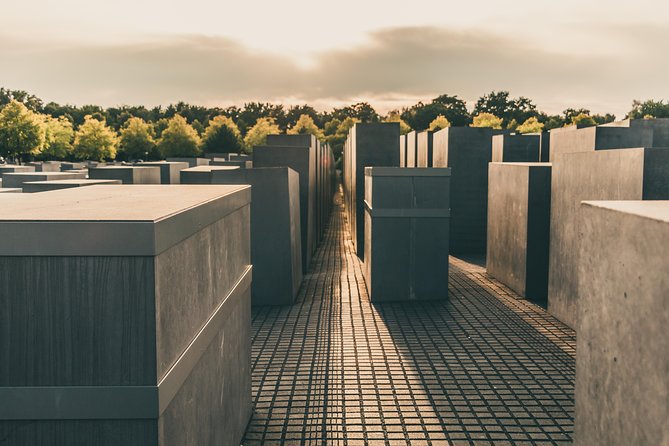
The nearby Memorial to the Murdered Jews of Europe is one of Berlin’s most powerful public memorials. Its field of concrete blocks creates a changing sense of space as you walk around it. The guide’s explanation focuses on the crime committed by the German state during the Nazi period and the memorial’s role in public remembrance.
Allow yourself quiet time here. The official tour stop is short, around 10 minutes, and the group schedule may not permit a long personal visit. You can return later if you want to walk through the memorial at your own pace or visit the underground information center, though no interior admission is included in this tour.
Reichstag and Brandenburg Gate
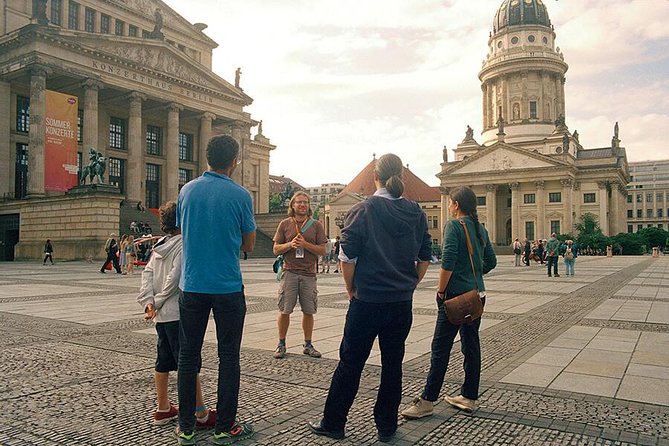
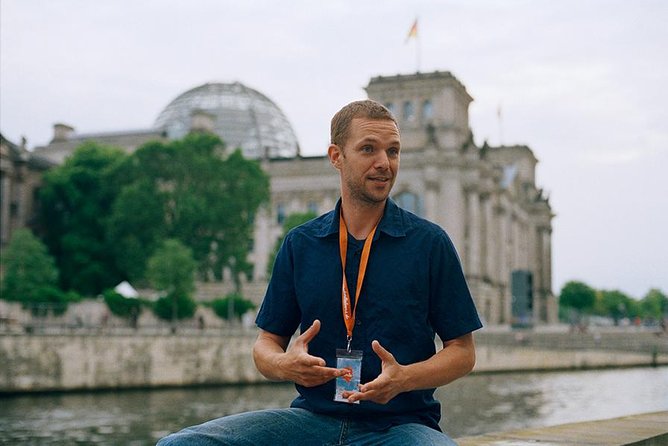
The route continues to the Reichstag Building, home of the German Parliament. The guide visits the exterior and explains how you can book a visit to the dome. This is useful advice, since the dome requires advance arrangements and is not part of the walking tour itself.
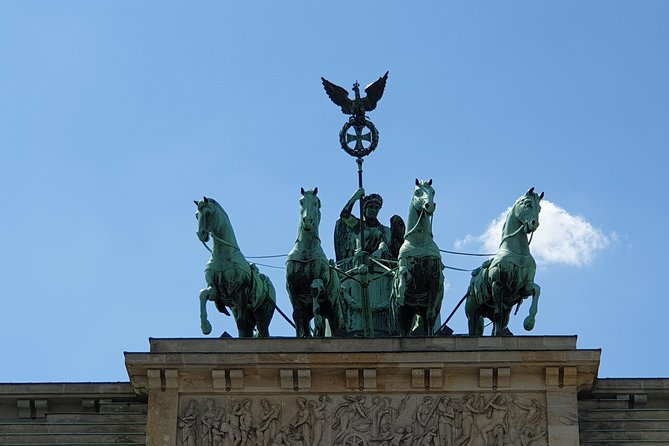
You then reach the Brandenburg Gate, Berlin’s best-known gateway. Its meaning has changed repeatedly. It began as a royal symbol, later stood near the Cold War division, and eventually became an image of German reunification.
The guide’s role here is to connect the architecture to those political changes. The gate is crowded with people taking pictures, but a short historical explanation keeps it from becoming just another photo stop. You will also be well placed to return independently later, since the route shows you exactly where this central landmark sits.
Unter den Linden and Bebelplatz
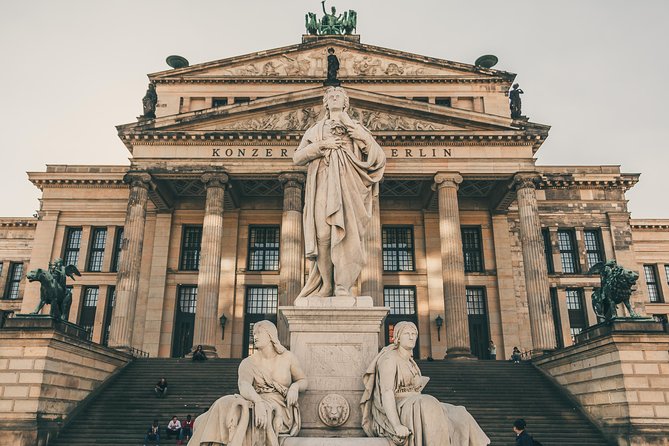
Unter den Linden provides a change of pace. This broad avenue once led toward the emperor’s palace, and its buildings reveal different construction periods. Your guide points out war damage and later rebuilding, helping you read the street as a record of Berlin’s past.
The walk then reaches Bebelplatz, a square linked to the Nazi book burning of 1933. It is also home to Humboldt University and the Catholic Cathedral, so the setting combines academic, religious, and political history in a compact area.
The Book Burning Memorial is easy to miss if you do not know where to look. Set into the square, it recalls the destruction of books during the Nazi dictatorship. The simple design is more effective than a large monument might be, because it invites you to pause and look down into the square.
The guide can add the human and political context that a quick glance cannot provide. This is one of the places where the Italian commentary is especially useful, since the historical meaning is not obvious from the surrounding buildings alone.
Humboldt University, Neue Wache, and Berlin Cathedral
At Humboldt University, the guide gives a short account of the institution and its notable students. This is a brief stop, only about five minutes, so think of it as a quick introduction rather than a campus visit.
Neue Wache offers another shift in tone. The memorial shows a grieving mother holding her fallen son, presenting war through private loss rather than military glory. The building’s message is direct: war leaves families with grief, not only governments with victories.
Berlin Cathedral brings the route toward Museum Island. Built with imperial ambitions, it was intended to serve as a grand Protestant counterpart to St. Peter’s Basilica. You see the exterior and hear about its place in Berlin’s religious and royal story, but entrance is not included.
The succession of sites works well because the themes keep changing. You move from university life to antiwar remembrance, then to imperial religion. The pace is brisk, but the guide’s narration ties the stops together.
Finishing on Museum Island
The tour ends on Museum Island, a UNESCO World Heritage Site and one of Berlin’s major cultural centers. The endpoint is listed at the Pergamon Museum, Bodestraße 1-3, though the experience does not include museum admission.
This is a smart finish. You are left near several important museums, and the guide provides directions for continuing your visit and choosing suitable tickets. That practical advice can save time, especially if you plan to spend the afternoon indoors after a morning outside.
The tour does not promise entry to the Pergamon Museum or any other museum. Treat the final stop as a handoff: you receive the city’s historical outline, then decide which collections deserve your remaining time.
Price, group size, and what you actually receive
At $27.91 per person, the tour offers a solid amount of guided sightseeing for the money. You are paying for an Italian-speaking local guide, local taxes, and a carefully connected route through central Berlin. You are not paying for transport, meals, drinks, hotel pickup, or admission tickets.
The value is strongest if you want interpretation. Berlin’s major monuments are free to view from public streets, but the connections between them are not always obvious. A guide turns a series of separate sights into a story about power, memory, destruction, division, and reunification.
The group maximum is 28 people. That is not an intimate private walk, and you should not expect every question to receive long personal attention if the group is full. Still, it is small enough to move through the city together without the logistics of a large coach group.
The tour uses a mobile ticket and operates in all weather. Wear proper shoes and dress for the forecast. The route is outdoors, and Berlin’s open spaces can feel cold, wet, or windy even when the morning looks pleasant.
The guides and the Italian experience
The most praised feature is the quality of the Italian explanations. Paolo was described as able to combine history with anecdotes, while Chiara was praised for explaining the background of the monuments visited in the Mitte district. Elena was credited with finding places that might otherwise be overlooked.
Giulia and Fabio were both described as highly prepared, and Daniele was praised for his availability and attention to detail. These comments point to a consistent strength: the tour depends on guides who can explain difficult subjects clearly without reducing them to a list of dates.
The exact guide may vary. You should book this tour because it offers Italian commentary, not because you are guaranteed a particular person. The names above give you a useful sense of the guide style that has been especially appreciated.
Who should book this walking tour
I would recommend it to you if:
- You want a first look at central Berlin in Italian.
- You are interested in twentieth-century German history.
- You prefer walking and outdoor monuments to a bus ride.
- You want help deciding which museums to visit afterward.
- You have about half a day and want to keep the rest of your schedule open.
It may be less suitable if you need extensive interior visits, dislike walking in poor weather, or want a very small private group. It also may feel fast if you want to read every memorial panel or spend time photographing each building.
Most people can take part, and service animals are allowed. The route is near public transportation, which makes both the meeting point and the endpoint practical for independent sightseeing.
Should you book this Berlin tour?
Book it if you want Berlin’s major central landmarks explained in Italian, with a strong focus on Nazi rule, the Berlin Wall, the Cold War, and reunification. The price is reasonable, the route is well chosen, and the finish on Museum Island gives you a useful next step.
Skip it if your priority is entering museums or exploring each monument in depth. For everyone else, this is a sensible way to get your bearings fast, learn the city’s difficult story, and leave with a better plan for the rest of your Berlin visit.
FAQ
Where does the tour begin?
It begins at Potsdamer Platz 10, 10785 Berlin, near the S and U-Bahn Potsdamer Platz station. Look for the blue bicycle and the Vive Berlin Tours flag.
What time does the tour start?
The listed start time is 10:00 a.m.
How long does the tour last?
The walking tour lasts approximately three hours and 30 minutes.
What language is the tour conducted in?
The tour is conducted in Italian by an Italian-speaking local guide.
Where does the tour end?
It ends at the Pergamon Museum on Museum Island, at Bodestraße 1-3, 10178 Berlin.
Is admission to the museums included?
No. The tour visits major sights from outside and provides directions for arranging museum visits, but museum admission is not included.
Is transportation included?
No. Transportation to and from the attractions is not included, and there is no hotel pickup.
Is food or drink included?
No. Food and drinks are not included.
How large can the group be?
The activity has a maximum of 28 participants.
Can I cancel the tour?
Yes. You can cancel up to 24 hours before the start time for a full refund. Cancellations or changes made less than 24 hours before the start are not accepted for a refund.
Just added around Berlin
- Berlin: Private Guided Tour of the Main Sights★ 5.0 · 13 reviews
- Private Highlights of Berlin Bike Tour★ 5.0 · 13 reviews
- Modern Berlin Private Walking Tour: Diverse, Vibrant and Exciting German Capital★ 5.0 · 13 reviews
- Tour in Berlin from Warnemünde and Rostock Cruise Port★ 4.1 · 13 reviews
- Berlin: Stasi Museum Private Guided Tour with Entry Ticket★ 4.8 · 13 reviews
- Private Food Tour Experience with a born and bred Berliner★ 5.0 · 14 reviews
- Berlin: Rheinsberg Palace Entrance Ticket★ 4.8 · 14 reviews
- Berlin in one day – day tour with an expert guide★ 5.0 · 14 reviews
Historical Tours, compared.
City History Canal Sightseeing Tour on a Motorboat
Read our review →

Bamberg: Guided Beer History Tour with Optional Tasting
Read our review →Browse the lists this tour appears in