
Reviewed · HOP-ON HOP-OFF BUS TOURS
Dortmund: 24-Hour Hop-On Hop-Off Sightseeing Bus Ticket
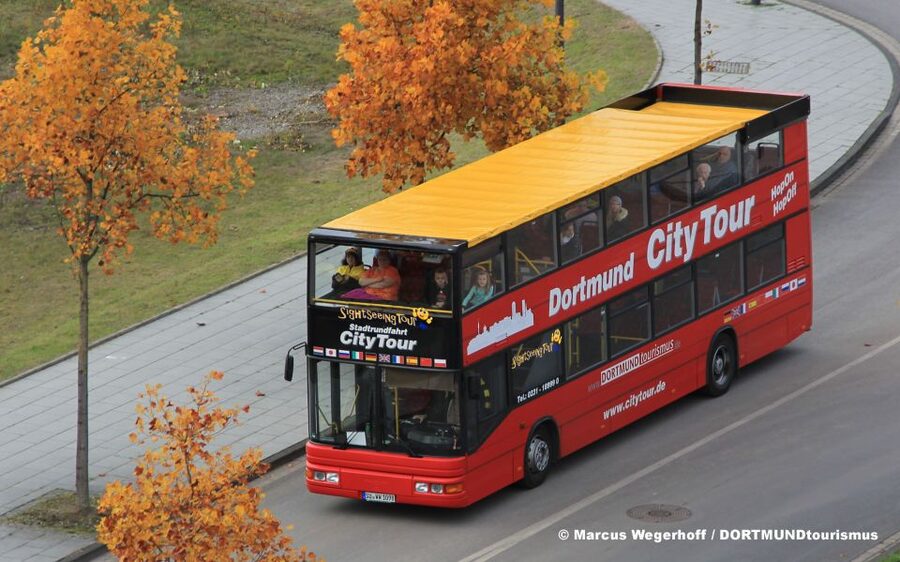
See Dortmund beyond the football headlines. This open-top bus tour gives you a simple way to connect the city’s football, industrial, cultural, and park attractions, with commentary in 11 languages and 13 stops to choose from. I like the clear city overview and the chance to reach places spread well beyond the central station without arranging several separate tram or bus trips.
I also like the focus on Dortmund’s change from a coal mining and steelworking center into a city of universities, museums, sports institutions, and public parks. The main drawback is the limited departure pattern, with buses leaving Dortmund Central Station at 10:20 a.m., 12:20 p.m., 2:20 p.m., and 4:20 p.m. If you miss a bus, your flexible day can become a long wait.
The tour costs $28 per person and lasts one day from first activation. That is reasonable if you use the bus to reach several outlying stops, but less attractive if you only want a short city-center ride. Open-top seating is weather-dependent, and the upper deck may be popular on a dry day.
In This Review
- Key points to know before boarding
- What the Dortmund route helps you understand
- Central Station and the compact city center
- Kreuzviertel, Harbour, and DASA
- TU Dortmund and the city’s university side
- Stadium and Westfalenpark
- Rombergpark and Phoenix Hall
- Phoenix See and Dortmund’s newer identity
- Town Hall and Reinoldi Church
- The audio guide and the view from the upper deck
- Price, timing, and who gets good value
- Accessibility, weather, and practical limits
- Should you book the Dortmund bus tour?
- FAQ
- How long is the Dortmund hop-on hop-off ticket valid?
- How many stops are on the route?
- Where can I start the tour?
- What time do buses leave Central Station?
- What languages are available for the audio guide?
- Is the bus wheelchair accessible?
- Are dogs allowed on the bus?
- Can I reserve a seat?
Key points to know before boarding
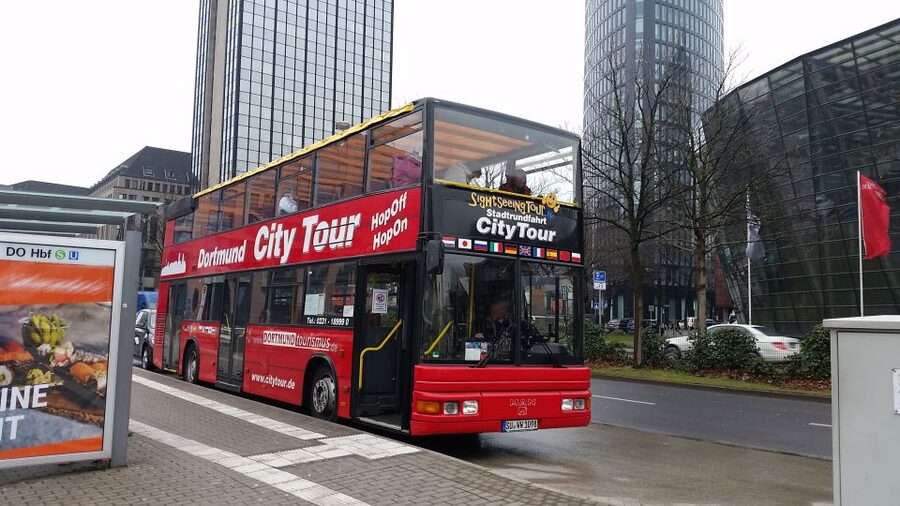
- Thirteen stops connect very different sides of Dortmund: You can move from Central Station and Reinoldi Church to Phoenix See, Rombergpark, the stadium, and the former steelworks area.
- The route explains Dortmund’s industrial change: Commentary covers the city’s coal and steel past as well as its newer cultural, sporting, and university identity.
- The bus schedule needs planning: Departures from Central Station are listed every two hours, so check the timetable at the stops before getting off.
- The upper deck gives the best city views: You can admire Dortmund from the open top, although rain or cold may make the lower level more sensible.
- The audio guide covers 11 languages: Options include English, German, French, Spanish, Italian, Dutch, Polish, Russian, Chinese, Japanese, and more.
- The lower level is wheelchair accessible: Dogs are allowed downstairs, smoking is not permitted, and seats cannot be reserved.
What the Dortmund route helps you understand
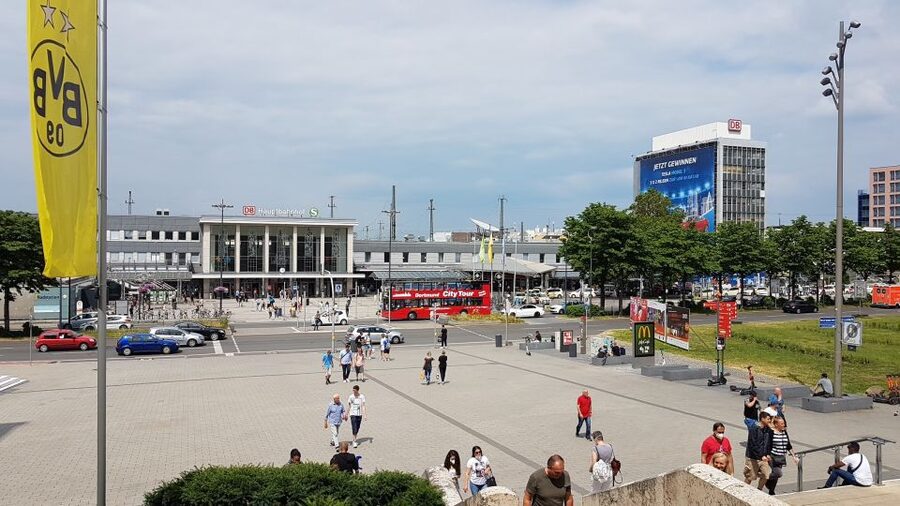
Dortmund is easy to reduce to one subject: football. The city’s stadium and football museum are important, but this route shows you a broader picture. It links old industrial districts with parks, university buildings, cultural sites, and newer waterfront development around Phoenix See.
That wider view is the main reason I would use the bus. Dortmund’s attractions are not packed into one small historic center. Some stops are central and easy to reach on foot, while others require local transport or a longer walk. The bus gives you a quick sense of how the city is arranged.
The audio commentary adds useful context as you ride. It covers Dortmund’s former coal mining and steel industry, then explains the structural changes that brought cultural institutions, sports facilities, and six universities into the modern city. The experience is not only a ride past buildings. It is a moving explanation of how an industrial city changed direction.
The recorded commentary may not feel fully current at every point. Some information has been described as dated, so I would treat it as background rather than the final word on every attraction. Still, it helps you notice the connection between the old industrial sites and the newer parts of Dortmund.
More Hop-On Hop-Off Bus Tours in Germany:
- Berlin: Hop-on Hop-off Bus Tour with Live Commentary
★ 4.3 · 8,579 reviews - Hamburg: Line A Sightseeing Hop-On Hop-Off Bus Tour
★ 4.6 · 6,958 reviews - Berlin: City Sightseeing Hop-On Hop-Off Bus Tour
★ 4.1 · 4,233 reviews
Central Station and the compact city center
Central Station is the most practical starting point. It is the main departure point, with buses scheduled at 10:20 a.m., 12:20 p.m., 2:20 p.m., and 4:20 p.m. The ride returns to the station at noon, 2 p.m., 4 p.m., and 6 p.m., according to the published timetable.
This timing gives you two basic ways to use the tour. You can stay aboard for a broad city circuit, or you can get off at one of the places that interests you and rejoin the route later. Since the buses are not running every few minutes, I would check the printed timetable before leaving the station.
Central Station also makes a sensible first stop for orientation. You can use the complete circuit to decide which areas deserve more time, then take a later bus to one or two chosen stops. Trying to visit all 13 stops in one day would leave little time to explore.
The city-center stops include Town Hall and Reinoldi Church. These are useful points for visitors who want a shorter outing focused on central Dortmund rather than the full route. If your time is limited, you can stay near the center and use the bus for an overview before exploring on foot.
Kreuzviertel, Harbour, and DASA
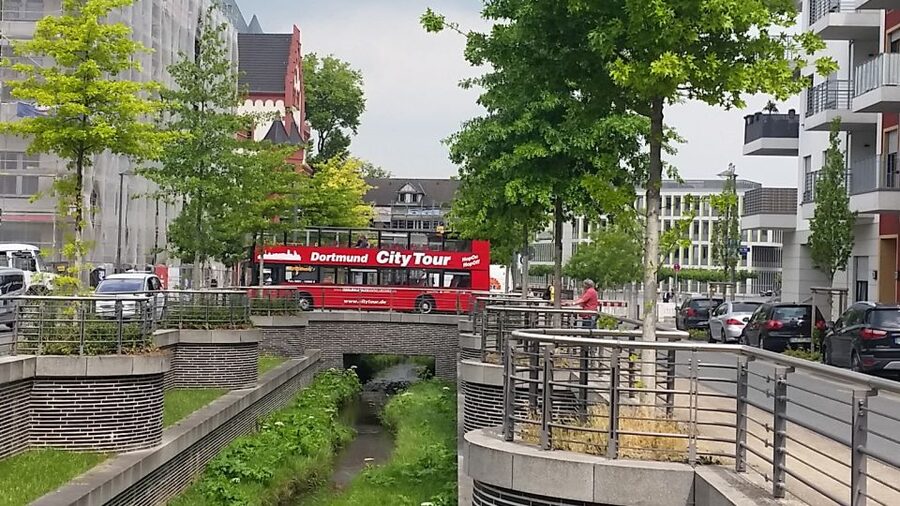
Kreuzviertel gives the route a neighborhood stop beyond the main center. The supplied information does not promise a guided walk or a set amount of free time here, so you should use it mainly as a place to explore independently if the district interests you.
The Harbour stop adds another side of Dortmund’s urban identity. After hearing about coal and steel, a stop in the harbour area helps you see the city as more than a former industrial center. The bus route is useful here because you can look from the upper deck as the surroundings change between central streets and wider working-city areas.
DASA is one of the route’s more distinctive stops. Its inclusion gives the tour an educational and industrial focus that fits the story told through the audio guide. If you want the industrial theme to be more than passing commentary, this is one of the stops worth considering.
You should check opening details separately if you plan to enter any attraction. The ticket covers the bus and audio guide, not food, drinks, or admission to additional sites.
TU Dortmund and the city’s university side
The TU Dortmund stop shows the city’s academic identity. The tour specifically presents Dortmund as a city with six universities, so this part of the route helps balance the familiar coal, steel, and football themes.
For you, the value here depends on your interests. If you are comparing universities, visiting someone at TU Dortmund, or simply interested in the city’s newer identity, getting off may make sense. If your day is short, you may prefer to stay on the bus and save time for the stadium, parks, or Phoenix area.
The route’s wider message is useful: Dortmund did not simply replace industry with one new attraction. It developed several kinds of institutions, including education, sport, and culture. The bus lets you see these parts as one connected city rather than isolated points on a map.
A few more tours and experiences worth a look
- Dresden: Semperoper Tickets and Guided Tour
★ 4.7 · 12,102 reviews - Berlin: Jewish Museum Berlin Entrance Ticket
★ 4.5 · 8,393 reviews - Berlin: Berlin Story Bunker Entry Ticket
★ 4.6 · 6,759 reviews - Hamburg: Hamburg Dungeon Admission Ticket
★ 4.7 · 5,745 reviews
Stadium and Westfalenpark
The stadium stop will be a priority for many people. Dortmund’s football culture is one of the city’s strongest draws, and the route provides a straightforward way to reach the stadium area without making it the entire day’s subject.
The tour does not include a stadium entry or match ticket. You get the bus stop and the outside view as part of the route, while any separate visit would require its own arrangements. That distinction matters if you are booking this specifically for football.
Westfalenpark offers a different mood. The route pairs it with the stadium, giving you a chance to move from sport to open green space. This is one of the more practical combinations on the circuit, especially if you are touring with children or want a break from central streets.
An open-top bus is particularly helpful around these larger attractions because you get a wider view than from a standard enclosed vehicle. On a sunny day, the upper deck should be the pleasant choice. In poor weather, use the barrier-free lower area instead.
Rombergpark and Phoenix Hall
Rombergpark continues the park theme and gives the route more variety. You are not simply moving from one urban building to another. The stop is part of the city’s greener side and may suit you if you want a calmer pause during a full day of sightseeing.
Phoenix Hall brings the industrial story back into focus. The former steelworks Phoenix area is one of the most meaningful parts of this ride because it shows the physical setting of Dortmund’s industrial past and its later reuse.
The audio guide’s explanation of structural change has real value here. You can hear about the former coal and steel economy while seeing places connected to that story. It is a better way to understand Dortmund than reading a short paragraph about industry and then moving on.
Again, plan your time carefully. A 24-hour ticket is valid from activation, but the published route operates on a set schedule. The ticket gives you the right to board during its validity, not a guarantee of an immediate bus.
Phoenix See and Dortmund’s newer identity
Phoenix See is one of the route’s most appealing stops for a longer break. The area represents the city’s newer development around a former industrial site and adds a waterfront setting to a tour otherwise focused on streets, parks, stadiums, and urban institutions.
This is where the route’s story becomes easy to grasp. The same city that once depended heavily on coal mining and steelworking now presents a different kind of public space and city life. You can compare the old industrial function with the newer use of the area as a place to spend time.
Phoenix Hall and Phoenix See work well as linked stops in your plans, but do not assume you can visit both at leisure and catch the next bus immediately. Check the current timetable at the stop, since travel times can change and the operator notes that schedules may be adjusted.
If you only have one day in Dortmund, I would give this area serious consideration. It offers a stronger sense of the city’s change than a fast loop through the center alone.
Town Hall and Reinoldi Church
Town Hall and Reinoldi Church bring you back to the central city. These stops are useful for a shorter version of the tour and for combining the bus with independent sightseeing.
Reinoldi Church is especially practical as a final stop because it returns you to a central location close to the city’s main pedestrian areas. The tour does not promise entry to the church, so check separately if you want to go inside.
For a first visit, I would use these central stops after seeing the outlying parts of the route. The bus is most valuable where it saves you time between distant attractions. Once you are back near Town Hall and Reinoldi Church, walking may be easier than waiting for another circuit.
The audio guide and the view from the upper deck
The recorded guide is available in 11 languages: Chinese, German, Dutch, English, French, Japanese, Italian, Polish, Russian, and Spanish. The driver speaks German and English, so basic boarding information should be available in both languages.
You listen through headphones as the bus moves through Dortmund. This gives you information without requiring a live guide, and it lets the driver focus on the road. I like that arrangement for a route with many stops and a citywide historical theme.
The commentary is not flawless. Some recordings may need updating, especially when describing places that have changed. I would listen for the broad story and use the ride to decide where you want to spend more time, rather than expecting a current, detailed guide to every stop.
The open top is the visual advantage. You can see over nearby traffic and buildings, and you get a more direct sense of the city as the bus moves between districts. Seats on top are not guaranteed during busy periods, and there is no seat reservation system. If the upper level is full, the lower deck remains the practical backup.
Price, timing, and who gets good value
At $28 per person, the ticket makes the most sense if you use several sections of the route. It can save you the trouble of arranging separate transport to the stadium, Westfalenpark, Rombergpark, and Phoenix See. It also gives you a structured way to cover a large city in one day.
The value drops if you only ride between Central Station, Town Hall, and Reinoldi Church. Those central areas are the easiest parts to combine with walking, so you may not get much from a full-day ticket unless you visit at least some outlying stops.
I would plan around the departure times rather than treating the bus like a frequent city shuttle. Start early if you want to get off more than once. For a relaxed day, choose two or three main stops and let the rest of the route provide the city overview.
The ticket is valid for one day from first activation. You can cancel up to 24 hours before the activity for a full refund, and reserve now while paying later if you need to keep plans flexible.
Accessibility, weather, and practical limits
The lower bus level is barrier-free and suitable for wheelchair users. Dogs are allowed on the lower level, while smoking is not allowed anywhere in the vehicle.
The open-top experience depends heavily on the weather. A cold or rainy day can make the upper deck uncomfortable, and poor conditions may also reduce the pleasure of sightseeing from above. Bring a layer and be ready to use the lower deck.
There is no seat reservation system, and high demand can mean that your preferred seat is unavailable. The operator also notes that travel times can change, so confirm the current timetable at the bus stops instead of relying only on a printed plan.
The tour has received an overall rating of 4.1 out of 5 from 161 ratings. The strongest practical praise centers on punctual, friendly operation. The clearest criticism concerns the long gap between buses, while another useful warning is that some audio explanations feel dated. One family found the complete route suitable as a holiday activity, but would have preferred better weather and an open upper deck.
Should you book the Dortmund bus tour?
I would book it if you want a broad first look at Dortmund, especially if you plan to visit the stadium, Westfalenpark, Rombergpark, DASA, or the Phoenix area. It is also a good fit for families, first-time visitors, and anyone who wants the city’s industrial change explained while riding between districts.
I would skip it if you only want central Dortmund or need a very flexible hop-on hop-off service with buses arriving every few minutes. The four listed departures from Central Station require planning, and the dated audio clips may bother visitors looking for highly current commentary.
For the best value, choose your main stops before boarding, check the day’s timetable, and keep the upper deck as a bonus rather than a promise. At $28, this is a useful city orientation and transport option, not a substitute for spending time inside Dortmund’s individual attractions.
FAQ
How long is the Dortmund hop-on hop-off ticket valid?
The ticket is valid for one day from the time you first activate it.
How many stops are on the route?
The route has 13 listed stops, including Central Station, Kreuzviertel, Harbour, DASA, TU Dortmund, Stadion, Westfalenpark, Rombergpark, Phoenix Hall, Phoenix See, Town Hall, and Reinoldi Church.
Where can I start the tour?
You can start at any of the 13 bus stops in Dortmund. Central Station is the main departure point.
What time do buses leave Central Station?
Listed departures from Central Station are at 10:20 a.m., 12:20 p.m., 2:20 p.m., and 4:20 p.m.
What languages are available for the audio guide?
The audio guide is available in Chinese, German, Dutch, English, French, Japanese, Italian, Polish, Russian, and Spanish.
Is the bus wheelchair accessible?
Yes. The lower level is barrier-free and suitable for wheelchair users.
Are dogs allowed on the bus?
Yes. Dogs are allowed on the lower bus level.
Can I reserve a seat?
No. Seat reservations are not possible, and seats are not guaranteed when demand is high.
Just added around Germany
- e-Scavenger hunt Aachen: Explore the city at your own pace★ 4.0 · 13 reviews
- Munich: Private or Group Third Reich and WWII Walking Tour★ 4.9 · 13 reviews
- Canyoning Advanced Day Trip★ 5.0 · 13 reviews
- Wiesbaden Biebrich: Outdoor Escape Game★ 4.7 · 13 reviews
- Berlin: Private Guided Tour of the Main Sights★ 5.0 · 13 reviews
- From Munich: Neuschwanstein Castle and Linderhof Private Tour★ 5.0 · 13 reviews
- Trier, Moselle: Wine excursion with boat trip★ 3.9 · 13 reviews
- From Dresden: Guided Day Tour by Bus of Seiffen Toy Village★ 4.0 · 13 reviews
Hop-On Hop-Off Bus Tours, compared.
Munich Hop-On Hop-Off Tour: 1-Day or 2-Day Ticket
Read our review →
Hop-On Hop-Off Sightseeing Bus with Boat Options
Read our review →
Browse the lists this tour appears in