
Reviewed · BERLIN WALL TOURS
Berlin Wall Self-Drive Trabi Tour
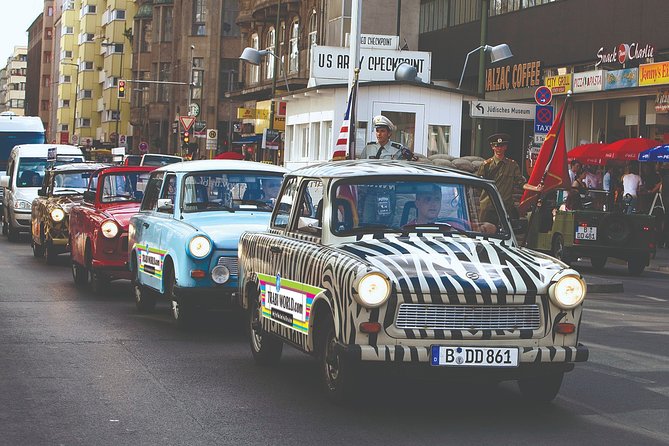
Berlin’s quirkiest history lesson has four wheels. This self-drive Trabant tour lets you guide an East German icon through central Berlin while a live guide explains the city’s divided past. I like the convoy format, which lets you see more ground than a walking tour, and the chance for two people to switch drivers. The catch is simple: the cars have manual gearboxes, and Berlin traffic is not the place for a nervous learner.
The tour lasts about 2 hours 15 minutes and costs $119.48 per person. That is not bargain sightseeing, but you are paying for transport, a live guide, a historical tour, and a very unusual driving experience in one package. Only four people fit in each car, and the whole convoy is limited to 12 people, so it feels more personal than a large bus excursion.
In This Review
- Key things to know before you book
- Why a Trabant makes Berlin’s history personal
- Starting at TrabiWorld Berlin at 11:30
- Learning the Trabant before entering traffic
- Berlin’s divided past from the driver’s seat
- The East Side Gallery and the remaining Berlin Wall
- Famous monuments and central squares along the route
- Former border crossings and the meaning of the wall
- What the convoy feels like on Berlin’s streets
- Sharing the car, the price, and the practical tradeoffs
- Who will enjoy this Berlin driving tour most
- Should you book the Berlin Wall Self-Drive Trabi Tour?
- FAQ
- Where does the Berlin Wall Self-Drive Trabi Tour start?
- What time does the tour begin?
- How long does the tour last?
- Do I need to know how to drive a manual car?
- How many people can ride in one Trabant?
- Can children join the tour?
- What happens if there is an accident?
- Does the tour include hotel pickup or lunch?
Key things to know before you book
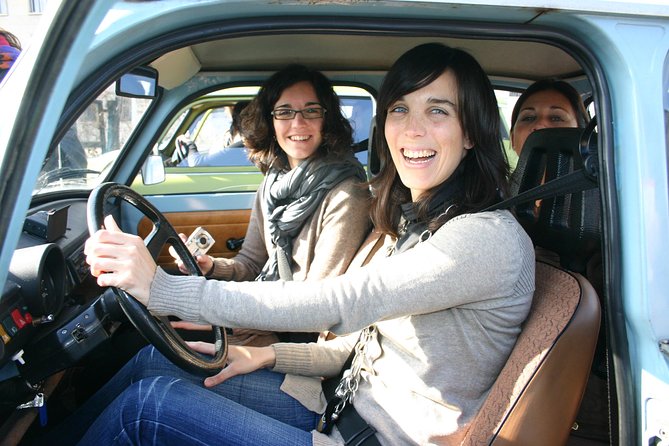
- You drive a real East German Trabant: Expect a small, basic manual car with a column-mounted gear stick, no power steering, and old-fashioned brakes.
- The convoy covers major Cold War sites: You pass the Berlin Wall, East Side Gallery, former border areas, central squares, and memorials to German division.
- Two people can share the driving: Switching halfway gives both qualified drivers a turn, though every driver must show a license for a manual car.
- The guide stays in touch by radio: Commentary continues as you drive, and the guide waits when the convoy spreads out.
- The cars attract attention: People along the streets often photograph and wave at the colorful line of Trabants.
- There is a serious insurance condition: In an accident, the operator requires a co-payment of EUR 850.
Why a Trabant makes Berlin’s history personal
The Trabant is not just a cute old car. It was one of the best-known products of East Germany, built during the years when Berlin was split between two political systems. Its modest size, noisy engine, and plain interior tell you something about daily life behind the Iron Curtain that a polished museum display cannot.
You do not simply look at a historic object here. You sit in one, wrestle with its gear change, and guide it through the same city that once had a fortified border running through its streets. That physical connection is the main reason this tour works.
The cars are small, but they are not modern rental cars with a retro paint job. Expect an authentic driving experience. One car described in the tour details had a column-mounted stick shift and wing mirrors that could not be adjusted. The lack of power steering and servo-assisted brakes adds charm, though it also demands more attention.
I would choose this tour for the story and the laughter, not for comfort. The car can feel tight with four adults, and one especially tall group managed three tall men and a shorter passenger only because everyone was willing to squeeze. Children up to age 17 can ride free with an adult, but you must bring a child seat if one is needed.
More Berlin Wall walks:
- Skip-the-Line: Berlin Wall Museum at Checkpoint Charlie
★ 4.1 · 2,041 reviews - Berlin: East Side Gallery Spree Cruise in a Solar Catamaran
★ 4.0 · 1,039 reviews - Cold War, Berlin Wall, Spies and the East Side Gallery
★ 5.0 · 1,024 reviews
Starting at TrabiWorld Berlin at 11:30
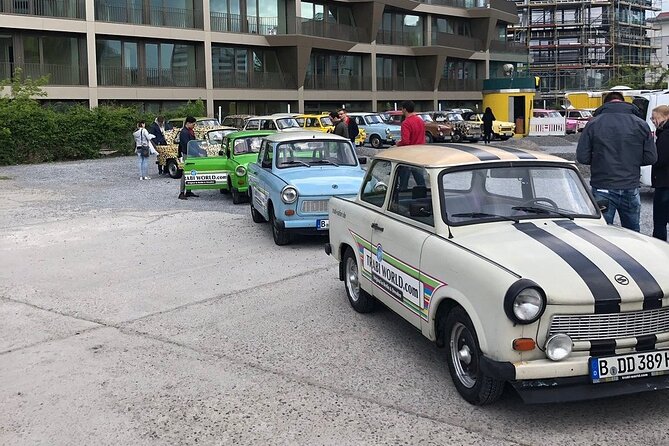
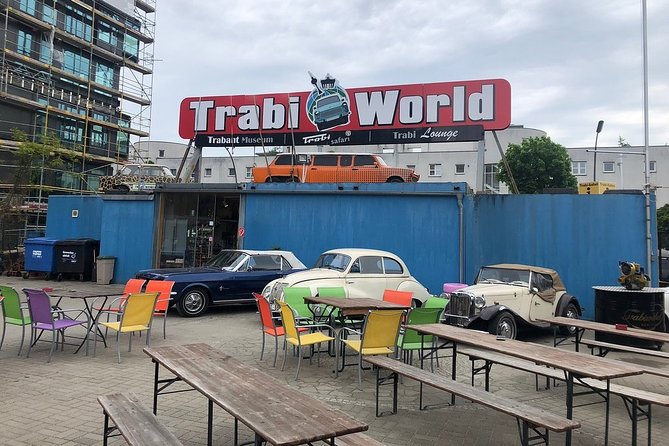
The meeting point is TrabiWorld Berlin at Zimmerstraße 97-100, 10117 Berlin. This is near major city sights and public transport, so you can reach it without hotel pickup. The tour starts at 11:30 am and ends back at the same place.
Allow time to find the shop, check in, and settle into your car. You choose from the available colors, but the choice is first come, first served. If having a particular color matters to you, arrive with enough time to avoid a last-minute scramble.
The opening briefing takes about 10 minutes. You receive basic safety instructions, learn how the car works, and join the convoy. The guide leads from the front, so you are not expected to navigate Berlin alone or memorize every turn.
That does not mean the driving is effortless. You need a valid manual-car license, and the minimum age to drive is 18. The operator can require evidence of the license from every driver, so do not assume one licensed person can quietly handle the paperwork for the whole car.
Learning the Trabant before entering traffic
The first few minutes can be the hardest. A manual Trabant does not respond like a newer European car, and the gear change may take time to master. One driver described a few early kangaroo starts, while another had trouble at a busy intersection before switching places with a more confident driver.
That is useful advice, not a reason to panic. If you already drive manual cars, you will probably enjoy the mechanical challenge. If you have only driven automatic cars, this is not the tour for learning from scratch. You also need to feel comfortable with city traffic involving cars, bikes, scooters, and pedestrians.
The guide leads at a pace designed for a convoy, and the group does not have to remain bumper to bumper. The guide waits when drivers fall behind, which takes some pressure off. Still, you should expect to concentrate on clutch control, lane position, traffic signals, and the route at the same time.
If one person in your party is a much stronger driver, let that person take the first turn. You can switch later if the other driver feels ready. The experience becomes more enjoyable when you treat the car as part of the attraction, rather than as a modern vehicle that should behave perfectly.
Berlin’s divided past from the driver’s seat
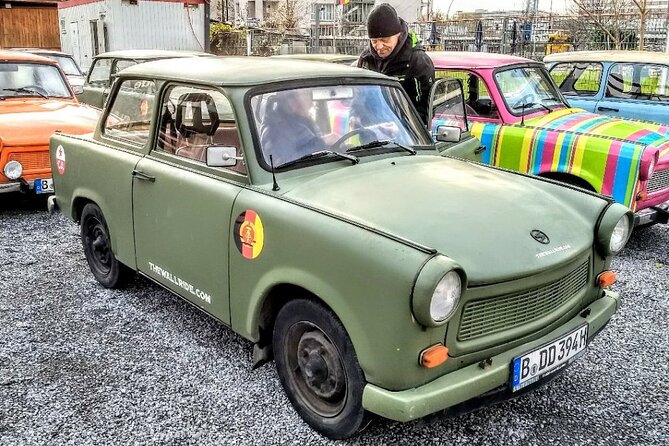
As you follow the guide through Berlin, the commentary covers three connected stories: the city’s Cold War division, the history of the Berlin Wall, and the role of the Trabant in East German life. This combination gives the drive more purpose than a simple city loop.
The route includes major public squares, famous monuments, former border areas, and memorial sites. You get a moving introduction to central Berlin, with enough context to return later on foot and look more closely.
A radio system carries the guide’s narration into the cars. The sound was clear for some people, including those seated in the back, but it was not perfect for everyone. At times, engine noise and the distance between cars can make the commentary harder to catch. If a particular historical detail matters to you, ask the guide to repeat it when the convoy stops or slows.
The guide’s manner matters here. The tour is not a private lecture, but the small convoy allows the leader to keep an eye on the group. Guides such as Heinrich and Tomas were praised for being friendly, patient, funny, and attentive. Tomas was also credited with turning the drive into a lively history lesson. Guide quality can vary by departure, but the format gives you direct contact rather than a recording.
Something different for another day:
- Berlin: Reichstag, Dome and Government District Guided Tour
★ 4.7 · 18,288 reviews - Berlin: 1-Hour City Tour by Boat with Guaranteed Seating
★ 4.3 · 16,993 reviews - Berlin: Boat Tour Along the River Spree
★ 4.4 · 11,252 reviews - Discover Berlin Half-Day Walking Tour
★ 5.0 · 9,624 reviews
The East Side Gallery and the remaining Berlin Wall
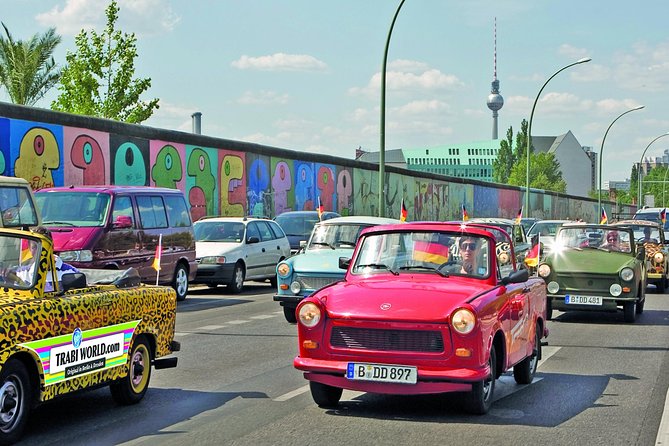
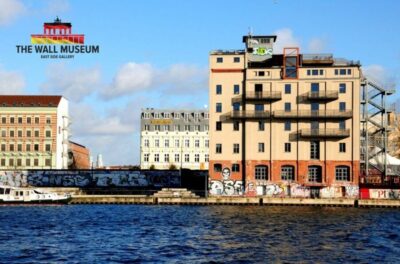
One of the most important stops is the East Side Gallery, an open-air collection of murals painted directly on a 1,316-meter section of the Berlin Wall. You have about five minutes here, enough for a quick look and a few photographs.
That short stop is useful for orientation, but it is not enough for a proper visit to the artwork. If the murals are a major reason for your Berlin trip, return later on foot and give the gallery more time. The Trabant drive shows you how the wall fits into the city, while a separate visit lets you study the paintings without watching the clock.
Seeing the wall from a Trabant adds a small but meaningful layer. The car was made in East Germany, and the wall divided the same city in which that car was produced and driven. The connection is not manufactured for the tour. It is built into the objects and places around you.
Famous monuments and central squares along the route
The route passes an important public square and traffic junction in central Berlin, as well as an 18th-century neoclassical monument. That monument is the Brandenburg Gate, one of the city’s best-known symbols and a powerful reminder of Berlin’s changing political role.
You also pass the Red Town Hall, built in 1870. Its red brick facade gives the drive a different visual note from Berlin’s grand neoclassical buildings. Passing these sights by car is not the same as stopping for a full visit, but the guide supplies the setting and helps you mark places to revisit.
Another stop takes you through the public square associated with Berlin’s television tower. That is Alexanderplatz, a major city space in the former East Berlin. The square is a useful place to think about the city before reunification, since the television tower became one of East Berlin’s most recognizable symbols.
The benefit of the route is range. In just over two hours, you see places that would take longer to connect on foot. The tradeoff is depth. You will get a quick introduction, not a long stop at each site.
Former border crossings and the meaning of the wall
The tour also passes a former border crossing, the kind of place where Berlin’s division once became a daily checkpoint rather than an abstract political idea. The route includes the area associated with Checkpoint Charlie, one of the most famous former crossing points between East and West Berlin.
A guide can explain why these crossings mattered, how the wall shaped movement, and why the surrounding streets remain loaded with memory. The drive cannot recreate the fear or bureaucracy of crossing the border, but it can help you understand the physical geography of the divided city.
The final memorial area is a central site connected with German division, located in the middle of Berlin. This points to the Berlin Wall Memorial area on Bernauer Straße, where the history of the wall is presented through preserved sections and memorial features.
Again, the timing is brief. Think of this tour as a first pass that gives you a map in your head. I especially like it for a first day in Berlin, because you can note the places that deserve a longer return visit.
What the convoy feels like on Berlin’s streets
A line of brightly colored Trabants is hard to miss. People take photographs, wave, and sometimes treat the convoy itself as part of the city’s sightseeing. That public reaction is one of the tour’s most amusing extras, and it makes the drive feel social even though you remain inside your own car.
You also need to accept the less charming side of the convoy. Exhaust from the cars ahead can drift back into your vehicle, and one person found it irritating on the throat. Keeping some distance when the road allows may help, but the cars are old and the convoy naturally produces fumes.
The streets can be demanding. Bikes, scooters, pedestrians, and modern cars share the road, and the Trabant has none of the easy handling you expect from a current vehicle. The brakes are not servo-assisted, and the steering requires more effort. If busy city driving makes you anxious, choose the ride-along option if available through the tour setup, or let the most confident qualified driver handle the car.
The radio commentary keeps the experience from becoming a silent driving test. The guide waits for stragglers, and that patience was a repeated strength of the tour. You still need to stay alert, but you are not abandoned if you miss a gear or lose sight of the car ahead.
Sharing the car, the price, and the practical tradeoffs
At $119.48 per person, the cost is easiest to justify if you plan to drive. You receive a manual Trabant, a live guide, transport around central Berlin, and a souvenir Trabant driver’s license at the end. Even passengers receive the license, so the person in the back is not left out.
The value is weaker if you want a slow historical tour with long stops. You are paying for a distinctive activity, not a museum-level examination of every monument. A conventional walking tour may give you more detail at each location, while public transport costs far less.
The four-person limit per car is helpful for families and small groups, but four adults may feel cramped. The overall activity has a maximum of 12 participants, which keeps the convoy manageable and lets the guide monitor the cars.
There is no lunch, and hotel pickup and drop-off are not included. Plan to eat before or after the drive and make your own way to Zimmerstraße. The activity is near public transportation, and most people can participate, but the manual driving requirement is the key test.
The cancellation policy is strict. The booking is non-refundable and cannot be changed for any reason, so only reserve once your plans and driving arrangements are firm. Also weigh the EUR 850 accident co-payment before booking. It is an important financial condition, not a footnote to ignore.
Who will enjoy this Berlin driving tour most
I would recommend it most strongly to:
- Couples who want to share the driving and have a story to tell afterward
- Families with older children who can fit comfortably in the car
- People interested in Cold War Berlin and East German life
- Drivers who already know manual transmission
- Anyone looking for a break from walking, especially on a rainy day
- Car enthusiasts who appreciate old machinery
I would be cautious about booking it for a first-time manual driver. One beginner managed to figure out the car, but another driver struggled in a busy junction. That is a sign of possibility, not a promise.
I would also avoid treating the tour as a substitute for Berlin’s museums and memorials. It gives you a lively framework, then leaves you to return for the serious detail. That is a good arrangement if you have more than one day in the city.
Should you book the Berlin Wall Self-Drive Trabi Tour?
Book it if you want to combine Cold War history with a hands-on, slightly absurd city drive. The best parts are the authentic Trabant, the patient convoy system, the guide’s live commentary, the chance to switch drivers, and the way the cars turn ordinary Berlin streets into a moving attraction.
Skip it if you dislike manual cars, crowded traffic, tight seating, or financial risk from the accident co-payment. The short sightseeing stops also mean you should plan separate visits to the East Side Gallery and Berlin Wall Memorial.
For the right person, this is more than a ride in an old car. It is a practical way to connect Berlin’s divided past with the object that carried ordinary East Germans through it. Just bring a manual license, steady nerves, and a sense of humor about the occasional kangaroo start.
FAQ
Where does the Berlin Wall Self-Drive Trabi Tour start?
It starts at TrabiWorld Berlin, Zimmerstraße 97-100, 10117 Berlin, Germany.
What time does the tour begin?
The scheduled start time is 11:30 am.
How long does the tour last?
The experience lasts approximately 2 hours and 15 minutes.
Do I need to know how to drive a manual car?
Yes. The Trabants have manual gearboxes, and every driver must provide evidence of a license for non-automatic cars.
How many people can ride in one Trabant?
Each Trabant can carry a maximum of four people and a total maximum weight of 350 kilograms.
Can children join the tour?
Children up to age 17 can join free when accompanied by at least one adult. If a child seat is needed, you must bring it yourself. Drivers must be at least 18 years old.
What happens if there is an accident?
The local operator requires a co-payment of EUR 850 in the case of an accident.
Does the tour include hotel pickup or lunch?
No. Hotel pickup, drop-off, and lunch are not included. The tour ends back at TrabiWorld Berlin.
Just added around Berlin
- Berlin: Private Guided Tour of the Main Sights★ 5.0 · 13 reviews
- Private Highlights of Berlin Bike Tour★ 5.0 · 13 reviews
- Modern Berlin Private Walking Tour: Diverse, Vibrant and Exciting German Capital★ 5.0 · 13 reviews
- Tour in Berlin from Warnemünde and Rostock Cruise Port★ 4.1 · 13 reviews
- Berlin: Stasi Museum Private Guided Tour with Entry Ticket★ 4.8 · 13 reviews
- Private Food Tour Experience with a born and bred Berliner★ 5.0 · 14 reviews
- Berlin: Rheinsberg Palace Entrance Ticket★ 4.8 · 14 reviews
- Berlin in one day – day tour with an expert guide★ 5.0 · 14 reviews
Berlin Wall Tours, compared.
Skip-the-Line: Berlin Wall Museum at Checkpoint Charlie
Read our review →
East Side Gallery Spree Cruise in a Solar Catamaran
Read our review →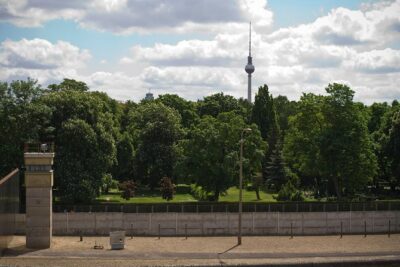
Cold War, Berlin Wall, Spies and the East Side Gallery
Read our review →
Guided Bike Tour of the Berlin Wall and Third Reich
Read our review →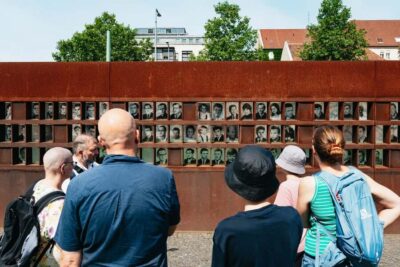

Cold War, Berlin Wall, Spies and the East Side Gallery
Read our review →Browse the lists this tour appears in