Reviewed · BERLIN TOURS
Berlin during Nazism – Tour in Italian
Berlin’s past is impossible to miss. This three-hour Italian-language tour connects Nazi-era memorials, Jewish landmarks, resistance sites, and wartime ruins in a way that gives the city’s modern streets a much heavier meaning. I especially like the route’s range: you see both the machinery of persecution and the people who resisted it. I also like the small-group format, capped at 20 people, which gives you a better chance to ask questions than on a huge city tour.
The main consideration is pace. The route covers several parts of Berlin, and transportation between sights is not included. You should buy a Berlin public transport day pass for zones AB, wear comfortable shoes, and come prepared for three serious hours of history. The price, about $27.87 per person, is fair for a professional Italian-speaking guide and a focused route through places that are easy to miss on your own.
In This Review
- Key points at a glance
- Starting at Potsdamer Platz with Berlin’s past in view
- Resistance at the Bendlerblock
- The T4 memorial and the crime of forced murder
- Anhalter Bahnhof, from grand station to wartime ruin
- Scheunenviertel and Berlin’s Jewish quarter
- Otto Weidt’s workshop and practical courage
- The New Synagogue and a destroyed community
- The Old Jewish Cemetery and what absence can reveal
- The Italian-speaking guides and teaching style
- Price, group size, and what you actually receive
- Who should book this experience?
- Should you book Berlin During Nazism in Italian?
- FAQ
- Where does the tour begin?
- Where does the tour finish?
- What time does the tour start?
- How long does the experience last?
- Is the tour conducted in Italian?
- Is public transportation included?
- What happens if I need to cancel?
Key points at a glance
- A serious route through Nazi Berlin: The tour links the German Resistance Memorial Center, the T4 memorial, Anhalter Bahnhof, and several Jewish sites.
- Italian guidance throughout: Guides named in past bookings include Lorenzo, Fabio, Vita, Paolo, Silvio, Federica, and Zuleika, though the assigned guide can vary.
- Small groups, up to 20 people: You get a more personal setting and a better chance to ask about difficult subjects.
- No museum admission fees listed: The value comes from the guide, historical explanation, and carefully chosen locations.
- Public transport is your responsibility: A Berlin AB day card is recommended because the route does not include transportation.
- A thoughtful, unsensational approach: The strongest praise focuses on clear explanations, passion, preparation, and the ability to handle painful history with care.
Starting at Potsdamer Platz with Berlin’s past in view
The meeting point is Potsdamer Platz 10, near the Potsdamer Platz S-Bahn and U-Bahn station. Look for the blue bicycle and the Vive Berlin Tours flag. That detail matters in a busy square, where a precise landmark is much easier to spot than a vague instruction to meet near the station.
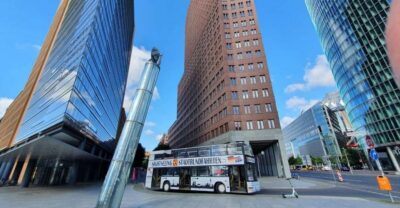
Potsdamer Platz is also a fitting place to begin. Modern buildings and wide public spaces now fill an area that was heavily damaged during the Second World War and later split by the Berlin Wall. The tour then moves from this rebuilt city into sites that preserve the crimes and choices of the Nazi period.
The official start time is 10 a.m. The experience lasts about three hours and finishes at Hackescher Markt, a useful central location for lunch, further sightseeing, or a train connection. Since the route includes several areas of Berlin, plan for movement between stops rather than expecting one compact walking circuit.
Other Berlin trips people book alongside this one:
- Berlin: Reichstag, Dome and Government District Guided Tour
★ 4.7 · 18,288 reviews - Berlin: 1-Hour City Tour by Boat with Guaranteed Seating
★ 4.3 · 16,993 reviews - Berlin: Boat Tour Along the River Spree
★ 4.4 · 11,252 reviews
Resistance at the Bendlerblock
The German Resistance Memorial Center is one of the most important stops because it changes the usual focus. Nazi Berlin was not only a story of dictatorship imposed from above. It was also a story of people who opposed the regime in different ways, often at great personal cost.
The memorial occupies the former Bendlerblock, the place from which the July 20, 1944, attempt to overthrow Hitler was directed. The center presents resistance from 1933 to 1945 and looks at individuals and groups who challenged National Socialism.
You spend about 25 minutes here. That is enough for an introduction, though not enough to examine every display in detail. The value is the guide’s framing. A good explanation can help you understand that resistance took many forms, from military opposition to acts of civil courage and help for people targeted by the state.
This stop works especially well for visitors who already know the basic outline of Hitler’s rise to power. It adds human decisions to the political timeline. The tour’s guides have been praised for making complicated subjects clear and holding attention, and this is the sort of place where that skill matters.
The T4 memorial and the crime of forced murder
The Memorial for the Victims of the Nazi Euthanasia Program addresses one of the darkest parts of Nazi rule. The T4 program was directed from Tiergartenstrasse 4, the address that gave the operation its name.
About 300,000 people with mental or physical disabilities, chronic illnesses, or other conditions were murdered under the program. The memorial explains how Nazi racial thinking and eugenics turned people needing care into targets for state killing.
The stop lasts about 15 minutes. It is brief, but its place in the route is important. T4 is often described as a precursor to the Holocaust because methods developed there, including organized killing and administrative techniques, later formed part of the wider Nazi murder system.
This is not a light sightseeing stop, and the subject may be difficult for children. Families with older teenagers can still find it meaningful, especially because one Italian-speaking guide was praised for helping a 10-year-old and a 17-year-old understand Nazism in a way books alone could not provide. The guide’s tone will shape the experience, but the itinerary gives this subject the attention it deserves.
Anhalter Bahnhof, from grand station to wartime ruin
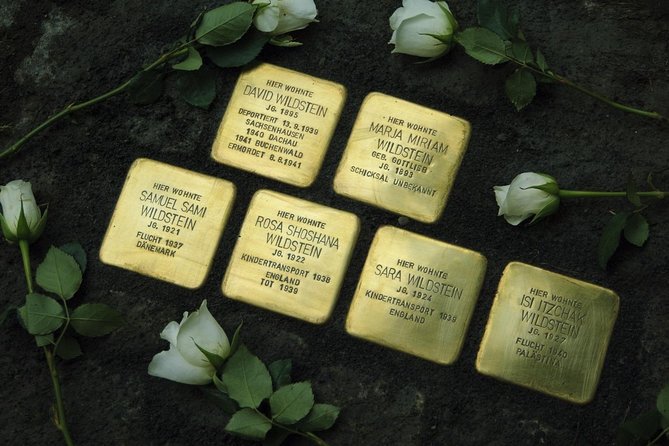
Anhalter Bahnhof was once one of Europe’s largest railway stations. Today, only part of the ruined facade remains, a striking reminder of how much Berlin lost during the war.
The stop lasts about 10 minutes. It is not a long visit, and you should not expect a complete station interior or a large museum presentation. Its strength is the physical setting. A ruin can make the scale of wartime destruction easier to grasp than a paragraph in a guidebook.
From 1942 to 1945, trains carrying people to death camps departed from the station. That fact gives the stop a second meaning. It was once a symbol of modern transport and civic pride, but it also became part of the system that carried deportees to their deaths.
The guide’s explanation is crucial here because the remaining structure does not explain itself. Without context, you might see a grand old wall and take a few photographs. With context, you understand why this battered fragment belongs on a tour about Nazi Berlin.
Something different for another day:
- Discover Berlin Half-Day Walking Tour
★ 5.0 · 9,624 reviews - Berlin: Hop-on Hop-off Bus Tour with Live Commentary
★ 4.3 · 8,579 reviews - Berlin: Government District around the Reichstag Guided Tour
★ 4.7 · 8,447 reviews - Berlin: Reichstag, Plenary Chamber, Cupola & Government Tour
★ 4.6 · 8,422 reviews
Scheunenviertel and Berlin’s Jewish quarter
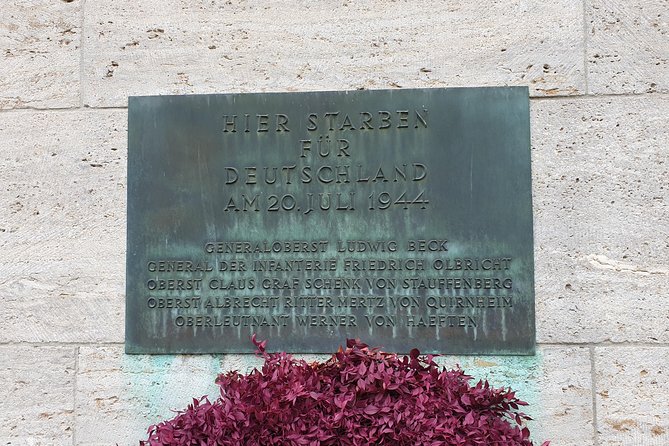
The tour then reaches Scheunenviertel, a section of Mitte often called Berlin’s Jewish Quarter. You spend about 45 minutes in this area, making it the longest stop on the route.
That extra time allows the guide to connect individual buildings and institutions with the wider story of Jewish life in Berlin. The route includes the New Synagogue and a school founded by Moses Mendelssohn, the Enlightenment philosopher and Jewish modernizer.
This is one of the tour’s strongest features. Nazi history can become a list of decrees, deportations, and murder statistics. Scheunenviertel brings attention back to the Jewish community that existed before the Holocaust, with schools, religious institutions, homes, and public life.
The area is not a preserved Jewish quarter in the sense of a place untouched by time. Berlin changed radically through war, division, reconstruction, and reunification. That is part of the lesson. You see a present-day neighborhood while learning how Nazi policy destroyed the people and institutions that once shaped it.
If you want a tour that focuses only on Hitler’s government buildings and military history, this route may feel different from what you expect. If you want to understand what was lost, the Jewish sites make the subject more personal and complete.
Otto Weidt’s workshop and practical courage
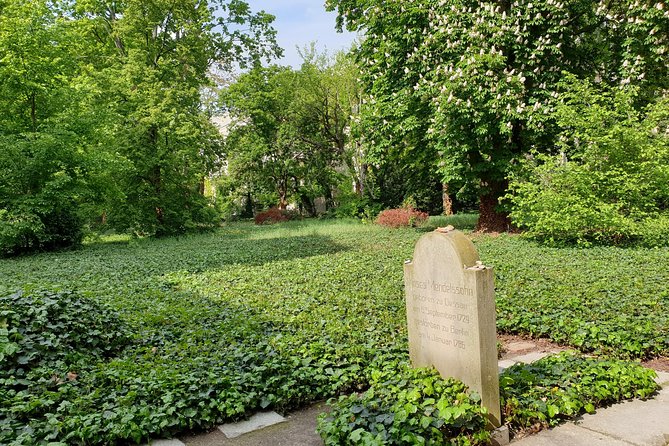
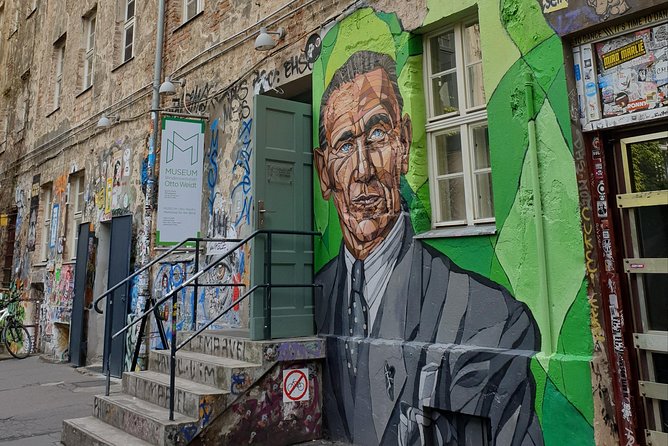
The Museum Blindenwerkstatt Otto Weidt is a small but powerful stop. It occupies the original location of the workshop run by Otto Weidt, who employed Jewish workers, including blind and disabled people, in an effort to protect them from deportation to Nazi extermination camps.
Weidt is sometimes called the Schindler of Berlin. The comparison can be useful, but the place is best understood on its own terms. His story shows how an individual used a workplace and personal relationships to help people targeted by the Nazi state.
You spend about 15 minutes here. That is enough for a focused introduction, but you should not expect a long museum visit. The original setting gives the story unusual force. You are not simply hearing about a rescuer in the abstract. You are connecting the story to the place where the work and protective efforts took place.
This stop also keeps the tour from presenting Jewish people only as victims. It shows relationships, choices, and acts of help. That balance is one reason the route feels more substantial than a basic list of Nazi landmarks.
The New Synagogue and a destroyed community
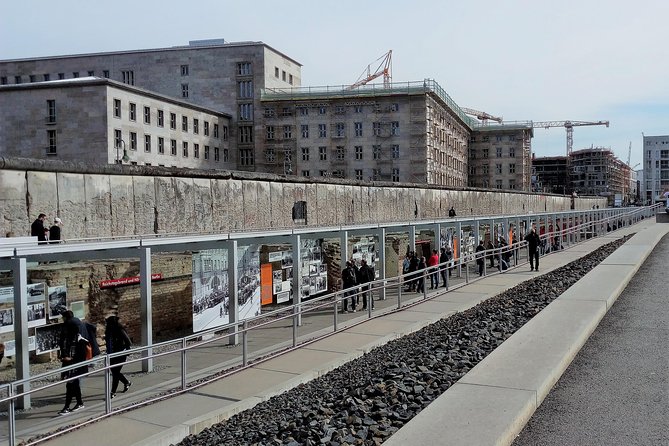
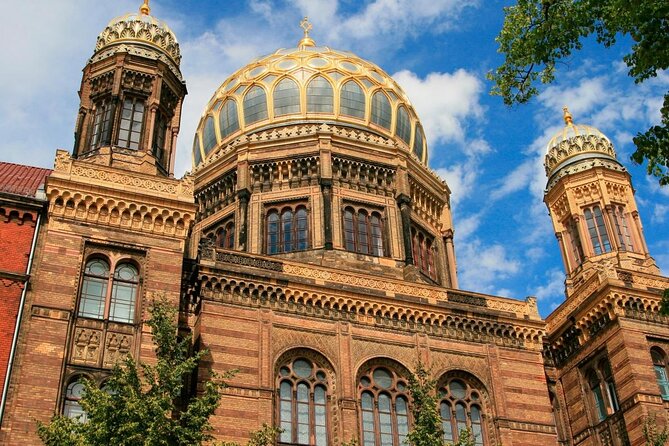
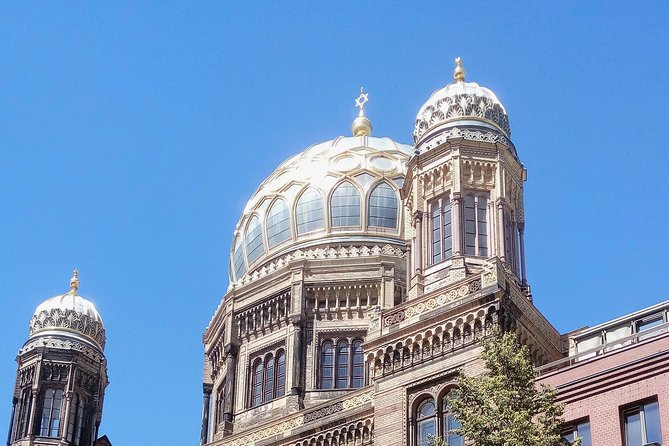
The New Synagogue on Oranienburger Strasse is one of Berlin’s best-known Jewish landmarks. Built in 1866, it once seated 3,200 people and symbolized the size and confidence of Berlin’s Jewish community.
The tour allows about 10 minutes here. That is enough to see the exterior and understand its place in the city, but it is not a full museum visit. If you want to study the building’s architecture or exhibitions at length, you will need separate time.
The synagogue’s history carries several layers. Its scale reflects a thriving community before Nazi persecution. Its damage and survival reflect the violence of the Nazi period and the destruction of the war. Its presence today also points to Jewish life returning to central Berlin, though the modern building is not a simple restoration of the past.
The guide helps connect architecture to history. Without that explanation, you may admire the dome and facade without understanding why the building matters so much.
The Old Jewish Cemetery and what absence can reveal
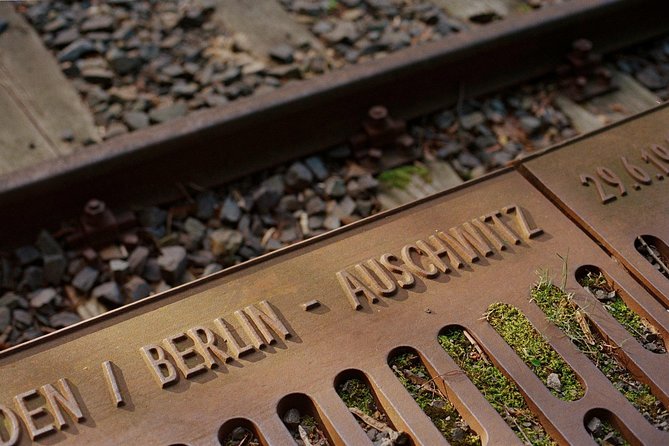
The Old Jewish Cemetery on Hamburger Strasse is the final listed stop. It was once the burial place of prominent members of Berlin’s Jewish community and is now the oldest recognizable cemetery in the inner city.
Very little of the original cemetery remains. The Gestapo destroyed it during the Nazi period, leaving absence as the main evidence. You spend about 10 minutes here.
This can be a quiet ending to an emotionally heavy route. Earlier stops show memorials, ruins, and surviving buildings. Here, the missing graves make destruction visible in another way. The site asks you to think about memory, erasure, and what happens when a community is attacked and its physical traces are removed.
The tour ends at Hackescher Markt. From there, you can continue exploring Mitte, but you may want a pause first. Three hours of concentrated history can leave you with plenty to process.
The Italian-speaking guides and teaching style
The strongest praise for this experience centers on the guides rather than on luxury features. Lorenzo is repeatedly described as engaging, kind, and clear, with enough warmth to keep a difficult subject from becoming a dry lecture. One comment compared his teaching style to the schoolteacher people wish they had received.
Other named guides include Fabio, praised for preparation and for answering questions; Vita, described as professional, passionate, and able to hold attention; Federica, who guided a family with children aged 10 and 17; and Silvio, praised for bringing lesser-known facts to life. Paolo and Zuleika also appear in positive comments about other Vive Berlin Tours experiences.
You should not assume you will receive one particular guide. Still, the pattern is useful. This company appears to place strong weight on historical explanation, personal delivery, and audience questions.
An Italian tour is especially valuable if Italian is your strongest language for complex subjects. Nuance matters here. Terms about Nazi institutions, resistance, persecution, and Jewish life can lose force when you are working through a language barrier.
Price, group size, and what you actually receive
At about $27.87 per person, the tour offers good value if you want interpretation rather than admission-based sightseeing. The listed inclusions are local taxes, a professional guide, and guidance in Italian. No attraction admission fees are listed, so the price mainly pays for the guide and the route.
The group maximum is 20 people. That is not a private tour, but it is small enough to feel more manageable than a large city walk. The group size also affects how easily you can hear the guide, ask follow-up questions, and stay together between locations.
Transportation is not included. You should buy a Berlin public transport day card for zones AB. This is an added cost, but the pass may also help you continue sightseeing after the tour. Food and drinks are not included, and tipping the guide is optional.
The tour operates in all weather. Berlin’s weather can change quickly, so dress for rain, wind, or cold as needed. Several hours outside, plus transport between locations, can feel long in poor conditions.
Who should book this experience?
I would choose this tour if you want a focused introduction to Nazi Berlin in Italian and prefer places connected to real people and events over a general city overview. It is particularly suitable for history-minded adults, families with older children, and visitors who want to connect Jewish Berlin with the wider story of Nazi Germany.
It may also suit you if you have already seen the main central memorials and want a route that adds resistance, forced murder, Jewish institutions, and deportation sites. The mix of famous landmarks and less obvious locations gives the tour more range.
You may want something else if you need a very slow pace, dislike public transportation, or want extensive time inside museums. Several stops are short, and the experience is designed to connect locations rather than provide long visits at each one.
Most participants can take part, and service animals are allowed. Since the route works in all weather and involves movement around Berlin, comfortable shoes remain a smart choice.
Should you book Berlin During Nazism in Italian?
Book it if you want a serious, well-paced introduction to Berlin’s Nazi past with an Italian-speaking guide. The route is strong because it does not stop at Hitler and military history. It includes resistance, the T4 murders, deportation trains, Jewish institutions, Otto Weidt’s rescue efforts, and the destruction of the Old Jewish Cemetery.
At $27.87, the cost is reasonable for three hours of guided history, especially in a group of no more than 20 people. Just budget for your AB transport pass, expect outdoor conditions, and allow time afterward to reflect.
I would not book it as your only Berlin tour if you mainly want Cold War history, the Berlin Wall, or broad sightseeing. For Nazi-era Berlin and Jewish history in Italian, though, this is a thoughtful and useful choice.
FAQ
Where does the tour begin?
The tour begins at Potsdamer Platz 10, 10785 Berlin, near the S-Bahn and U-Bahn Potsdamer Platz station. Look for the blue Vive Berlin Tours bicycle and the company flag.
Where does the tour finish?
The tour ends at Hackescher Markt in central Berlin.
What time does the tour start?
The stated start time is 10 a.m.
How long does the experience last?
The tour lasts approximately three hours.
Is the tour conducted in Italian?
Yes. A professional guide provides the tour in Italian.
Is public transportation included?
No. Transportation to and from the attractions is not included. You are advised to purchase a Berlin public transport day card for zones AB.
What happens if I need to cancel?
You can receive a full refund if you cancel at least 24 hours before the local start time. Cancellations or changes made less than 24 hours before the start are not accepted for a refund.
Just added around Berlin
- Berlin: Private Guided Tour of the Main Sights★ 5.0 · 13 reviews
- Private Highlights of Berlin Bike Tour★ 5.0 · 13 reviews
- Modern Berlin Private Walking Tour: Diverse, Vibrant and Exciting German Capital★ 5.0 · 13 reviews
- Tour in Berlin from Warnemünde and Rostock Cruise Port★ 4.1 · 13 reviews
- Berlin: Stasi Museum Private Guided Tour with Entry Ticket★ 4.8 · 13 reviews
- Private Food Tour Experience with a born and bred Berliner★ 5.0 · 14 reviews
- Berlin: Rheinsberg Palace Entrance Ticket★ 4.8 · 14 reviews
- Berlin in one day – day tour with an expert guide★ 5.0 · 14 reviews
Berlin Tours, compared.
Reichstag, Dome and Government District Guided Tour
Read our review →
1-Hour City Tour by Boat with Guaranteed Seating
Read our review →
Government District around the Reichstag Guided Tour
Read our review →
Reichstag, Plenary Chamber, Cupola & Government Tour
Read our review →