
Reviewed · CITY TOURS
All of Berlin (city panorama)
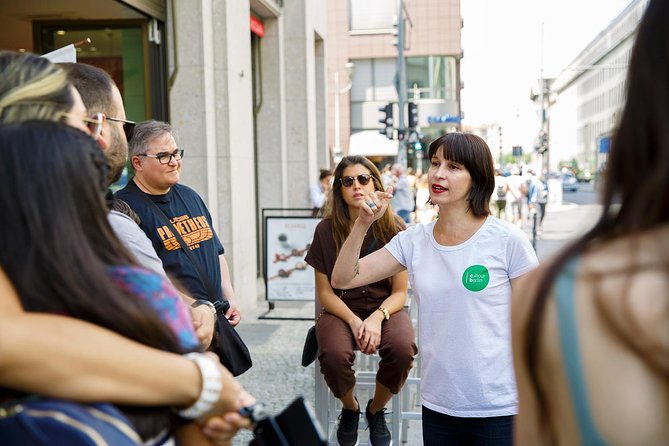
Berlin rewards a guided first look. I like the wide sweep of landmarks and the way the walk links medieval Berlin, Prussian power, Nazi-era memory, and Cold War division. I also like the strong value: about $25.58 for roughly four hours, with guide commentary and a group capped at 25 people. The main drawback is clear: the tour is Spanish-only, and its long walking route will not suit anyone who struggles with distance.
This is a useful orientation tour rather than a museum visit. You move from Alexanderplatz to Brandenburg Gate, stopping often for stories, photos, and explanations. Guide Juan receives special praise for giving detailed historical context, so I would choose this experience if you want Berlin to make sense before exploring its museums and interiors on your own.
In This Review
- Key points at a glance
- Why this four-hour Berlin route works
- Alexanderplatz and Berlin’s eastern center
- Nikolaiviertel and Museum Island
- Unter den Linden and the royal center
- Gendarmenmarkt and the road to Checkpoint Charlie
- Potsdamer Platz and Berlin’s rebuilt center
- The Holocaust Memorial and Brandenburg Gate
- Walking, group size, and the Spanish-language format
- Who gets the best value from this tour?
- Should you book the All of Berlin city panorama tour?
- FAQ
- What language is the tour conducted in?
- How long does the experience last?
- Where does the tour start?
- What time does the tour begin?
- Is transportation included?
- Is the tour suitable for people who cannot walk long distances?
- What is the cancellation policy?
Key points at a glance
- Starts beneath the Berlin TV Tower: The meeting point at Alexanderplatz puts you in one of central Berlin’s most recognizable squares from the first minute.
- Covers a remarkable central route: You see Alexanderplatz, Museum Island, Berlin Cathedral, Unter den Linden, Gendarmenmarkt, Checkpoint Charlie, Potsdamer Platz, the Holocaust Memorial, and Brandenburg Gate.
- History shapes the entire walk: The route connects Berlin’s royal past with Nazi persecution, Cold War division, reunification, and modern rebuilding.
- Spanish-speaking guidance only: This matters greatly when deciding if the tour fits you. The guide commentary is not offered in English.
- A small-to-moderate group size: With no more than 25 people, the group should remain manageable, though it is not a private tour.
- Plan for a long walking morning: Private transport is not included, and several stops involve walking between major sights.
Why this four-hour Berlin route works
Berlin can feel scattered at first. Its important sights are spread across several districts, and the city’s story is split between surviving buildings, empty spaces, reconstructed squares, and memorials. I like this tour because it gives you a usable mental map in one morning.
The route also has a sensible historical rhythm. You begin in the old eastern center at Alexanderplatz, pass through the medieval Nikolaiviertel and Museum Island, follow Unter den Linden toward the former royal heart, then move through Cold War and twentieth-century sites before ending near Brandenburg Gate.
That range is the real value. You are not spending four hours on a bus looking through glass. You get out at key points and walk through places that vehicles cannot explain well, especially Bebelplatz, the Holocaust Memorial, and the area around Checkpoint Charlie.
At $25.58, I consider the price fair for a four-hour introduction, especially if this is your first time in Berlin. You are paying for a Spanish-speaking local guide and a carefully arranged route, not for entry to a string of museums. Most admissions are not included, so budget separately if you want to go inside Berlin Cathedral or other sights later.
The tour is booked, on average, 29 days ahead. That suggests you should reserve before your trip if the date matters, particularly during busy periods. Confirmation arrives at booking, and free cancellation is available until 24 hours before the start time.
More City Tours in Berlin
- Berlin: 1-Hour City Tour by Boat with Guaranteed Seating
★ 4.3 · 16,993 reviews - Berlin: City Sightseeing Hop-On Hop-Off Bus Tour
★ 4.1 · 4,233 reviews - Potsdam: City and Castles Tour
★ 4.7 · 3,721 reviews
Alexanderplatz and Berlin’s eastern center
The tour begins at 10:00 a.m. beside the entrance to the Berlin TV Tower, at Panoramastraße 1A. Alexanderplatz is an effective starting point because it immediately shows you the contrast between old Berlin and the heavily reshaped city of the twentieth century.
You spend about 20 minutes here looking at the square, its monuments, and its place in Berlin’s story. This is not just a photo stop. The guide explains what you are seeing and how the square fits into the city around it.
Next comes Neptunbrunnen, the Neptune Fountain, for about five minutes. The fountain gives the guide a chance to explain its symbolism and its role in the central city. It is a short stop, but it helps you read the square as more than an open public space.
At Rotes Rathaus, the red town hall, you pause for another five minutes. The building is tied to Berlin’s city government, and the stop explains the role of the council. The exterior is the focus, so do not expect an extended interior visit.
This opening section is especially helpful if you are staying near Alexanderplatz. After the tour, you will understand the area’s main reference points instead of treating the TV Tower, fountain, and town hall as unrelated sights.
Nikolaiviertel and Museum Island
Nikolaiviertel offers a change of mood. The tour spends about 15 minutes in what is described as the most original part of Berlin, with attention to the city’s foundation more than 800 years ago.
The area helps you picture Berlin before its modern avenues and monumental government buildings took over the center. The reference to St. Georg adds a local detail to the square, giving the guide something concrete to point out rather than delivering only broad dates.
From here, you see the entrance to the group of buildings and museums connected with Berlin’s UNESCO World Heritage designation. The exact stop is not assigned a numbered time in the schedule, so treat it as a short transition and orientation point rather than a museum visit.
That distinction matters. This experience shows you where the cultural center is, but it does not include museum admission or time to explore collections. I would use the visit to mark down the museums you want to return to later.
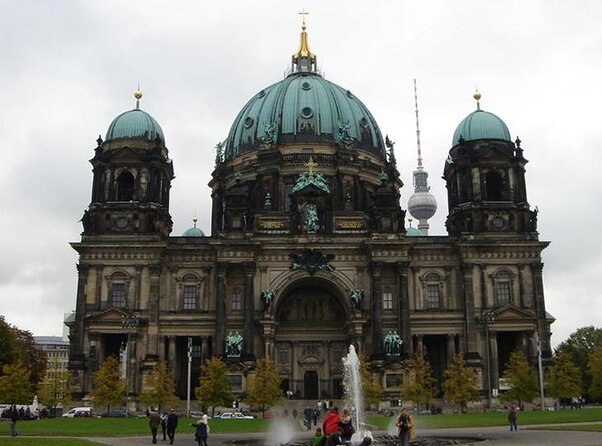
Berlin Cathedral is next, with about 10 minutes to admire the dome, decoration, and story behind the church. The guide explains who made the building possible and why it occupies such an important position in the city center.
You see the cathedral from outside during this tour. If the interior, dome, or crypt is on your wish list, plan a separate visit. The quick stop is enough for context and photographs, but not for a full architectural visit.
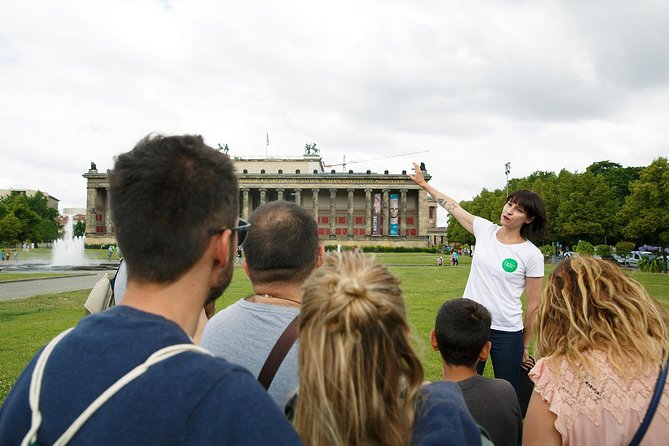
The route continues to Lustgarten for around five minutes. The guide explains the name, purpose, and placement of this open space. With the cathedral and museum area nearby, Lustgarten is one of the best points on the route for understanding how Berlin’s central institutions were arranged.
Unter den Linden and the royal center
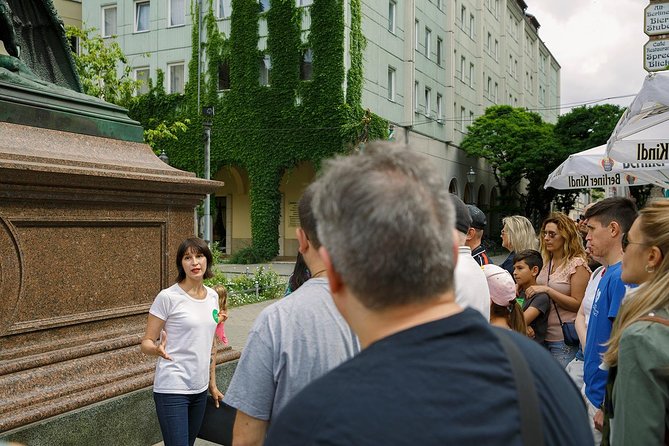
Unter den Linden is one of Berlin’s main avenues. The tour explains its earlier role as a royal route linking the palace area with the Tiergarten, then connects that past with its place as one of the city’s most visited streets today.
I like this part because the street works as a history lesson without needing a long lecture. Its buildings and sight lines show how Berlin projected power, culture, and public ceremony through architecture.
At Staatsoper Unter den Linden, you stop for about five minutes. The opera house brings culture and formal architecture to the avenue, and the guide provides more background about the building.
Bebelplatz receives a longer 10-minute explanation. This square carries painful twentieth-century history, and the guide addresses the memorial in its center along with the role of Joseph Goebbels, Hitler’s propaganda minister, in the events associated with the site.
This is one of the stops where a guide adds real value. A quick photograph can miss the meaning of the square. I would listen carefully here, since the point is not only to identify a building but to understand how propaganda and persecution operated in public space.
Neue Wache follows, with about 10 minutes and admission included. The memorial has been adapted to different periods of German history, and the tour highlights Käthe Kollwitz’s work inside.
The stop is brief, but the subject deserves a respectful pause. You are seeing a memorial shaped by changing political eras, which fits Berlin’s wider pattern: the city repeatedly revises how it remembers war, loss, and state power.
Something different for another day:
- Berlin: Reichstag, Dome and Government District Guided Tour
★ 4.7 · 18,288 reviews - Berlin: Boat Tour Along the River Spree
★ 4.4 · 11,252 reviews - Discover Berlin Half-Day Walking Tour
★ 5.0 · 9,624 reviews - Berlin: Hop-on Hop-off Bus Tour with Live Commentary
★ 4.3 · 8,579 reviews
Gendarmenmarkt and the road to Checkpoint Charlie
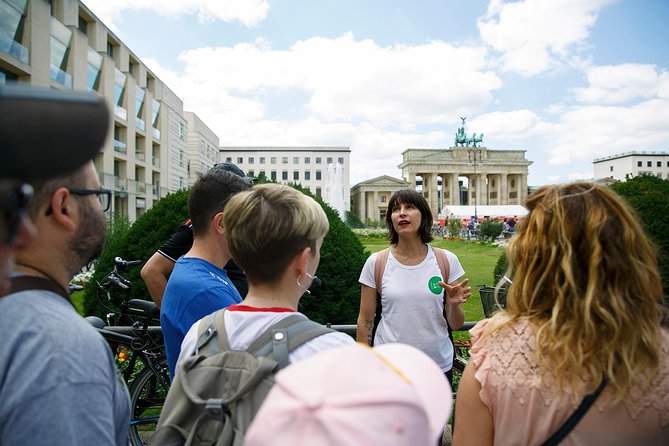
Gendarmenmarkt gets about 15 minutes. It is one of Berlin’s most harmonious public squares, formed by the concert hall and two church buildings with matching towers.
This is a strong sightseeing stop because the buildings are easy to understand as a group. The guide can explain the square’s design while you take in the full arrangement, rather than viewing each building in isolation.
The tour then reaches Checkpoint Charlie, with approximately 25 minutes devoted to the area. The former border crossing is tied to the Cold War, the partition of Berlin, and the tense relationship between East and West.
You should keep your expectations sensible. Checkpoint Charlie is important for what it represents, but the tour focuses on the historical setting and surrounding area, not a museum admission. The guide’s explanation is particularly useful here because the checkpoint’s modern appearance alone does not convey the seriousness of the border.
This is also a point where you may notice the tour’s pace. The schedule includes many stops, and the guide has to balance explanation with movement. You get a broad account of the area, but not an hour-long treatment of every Cold War detail.
Potsdamer Platz and Berlin’s rebuilt center
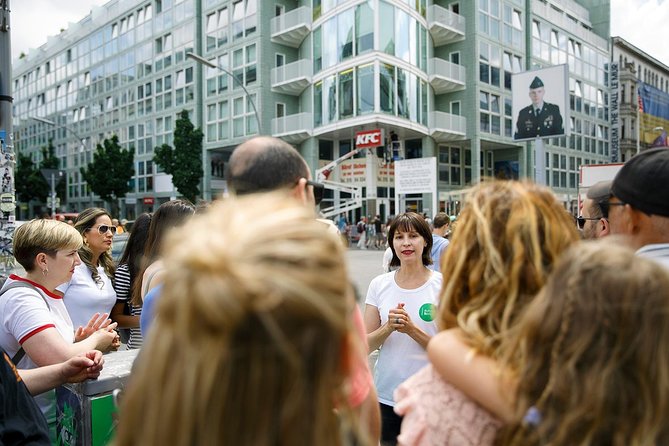
Potsdamer Platz is a short five-minute stop, but it adds an essential modern chapter. The guide traces the square from its earlier importance through the changes that made it one of contemporary Berlin’s most modern areas.
The contrast with Checkpoint Charlie is useful. One stop shows a former border and divided city. The next shows rebuilding and a new urban identity. You may not have time to inspect the architecture closely, but you will understand why the square matters in Berlin’s present-day story.
I would treat this as a visual transition rather than a major sightseeing break. If modern architecture is your main interest, you may want to return later with more time. On this tour, the purpose is to connect Potsdamer Platz to the larger story of a city repeatedly reshaped by political change.
The Holocaust Memorial and Brandenburg Gate
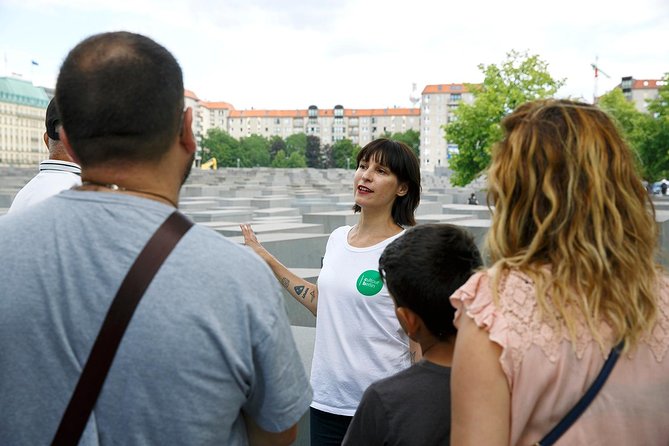
The Holocaust Memorial receives about 15 minutes. Its location near Brandenburg Gate makes it a central part of the route, but its meaning requires more than a quick photograph.
The guide works to explain the author’s intent and the memorial’s significance. I appreciate that the stop is given more time than a simple landmark photo. You walk through a place designed to make you think about the murdered Jews of Europe, and the tone should be serious and unhurried.
The tour finishes at Brandenburg Gate, with about 20 minutes devoted to the monument and its setting. From here, you see the Tiergarten, Pariser Platz, and the Adlon Hotel while learning how the gate fits into Berlin’s history.
Brandenburg Gate is a fitting final landmark because it connects several eras at once: royal Berlin, twentieth-century division, and the reunited capital. After the guide’s explanations, you can look at the gate with more than its familiar postcard image in mind.
There is one practical point to clarify before booking. The details say the activity ends back at the meeting point, but the route description says it finishes at Brandenburg Gate. Those locations are not the same. Ask the operator to confirm the actual end point before you go, especially if you have a timed reservation or train to catch.
Walking, group size, and the Spanish-language format
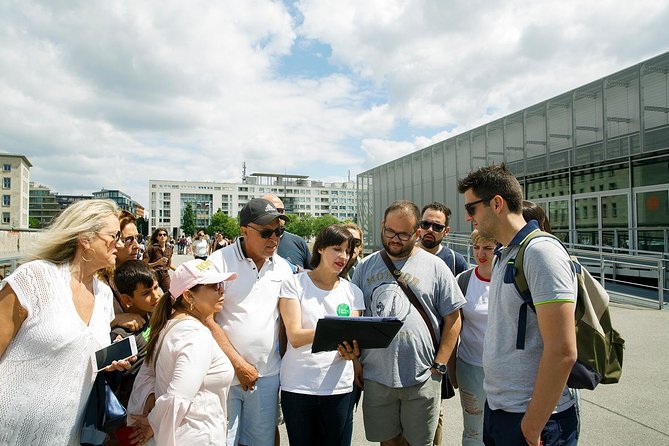
The tour lasts about four hours and includes substantial walking between stops. No private transportation is included, and the schedule is built around outdoor visits and pedestrian sections. If you cannot walk long distances comfortably, this is not a good match.
The group maximum is 25 people. That is small enough to feel more personal than a large city coach tour, though you should not expect the flexibility of a private guide. Staying near the guide matters, especially in busy public areas.
The mobile ticket makes arrival simple. Meet at the TV Tower entrance at Alexanderplatz before the 10:00 a.m. start. The meeting point is near public transportation, and service animals are allowed.
The language choice is the most important decision. This tour is operated by a Spanish-speaking guide and is offered only in Spanish. If you understand Spanish well, the format could be an excellent way to hear Berlin’s story with sustained commentary. If you do not, the price is irrelevant because you would miss the central service.
Guide Juan is specifically praised for giving a great deal of historical information about the places visited. That detail is worth noting if you value context over quick sightseeing. The strongest part of the tour is not a special ticket or luxury vehicle. It is having someone explain why each square, memorial, and street matters.
Who gets the best value from this tour?
I would recommend it most strongly to first-time visitors with only a few days in Berlin. You see many central landmarks in one morning and finish with a clear list of places worth revisiting.
It also suits you if you prefer history explained on foot. The route does not merely string together famous names. It asks what a fountain symbolizes, why a royal avenue developed where it did, how a memorial changed meaning, and what Checkpoint Charlie represents.
This is less suitable if you want long interior visits. Berlin Cathedral, museums, the opera house, and other buildings are mainly viewed from outside. You also need enough stamina for a four-hour route with repeated stops.
The tour may not suit you if you prefer to move at your own pace. The schedule is full, and each stop has a set time. You gain coverage, but you give up the freedom to linger wherever a building catches your eye.
At a 4.9 rating from 181 reviews and a 99 percent recommendation rate, the experience has a strong record. Still, the rating should not hide the two practical limits: Spanish-only commentary and a demanding walk.
Should you book the All of Berlin city panorama tour?
Book it if you want a fast, history-focused introduction to central Berlin in Spanish. The $25.58 price is reasonable for four hours of guiding, the route covers an impressive number of major sites, and Juan’s detailed explanations suggest the commentary is the main strength.
Skip it if you need English, want museum interiors, or cannot walk for long stretches. Before paying, confirm the final meeting point because the stated return location and the stated Brandenburg Gate finish do not match.
For the right person, this is a smart first morning in Berlin. You get your bearings, learn the city’s big story, and can spend the rest of your visit returning to the places that deserve more time.
FAQ
What language is the tour conducted in?
The tour is conducted only in Spanish by a Spanish-speaking local guide.
How long does the experience last?
It lasts approximately four hours.
Where does the tour start?
It starts at the Berlin TV Tower entrance, Panoramastraße 1A, 10178 Berlin, at Alexanderplatz.
What time does the tour begin?
The scheduled start time is 10:00 a.m.
Is transportation included?
Private transportation is not included. The experience includes walking between the central Berlin sights.
Is the tour suitable for people who cannot walk long distances?
No. It is not recommended for people who are unable to walk properly for long distances.
What is the cancellation policy?
You can cancel for a full refund up to 24 hours before the experience starts. Changes or cancellations made less than 24 hours before the start time are not accepted for a refund.
Just added around Berlin
- Berlin: Private Guided Tour of the Main Sights★ 5.0 · 13 reviews
- Private Highlights of Berlin Bike Tour★ 5.0 · 13 reviews
- Modern Berlin Private Walking Tour: Diverse, Vibrant and Exciting German Capital★ 5.0 · 13 reviews
- Tour in Berlin from Warnemünde and Rostock Cruise Port★ 4.1 · 13 reviews
- Berlin: Stasi Museum Private Guided Tour with Entry Ticket★ 4.8 · 13 reviews
- Private Food Tour Experience with a born and bred Berliner★ 5.0 · 14 reviews
- Berlin: Rheinsberg Palace Entrance Ticket★ 4.8 · 14 reviews
- Berlin in one day – day tour with an expert guide★ 5.0 · 14 reviews
City Tours, compared.
1-Hour City Tour by Boat with Guaranteed Seating
Read our review →
City History Canal Sightseeing Tour on a Motorboat
Read our review →
Browse the lists this tour appears in