

Reviewed · CITY TOURS
e-Scavenger hunt Paderborn: Explore the city at your own pace
Small clues, big history. This private phone-based walk gives you a flexible way to explore Paderborn, linking old churches, carved timber houses, fountains, shopping streets, and the little river that gives the city its name. I like the self-guided pace and the fact that one booking covers up to six people. I also like the modest group price, which can make this a good-value outing for families or friends.
The main catch is navigation. The game works on your smartphone, but you need to supply the phone and mobile data. One useful tip is to keep Google Maps ready as a backup, since finding the next point may not always feel perfectly clear inside the game.
In This Review
- Key points to know before you start
- Starting at Liboriberg and finding your rhythm
- A pleasant square for the first pause
- The carved half-timbered house and its Adam and Eve story
- Abdinghof Monastery, founded in 1015
- The Bartholomäuskapelle and its remarkable acoustics
- Paderborn Cathedral and three patron saints
- Marktkerk and the city’s Jesuit connection
- Shopping streets, Neptune, and Friedrich von Spee
- Paderborn Town Hall and Weser Renaissance details
- Following the Pader River back through the city
- What the $36.69 group price really buys
- Who will enjoy this format most
- A practical note about navigation
- Should you book the Paderborn e-Scavenger Hunt?
- FAQ
- Where does the e-Scavenger Hunt Paderborn start?
- Where does the activity finish?
- How long does the experience take?
- How many people can join one booking?
- Is the experience guided in person?
- Is English available?
- Do I need my own smartphone and data?
- Can service animals participate?
- Can I cancel for a full refund?
Key points to know before you start
- A private walk for up to six people: Your group plays together, with no strangers and no fixed guide.
- A two to four-hour route: You can move at your own speed and pause for a drink, a rest, shopping, or a closer look at a church.
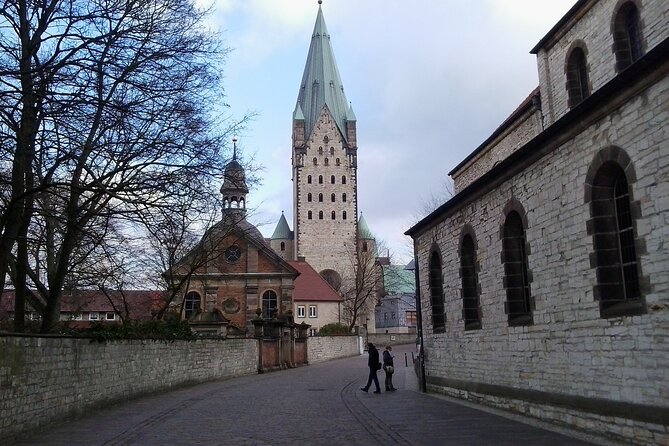
- Paderborn’s main sights fit into one walk: The route includes the cathedral, Abdinghof Monastery, the Bartholomäuskapelle, Marktkerk, town hall, Neptune Fountain, and more.
- The phone is your guide: The booking includes the online game and city walk, but not your smartphone or data connection.
- English is available: This makes the experience practical for English-speaking visitors.
- The route ends where it begins: You start at Parkplatz Liboriberg and return there when the activity is complete.
Starting at Liboriberg and finding your rhythm
The meeting point is Parkplatz Liboriberg 1004, 33098 Paderborn. This gives you a clear place to begin, but remember that the experience depends on your phone, your battery, and your data connection. I would arrive with the game already available on the device and enough battery for several hours of walking.
The activity is offered every day around the clock during its operating period, so you are not tied to a morning departure or a guide’s timetable. That flexibility is one of its strongest features. You can begin at midday, later in the afternoon, or at another convenient time shown during booking.
The expected duration is about two to four hours. That broad range tells you something important: this is not a tightly timed sightseeing march. You can move quickly if you mainly want the puzzles and a basic look at the city, or take longer at the cathedral, churches, square, shops, and river.
The game format should suit you if you like a little structure but do not want someone speaking at you the whole time. It gives you a reason to notice architectural details, while leaving room for your own breaks.
More Escape Rooms & Games in Koblenz:
- e-Scavenger hunt Koblenz: Explore the city at your own pace
★ 4.0 · 20 reviews - Digital scavenger hunt around Wittringen Castle in Gladbeck
★ 4.0 · 9 reviews - Bielefeld Scavenger Hunt and Private Sights Self-Guided Tour
★ 4.0 · 5 reviews
A pleasant square for the first pause
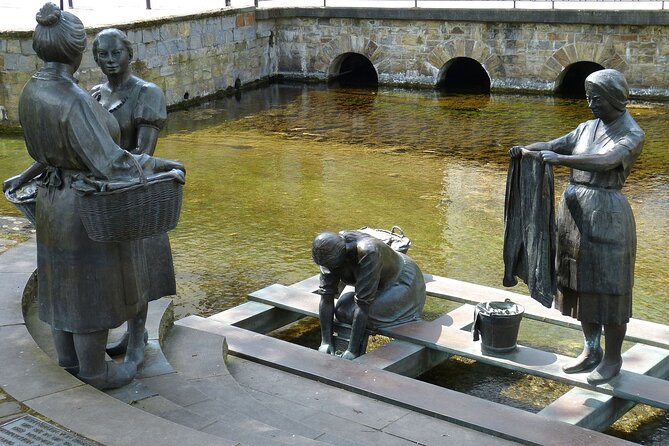
One early stop is described simply as a pleasant square in the middle of the city, with space to have a drink and rest. That may sound modest beside Paderborn’s churches, but it serves an important purpose in the route.
A good city walk needs breathing room. You can use this square to check the next clue, let children recharge, or pause before the more detailed historical stops. Since the route can take up to four hours, this kind of open resting place helps keep the walk comfortable.
Do not treat every stop as a formal monument. Some are there to help you read the city as a lived-in place, not just a string of attractions. A central square, a drink, and a few minutes of people-watching can be as useful as another paragraph of history.
The carved half-timbered house and its Adam and Eve story
One of the most memorable architectural stops is a three-storey half-timbered gable house built around 1560. Its front is decorated with carved friezes, including ornamental and figurative scenes.
The lowest of the three carved bands is the key detail. Read in the classic direction, it tells the story of Adam and Eve’s fall into sin. This is the sort of feature that a fast walk through town could easily miss. The game gives you a reason to stop, look upward, and study the building rather than simply pass it.
The house also gives you a taste of Paderborn’s older domestic architecture. It is not only grand churches that tell the story of the city. A richly carved private building can reveal the values, religious ideas, and craftsmanship of its period.
You may need to spend a little time positioning yourself to see the carvings properly. This is one place where the self-guided format works well, since you are not being hurried along by a larger group.
Abdinghof Monastery, founded in 1015

The route continues to Abdinghof Monastery Petrus and Paulus, a former Benedictine abbey founded in 1015. That date puts the site deep into the medieval story of Paderborn.
The monastery is important because it connects the city to religious institutions that shaped education, culture, land ownership, and daily life. The route does not require you to sit through a long lecture, but the stop gives the game a stronger historical backbone.
I appreciate the range here. The walk is not built only around postcard views. You get religious buildings, civic architecture, public art, shopping, and water. That mixture makes the experience more useful for a first look at Paderborn.
As with the other church stops, check opening conditions when you book if entering an interior is important to you. The supplied details identify the sites on the route, but they do not promise interior access or a specific guided explanation inside each building.
More City Tours in Koblenz:
- Koblenz: City & Rhine Valley Sightseeing Cruise
★ 4.7 · 39 reviews - Private audio book city rally around the Jahrhunderthalle in Bochum
★ 5.0 · 12 reviews - Private city rally around the Zollverein Coal Mine Industrial Complex in Essen
★ 3.5 · 10 reviews - Private audio book city rally around the old town of Essen Kettwig
★ 4.0 · 6 reviews
The Bartholomäuskapelle and its remarkable acoustics
The Bartholomäuskapelle is identified as the oldest known hall church on German soil. Its special acoustics are a major reason to pay attention here.
The best part of this stop may be less visual than audible. If the chapel is accessible during your visit, notice how sound behaves inside. The space gives the route a different kind of interest, since you are not only looking at masonry, decoration, or shape.
Because the route is played through a phone, you may want to lower the volume and take a quiet moment rather than rushing through the clue. The experience is at its best when the game prompts you to notice something real in front of you.
This is also a good example of the limits of a self-guided walk. A human guide could explain the acoustics in more depth or answer questions on the spot. You gain privacy and flexibility, but you give up that personal exchange.
Paderborn Cathedral and three patron saints
Paderborn Cathedral is the route’s major church stop. It is the archiepiscopal church of Paderborn and one of Germany’s important church buildings from an art-historical point of view.
The cathedral is dedicated to Mary, Saint Kilian, and Saint Liborius of Le Mans, who is the principal patron. These dedications give you a useful key to understanding the religious identity of the building.
Allow extra time here if you care about church art or architecture. The walk may give you a prompt or fact, but the cathedral deserves more than a quick answer before you move on. You can use the flexible timing to look carefully, sit quietly, or simply take in the scale of the building.
The experience does not state that an admission fee, special entry, or timed access is included. If seeing the interior is central to your plan, verify local access separately. The route itself should still be useful from the surrounding city streets.
Marktkerk and the city’s Jesuit connection

The Marktkerk is a Roman Catholic church in central Paderborn. It began as a Jesuit and university church connected with the first university of Westphalia, and it is dedicated to Saint Francis Xavier.
That background adds another layer to the walk. Paderborn’s religious buildings were not all serving the same purpose. This church links worship with education and the Jesuit presence in the city.
The route information repeats the Marktkerk stop in slightly different wording, so you should think of it as one church attraction rather than assume there are two separate buildings. The useful detail is its central location and its Jesuit and university past.
I like this stop for visitors who want context without a full academic tour. You get a concise reason why the church matters, then you can compare it with the cathedral and Bartholomäuskapelle.
Shopping streets, Neptune, and Friedrich von Spee
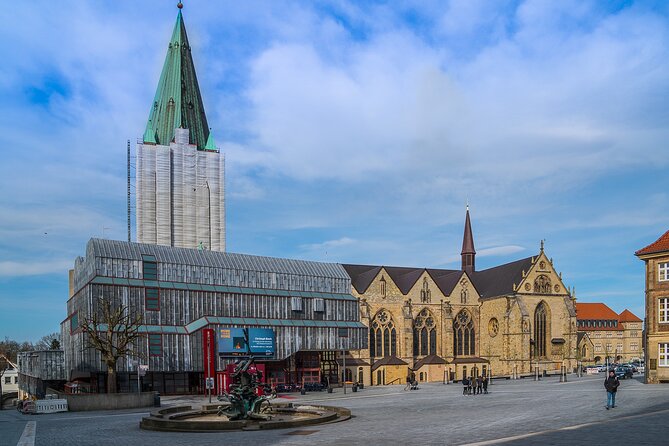
The walk is not all old stone and church history. It also leads through a modern shopping street described as one of the city’s best places for fashionable shops.
This section gives you a look at present-day Paderborn. You may find it useful for a coffee break, a bit of browsing, or a change of pace after several historic buildings. The route does not turn into a shopping tour, but it recognizes that a city is more than its monuments.
In the market square, look for the Neptune Fountain, created by Paderborn artist Josef Rikus between 1977 and 1979. The work adds modern public art to the historic center and gives the square a clear visual marker.
Another stop is a bronze statue of Friedrich von Spee reading a book. The statue is easy to understand at a glance, but the game can encourage you to notice the person represented rather than walk past another piece of street furniture.
These stops are especially helpful if your group has mixed interests. Someone who is less excited by church architecture may enjoy the shops, fountain, or statue while still taking part in the same route.
Paderborn Town Hall and Weser Renaissance details
Paderborn Town Hall is a fine example of Weser Renaissance architecture. Its three gables give the building a distinctive profile, while the upper floor’s many windows show the style’s taste for strong visual detail.
This is a rewarding stop because it puts civic power beside religious power. The cathedral and churches show one side of Paderborn’s past. The town hall shows how the city expressed public authority and municipal pride.
Look closely at the façade rather than stopping at the broad label of Renaissance. The gables and windows are the details that make the building worth your attention. Since the game is designed to get you from feature to feature, it can turn a general city walk into a more observant one.
You will not get the same depth as you would from a specialist architecture tour, but the format gives you a practical introduction. If the town hall catches your interest, note it as a place to revisit after completing the game.
Following the Pader River back through the city
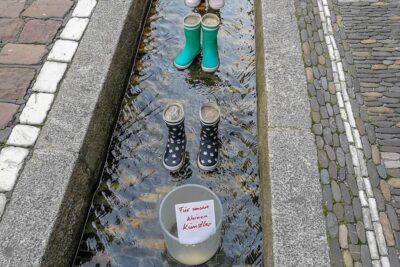
The final part of the route follows the small Pader River. Paderborn has more than 150,000 inhabitants, and its name and development are tied to the Pader’s headwaters.
This is a gentle way to finish the walk. After churches, carved façades, public squares, and shopping streets, the water offers a quieter thread through the city. The route asks you to follow the river, giving the city a clear geographic connection rather than leaving you with a pile of unrelated sights.
The Pader is small, but that is part of its appeal. You do not need a grand river view to understand how water can shape a city. The walk uses this local feature to connect Paderborn’s identity with its physical setting.
The activity ends back at the Liboriberg meeting point. That makes planning easier, especially if you leave bags, arrange transport, or need to continue with the rest of your day.
What the $36.69 group price really buys
The listed price is $36.69 per group of up to six people. That is not a per-person charge, so the value improves sharply when several people play together. A full group would pay roughly $6.12 each, before any separate phone or data costs.
You are paying for a private city walk and an online game. There is no live guide, so the price should be compared with the freedom and privacy you receive, not with a traditional guided tour that includes a person.
For two people, the per-person cost is higher. For a family or group of friends, it becomes much more attractive. You can also control the pace, stop for a drink, and spend longer at the cathedral or town hall without worrying about holding up strangers.
The important limitation is that smartphone use and data are not included. Check that your phone can access the game, and consider roaming costs if you are visiting Germany from another country.
Who will enjoy this format most
I would recommend this experience to independent visitors who want a planned route but dislike fixed schedules. It also suits families, couples, and small groups who enjoy solving clues and deciding for themselves how long to stay at each sight.
English speakers have a clear advantage because English is offered. The activity is also described as user-friendly for people with hearing impairments, since it does not depend on listening to a guide’s spoken presentation.
The walk is suitable for most participants, and service animals are allowed. It is near public transportation, though no specific route or station details are provided, so you should check your own arrival plan.
You may want something else if you prefer detailed storytelling, live questions, or guaranteed interior visits. A guide can respond to your interests in a way a phone game cannot. The trade is simple: less personal explanation, more control.
A practical note about navigation
The most useful improvement you can make is to prepare for navigation. The route is designed for a phone, but the experience may not always make the next location obvious. Keep Google Maps available as a parallel tool if the game’s directions become confusing.
That does not defeat the purpose of the activity. You are still using the game for the clues and information, while Maps helps you get your bearings. Also keep your phone charged, since the walk can last several hours and the phone is the central piece of equipment.
The format has received a strong 4.8 rating from four published ratings, with one especially positive assessment praising the clear amount of information and the ability to learn about Paderborn without a guide. That praise matches the tour’s main strength: it gives you enough structure to notice the city without burying you in text.
Should you book the Paderborn e-Scavenger Hunt?
Book it if you want an easy, private introduction to Paderborn with a flexible schedule and a good mix of sights. The route covers far more than one church: you get medieval and Renaissance architecture, a carved biblical story, unusual acoustics, Jesuit history, modern shopping, public art, the town hall, and the Pader River.
I would be more cautious if your main goal is expert interpretation or a guaranteed look inside every religious building. In that case, a live guide may serve you better.
For a group of four to six, the $36.69 price is appealing. Start with a full battery, have mobile data ready, and keep Google Maps as a backup. If you like exploring at your own speed and learning through small discoveries, this is a sensible way to spend two to four hours in Paderborn.
Free cancellation is available with at least 24 hours’ notice before the local start time. Cancellations or changes made within 24 hours are not refunded or accepted.
FAQ
Where does the e-Scavenger Hunt Paderborn start?
It starts at Parkplatz Liboriberg, Liboriberg 1004, 33098 Paderborn, Germany.
Where does the activity finish?
The walk ends back at the meeting point at Parkplatz Liboriberg.
How long does the experience take?
The expected duration is approximately two to four hours.
How many people can join one booking?
One booking is for a private group of up to six people.
Is the experience guided in person?
No live guide is listed. The experience is an online game and city walk used on your phone.
Is English available?
Yes. The experience is offered in English.
Do I need my own smartphone and data?
Yes. Smartphone use and data are not included, so you need to provide both.
Can service animals participate?
Yes. Service animals are allowed.
Can I cancel for a full refund?
Yes, if you cancel at least 24 hours before the experience’s start time. Cancellations within 24 hours are not refunded.
Just added around Koblenz
- Evening-Cruise to the fireworks of the Cochemer Winefest.★ 4.5 · 4 reviews
- Koblenz: Old Town Tour with the Ehrenbreitstein Fortress★ 4.8 · 4 reviews
- Koblenz: Private pub crawl with insider guide & free shots★ 5.0 · 5 reviews
- Bielefeld Scavenger Hunt and Private Sights Self-Guided Tour★ 4.0 · 5 reviews
- Private scavenger hunt around Broich Castle in Mülheim an der Ruhr★ 5.0 · 5 reviews
- Private audio book city rally around the old town of Essen Kettwig★ 4.0 · 6 reviews
- Koblenz – Old Town with the Ehrenbreitstein Fortress★ 4.0 · 7 reviews
- Koblenz Guided tour of the Ehrenbreitstein Fortress★ 4.5 · 7 reviews
City Tours, compared.

1-Hour City Tour by Boat with Guaranteed Seating
Read our review →
City History Canal Sightseeing Tour on a Motorboat
Read our review →

Browse the lists this tour appears in