
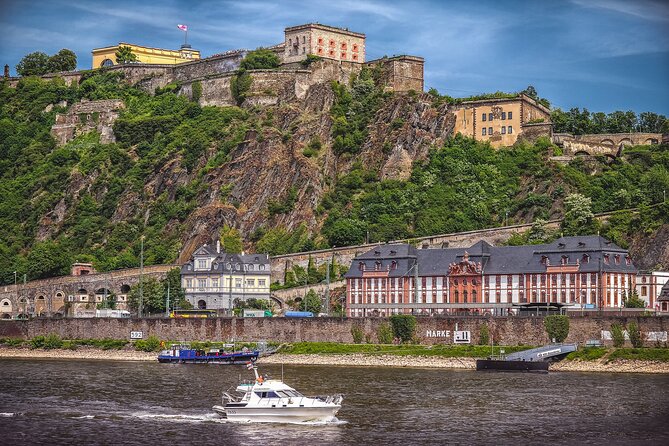
Reviewed · CITY TOURS
e-Scavenger hunt Koblenz: Explore the city at your own pace
Let Koblenz set the pace. This phone-led scavenger hunt turns the old town into a simple game, guiding you to churches, squares, fountains, bridges, and riverfront sights. I like the freedom to pause whenever you wish, and I like the private format, which lets your own group of up to six people play together.
The main caution is that the experience depends heavily on the app. Some questions are very easy, translations can be awkward, and GPS has not worked reliably for every participant. You should be comfortable using your own map or navigation app if the route guidance gives you trouble.
In This Review
- Key points before you book
- Starting at Münzplatz in Koblenz’s old town
- Deutsches Eck and the meeting of two rivers
- Fountains that turn Koblenz into a history lesson
- The Electoral Palace and Koblenz’s political past
- The Level House and Koblenz’s riverfront work
- Four Towers, the Church of Our Lady, and Münzplatz
- Government buildings, churches, and the Old Castle
- The Romanesque church and the Moselle Bridge
- How the app-led format really works
- Is $37.33 good value for up to six people?
- Who should book this Koblenz activity?
- FAQ
- How long does the e-Scavenger Hunt Koblenz take?
- Where does the activity start and finish?
- How many people can join one booking?
- Is the activity available in English?
- Do I need to bring my own smartphone and data?
- Can I cancel for a full refund?
- Should you book it?
Key points before you book

- Flexible two to four-hour route: Pause the game for lunch, extra sightseeing, or a quick look inside a church.
- Major Koblenz sights included: The route reaches Deutsches Eck, the Electoral Palace, the Four Towers, several historic churches, and the Moselle Bridge.
- Private group pricing: One booking covers up to six people, making the $37.33 cost more attractive for families or friends.
- Simple game format: You answer questions, complete challenges, and look for objects connected with each stop.
- English-language access: The activity is offered in English, though some wording may feel rough or unclear.
- Bring your own phone data: The mobile ticket and game are included, but your smartphone and data connection are not.
Starting at Münzplatz in Koblenz’s old town
The activity begins at Münzplatz, a historic square in the center of Koblenz. Its name recalls the former electoral mint, so the starting point gives you an immediate link to the city’s political and economic past.
From here, the route leads through the old town rather than keeping you on a single straight sightseeing path. That is part of the appeal. You are not sitting through a fixed talk or following a guide’s schedule. Your phone gives you a prompt, you find the place, and your group works out the answer.
The format suits people who enjoy a little purpose while walking. Instead of simply passing a decorated building, you stop to inspect it. Instead of rushing through a square, you look for a detail that answers the next challenge.
The route ends back at the meeting point. The advertised duration is about two to four hours, but the pause function gives you more control than that range suggests. You can stop the game to eat, take photographs, visit an extra sight, or wait out bad weather.
One practical point matters here: the experience does not include your phone or mobile data. Make sure your device is charged and that you have a workable data connection before starting.
More Escape Rooms & Games:
- Hamburg: Sex and Crime in St. Pauli Tour for Ages 18+
★ 4.7 · 15,447 reviews - Hamburg: Treasure Hunt Game through HafenCity
★ 4.7 · 364 reviews - Hamburg: Scavenger Hunt Self-Guided Tour for Children
★ 4.5 · 319 reviews
Deutsches Eck and the meeting of two rivers
The Basilica of St. Kastor is one of the first major sights on the route. This Roman Catholic church dates from the years 817 to 836 and sits near Deutsches Eck, the pointed piece of land between the Rhine and Moselle.
Its age gives the game some serious historical weight. You are not just looking at a pretty old church. You are standing beside one of the places that helped shape Koblenz as a meeting point of rivers, trade, church power, and government.
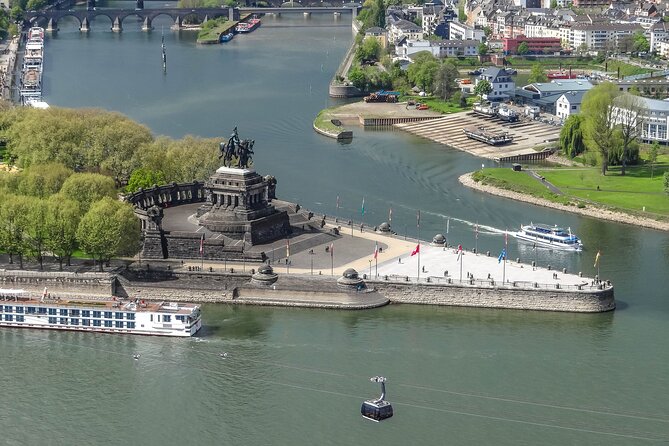
The next stop, Deutsches Eck, is perhaps Koblenz’s most recognizable sight. The artificial headland marks the mouth of the Moselle, where it flows into the Rhine. A national monument dedicated to German unity occupies the point.
This is one of the best parts of the route for photographs. It also gives the app a chance to connect the physical setting with German history. The monument and the two rivers make the location easy to understand, even if you know little about Koblenz before arriving.
The area can attract many people, including passengers from large sightseeing boats. If you want a quieter look, the pause feature lets you wait before continuing the game. That flexibility is more useful here than at a small side street because the riverfront may feel much busier at certain times.
Fountains that turn Koblenz into a history lesson
The route includes a fountain with a large column explaining roughly 2,000 years of Koblenz’s past. It is a popular stop, and the site can fill with people arriving from river cruises.
A city-history column is a smart choice for a scavenger hunt. You get a quick timeline in one place, and the question or challenge encourages you to read the monument instead of treating it as background decoration. Still, the information supplied through the activity is brief. If you want a fuller account of Koblenz, you will need to read the displays carefully or do additional research afterward.
Another fountain features a bronze statue of a boy by Carl Burger. It is dedicated to the poet Josef Cornelius. This is exactly the sort of smaller detail that independent sightseeing can miss. The statue is not as famous as the river junction or the national monument, but it gives the walk a local character.
The game’s object-finding tasks work best at stops like this. A player has to look closely, compare details, and decide what the app is asking for. The questions are generally easy, which makes the activity accessible to families and casual groups. If you want difficult puzzles, you may find the challenge level modest.
The Electoral Palace and Koblenz’s political past
The Electoral Palace recalls the period when Koblenz was tied to the Archbishops and Electors of Trier. It was the residence of the last Archbishop and Elector of Trier, so this is a key stop for understanding the city’s former political role.
The building also gives the route a change of mood. After the open riverfront and public monuments, you encounter a formal residence connected with church and state authority. The app provides a reason to stop and notice the setting, although its historical notes are not designed to replace a full guided explanation.
This is a recurring feature of the activity. The route selects important places, then gives you a small amount of information and a question. That works well if you want a light introduction. It is less satisfying if you hope for a detailed account of architecture, wartime damage, restoration, or the people connected with each building.
You can always pause the game and spend more time at a stop. One especially useful feature is that the activity does not force you to finish in one uninterrupted session. That makes the palace and nearby sights easier to combine with your own old-town plans.
More City Tours:
- Koblenz: City & Rhine Valley Sightseeing Cruise
★ 4.7 · 39 reviews - Berlin: 1-Hour City Tour by Boat with Guaranteed Seating
★ 4.3 · 16,993 reviews - Leipzig: City History Canal Sightseeing Tour on a Motorboat
★ 4.7 · 6,232 reviews - Cologne: Panoramic City Cruise
★ 4.3 · 5,698 reviews
The Level House and Koblenz’s riverfront work
The Level House dates to around 1609. It first served as a Rhine crane, then became a gauge house station in 1839. The crane on the roof was removed around 1900, and another floor was added for the 2011 Federal Horticultural Show.
This is a good example of why a walking game can be useful. A building that might look like an attractive old structure becomes more interesting once you know its changing jobs. Its story follows the practical life of the river: lifting cargo, measuring water levels, and adapting to a new public role.
The route then brings you to a photogenic square with handsome facades and outdoor terraces. The supplied details do not identify the square by name, but the description points to a pleasant pause in the old town. You can use the game there as a short break rather than treating every stop as a race to the next answer.
That is where the private format helps. A family with children can move on when interest fades. Friends can stop for a drink. A couple can take photographs without holding up a larger group.
Four Towers, the Church of Our Lady, and Münzplatz
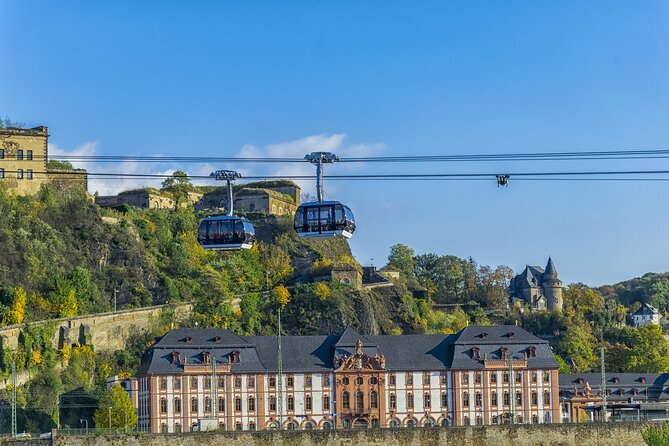
The Vier Türme, or Four Towers, are four historic buildings at the crossing of Am Plan, Löhrstraße, and Altengraben. Their unusual facades make them a strong visual stop, and the route gives you a reason to look up at the upper floors.
The Church of Our Lady occupies the highest point in the old town. Together with St. Kastor and St. Florin’s Church, it helps define Koblenz’s old-center silhouette.
This trio of churches gives you a useful sense of the city’s historic shape. They are not isolated monuments placed on a modern grid. They form a recognizable profile and help you understand how the old town is organized around religious and civic buildings.
Münzplatz appears both as the start and as part of the route’s old-town setting. Because the activity returns here at the end, it is a practical place to finish. You already know where you need to go, and the central location makes it easier to continue with your own plans.
The questions at these stops are unlikely to challenge serious puzzle fans. Their value is different: they keep a group alert and give children or first-time visitors a small task at each building.
Government buildings, churches, and the Old Castle
The Prussian government building in Rhine Park once served as the seat of the Prussian government for the Koblenz administrative district of the Rhine Province. Its inclusion widens the story beyond medieval churches and picturesque streets.
Koblenz has long been shaped by institutions as much as by its rivers. The palace, government building, town hall, and old castle each point to a different layer of authority. The app’s short prompts help you connect those buildings, even if they do not provide a full political history.
Today, Koblenz’s town hall occupies the former Jesuit college in the old town. That detail makes the building more interesting than a typical municipal office. The earlier religious use remains part of the city’s built story.
St. Florin’s Church is an evangelical church in the city center. The church was built around the year 1100 and belonged to the Florinusstift. Its position among the old-town churches helps show the range of religious history packed into a fairly small area.
The Old Castle was a substantial moated castle founded in the 13th century and owned by the Elector. Much of the original complex has disappeared, leaving the later Burghaus, which now houses the city archive.
This stop rewards careful attention because you are looking at what remains, not a fully preserved medieval fortress. A short game prompt can point you toward that change over time, but you should not expect a detailed reconstruction or museum visit as part of the activity.
The Romanesque church and the Moselle Bridge
One stop is described as one of Germany’s most important Romanesque church buildings and as part of the World Heritage List since 2002. The route therefore adds another strong architectural point, though the supplied information does not clearly name this stop.
That lack of detail is worth noting. If you want precise background on every monument, the app may leave you wanting more. The activity is built around discovery and short answers, not long explanations.
The final major sight is a 14th-century stone bridge over the Moselle. It is the oldest surviving bridge in Koblenz and connects the old town with the Lützel district.
This bridge gives the walk a satisfying sense of place. The Rhine and Moselle are not just scenic views around Koblenz. They have always affected movement, trade, defense, and the city’s connections with nearby districts. Crossing or viewing the bridge helps tie those themes together.
You should allow time to look at the bridge beyond the question itself. A scavenger hunt can tempt you to solve the task and move on, but this is one of the route’s more substantial historic structures.
How the app-led format really works
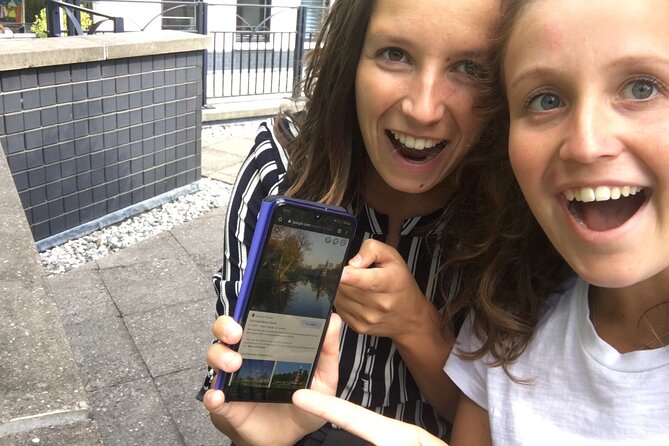
The experience combines an online game with a city walk. Your phone supplies the route, facts, questions, and challenges. You look for objects, answer prompts, and move from one location to the next.
The pause function is a genuine strength. One person who used it wanted to see extra sights, and the ability to stop the game made that easy. I would use the same approach: treat the game as a loose framework, not a strict timetable.
The GPS function deserves a cautious note. It has not worked reliably for everyone, and some participants have had to find the locations using their own navigation. The provider says its help desk is available around the clock, so contact support if the app fails rather than spending too long wrestling with it.
Registration has also been described as complicated. Give yourself a little time before the walk begins. English translations may contain errors, and some questions can become hard to understand when the wording is unclear.
The activity is user-friendly for people with hearing impairments because it is app-led rather than dependent on spoken commentary. Service animals are allowed, public transportation is nearby, and most people can participate.
Is $37.33 good value for up to six people?
The price is $37.33 per group, with up to six people included. That works out well for a full group, at roughly $6.22 per person. For two people, it is a less impressive deal, though still reasonable if you value privacy and flexible timing.
You are paying for a self-guided activity rather than a live guide. There is no personal storytelling, no chance to ask a local guide follow-up questions during the walk, and no promise of deep historical detail.
The value comes from convenience. You get a prepared route through many of Koblenz’s central sights, a game to keep the group involved, and the freedom to pause. For a family or group of friends, those benefits can justify the cost.
For experienced independent sightseers who already know the old town, the product may feel expensive. You can walk to many of these places without an app. The price makes the most sense when the game itself is part of the entertainment.
Who should book this Koblenz activity?
I would recommend it most strongly to:
- Families who want children to look for details instead of simply following an adult through town.
- Friends who enjoy light competition and shared challenges.
- Groups that prefer a private activity over a scheduled public tour.
- First-time visitors who want a route linking major old-town sights.
- People who need the freedom to stop for food, photographs, or extra sightseeing.
I would be more cautious if you want expert-level history, polished translations, hard puzzles, or dependable turn-by-turn GPS. The questions are generally simple, and the historical information is brief.
The experience is offered in English and runs every day within the stated operating period, from April 26, 2022, through December 13, 2026. You receive confirmation at booking, and free cancellation is available up to 24 hours before the start time. Inside that window, the payment is not refunded.
FAQ
How long does the e-Scavenger Hunt Koblenz take?
The activity takes approximately two to four hours. You can also pause the game, giving you more freedom to spend extra time at sights or take a break.
Where does the activity start and finish?
It starts at Münzplatz 15, 56068 Koblenz, Germany. The activity ends back at the meeting point.
How many people can join one booking?
One private booking covers a group of up to six people.
Is the activity available in English?
Yes. The activity is offered in English and uses a mobile app.
Do I need to bring my own smartphone and data?
Yes. Smartphone use and data are not included, so you need your own phone and mobile data connection.
Can I cancel for a full refund?
Yes. You can cancel at least 24 hours before the experience start time for a full refund. Cancellations or changes made less than 24 hours before the start time are not refunded or accepted.
Should you book it?
Book this scavenger hunt if you want a flexible, private way to see Koblenz and your group enjoys simple games. The route covers an impressive number of central sights, the pause feature is genuinely useful, and the group price is fair when divided among four to six people.
Skip it if you expect a polished guided tour with detailed scholarship and flawless navigation. Bring a charged phone, keep your own map app ready, and approach the questions as light prompts rather than a serious test. With those expectations, the activity can add structure and a bit of fun to a walk through Koblenz’s old town.
Just added around Koblenz
- Koblenz: The Living Vineyard, Nature & Wine Enjoyment★ 5.0 · 14 reviews
- Koblenz – Old Town including the Deutsches Eck★ 4.5 · 16 reviews
- Discovery tour – cellar tour with wine tasting★ 4.2 · 26 reviews
- Koblenz: Historical Sparkling Wine Museum Guided Tour★ 4.6 · 28 reviews
- Winetasting / Weinprobe Koblenz★ 4.3 · 31 reviews
- Cochem: Bike and Boat Tour with Picnic and Wine Tasting★ 3.7 · 35 reviews
- Koblenz: Christmas Boat Tour with Mulled Wine★ 4.3 · 35 reviews
- Koblenz: City & Rhine Valley Sightseeing Cruise★ 4.7 · 39 reviews
City Tours, compared.

1-Hour City Tour by Boat with Guaranteed Seating
Read our review →
City History Canal Sightseeing Tour on a Motorboat
Read our review →

Browse the lists this tour appears in