
Reviewed · OLD TOWN WALKS
Koblenz – Old Town including the Deutsches Eck
Two thousand years meet at the river. This private Koblenz walk gives you a clear first look at the Old Town, from Roman foundations at Münzplatz to the Kaiser Wilhelm memorial at Deutsches Eck. I especially like the private format for groups of up to 15 and the guide’s lively, easy-to-follow storytelling, praised in the available feedback. The main drawback is cost: $420.53 is a serious price for one or two people, though it can make sense when shared across a larger group.
The route is simple, central, and well suited to a first visit. You move through historic squares, two important churches, the city hall area, and the famous river junction. At roughly two hours, it is long enough to give you a useful sense of Koblenz, but short enough to fit before lunch, dinner, or another scheduled activity.
In This Review
- Key points to know before booking
- Why this two-hour walk works for a first visit
- Münzplatz and the Roman start of Koblenz
- Liebfrauenkirche and the street between two churches
- Basilica of St. Castor, Koblenz’s oldest church
- Schängelbrunnen and Koblenz’s French connection
- Deutsches Eck and the end at the river
- The guide and the pace
- Price, group size, and real value
- Who should book this Koblenz walk?
- Should you book it?
- FAQ
- Where does the Koblenz Old Town tour begin?
- Where does the tour end?
- How long does the tour last?
- How much does the private tour cost?
- Is the tour private?
- Is the tour offered in English?
- What places are visited?
- Are the tour stops free to enter?
- Is the tour suitable for most people?
- Can I cancel for a full refund?
Key points to know before booking
- Münzplatz marks the Roman beginning of Koblenz, with the city’s name linked to its position at the confluence of two rivers.
- The private group format can be good value for a large party, since one price covers as many as 15 people.
- The route ends at Deutsches Eck, Koblenz’s best-known meeting point of the Rhine and Moselle.
- You see three major churches and historic civic spaces, but the tour focuses on exterior sightseeing and general orientation rather than long indoor visits.
- The guide’s clear and lively delivery is a strong point, especially if you want history explained without a heavy lecture.
- The tour is offered in English, with several daily start times and a mobile ticket.
Why this two-hour walk works for a first visit
Koblenz can feel confusing at first because its sights are spread between the Old Town, the rivers, and the broad open area around Deutsches Eck. This walk gives you a tidy east-to-west-style introduction, beginning in Münzplatz and finishing beside the water.
I like the route because it does not try to cover every corner of the city. Instead, it links a handful of places that explain how Koblenz developed: Roman beginnings, church power, French influence, civic identity, and German imperial memory. You get a useful framework for exploring on your own afterward.
The tour is private, so your group is the only group participating. That matters if you want to ask questions, pause for photographs, or keep the pace comfortable. It also means the $420.53 price should be judged by group size. For one person, it is expensive. Split among 10 to 15 people, it becomes much more reasonable for a two-hour guided introduction.
The available rating is 4.7 out of 5 from 16 ratings, with 94 percent recommending the experience. One especially useful comment praises the guide’s lively and understandable explanation of Koblenz. No individual guide name is provided, but the praise suggests that the quality of the narration is central to the outing.
More Old Town Walks:
- Koblenz: Old Town Sightseeing Cruise along the Rhine
★ 4.5 · 305 reviews - Dresden: Semperoper and Old Town Tour
★ 4.8 · 5,735 reviews - Nuremberg: Old Town Guided Walking Tour
★ 4.6 · 2,416 reviews
Münzplatz and the Roman start of Koblenz
The walk begins at Münzplatz, in the heart of the Old Town. This is a smart meeting point because it introduces Koblenz through both its name and its earliest known roots.
The square takes its name from the electoral coin called Münz. These coins were minted in the 11th century, giving the place a direct link to the city’s medieval economic life. You also see a fountain created by Wili Heinzen for Koblenz’s 2,000-year anniversary in 1992. It was given to the city and its citizens by Sparkasse Koblenz.
The most important detail here reaches back much further. The Romans founded a fort called Castellum apud confluentes, meaning the fort at the confluence. Koblenz owes its name to this position where waterways meet. I find this an effective opening because it connects the modern square with the city’s earliest recorded identity.
You spend about 15 minutes at Münzplatz. That is enough time for an introduction and a few photographs, but not enough for an extended archaeological discussion. If Roman history is your main interest, you may want to ask the guide for extra context during this first stop.
Liebfrauenkirche and the street between two churches
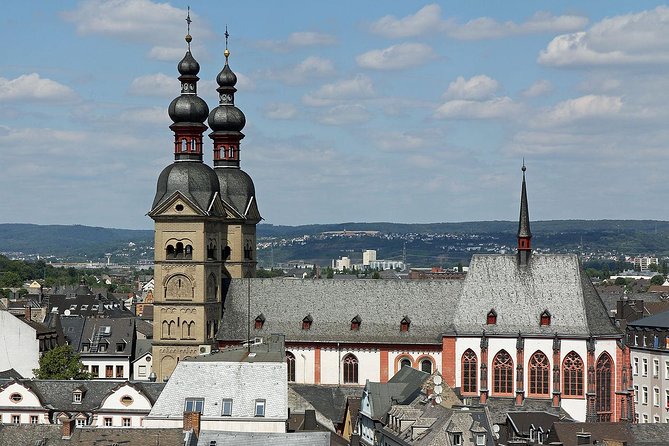
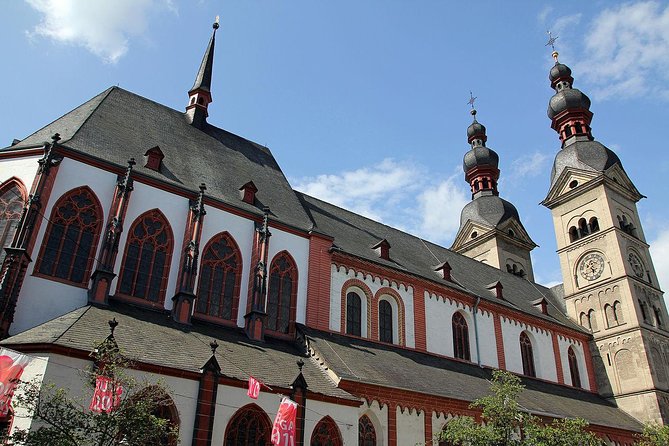
From Münzplatz, you continue toward Liebfrauenkirche, one of the city’s most recognizable church buildings. Its onion domes give it an immediately distinctive outline, and its location on the highest point of Koblenz adds to its visual importance.
The church was built in the 17th century and served as one of the main parish churches during the French Revolution. It was destroyed in 1944 and rebuilt in 1955. That sequence gives you a useful reminder that Koblenz is not simply a preserved medieval town. Parts of what you see today are reconstructions shaped by war and later rebuilding.
The route between Liebfrauenkirche and the next church is described as a romantic street between the two churches. This short section should appeal to you if you enjoy city walks that connect buildings through atmosphere, not just dates. The route feels more personal than a string of isolated monuments because the churches are viewed as part of the Old Town fabric.
You have about 15 minutes here. The stop is best treated as a guided exterior introduction unless your guide says otherwise. The supplied details do not promise an interior visit, a service schedule, or admission arrangements, so you should not book this tour expecting a long church tour.
Basilica of St. Castor, Koblenz’s oldest church
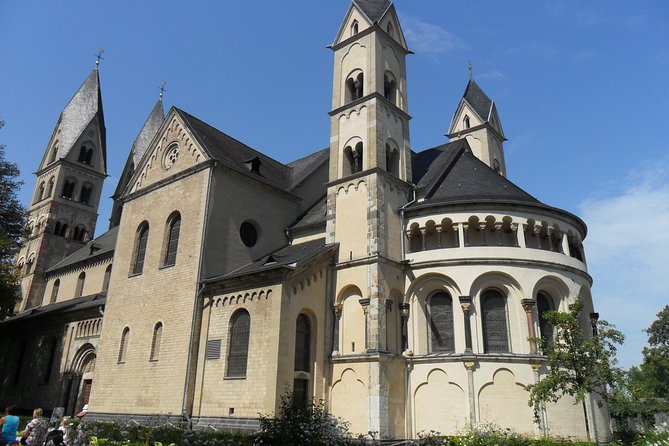
The next stop is the Basilica of St. Castor, identified as the oldest church in Koblenz. It was constructed between 817 and 836 by the Archbishop of Trier, with support from Emperor Louis the Pious. Its original role was that of a Carolingian proprietary church.
That early date makes this more than a pretty church stop. St. Castor helps explain the importance of Koblenz during the Carolingian period, when religious and imperial power were closely tied. You do not need to be a specialist to appreciate the age of the site. The basic fact that the church reaches back to the early ninth century gives the Old Town a much larger time scale.
The stop lasts around 15 minutes. I would use that time to listen for the guide’s explanation of how the church fits into Koblenz’s growth. The tour is especially useful here because the dates and political names can blur together when you see the building without context.
There is also a practical limit. A two-hour route cannot provide a full architectural study of the basilica, and the tour details do not specify an interior entrance. If you want to examine the church closely, note the location and return later with more time.
Something different for another day:
- Koblenz: Rhine Valley Castles and Palaces Boat Tour
★ 4.4 · 1,824 reviews - Koblenz: 2-Hour Sightseeing Cruise on the Rhine
★ 4.6 · 839 reviews - Koblenz: Panoramic Cruise on Moselle River to Winningen
★ 4.4 · 283 reviews - From Alken: Return Day Trip by Boat to Cochem
★ 4.6 · 141 reviews
Schängelbrunnen and Koblenz’s French connection
At Schängelbrunnen, the focus shifts from medieval and Carolingian church history to local identity. The fountain is beside the city hall and is regarded as a symbol of Koblenz.
The name Schängel comes from Koblenz’s 20-year allegiance to France from 1794 to 1813. The fountain was designed in 1940 by Carl Burger and dedicated to the poet Josef Cornelius. These details give the stop a different feel from the churches. Here, the city is telling a story about language, politics, and civic character.
I like this part of the route because symbols often tell you more about a city than grand monuments do. A fountain near city hall can reveal how local people remember their past. The French period is not just a date on a timeline; it is tied to the word Schängel and to a recognizable feature of daily city life.
Allow about 15 minutes. This is a good point to ask the guide about the meaning of Schängel and how the French connection affected Koblenz. The provided information does not explain the fountain’s sculptural details, so the depth of that discussion will depend on the guide.
Deutsches Eck and the end at the river
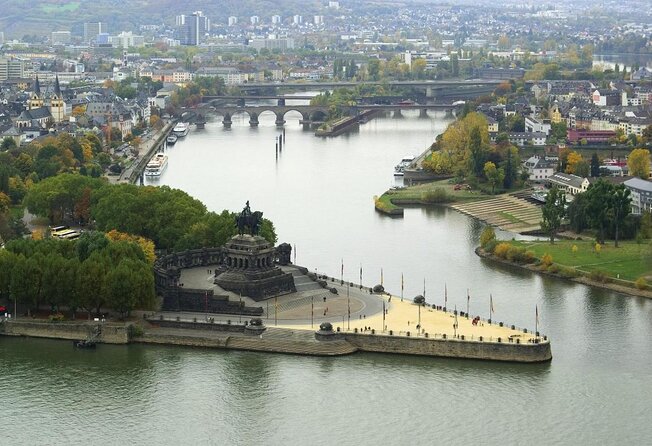
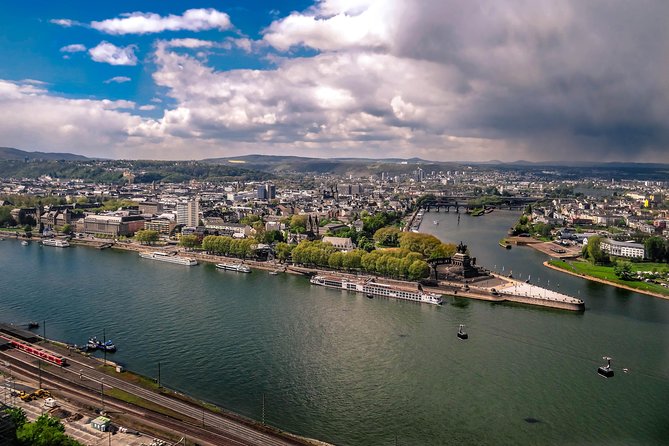
The final stop is Deutsches Eck, or German Corner, the headland where the Rhine and Moselle meet. The tour ends at Konrad-Adenauer-Ufer, beside one of Koblenz’s most famous open spaces.
The area is marked by the Kaiser Wilhelm memorial. Kaiser Wilhelm I was the first German Emperor, and the memorial was erected in 1897. This is a powerful ending because the tour moves from the Roman fort at the confluence to a monument built to express German national identity at the same meeting point of rivers.
You have about 35 minutes here, the longest stop of the tour. That makes sense. Deutsches Eck is broader than the earlier squares, and the location gives you time to view the memorial and other sights near the river. It is also the natural place for photographs, especially if you want the Rhine, Moselle, and Koblenz setting in the same visit.
I appreciate that the tour ends here rather than returning you to its starting point. The route has a clear finish, and you can continue exploring from the riverfront after the guide leaves. The tradeoff is that you must arrange your own return to Münzplatz or another part of Koblenz. The two meeting points are both in Koblenz’s central area, but the tour does not include transport.
The guide and the pace
A good city walk depends heavily on the guide. The strongest feedback available praises a guide who explained Koblenz in a lively and understandable way. That is exactly what you want on a short introductory walk, since the value comes from connecting the sights rather than simply naming them.
The schedule gives each early stop 15 minutes, followed by 35 minutes at Deutsches Eck. Those times include movement between locations, so you should expect a steady walking pace. The route is not designed for long café breaks, extended church visits, or detailed museum-style inspection.
You will benefit most if you arrive ready to listen while walking. Bring questions about the Roman origins, the French period, the churches, or the Kaiser Wilhelm memorial. Since the tour is private, your group has a better chance of shaping the conversation than it would on a large shared walk.
The tour is offered in English and uses a mobile ticket. Confirmation is received at booking. It is near public transportation, and the supplied participation information says most people can take part. Specific details about step-free access, seating, or the exact walking surface are not provided, so you should ask the operator if those points matter to you.
Price, group size, and real value
The price is $420.53 per group of up to 15 people. The wording matters: you are not paying per person, so the cost changes sharply depending on the size of your party.
For a couple, this is a premium walking tour. You may prefer a shared tour or self-guided visit if keeping costs low is your priority. For a family, cruise group, wedding party, or reunion of 10 or more people, the calculation is much better. At the full group size, the per-person cost is about $28, before any currency conversion, which is more defensible for a private guide.
The tour includes a focused two-hour route, an English-speaking guide, and private participation. The listed stops have free admission, but the details do not promise paid entries, food, drinks, hotel pickup, or transportation. That makes the tour’s value depend almost entirely on the quality of the guide and your desire for context.
The fact that it is booked on average 27 days ahead is a useful planning signal. I would not leave a private group booking until the last moment if your visit date is fixed. Several daily start times help, but they do not guarantee that your preferred time will remain open.
Who should book this Koblenz walk?
I would recommend it most strongly to first-time visitors who want orientation without committing half a day. It also fits families and larger private groups that value a shared guide and want the freedom to ask questions.
History-minded visitors should find plenty to enjoy, especially if Roman foundations, Carolingian church history, French rule, and German imperial memory appeal to you. The route gives you a compact introduction to all four subjects.
I would be more cautious if you want long interior visits, detailed art history, or a slow photography walk. The tour touches important churches, but the supplied details do not guarantee entry. The pace and two-hour limit also mean that you will see a lot of places without lingering at each one.
For visitors with limited time in Koblenz, the route is practical. Münzplatz and Deutsches Eck provide a clear beginning and end, while the churches and Schängelbrunnen fill in the story between them. You can use the final riverfront stop to decide what deserves a return visit.
Cancellation is free up to 24 hours before the start time for a full refund. Cancellations or changes made less than 24 hours before the start are not accepted for a refund, and the cut-off uses local time.
Should you book it?
Book this tour if you want a private, English-language introduction to central Koblenz and can share the cost with a sizable group. Its best qualities are the logical route, the strong focus on major Old Town sights, and the guide’s praised ability to make the history clear and lively.
Think twice if you are traveling alone or as a couple on a tight budget. You can see these central locations without paying a private-group rate, though you will lose the guide’s explanations and the chance to shape the conversation.
My practical call: choose it early for a group of five or more, especially if you want an easy first orientation. For a small party, compare the price carefully against your interest in guided history. The tour is short, focused, and useful, but its value rises or falls with the number of people sharing the fee.
FAQ
Where does the Koblenz Old Town tour begin?
It begins at Münzplatz, Münzplatz, 56068 Koblenz, Germany.
Where does the tour end?
It ends at Deutsches Eck on Konrad-Adenauer-Ufer, 56068 Koblenz, Germany.
How long does the tour last?
The tour lasts approximately two hours.
How much does the private tour cost?
The price is $420.53 per group, with up to 15 people included.
Is the tour private?
Yes. Only your group participates in the private tour or activity.
Is the tour offered in English?
Yes. English is the listed language.
What places are visited?
The route includes Münzplatz, Liebfrauenkirche, the Basilica of St. Castor, Schängelbrunnen, and Deutsches Eck.
Are the tour stops free to enter?
The listed admission for each stop is free. The details do not state that any separate paid attraction entry is included.
Is the tour suitable for most people?
The participation information says most people can take part. Specific details about accessibility features are not provided.
Can I cancel for a full refund?
Yes. You can cancel at least 24 hours before the start time for a full refund. Cancellations or changes made less than 24 hours before the start time are not accepted for a refund.
Just added around Koblenz
- Koblenz: The Living Vineyard, Nature & Wine Enjoyment★ 5.0 · 14 reviews
- e-Scavenger hunt Koblenz: Explore the city at your own pace★ 4.0 · 20 reviews
- Discovery tour – cellar tour with wine tasting★ 4.2 · 26 reviews
- Koblenz: Historical Sparkling Wine Museum Guided Tour★ 4.6 · 28 reviews
- Winetasting / Weinprobe Koblenz★ 4.3 · 31 reviews
- Cochem: Bike and Boat Tour with Picnic and Wine Tasting★ 3.7 · 35 reviews
- Koblenz: Christmas Boat Tour with Mulled Wine★ 4.3 · 35 reviews
- Koblenz: City & Rhine Valley Sightseeing Cruise★ 4.7 · 39 reviews
Old Town Walks, compared.
Old Town & Viktualienmarkt City Walk in German
Read our review →
The Night Watchman Old Town Walking Tour in German
Read our review →
Browse the lists this tour appears in