
Reviewed · HISTORICAL TOURS
Classic city tour in the World Heritage City of Augsburg
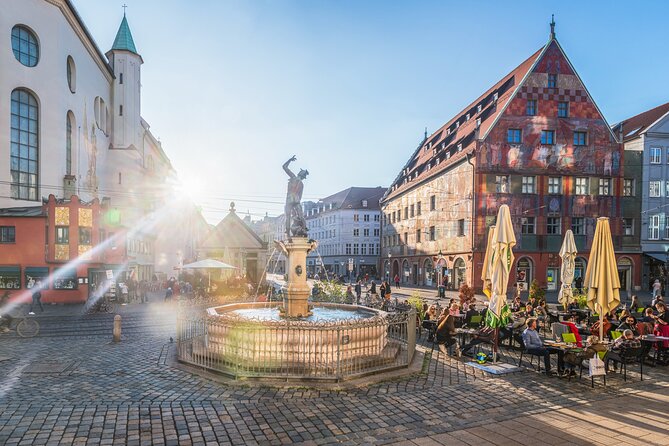
Augsburg packs centuries into two hours. This guided walk links the grand Town Hall, the Augustus Fountain, the canal-lined Lechviertel, and the famous Fuggerei, giving you a useful first look at the city without taking up an entire afternoon. I like the way the route mixes major sights with smaller streets, and I especially value the included admission to the Fuggerei.
I also like the focus on Augsburg’s water system, a UNESCO World Heritage Site feature that can be easy to miss on your own. The main drawback is that the tour may be bilingual, so English explanations can feel shorter, and a soft-spoken guide may be hard to hear outdoors.
In This Review
- Key points to know before you book
- Why this Augsburg walk makes sense for a short visit
- Rathausplatz and Augsburg’s grand Town Hall
- Augustus Fountain and the Roman city center
- The Lechviertel canals and old craftsman streets
- The Fugger story and the Fuggerei
- Language, guide quality, and hearing clearly
- Is $16.20 a fair price?
- Who should take this tour?
- Should you book the Augsburg classic city tour?
- FAQ
- Where does the tour begin?
- What time does the tour start?
- How long does the tour last?
- Where does the tour end?
- What admissions are included?
- Is the tour available with an amplifier system?
- Can I cancel for a full refund?
Key points to know before you book
- Two hours, four contrasting stops: You move from the grand Rathausplatz to fountains, canals, old artisan streets, and the Fuggerei.
- Two admissions included: The route includes entry to the Fuggerei and, depending on the date, either the Golden Hall, Roman Camp, or Brecht House.
- Augsburg’s water system gets real attention: The Lechviertel canals help explain how water supported the city’s growth and importance.
- The walk ends at the Fuggerei: You do not return to the starting point at the Tourist Information office, so plan your next stop from Jakoberstraße.
- English may be paired with German: The tour works well for many English speakers, but bilingual delivery can reduce the English time.
- Punctuality matters: The walk begins at 2:00 pm, and late arrivals may find the group has already left with no refund.
Why this Augsburg walk makes sense for a short visit
Augsburg is one of those German cities that rewards a little context. Its monuments are attractive on their own, but the city makes more sense when you connect the Roman settlement, merchant families, water channels, religious change, and social housing.
This tour gives you that basic framework in a compact format. At about two hours, it fits neatly into a day trip, a stop between train connections, or the first afternoon of a longer stay. You get a guided introduction rather than a string of disconnected photo stops.
The group can include up to 25 people. That is small enough for a personal feel in most places, though the experience depends on the guide’s voice and on how well the group gathers around each stop. An optional free sound amplifier system called elysium® is available if you bring your own smartphone, headphones, and internet connection.
That detail matters. Several stops take place outdoors, and Augsburg’s streets can carry sound away quickly. If you have trouble hearing in groups, bring headphones and use the system if it is offered for your tour.
The meeting point is the Tourist Information office at Rathausplatz 1. The 2:00 pm start is precise, so arrive early rather than trying to cut it close. One late arrival missed the group after being only a minute behind and received no refund. That is a painful lesson, but an easy one to avoid.
More Historical Tours in Germany:
- Leipzig: City History Canal Sightseeing Tour on a Motorboat
★ 4.7 · 6,232 reviews - Berlin: Natural History Museum Entrance Ticket
★ 4.6 · 3,382 reviews - Leipzig: 1.5-Hour Historical Walking Tour in German
★ 4.7 · 2,217 reviews
Rathausplatz and Augsburg’s grand Town Hall
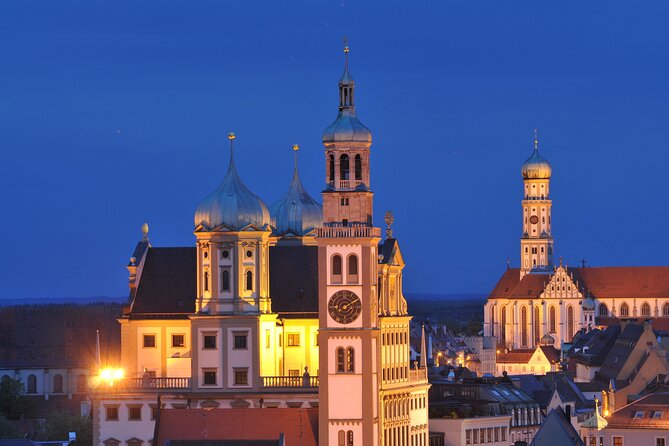
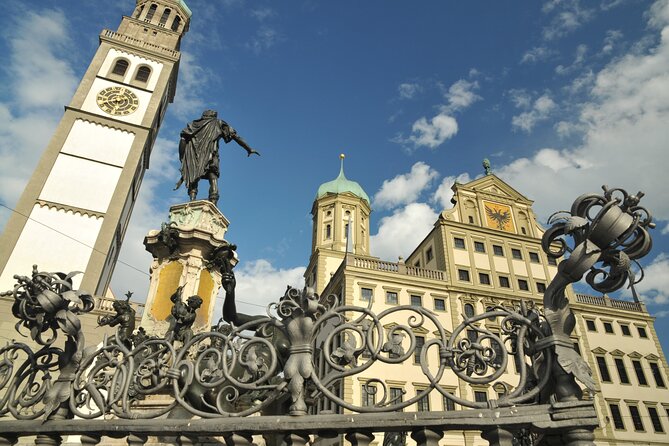
The tour begins at the city’s symbolic center, Rathausplatz. The first major stop is Augsburg Town Hall, where the included indoor visit gives the walk some visual drama right away.
Until the end of July 2024, the scheduled visit was to the Golden Hall. This is the tour’s most ornate interior option, and it gives you a sense of the wealth and confidence behind Augsburg’s historic merchant families. If you are visiting under that arrangement, allow the guide’s explanation to do more than identify decorative details. The important point is what the hall says about civic ambition and the money that flowed through the city.
From August 2024, the indoor stop changes by day. Tuesday through Friday includes the Roman Camp, while Saturday and Sunday includes the Brecht House. Check the exact arrangement for your date, since this affects the kind of story you will hear.
The Roman Camp connects Augsburg with its early settlement and Roman past. The Brecht House shifts the focus to literature and the city’s connection with Bertolt Brecht. These alternatives are quite different from the Golden Hall, so repeat visitors should not assume every tour provides the same interior experience.
The Town Hall visit lasts about 30 minutes and includes admission. That is a generous portion of a two-hour tour. It also explains why some people find the walking portion slightly light on additional stops: a large share of the time is spent inside the major attractions.
Augustus Fountain and the Roman city center
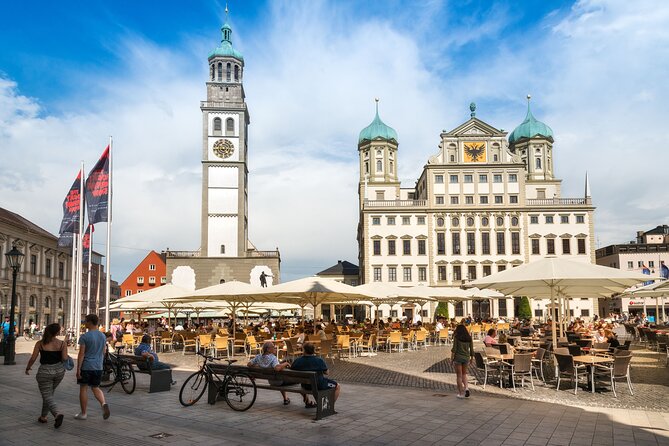
From the Town Hall, the route continues to the Augustus Fountain, one of Augsburg’s three grand fountains. It sits on Town Hall Square, making this an easy stop to combine with the building itself.
The fountain is more than a quick photograph. Augustus gives the city a direct link to its ancient Roman foundation, and the guide can place the monument within Augsburg’s larger civic story. You get about 15 minutes here, enough to look closely and hear an explanation without lingering too long.
This is also a good place to notice the changing scale of the city. The Town Hall and fountain present Augsburg as a powerful public center, while later parts of the route move into narrower streets and working neighborhoods. That contrast is one of the walk’s strengths.
The tour does not try to cover every Augsburg sight. You should not expect a full treatment of the Protestant movement, the Mozart family connection, or every major church and merchant house. Those subjects may come up, but the route gives more weight to the Fugger legacy and the city’s water system.
If you have particular interests, ask questions early. Guides have been praised for answering questions and for explaining how wealthy families built their fortunes and invested in the community. The amount of extra detail will depend on the group, the language mix, and the time available.
The Lechviertel canals and old craftsman streets
The Lechviertel is the most distinctive walking section. Here, the route leaves the broad civic square and follows small alleys beside Augsburg’s canals.
The water channels are central to the character of this part of town. They are not simply pretty urban details. They helped power craft and industry and played a part in Augsburg’s rise as an important city. The guide’s explanation turns the canals into evidence of how the city worked.
You will spend about 15 minutes in this area. That is enough for a useful introduction, but it is not a slow photographic walk. If you enjoy old streets, bridges, and watercourses, you may wish the route allowed more time here.
The Lechviertel also brings a more human scale to the tour. Grand fountains and decorated halls tell you about public wealth. The narrow lanes and canals suggest daily work, trade, and the practical systems that kept the city running.
Pay attention to the group’s position during this section. Narrow streets make it harder to stand in one large circle, and a quiet guide can be difficult to follow. Stay close enough to hear, and do not assume the whole group will automatically stop in the same place.
More City Tours in Germany:
- Berlin: 1-Hour City Tour by Boat with Guaranteed Seating
★ 4.3 · 16,993 reviews - Cologne: Panoramic City Cruise
★ 4.3 · 5,698 reviews - Berlin: City Sightseeing Hop-On Hop-Off Bus Tour
★ 4.1 · 4,233 reviews - Potsdam: City and Castles Tour
★ 4.7 · 3,721 reviews
The Fugger story and the Fuggerei
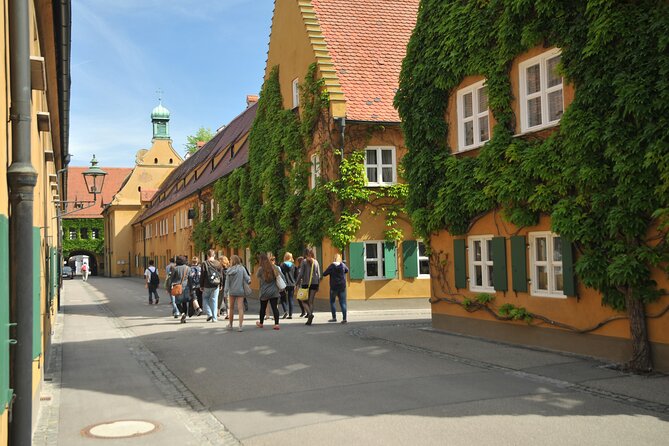
The final stop is the Fuggerei, the more than 500-year-old housing complex founded by the Fugger family. Admission is included, and the tour ends here at Jakoberstraße 26.
This is the part most directly tied to Augsburg’s famous merchant dynasty. The Fuggers built wealth through commerce and finance, then put money into civic and social projects. The Fuggerei shows that public role in a concrete way, through housing rather than a palace or ceremonial room.
The visit lasts about 30 minutes. That is enough time to understand why the complex is important and to see how its purpose differs from the grand spaces earlier in the tour. It is still a functioning social housing project, not merely a historic monument, which gives the stop more weight than a standard old-town courtyard.
Still, the balance may not suit everyone. Some people will find the Fuggerei the most memorable part of the afternoon. Others may feel that too much of the tour is devoted to the Fugger family, especially if they hoped for more about Augsburg’s religious history, Roman origins, or the Mozart family.
I would book this tour with the Fuggerei in mind, not as an afterthought. If that site is already high on your list, the included entry and guided explanation make the price attractive. If you have visited it before, you might prefer a tour with more emphasis on churches, architecture, or Augsburg’s wider cultural story.
Because the tour ends here, you can continue exploring the Fuggerei on your own if opening arrangements allow, or use the location as a starting point for the rest of your afternoon. The ending is practical for anyone who wants to keep walking east through the old city, but it is less convenient if you need to return to Rathausplatz immediately.
Language, guide quality, and hearing clearly
The strongest part of the experience is the guide’s interpretation. Several guides have been praised for making Augsburg’s story lively, adding amusing anecdotes, and explaining connections between the city’s families, waterworks, and civic life.
The tour is not always English-only. A mixed German and English group may receive the explanation in both languages. That can work well when the guide is comfortable switching between them, but the English version may be shorter. One English-speaking participant felt the guide seemed unhappy about presenting in English, while other bilingual groups found the explanations very good.
The difference appears to come down to the individual guide and the group on your date. The supplied information does not provide guide names, so you cannot choose a particular person in advance.
Sound is the more practical concern. At least one guide was described as too quiet to hear, and cold weather, snow, and outdoor noise have made listening harder for some groups. The free elysium® amplifier option is worth using if available. Bring a charged smartphone, headphones, and an internet connection.
Rain or cold does not cancel the main value of the walk, but it changes your comfort. One guide handled wet conditions well, while another winter group enjoyed the content despite cold feet and occasional trouble hearing. Dress for standing outside, since the route includes several open-air explanations.
Is $16.20 a fair price?
At the stated price of $16.20 per person, this is a strong-value introduction to Augsburg. You receive about two hours with a guide, entry to the Fuggerei, and entry to one additional indoor site depending on the date. The admissions alone make the cost more appealing than a simple orientation walk.
The value is best if you are new to Augsburg and want the city’s main themes explained quickly. You get architecture, civic power, Roman connections, water engineering, merchant wealth, and social housing in one route.
The price is less compelling if you want extensive detail at every stop. The route covers a lot, and the short 15-minute sections cannot provide a full lecture on Augsburg’s religious, artistic, and political development. A bilingual tour may also mean less English content for your money.
With an average booking time of 11 days ahead, it is sensible to reserve before your visit if the afternoon timing matters. The maximum group size is 25, and the tour requires a minimum number of participants. If the operator cancels because that minimum is not met, you are offered another date or experience, or a full refund.
Free cancellation is available until 24 hours before the 2:00 pm start. Inside that 24-hour window, you cannot receive a refund or make changes, so do not book this as a loose, last-minute placeholder.
Who should take this tour?
I would recommend it to first-time visitors, day trippers, and anyone who wants a clear introduction before exploring Augsburg independently. It is also a good choice if the Fuggerei is a priority and you want the admission included.
The walk suits most participants, and service animals are allowed. It is near public transportation, but the information does not give a specific accessibility rating or promise a step-free route, so contact the provider if mobility details are important to you.
You may want another type of tour if you already know the Rathausplatz and Fuggerei, or if your main interests are the Protestant movement, the Mozart family, or a more detailed Roman-era account. This route gives those subjects less room than the city’s Fugger and water stories.
Should you book the Augsburg classic city tour?
Book it if you have two hours, want the major Augsburg themes in one walk, and have not yet seen the Fuggerei. The included admissions, modest price, and route through the Lechviertel canals make it a practical first step.
Go in with sensible expectations. Arrive early, stay close enough to hear, bring headphones for the optional amplifier, and confirm which indoor stop applies to your date. If your group is bilingual, expect the English portion to vary.
For a short visit, I think the tour earns its place. It gives you enough background to make Augsburg’s monuments and canals more meaningful, while leaving the rest of the day open for your own discoveries.
FAQ
Where does the tour begin?
It begins at the Tourist Information office, Rathausplatz 1, 86150 Augsburg, Germany.
What time does the tour start?
The scheduled start time is 2:00 pm.
How long does the tour last?
The tour lasts approximately two hours.
Where does the tour end?
It ends at the Fuggerei, Jakoberstraße 26, 86152 Augsburg, Germany.
What admissions are included?
Admission to the Fuggerei is included. The indoor stop is the Golden Hall until the end of July 2024, then the Roman Camp Tuesday through Friday or the Brecht House on Saturday and Sunday.
Is the tour available with an amplifier system?
Yes. The elysium® sound amplifier system is optional and free of charge. You need your own smartphone, headphones, and internet connection.
Can I cancel for a full refund?
Yes, if you cancel at least 24 hours before the experience start time. Cancellations or changes made less than 24 hours before the start are not refunded or accepted.
Just added around Germany
- e-Scavenger hunt Aachen: Explore the city at your own pace★ 4.0 · 13 reviews
- Munich: Private or Group Third Reich and WWII Walking Tour★ 4.9 · 13 reviews
- Canyoning Advanced Day Trip★ 5.0 · 13 reviews
- Wiesbaden Biebrich: Outdoor Escape Game★ 4.7 · 13 reviews
- Berlin: Private Guided Tour of the Main Sights★ 5.0 · 13 reviews
- From Munich: Neuschwanstein Castle and Linderhof Private Tour★ 5.0 · 13 reviews
- Trier, Moselle: Wine excursion with boat trip★ 3.9 · 13 reviews
- From Dresden: Guided Day Tour by Bus of Seiffen Toy Village★ 4.0 · 13 reviews
Historical Tours, compared.
City History Canal Sightseeing Tour on a Motorboat
Read our review →



Bamberg: Guided Beer History Tour with Optional Tasting
Read our review →Browse the lists this tour appears in