
Reviewed · 3-HOUR EXPERIENCES
Berlin Private Custom 3-Hour Tour by Car
Berlin makes a strong first impression. This private car tour links the city’s major landmarks with room to follow your interests, from the Reichstag and Brandenburg Gate to Cold War sites and Museum Island. I especially like the custom itinerary and the ease of hotel pickup and drop-off. The main drawback is time: three hours is enough for orientation and brief stops, not full museum visits or long walks.
The tour costs $337.90 per person, so it makes the most sense for a small group that values privacy, comfort, and efficient sightseeing. Guides such as Thomas, Winfried, Luca, Wilfred, and Sven have been praised for clear explanations, personal stories, and flexible planning. Just remember that most stops last five to ten minutes.
In This Review
- Key points at a glance
- Why a private car works well in Berlin
- Starting at the Reichstag and Brandenburg Gate
- The Holocaust Memorial and Potsdamer Platz
- Tracing repression at the Topography of Terror
- Checkpoint Charlie and the former East-West divide
- Gendarmenmarkt and Unter den Linden
- Berliner Dom and Museum Island
- Victory Column and the green center of Berlin
- Kurfürstendamm, the Memorial Church, and KaDeWe
- What the guides add to the drive
- Timing, comfort, and the real value of $337.90
- Who will get the most from this tour
- Should you book the Berlin private car tour?
- FAQ
- How long is the Berlin private custom tour?
- What transportation is provided?
- Is hotel pickup and drop-off included?
- Can I be picked up at the airport?
- Is the itinerary customizable?
- Is cancellation free?
Key points at a glance
- Covers a wide stretch of Berlin: You can reach Mitte, the former Wall zone, Tiergarten, and western Berlin in one compact outing.
- Built around your interests: Ask to focus on political history, the Cold War, architecture, shopping, or a broad first look at the city.
- Useful hotel service: Pickup and drop-off anywhere in Berlin are included, with airport pickup possible under special conditions.
- Strong guide element: Thomas and Winfried receive especially warm praise for their historical detail, humor, and ability to engage teenagers and adults.
- Mostly exterior sightseeing: The tour gives you context at famous sites, but the short stops do not allow time for full museum visits.
- Comfort matters here: An air-conditioned private minivan saves time and gives you shelter in poor weather.
Why a private car works well in Berlin
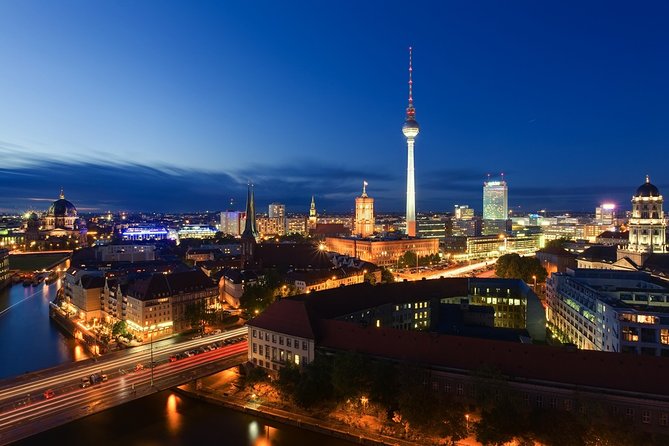
Berlin is spread out. Its important places do not sit in one tidy old town, and the city’s story is divided between former East and West Berlin. A private vehicle helps connect those pieces without making you spend much of your short visit studying transit maps.
That convenience is the central value of this experience. You can move from the Reichstag to Checkpoint Charlie, then out toward Kurfürstendamm and the Kaiser Wilhelm Memorial Church, all while listening to commentary between stops.
The tour is private, so only your group participates. That gives you more freedom than a scheduled coach tour. You can ask questions, request a different emphasis, or spend more time on a place that matters to you.
Still, you should set realistic expectations. The listed route includes 14 stops, but the scheduled visits add up to roughly 105 minutes. The remaining time covers driving, parking, orientation, and conversation. You will see a lot, but much of it will be from the vehicle or during a quick photo stop.
A few more tours and experiences worth a look
- Berlin Highlights 3-Hour Bike Tour
★ 5.0 · 948 reviews - Berlin Highlights: 3-Hour Bike Tour
★ 4.9 · 809 reviews - Berlin: 3-Hour Street Art Tour
★ 4.7 · 778 reviews
Starting at the Reichstag and Brandenburg Gate
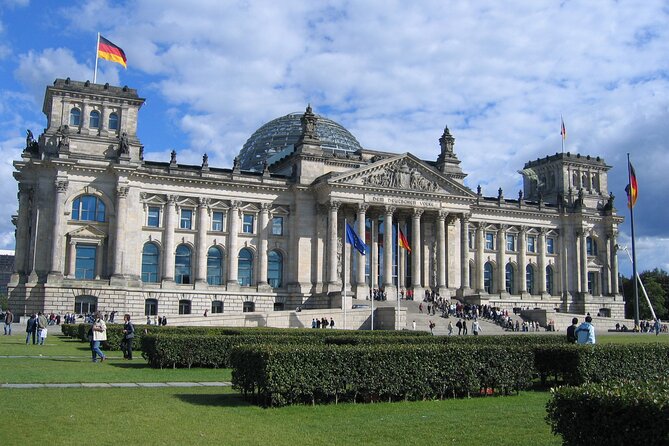
The Reichstag is a sensible opening stop because it introduces Berlin’s political past and present. Built in 1895, it endured the 1933 fire, wartime damage, bombs, and bullet holes before Norman Foster’s renovation gave it a modern parliamentary role.
You receive about ten minutes here, enough to look at the exterior and hear why the building matters. Admission is listed as free, but this tour does not promise entry into the building or its dome. If seeing the interior is important to you, ask the operator before booking.
A short drive brings you to Brandenburg Gate, Berlin’s best-known symbol. Napoleon, Hitler, and Reagan all used this setting for very different political purposes, which gives your guide plenty to explain in a small space.
Ten minutes is enough for photographs and a quick look at the surrounding Pariser Platz. It is not enough to linger, study every architectural detail, or wait for a quiet view. The car allows you to arrive without sacrificing a long chunk of your day.
The Holocaust Memorial and Potsdamer Platz
The Memorial to the Murdered Jews of Europe requires a slower, quieter approach than a standard sightseeing stop. Its field of concrete blocks is Berlin’s central place of mourning for the six million Jews murdered during the Holocaust.
The tour allows about ten minutes. That gives you a first encounter with the memorial, but it is too brief for the underground information center or a careful walk through the entire site. I would treat this as an introduction and return later if you want time for reflection.
Potsdamer Platz shows a different side of modern Berlin. Once a no man’s land beside the Berlin Wall, it became one of the city’s busiest intersections after reunification. The five-minute stop is mainly for orientation and a quick photograph.
This contrast is one of the tour’s strengths. In a few minutes, you move from remembrance to redevelopment, seeing how Berlin has rebuilt spaces that were once divided or damaged. The guide’s commentary is especially useful here because the present-day streets do not always reveal what stood there before.
Tracing repression at the Topography of Terror
At the Topography of Terror, you see surviving sections of the Berlin Wall near a documentation center built on the former site of the Gestapo and SS headquarters. It is one of the clearest places in the city to connect Nazi state terror with the later history of division.
The stop lasts about ten minutes. You can view the Wall remains and get a sense of the site, but a full visit to the documentation center needs more time. If modern German history is your main interest, tell your guide at the start so the route and commentary can give this area more weight.
This is also a good example of why a private tour can be more useful than a fixed sightseeing circuit. The itinerary includes many locations, yet your guide can explain which ones deserve a return visit and help you plan the rest of your stay.
Something different for another day:
- Berlin: Reichstag, Dome and Government District Guided Tour
★ 4.7 · 18,288 reviews - Berlin: 1-Hour City Tour by Boat with Guaranteed Seating
★ 4.3 · 16,993 reviews - Berlin: Boat Tour Along the River Spree
★ 4.4 · 11,252 reviews - Discover Berlin Half-Day Walking Tour
★ 5.0 · 9,624 reviews
Checkpoint Charlie and the former East-West divide
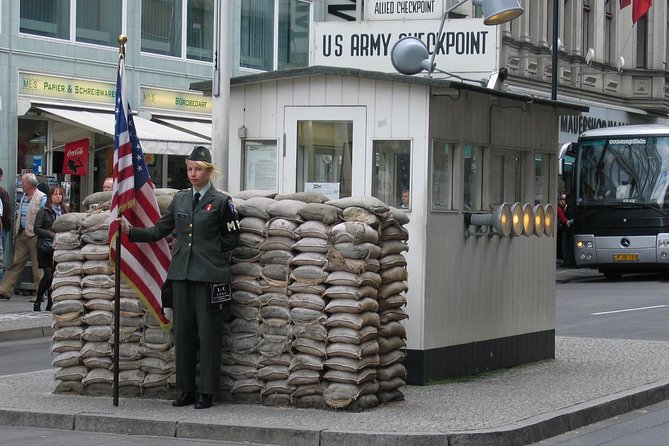
Checkpoint Charlie is the most famous crossing point between East and West Berlin. It was reserved for Allied soldiers and other foreigners, while German citizens could not use it.
The planned stop is only five minutes. You can see the location and hear its role in the Cold War, but do not expect a long examination of the surrounding exhibits or modern commercial displays. The value here comes mainly from the guide’s explanation of who could cross, who could not, and why the checkpoint became such a powerful symbol.
For first-time visitors, this portion of the route helps place Berlin’s divided history on a map. You have already seen wartime destruction and Nazi institutions, and now you are following the city into the postwar struggle between East and West.
Gendarmenmarkt and Unter den Linden
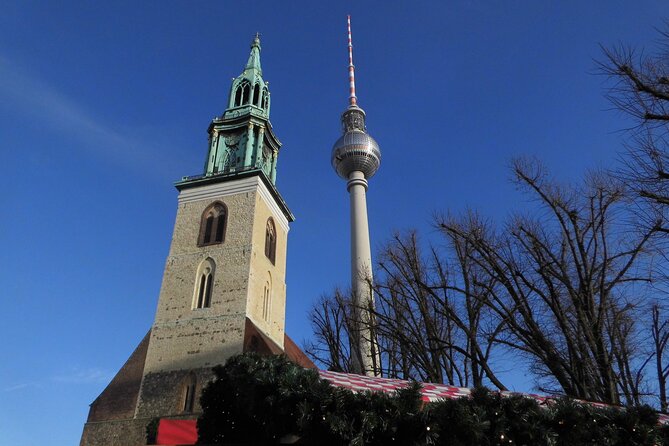
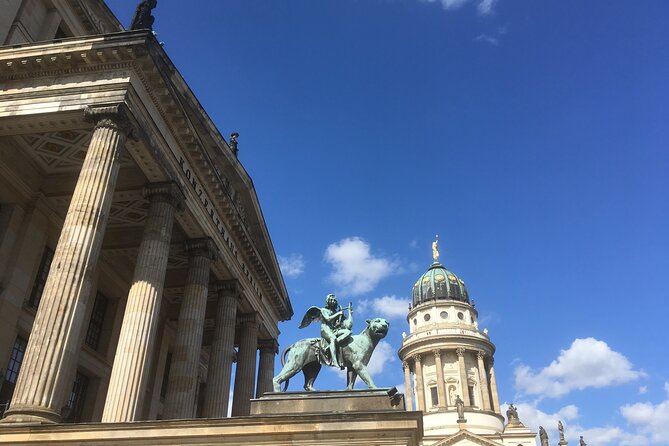
Gendarmenmarkt is presented as Berlin’s most beautiful square, framed by the German and French Domes with Schinkel’s Concert Hall in the center. The five-minute stop is brief, but the square is compact enough for a quick look and a strong architectural overview.
Ask your guide to point out how the buildings relate to one another. This is one place where a little explanation adds much more than a photograph alone. Construction, political power, religion, and public ceremony all meet in one urban space.
Unter den Linden then carries you toward the former Hohenzollern Palace site. The palace was demolished and the area has since been rebuilt as the Humboldt Forum, now a major museum. Along the avenue, you pass historic buildings including the Opera House and the former Armory, now Germany’s History Museum.
The ten-minute stop is best understood as a moving introduction to Berlin’s grand central axis. You will not have time to explore the museums, but you can mark them for later. I like this approach because it helps you choose where to spend your independent time instead of wandering without a plan.
Berliner Dom and Museum Island
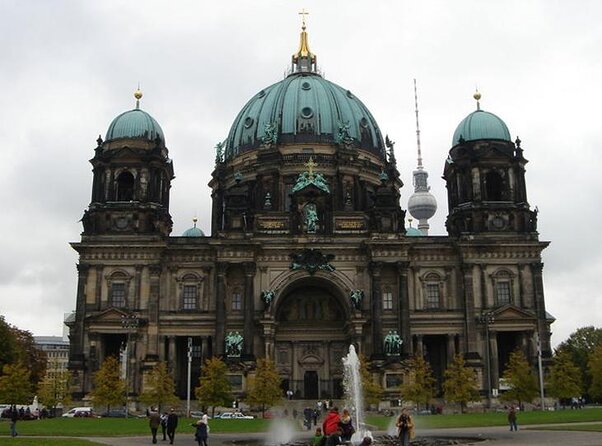
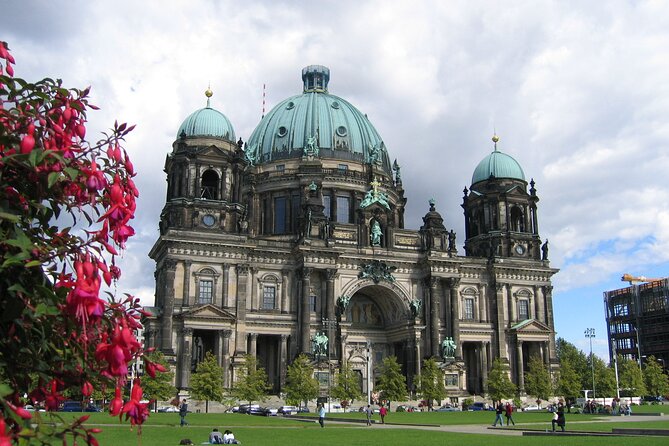
Berlin Cathedral is Germany’s largest Protestant church, and members of the Hohenzollern family are buried inside, including King Frederick I and Sophie Charlotte. The listed stop lasts five minutes, so expect an exterior visit and a short explanation rather than a full look inside.
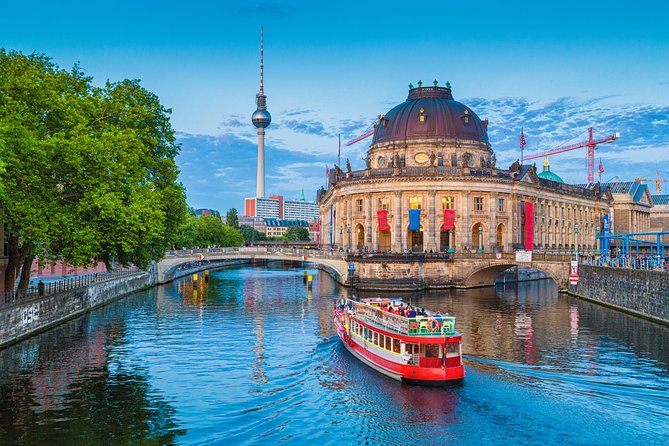
Museum Island sits nearby and is a UNESCO World Heritage Site. The complex includes the Neues Museum, home to Nefertiti, and the Pergamon Museum, known for the Ishtar Gate.
Again, the five-minute stop does not include a museum visit. That limitation matters. Museum Island can absorb half a day or more, and admission arrangements vary by museum. Use the car tour to understand the setting, then return independently if you want to see the collections.
The nearby sights also make this part useful for planning. Your guide can point out the museums and give you a sense of how they fit into central Berlin. Several tour participants valued recommendations for extending their visit, including a lunch suggestion at the rebuilt royal palace area.
Victory Column and the green center of Berlin
The Victory Column commemorates three Prussian victories, including the 1871 victory over France. It was originally placed in front of the Reichstag and later moved to its current position in Tiergarten by Albert Speer.
The five-minute stop offers a quick look at the column and its setting. The site is visually different from the dense central streets, giving you a brief view of Tiergarten, Berlin’s large central park.
This stop also shows how political symbols have been moved and reinterpreted over time. A good guide will explain more than the date on the monument, connecting its location to the changing uses of Berlin’s public spaces.
Kurfürstendamm, the Memorial Church, and KaDeWe
Kurfürstendamm, or Ku-Damm, takes you into former West Berlin. The broad boulevard is lined with high-end stores, cafés, restaurants, theaters, and the Kaiser Wilhelm Memorial Church.
The ten-minute drive-by or stop lets you compare western Berlin with the grand avenues of Mitte. It is a useful reminder that Berlin is not one uniform city. Different districts reflect different political eras, rebuilding choices, and ideas about urban life.
The Kaiser Wilhelm Memorial Church is particularly striking. The original church, dedicated to Emperor Wilhelm I, remains a war ruin beside a modern church designed by Egon Eiermann. You can see how the damaged tower was preserved rather than erased, turning destruction into a public reminder.
Kaufhaus des Westens, usually called KaDeWe, is described as continental Europe’s largest and perhaps most luxurious department store. The planned five-minute stop is enough to identify it and understand its role as a West Berlin shopping symbol. If you want to shop or visit its food offerings, plan a separate visit.
This western section is a good fit for people interested in architecture, shopping, postwar history, or the contrast between the city’s former halves. It also gives the route a welcome change of pace after the memorials and political sites.
What the guides add to the drive
The strongest part of the experience is not the minivan itself. It is the guide’s ability to turn a fast-moving city tour into a coherent story.
Thomas is repeatedly praised for his preparation, enthusiasm, friendliness, and detailed explanations of both prewar and postwar Berlin. Winfried is noted for his command of German and Berlin history, perfect English, humor, and ability to keep teenagers engaged. Luca receives similar praise for clear explanations and useful local recommendations, while Wilfred and Sven are described as flexible and well prepared.
Guide assignments can vary, and the tour may be operated by a multilingual guide. English is offered, but you should not assume a particular guide by name unless the company confirms it.
The best results come when you explain your interests before or at pickup. You might ask for more Cold War context, more Nazi-era history, architecture, shopping, or local recommendations. The experience is designed to adjust, and several groups appreciated that their route changed to fit their priorities.
Timing, comfort, and the real value of $337.90
At $337.90 per person, this is not a budget sightseeing ride. The price includes local taxes, a private tour, a driver-guide, hotel pickup and drop-off, and transport in an air-conditioned minivan.
The value depends heavily on group size. For one or two people, the per-person cost is high. For a family or small group, the private vehicle, door-to-door service, and ability to share one guide can make the price more reasonable, especially if you want a polished introduction without organizing several separate excursions.
You are also paying for time saved. Berlin’s major sights are widely scattered, and navigating between them by public transport takes planning. The car does not eliminate traffic or parking delays, but it gives you a comfortable base and lets you cover districts that would be difficult to combine on foot.
The tour operates in all weather, so dress for conditions. That matters in winter, when one participant found the vehicle especially useful during a freezing spell. Service animals are allowed, most people can participate, and the activity is near public transportation.
Pickup is available at any hotel or residence in Berlin. Airport pickup can be arranged under special conditions, so ask about it before assuming it is included in the standard arrangement. One group used an airport pickup followed by the city tour and hotel drop-off, which made the experience a practical arrival-day option.
You receive confirmation at booking, and free cancellation is available up to 24 hours before the start time. Changes or cancellations inside that window are not accepted for a refund.
Who will get the most from this tour
I would choose this tour for a first morning in Berlin, especially if you want to understand the city before exploring it on your own. One participant described it as an effective way to get oriented after realizing how large Berlin is, and that is exactly the point.
It also suits families, older visitors, and anyone who does not want a day of long walks. Teenagers can stay engaged because the route changes often, while the private setting gives them space to ask direct questions.
History-minded visitors will get the most from the commentary. The route links the Nazi period, World War II, the Holocaust, the Berlin Wall, reunification, Prussian architecture, and modern redevelopment. That is a lot for three hours, but the sequence gives Berlin’s complicated past a clear shape.
I would not choose it as your only Berlin experience if you want to enter museums, climb the Cathedral, spend time at the Holocaust Memorial, or explore Checkpoint Charlie on foot. Think of it as a guided overview and planning tool, not a complete visit to every attraction.
Should you book the Berlin private car tour?
Book it if you want a comfortable, private introduction to a large and historically complex city. The best reasons are the flexible route, hotel service, broad coverage, and guides such as Thomas or Winfried, who bring detail, humor, and personal stories to the drive.
Skip it if $337.90 per person feels steep for brief stops, or if you prefer slow walking and long museum visits. If you do book, tell the operator your priorities and ask whether your preferred guide is available. Used on the first day, this tour can help you choose where to return, what to study, and how Berlin’s divided past fits together.
FAQ
How long is the Berlin private custom tour?
The tour lasts approximately three hours.
What transportation is provided?
Transport is provided in a private, air-conditioned minivan.
Is hotel pickup and drop-off included?
Yes. Pickup and drop-off are offered at hotels or residences anywhere in Berlin.
Can I be picked up at the airport?
Airport pickup is possible under special conditions. You should ask the operator for details before booking.
Is the itinerary customizable?
Yes. You can customize the itinerary around your interests, including major landmarks and less familiar places.
Is cancellation free?
You can cancel for a full refund up to 24 hours before the experience start time. Cancellations or changes made less than 24 hours in advance are not accepted for a refund.
Just added around Berlin
- Berlin: Private Guided Tour of the Main Sights★ 5.0 · 13 reviews
- Private Highlights of Berlin Bike Tour★ 5.0 · 13 reviews
- Modern Berlin Private Walking Tour: Diverse, Vibrant and Exciting German Capital★ 5.0 · 13 reviews
- Tour in Berlin from Warnemünde and Rostock Cruise Port★ 4.1 · 13 reviews
- Berlin: Stasi Museum Private Guided Tour with Entry Ticket★ 4.8 · 13 reviews
- Private Food Tour Experience with a born and bred Berliner★ 5.0 · 14 reviews
- Berlin: Rheinsberg Palace Entrance Ticket★ 4.8 · 14 reviews
- Berlin in one day – day tour with an expert guide★ 5.0 · 14 reviews
3-Hour Experiences, compared.



Munich’s Beer Halls and Breweries: 3-Hour Guided Tour
Read our review →

Browse the lists this tour appears in