
Reviewed · CYCLING TOURS
Berlin: Experience the Alternative Kreuzberg on a Bike Tour
Berlin has more than Brandenburg Gate. This three-hour bike ride leads you into Kreuzberg, Friedrichshain, and Kreuzkölln, where old Wall traces, artists’ spaces, Turkish markets, river views, and rough-edged city life share the same streets. I like the route’s mix of history and present-day Berlin, and I like that guides such as Rico, Jake, Bjorn, Karl, and Rufus bring personal stories and humor to the ride. The main drawback is that the tour includes many stops and explanations, so you may pedal less than you expect.
I also like the small group size, capped at 15 people, along with bikes and helmets included in the $42.33 price. You should know that this is not a fast cycling workout. It is a guided city tour with frequent stops, and rain will not automatically cancel it. Wear practical clothes, and be careful with loose trousers around the bike chain.
In This Review
- Key points to know before you book
- Why this bike tour shows a different Berlin
- Nikolaiviertel to Kreuzberg: leaving the polished center
- Engelbecken and Das Baumhaus: quiet corners beside the Wall
- Squats, artists, and the view near YAAM
- East Side Gallery and Oberbaum Bridge: Berlin’s Wall in public view
- Osthafen and the strange sculpture
- Falckensteinstraße and Görlitzer Park
- Liegnitzer Straße, the Turkish market, and neighborhood life
- Admiral Bridge and Kottbusser Tor: two final faces of Kreuzberg
- Guides, pace, and what the ride feels like
- Is $42.33 a fair price?
- Who should book this tour?
- Final verdict: a strong choice for Berlin’s rougher, more human side
- FAQ
- How long is the Berlin alternative Kreuzberg bike tour?
- Where does the tour start and finish?
- What time does the tour start?
- Is bicycle equipment included?
- Is the tour available in English?
- Can children join the tour?
- What happens if the tour is canceled because too few people book?
Key points to know before you book
- Kreuzberg beyond the postcard: See neighborhoods shaped by migration, political activism, squatting, art, nightlife, and major urban change.
- A Wall story with many angles: The route links Nikolaiviertel, the East Side Gallery, Oberbaum Bridge, Osthafen, and places where the former border still shapes the city.
- Guides make the difference: The strongest praise goes to guides including Jake, Bjorn, Rico, Karl, Rufus, and Vincent for their stories, humor, safety, and local insight.
- An easygoing pace: Frequent stops make the ride manageable for most people, but anyone expecting nonstop cycling may find the talking time long.
- Useful equipment included: Your bicycle and helmet are supplied, and infant seats can be provided on request.
- A city ride with rough edges: Kottbusser Tor, Görlitzer Park, and the car loft on Liegnitzer Straße show Berlin’s contradictions rather than polishing them away.
Why this bike tour shows a different Berlin
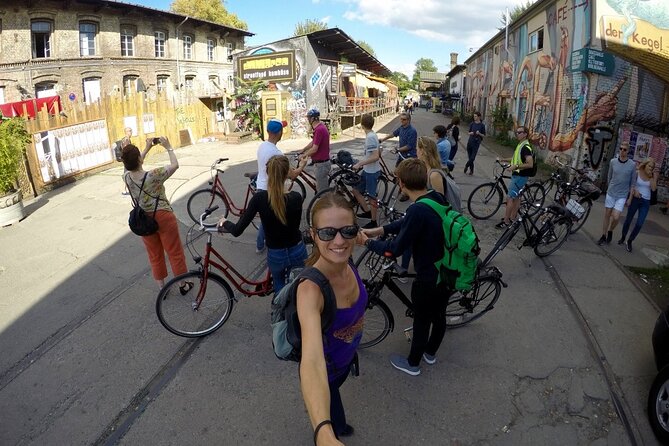
The route begins at Free Berlin Bike Tours & Rental, Poststraße 11, in central Berlin. That starting point near Nikolaiviertel gives you a brief look at one of the city’s most established and carefully presented historic areas. Then the tone changes.
The tour heads toward Kreuzberg and nearby districts, places where Berlin feels less arranged for sightseeing. You see a city shaped by workers arriving from abroad, former East and West Berlin divisions, artists taking over unused buildings, and residents defending their own way of life.
That contrast is the point. You are not only looking at monuments. You are using the bicycle to connect streets, courtyards, bridges, parks, markets, and riverside spaces that can feel scattered when explored on foot.
The tour runs for about three hours and is offered in English, with German available depending on the selected option. The usual group size is between four and 15 people. That is small enough for a guide to answer questions, but large enough that the ride does not feel like a private outing.
More Bike Tours in Berlin
- Berlin: Sights and Highlights Bike Tour with a Local Guide
★ 4.8 · 2,698 reviews - Berlin Highlights 3-Hour Bike Tour
★ 5.0 · 948 reviews - Berlin City Bike Tour with Beer Garden Stop
★ 5.0 · 917 reviews
Nikolaiviertel to Kreuzberg: leaving the polished center
Nikolaiviertel is a short opening stop, lasting about five minutes. It functions almost like a visual doorway between two versions of Berlin.
You start in one of the city’s more established historic settings, then move toward Kreuzberg, a district with a more mixed and unsettled character. The quick stop means you should not expect a full tour of Nikolaiviertel. Its value is in the contrast it creates.
Kreuzberg receives about 30 minutes and is the main setting for the tour’s social and cultural story. The area is presented as a meeting place for different communities, architectural styles, political ideas, and ways of living.
This is where a good guide matters. The strongest guides do not simply recite dates. They explain how the district changed, how people made use of neglected spaces, and how Kreuzberg became associated with alternative culture. Guides have also brought personal experiences into the storytelling, which can make the neighborhood feel less like a museum exhibit.
Engelbecken and Das Baumhaus: quiet corners beside the Wall
Engelbecken is a short ten-minute pause in an unexpected pocket of calm. Its setting between prefabricated buildings, older structures, and newer architecture helps you read the district as a place of layers rather than a single style.
It is a useful stop for anyone interested in how Berlin rebuilt and changed after division. You have time to look around and listen, but not enough for a long independent exploration.
Das Baumhaus, or the Treehouse by the Wall, offers one of the route’s most unusual stories. It concerns a guest worker who adapted quickly to Kreuzberg’s bold, do-it-yourself spirit and established a garden structure beside the Wall.
The story captures an important part of the neighborhood’s character: people using nerve, imagination, and persistence to claim a small piece of space. You get a better sense of Kreuzberg as a lived-in district, not just a nightlife address.
Squats, artists, and the view near YAAM
The route includes a former squatting site that later became a place for artists. Squatting played a major role in Berlin’s alternative scene, especially during its peak in the 1980s and again in the early 2000s.
The building’s use by artists of different kinds gives the stop a clear lesson about Berlin’s cultural life. It also shows the tension behind the city’s creative reputation. Spaces that once offered room for experimentation can later become part of a changing property market.
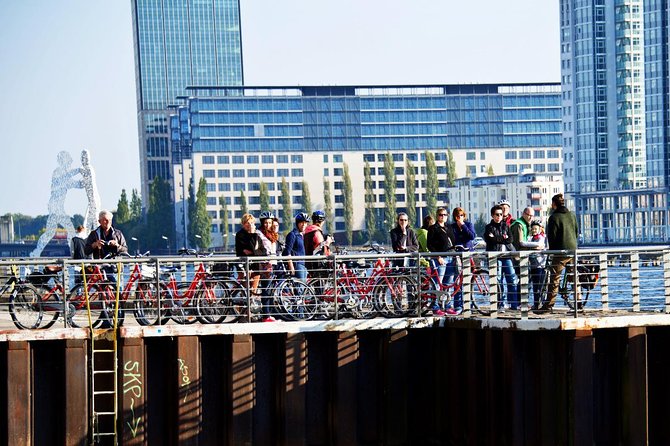
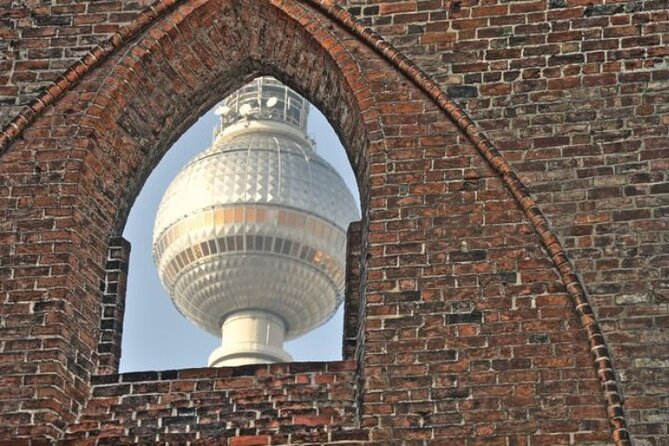
Near YAAM, the view may be one of the best visual pauses on the ride. From this area, you can see the TV Tower, Holzmarkt, Oberbaum Bridge, and the Spree.
YAAM itself is described as an important club, but the point here is the wider scene around it. The river, bridge, tower, and new development make Berlin’s past and present visible in one glance. Take a minute to look instead of treating the stop as a quick photo break.
More Bike Tours around Berlin:
- Berlin Highlights: 3-Hour Bike Tour
★ 4.9 · 809 reviews - Berlin Highlights Sightseeing Bike Tour in Small Groups
★ 5.0 · 652 reviews - Berlin: Alternative Bike Tour of Kreuzberg & Friedrichshain
★ 4.7 · 548 reviews - Berlin: Guided Bike Tour of the Berlin Wall and Third Reich
★ 4.7 · 499 reviews
East Side Gallery and Oberbaum Bridge: Berlin’s Wall in public view
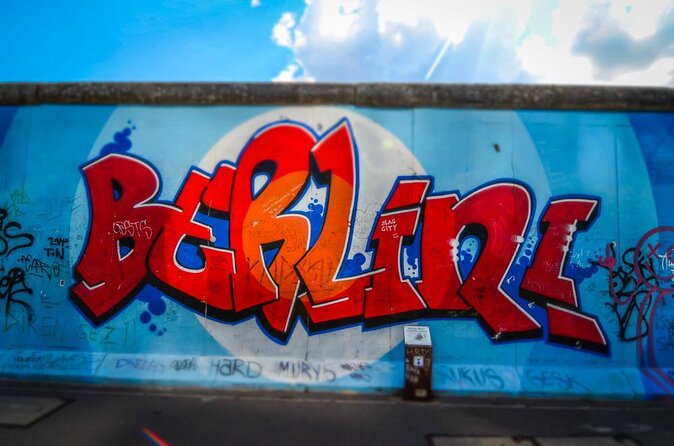
The East Side Gallery is the longest remaining section of the Berlin Wall. Its painted panels make it one of Berlin’s most recognizable places, yet the surrounding setting keeps changing.
The Wall now runs beside a redesigned business quarter, which creates a sharp contrast. Political art and commercial development occupy the same stretch of city. The stop lasts about ten minutes, so you will see a section rather than study every mural.
The tour then reaches Oberbaum Bridge, the landmark connecting Kreuzberg and Friedrichshain. Its symbolism is especially strong because the bridge represents crossing borders in both literal and broader ways.
This is one of the route’s clearest reminders that Berlin was divided, controlled, and later reconnected. The bridge also helps you understand how closely the districts are linked today, even though their identities remain distinct.
Osthafen and the strange sculpture
Osthafen was once restricted borderland. Today it is associated with young urban creatives and riverside redevelopment.
This stop gives you a practical way to think about the former East German border system. The Spree may look open and inviting now, but the border once made movement tightly controlled. The tour uses this spot to explain why the Wall and its surrounding restrictions mattered so much to the government of the former GDR.
You also stop near a distinctive sculpture that has inspired several interpretations. The official explanation is presented as the least convincing one, which fits the tour’s playful attitude toward Berlin’s public art.
Do not expect a formal art lecture here. The appeal is the oddness of the object and the chance to hear how Berliners can read the same piece in different ways.
Falckensteinstraße and Görlitzer Park
Falckensteinstraße is a strong example of Kreuzberg’s mix of buildings, people, and history. The street is used to explain how city life can feel crowded and intense while still offering room for escape.
The stop lasts about ten minutes. You get a look at the area’s contrasts without trying to reduce them to a single label. Kreuzberg is not only anarchists, artists, or people living outside the mainstream. It includes many different lives and attitudes, often right beside one another.
Görlitzer Park occupies the site of a former railway station. Its transformation from transport infrastructure into public parkland says something about Berlin’s habit of adapting old spaces.
The park also represents the fine line between alternative living and disorder. This is not a polished attraction, and the tour does not pretend otherwise. If you want only clean, orderly sightseeing, this section may feel uncomfortable. If you want a frank look at how a major city handles contested public space, it is useful.
Liegnitzer Straße, the Turkish market, and neighborhood life
Liegnitzer Straße offers one of the route’s most surprising details: the car loft. In the middle of Kreuzberg, a building allows cars to be taken up to balconies.
The image is almost comic, but it also makes a point. High-end ideas and the peak of private consumption can appear inside a district better known for political activism, alternative culture, and older neighborhood life.
Another stop brings you to the waterfront and the Turkish market, held on Tuesdays and Fridays. The market adds a strong local and commercial dimension to the route, though your experience will depend on the day of the week.
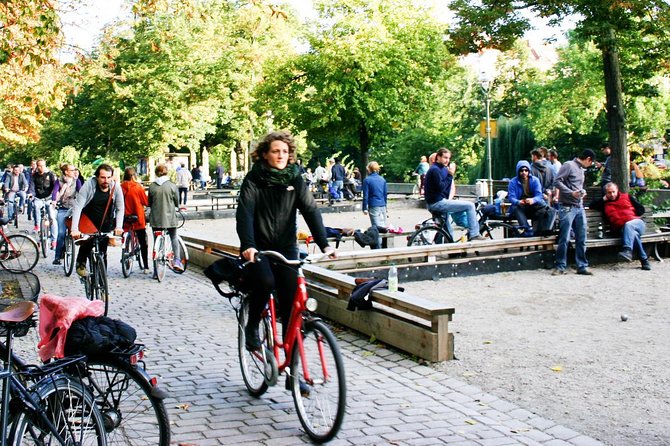
You also get a pause in a bohemian neighborhood where people play boule and take a break from city pressure. These small scenes help keep the tour from becoming only a lesson about the Wall or counterculture. You see people using Berlin’s public spaces for ordinary pleasure, too.
Admiral Bridge and Kottbusser Tor: two final faces of Kreuzberg
Admiral Bridge is presented as a place where you might begin an evening in a bar or watch the summer sunset with a crowd of strangers. The stop is short, about five minutes, but the setting gives the tour a social finish.
It captures Kreuzberg’s open, casual side. You can arrive without needing a special identity or dress code. Just being there is part of the experience.
Kottbusser Tor provides the harder contrast. Known locally as Kotti, it has heavy traffic, stark 1970s architecture, and an active drug scene.
This is not a beautiful final postcard, and that is precisely why it belongs on an alternative tour. Kotti shows the pressure points of a large city. It also keeps the tour honest. Berlin’s creative reputation exists alongside poverty, addiction, traffic, and difficult public spaces.
After this final stop, the activity returns to the original meeting point. Because the route covers many subjects in three hours, you should expect a broad introduction rather than a specialist study of any one neighborhood.
Guides, pace, and what the ride feels like
The guide is the heart of this experience. Names praised in the feedback include Rico, Jake, Bjorn, Rufus, Karl, and Vincent. Their strengths include humor, energy, personal stories, clear explanations, and careful attention to safety.
Jake is noted for detailed storytelling and even helping translate difficult words for Dutch speakers. Bjorn is praised for thoughtful discussion of Berlin’s alternative culture and for adding depth to the usual sightseeing route. Karl receives credit for fun facts and an articulate style, while Rico is described as friendly, funny, and safe.
The ride is not meant to be strenuous. You stop often to hear explanations, take in a view, or understand why a location matters. One participant felt the balance leaned toward talking rather than cycling, so set your expectations correctly.
That pace makes the tour suitable for many families and for people who do not cycle long distances often. Children are welcome when accompanied by an adult, and infant seats can be arranged on request. Most people can participate, but you still need to feel comfortable riding a bicycle in a city.
All equipment is provided, including the bicycle and helmet. One practical warning is worth taking seriously: loose or wide trousers can brush the chain and get dirty. Dress for the weather, since the tour operates in rain and other conditions.
Is $42.33 a fair price?
At $42.33 per person, the price is reasonable if you value a guide who connects many parts of Berlin into one story. You receive a bicycle, helmet, professional guide, and three hours of riding and commentary.
You are not paying for food or drinks, so bring your own water and plan any market or café purchases separately. The route does not include admission fees at the listed stops, which keeps the cost straightforward.
The best value comes from the route design. On foot, you would need much more time to link Nikolaiviertel, Kreuzberg, the East Side Gallery, Oberbaum Bridge, Osthafen, Görlitzer Park, and Kottbusser Tor. A bicycle lets you cover that wide area while still stopping often.
The price is less attractive if you want a fast ride, a small private group, or a deep examination of one subject. It works best as an orientation tour that helps you decide where to return later.
Who should book this tour?
I would choose this tour early in a Berlin visit if you want to understand the city beyond its central monuments. The ride gives you a useful map of Kreuzberg and Friedrichshain, plus ideas for places to revisit on foot.
It suits curious adults, families with older children, and anyone interested in the Berlin Wall, migration, architecture, political activism, street culture, and urban change. It also works well if you prefer stories and local context over a long list of famous sights.
I would hesitate if cycling in traffic makes you anxious, if you want a quiet sightseeing trip, or if you dislike rough public spaces. The tour includes places connected with drug use, heavy traffic, and contested urban life.
Book at least a day ahead, since the experience is often reserved around 10 days in advance. Free cancellation is available up to 24 hours before the start time. The tour requires a minimum number of participants, so a low-season cancellation is possible, with another date, another experience, or a full refund offered.
Final verdict: a strong choice for Berlin’s rougher, more human side
This is a good-value introduction to the Berlin that many first-time visitors miss. Its best moments come from the contrasts: a quiet canal-side space beside large apartment blocks, Wall murals beside new offices, a riverside creative quarter beside former borderland, and a bohemian street not far from Kottbusser Tor.
The guides receive the strongest praise for good reason. A lively guide can turn a three-hour ride into a thoughtful look at how Berlin became Berlin. Just remember that the experience is part bike ride and part neighborhood conversation.
Book it if you want local stories, broad context, and a relaxed route through Kreuzberg’s contradictions. Skip it if you are seeking nonstop pedaling or a polished tour of classic landmarks.
FAQ
How long is the Berlin alternative Kreuzberg bike tour?
The tour lasts approximately three hours.
Where does the tour start and finish?
It starts at Free Berlin Bike Tours & Rental, Poststraße 11, 10178 Berlin, Germany, and finishes back at the same meeting point.
What time does the tour start?
The listed start time is 2:24 pm.
Is bicycle equipment included?
Yes. The bicycle and helmet are included in the tour price.
Is the tour available in English?
Yes. The experience is offered in English. German is also available depending on the option selected.
Can children join the tour?
Yes. Children are welcome but must be accompanied by an adult. Infant seats can be provided on request.
What happens if the tour is canceled because too few people book?
If the minimum number of participants is not met, you will be offered a different date or experience, or a full refund.
Just added around Berlin
- Berlin: Private Guided Tour of the Main Sights★ 5.0 · 13 reviews
- Private Highlights of Berlin Bike Tour★ 5.0 · 13 reviews
- Modern Berlin Private Walking Tour: Diverse, Vibrant and Exciting German Capital★ 5.0 · 13 reviews
- Tour in Berlin from Warnemünde and Rostock Cruise Port★ 4.1 · 13 reviews
- Berlin: Stasi Museum Private Guided Tour with Entry Ticket★ 4.8 · 13 reviews
- Private Food Tour Experience with a born and bred Berliner★ 5.0 · 14 reviews
- Berlin: Rheinsberg Palace Entrance Ticket★ 4.8 · 14 reviews
- Berlin in one day – day tour with an expert guide★ 5.0 · 14 reviews
Cycling Tours, compared.
Sights and Highlights Bike Tour with a Local Guide
Read our review →
Classic Mike’s Bike Tour daily @ 11.30 incl Beer Garden & Surfers
Read our review →
Browse the lists this tour appears in