
Reviewed · CITY TOURS
Hamburg: City Tour by Bike with Elbphilharmonie
Hamburg makes sense from a bicycle seat. This 3.5-hour ride links the calm waters of the Alster, the old port streets, Speicherstadt, HafenCity, and the Elbphilharmonie in one well-planned outing. I like the wide range of Hamburg sights and the way the route moves between grand city views, working-class lanes, waterways, and modern architecture.
I also like that a guide leads the way and adds local context instead of leaving you to decode the city from a map. The main drawback is simple: this is a moving city tour, not a museum visit, so you will spend most of the time cycling and stopping briefly. Access to the Elbphilharmonie Plaza can also be limited on major event days.
In This Review
- Key points before you book
- Starting near Rotherbaum and the University of Hamburg
- Along the Alster, Hamburg’s watery front door
- From the Gängeviertel to the City Hall
- Deichstraße and the story of the old port
- Speicherstadt, the brick heart of the harbor
- HafenCity and the changing waterfront
- Seeing the Elbphilharmonie from below
- Neustadt, St. Michael’s, and Peterstraße
- St. Pauli Piers and the ride back
- What the guide adds to the ride
- Is $39 a fair price?
- Who should take this Hamburg bike tour?
- Should you book it?
- FAQ
- Where does the bike tour begin?
- Where does the tour end?
- How long does the experience last?
- Which languages are available?
- Is a bicycle included?
- Is a guide included?
- Does the tour include the Elbphilharmonie Plaza?
- What sights does the route visit?
Key points before you book
- A strong first-day orientation: The route covers Hamburg’s central districts and major sights in one ride.
- Old and new Hamburg together: You cycle from 18th-century working-class lanes and brick warehouses to modern HafenCity.
- The guide is central to the experience: Bernhard receives especially warm praise for sharing lots of interesting information about his city.
- The Elbphilharmonie visit has a condition: Time is allowed to reach the Plaza, but access depends on conditions that day.
- Good value at $39: A bicycle, guide, city map, and emailed photo series are included.
- A manageable half-day commitment: The tour returns to its starting point at Schlüterstraße 11.
Starting near Rotherbaum and the University of Hamburg
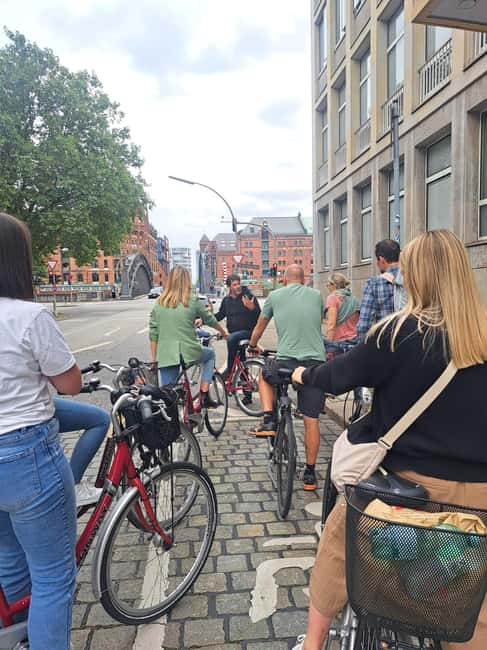
The tour begins outside the Fahrradstation of the University of Hamburg at Schlüterstraße 11, in the Rotherbaum area. This is useful for planning because you do not need to find your way to a distant port departure point. You begin in a city district, then gradually work toward Hamburg’s waterways and old harbor.
Your bicycle, guide, and city map are included. The map is a small but useful touch, especially if you want to revisit a neighborhood later on foot. The tour also sends a photo series about Hamburg by email, giving you a visual reminder of the route after you leave.
The listed duration is 3.5 hours, while the included cycling portion is described as three hours. That difference likely allows time for meeting up, pauses, and the Elbphilharmonie portion. I would still treat the experience as a half-day activity and avoid scheduling a tight lunch reservation or museum entry immediately afterward.
The tour runs in English and German. If you want the fullest explanation of Hamburg’s past and present, choose a departure in the language you understand best.
More Bike Tours in Hamburg
- Hamburg 3-Hour Bike Tour
★ 4.8 · 1,353 reviews - Guided Hamburg City Bike Tour
★ 5.0 · 642 reviews - Hamburg: Downtown, Alster & Creative Neighborhoods by Bike
★ 4.5 · 217 reviews
Along the Alster, Hamburg’s watery front door
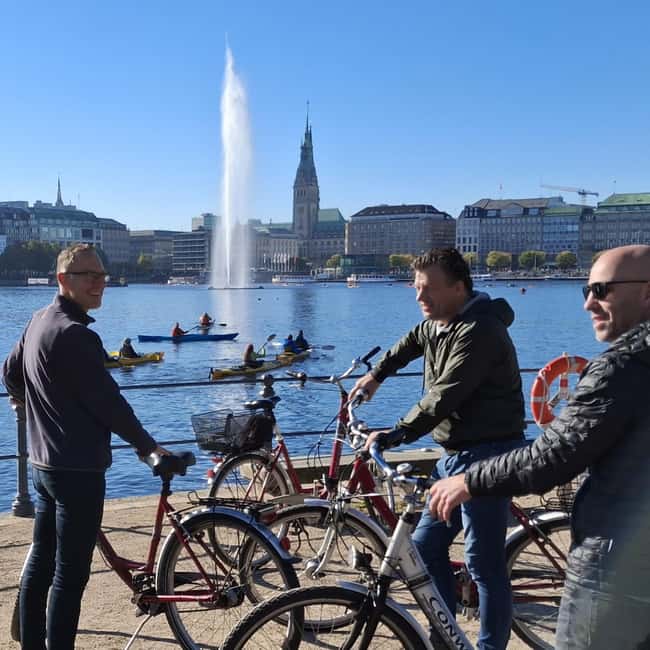
The first major stretch follows the Außenalster toward the Binnenalster. These connected bodies of water give you an early sense of why Hamburg feels tied to water even away from the Elbe and the port.
The route includes a photo stop and guided cycling around the Alster. You can expect open views, city panoramas, and a calmer start than the more urban sections later in the ride. This is one reason the route works well early in a Hamburg visit. You begin by seeing the city as a whole before moving into its tighter streets.
At the Binnenalster, the old and new town come into view together. Hamburg’s center does not present one single architectural mood. Instead, it shifts between historic facades, commercial streets, civic buildings, canals, and newer developments. The bicycle lets you cover these changes without spending the day underground or waiting for buses.
You should expect regular stops for explanations and photographs, but this is still an active ride. If you prefer a slow walk with long visits inside buildings, this will feel brisk. If you want to understand how the central districts connect, the pace is useful.
From the Gängeviertel to the City Hall
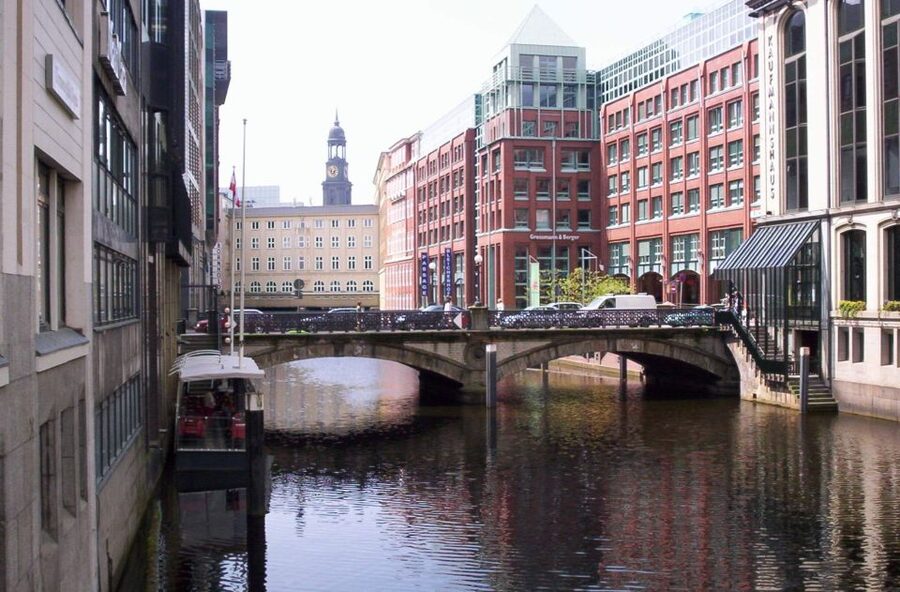
The route then enters the Gängeviertel of the Neustadt, an old working-class district with narrow lanes and surviving 18th-century structures. Today, the area is linked with Hamburg’s art scene, giving this section a different feel from the formal shopping streets and civic center.
One detail worth listening for is the memorial stone marking the birthplace of Johannes Brahms. It is the kind of small marker that is easy to miss when exploring alone. A guide can point out why a seemingly ordinary street corner matters.
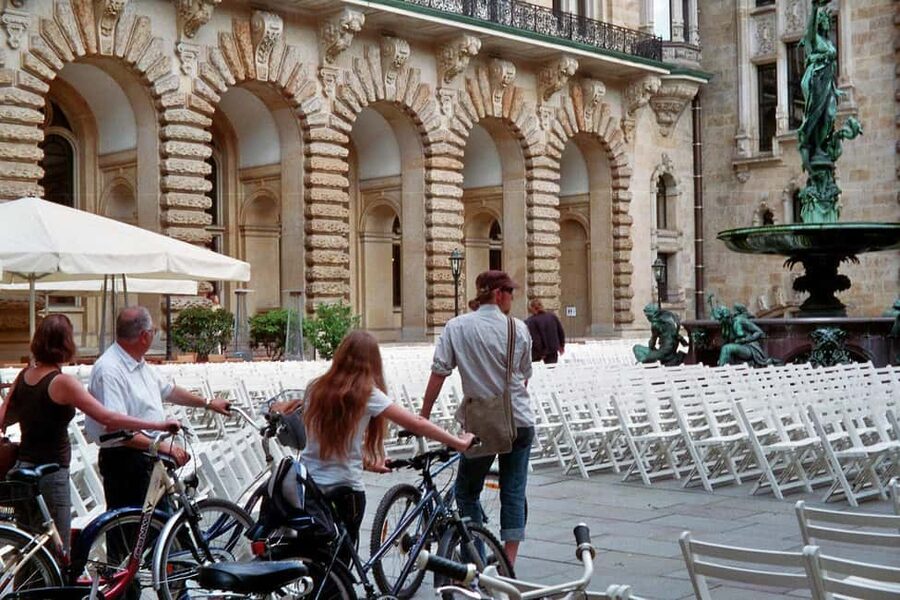
The ride continues through the newer city toward Hamburg’s Town Hall and Old Town. These stops give you the grand civic side of Hamburg after the tighter lanes of the Gängeviertel. You will have time for photographs and a guided explanation, but the schedule does not suggest an extended interior visit to the Town Hall.
That is an important distinction. The value here is the connection between districts, not a series of long indoor tours. You see how Hamburg’s commercial, civic, and residential areas sit close together, then continue toward the former harbor.
Deichstraße and the story of the old port
Deichstraße marks the origin of port operations in Alt-Hamburg and provides one of the route’s most atmospheric historical sections. The street leads toward the old warehouse district and helps explain how Hamburg’s trade grew around its waterways.
The tour also follows the tracks of the great fire of 1842 as it crosses Fleet-Island. That event reshaped much of the city, and the ride uses the streets themselves to show how Hamburg moved from an older port town toward the modern city you see today.
Before reaching Deichstraße, you pass Neuer Wall, known for its passages and designer shops. This creates a sharp contrast. One moment you are in a polished metropolitan shopping area, and soon after you are tracing the beginnings of Hamburg’s port activity.
I like this part because it avoids presenting Hamburg as only a maritime postcard. You see commerce in several forms: luxury retail, old port trade, canals, warehouses, and modern business districts. The drawback is that central streets can feel busy, and you need to pay attention to the guide and traffic around you.
More City Tours in Hamburg
- Reeperbahn: Panik City Udo Lindenberg Multimedia Experience
★ 4.9 · 893 reviews - Hamburg: Hop-On Hop-Off Bus City Tour – Line F
★ 4.2 · 590 reviews - Hamburg: City Cruise on Alster Lake
★ 4.4 · 533 reviews - English Hamburg City Center Pay-What-You-Want Walking Tour
★ 4.9 · 262 reviews
Speicherstadt, the brick heart of the harbor
Speicherstadt is one of the key stops, and the bicycle route gives you a good way to appreciate its scale. The UNESCO World Heritage Site is made up of massive 19th-century brick warehouse buildings set among waterways known as Fleete.
The warehouses were built on millions of oak poles, a detail that helps explain how this unusual district was created over wet ground. From a bicycle, you can move along the canals and see the repeating brick facades from several angles rather than viewing one short section and turning back.
This is a photo stop and a guided cycling section, not a dedicated museum visit. You should plan to admire the architecture from outside unless you arrange another visit later. The route gives you an overview of Speicherstadt’s structure and role, while a separate walking visit would be better if you want to explore interiors at length.
For many people, this will be the visual high point before the Elbphilharmonie. The red brick, water channels, and narrow urban passages feel distinctively Hamburg. You also get a clear sense of how the port once functioned as a city within the city.
HafenCity and the changing waterfront
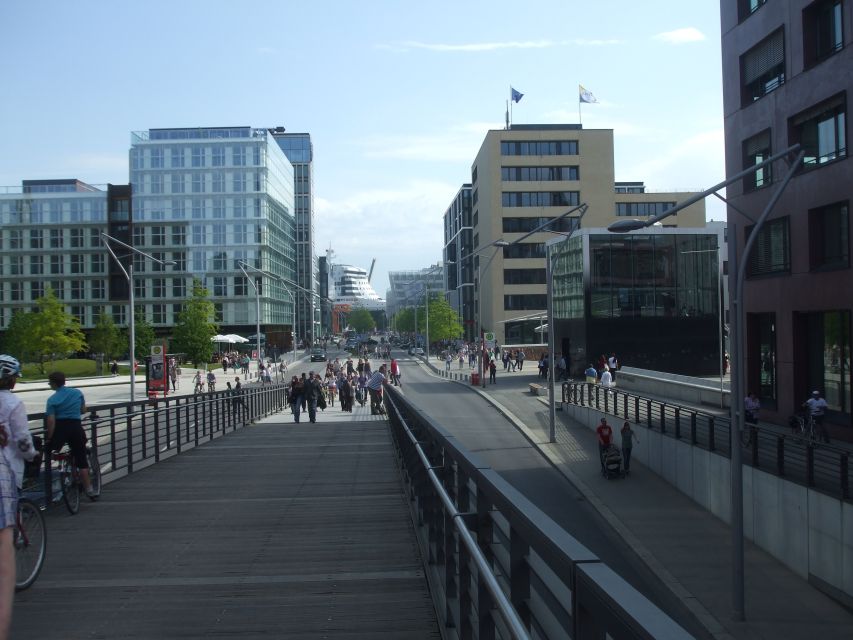
From Speicherstadt, the ride enters HafenCity, the former harbor area now reshaped by postmodern buildings and new flood protection. This is where Hamburg’s current ambitions become most visible.
HafenCity can feel very different from the older districts. Rather than focusing on preserved facades, you see new construction, steel, open spaces, and buildings designed around the water. The route shows the city in transition, with old warehouses nearby and newer structures taking their place.
The contrast is the point. I would not choose this tour if you wanted only old Hamburg, but I would choose it if you want to understand how the city connects its port past with its modern business and cultural identity.
The ride also passes a steel publishing building at Baumwall, described as almost futuristic in appearance. This section adds another architectural layer before you reach the city’s most famous recent landmark.
Seeing the Elbphilharmonie from below
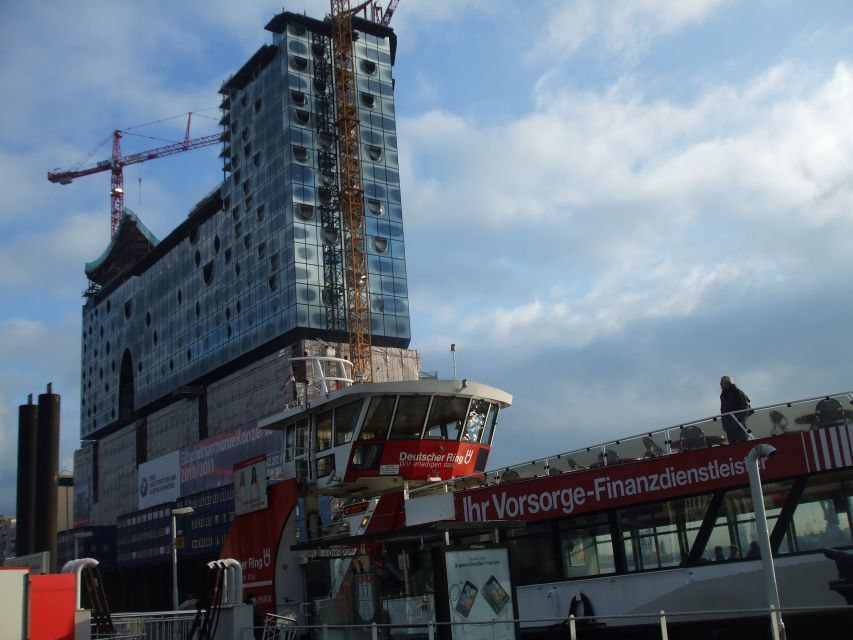
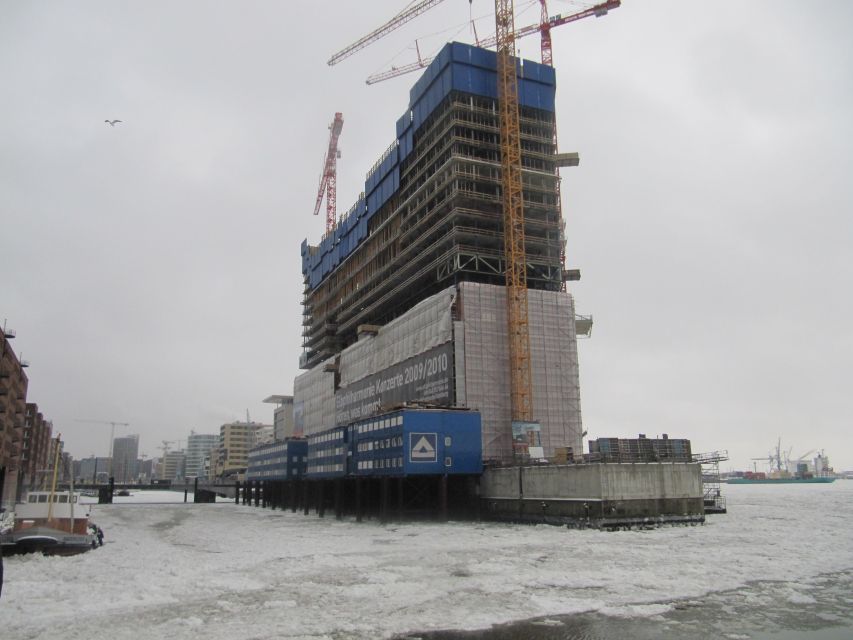
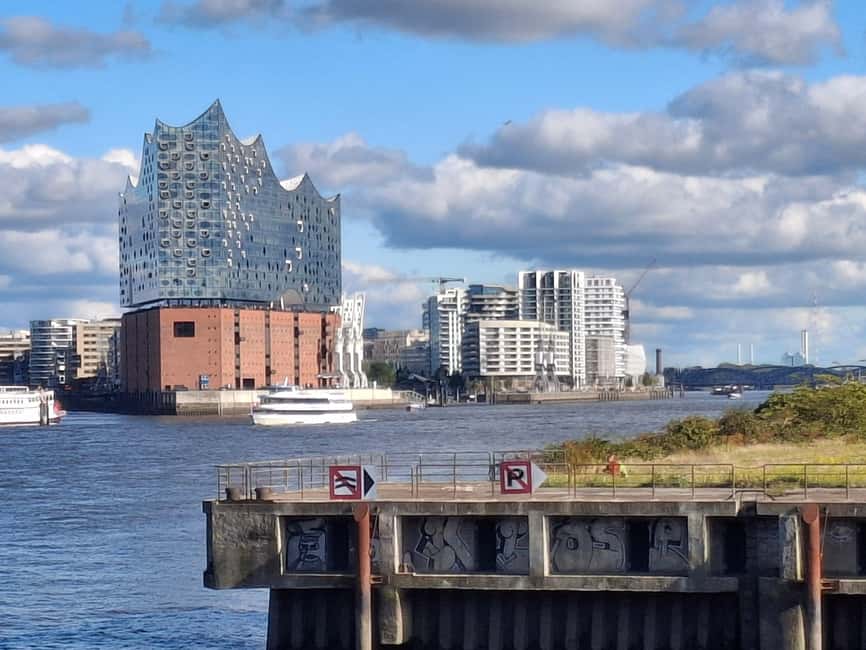
The Elbphilharmonie is the tour’s headline sight. The building rises 110 meters above HafenCity and has been controversial as well as famous. Its location above the old harbor makes it easy to understand why the structure became such a powerful symbol of Hamburg’s changing waterfront.
The route offers time to ride to the Elbphilharmonie Plaza, subject to access. On days with major events, entry may be restricted or closed, so you should not book this experience solely for a guaranteed Plaza visit.
Even if Plaza access is unavailable, the route still gives you several ways to see the building. You follow the new flood protection system and reach viewpoints below the Elbphilharmonie, where its scale becomes especially clear. Looking up from the waterfront gives you a different impression than viewing it from across the river or from a distant city street.
The guide can also help you place the building within HafenCity and the old port. That context matters because the Elbphilharmonie is not simply a concert hall to photograph. It is part of Hamburg’s larger shift from working harbor to cultural and commercial district.
Neustadt, St. Michael’s, and Peterstraße
After HafenCity, the route turns back toward Neustadt and passes St. Michael’s Church. The church is one of the city’s major landmarks and provides a strong change of mood after the modern waterfront buildings.
The ride also follows historic Peterstraße, where the Brahms and Telemann Museums are located. These museums connect the neighborhood with Hamburg’s musical past. The bicycle tour does not include a separate museum visit, but you can note their location and return later if music history interests you.
This part of the route is valuable because it brings together several strands of Hamburg identity: port city, commercial center, church city, and home to important composers. It also gives you more than the usual port-focused view of Hamburg.
You will have guided photo stops here, but again, expect an outdoor introduction rather than extended time inside each attraction. I would make a note of anything you want to revisit, then return on foot after the tour.
St. Pauli Piers and the ride back
The route includes the St. Pauli Piers before returning to Schlüterstraße 11. This brings the ride back to Hamburg’s working waterfront and gives you another view of the city’s maritime character.
The piers are a fitting final stop because the tour has traced Hamburg’s relationship with water from the Alster to the Fleete, the old harbor, HafenCity, and the Elbe. You have seen both quiet city water and the larger port setting.
The return to the University of Hamburg area passes the exhibition halls and completes the loop. Ending where you began is practical. You do not need to arrange a separate ride back from the port, and you can continue with your day from a familiar starting point.
What the guide adds to the ride
A bike route through Hamburg is easy enough to follow in broad outline, but the guide is what turns it into a city lesson. You are not only moving between attractions. You are hearing why a birthplace marker matters, how the great fire affected the city, why the warehouses were built on oak poles, and how the port districts changed.
The strongest praise centers on the guides, with Bernhard singled out for having plenty to say about his city and making the ride interesting. Another short assessment calls the guide excellent, while a separate comment praises the large amount of information. That pattern suggests you should book this for interpretation as much as for transport.
The exact group size is not provided, so I would not assume an intimate private ride. If you want to ask about group size or bicycle type, contact the provider before booking. The provider is Kaupert-Hamburg-Radtour.de.
Is $39 a fair price?
At $39 per person, this is a solid value if you want a broad introduction to Hamburg. The price includes the bicycle, guide, city map, and emailed photo series. More important, it combines sights that are spread across several districts and would take more planning to connect independently.
You are paying for coverage and local explanation, not admission to a long list of attractions. There is no promise of extended interior access at the Town Hall, museums, or Elbphilharmonie. The Plaza visit is also conditional.
I would compare the price with what you would spend renting a bicycle and planning the route yourself. The guided experience saves you navigation time and adds historical context. For a first visit, that makes $39 reasonable. For someone who already knows Hamburg well and wants to set an independent pace, a self-guided ride may offer more freedom.
The tour earns a reported rating of 4.5 from 60 ratings, with the guide and amount of information receiving the clearest praise. That fits the design of the experience: its strength is the guide-led overview rather than a single landmark visit.
Who should take this Hamburg bike tour?
I would recommend it to you if you want to cover a lot of ground without spending the day on public transport. It suits active visitors, first-time visitors, and anyone curious about how old Hamburg and new HafenCity fit together.
It is also a good choice if you enjoy architecture and city history but do not want a formal lecture. The route has enough variety to keep the ride moving: Alster views, old lanes, luxury shopping streets, brick warehouses, modern waterfront buildings, a major church, music history, and the piers.
You should think twice if you dislike cycling, want long stops at each sight, or need guaranteed entry to the Elbphilharmonie Plaza. The tour is conducted in English or German, and the pace is designed to connect many locations within a limited time.
Plan for changing weather because much of the experience takes place outdoors. The supplied information does not specify bike type, group size, or riding conditions, so ask the provider if those details affect your comfort.
Book with flexibility if possible. Free cancellation is available up to 24 hours before departure, and you can reserve now and pay later. That is useful when your Hamburg schedule depends on weather or other timed visits.
Should you book it?
Book this tour if you want a practical, informative first look at Hamburg and like the idea of seeing the city by bicycle rather than from a tour bus. The route is unusually varied, and the guide-led explanations add real value, especially around Speicherstadt, the old port, the great fire, and the Elbphilharmonie.
Skip it if you want guaranteed indoor access or a slow, stop-and-stare visit at every landmark. For $39, the experience is best understood as a guided city orientation with strong waterfront views, not as a collection of admission-based attractions.
FAQ
Where does the bike tour begin?
The tour begins outside the Fahrradstation of the University of Hamburg at Schlüterstraße 11.
Where does the tour end?
The tour ends back at the starting point on Schlüterstraße 11.
How long does the experience last?
The activity lasts 3.5 hours. The included cycling portion is described as three hours.
Which languages are available?
The live tour guide is available in English and German.
Is a bicycle included?
Yes. The bicycle is included with the guided tour.
Is a guide included?
Yes. A live guide leads the tour. Bernhard is one guide associated with the experience.
Does the tour include the Elbphilharmonie Plaza?
The tour includes time to ride to the Plaza, but access depends on its availability. On days with major events, access may be restricted or closed.
What sights does the route visit?
The route includes the Alster, Hamburg Old Town, Town Hall, Deichstraße, Speicherstadt, HafenCity, the Elbphilharmonie, Neustadt, St. Michael’s Church, and the St. Pauli Piers.
More Bike Tours around Hamburg
- Hamburg: Guided Bike Tour
★ 4.7 · 71 reviews - Hamburg: Bike Tour of the Speicherstadt & Old Harbor
★ 4.6 · 61 reviews - Guided bike tour Hamburg with neat city bikes, cruisers, mountain bikes
★ 5.0 · 44 reviews - Celebs, Waterfronts and Nature Cycle Tour
★ 4.3 · 38 reviews
Just added around Hamburg
- Hamburg: Private 1.5-Hour Walking Tour of St. Pauli★ 4.9 · 13 reviews
- Mister X Hamburg 2h city tour, hunting & games for all ages★ 5.0 · 13 reviews
- Yacht Sailing After Work Tour of Hamburg Harbor★ 5.0 · 13 reviews
- Free Tour: Port, Red Light District and Beatles. You decide how much to pay at the end★ 3.9 · 13 reviews
- Private 5-Hour Hamburg Countryside Tour with a former policeman★ 5.0 · 14 reviews
- Hamburg: After work Millerntor stadium tour with drinks★ 4.8 · 14 reviews
- Hamburg: Guided Walking Tour★ 4.2 · 14 reviews
- Hamburg: Tour of Blankenese on the Banks of the Elbe★ 4.5 · 14 reviews
City Tours, compared.
1-Hour City Tour by Boat with Guaranteed Seating
Read our review →
City History Canal Sightseeing Tour on a Motorboat
Read our review →
Browse the lists this tour appears in