
Reviewed · OLD TOWN WALKS
Frankfurt: Highlights and New Old Town English-Language Tour
Frankfurt’s old center has a surprising second life. This 90-minute walk brings you through the reconstructed New Old Town, past the medieval Römer and into the story of a city shaped by war, rebuilding, trade, and democracy. I like the clear historical focus and the compact route, which gives you a useful first look without taking half your day. I also like the mix of grand sights and small lanes, especially the half-timbered buildings and the view from Eiserner Steg.
The main thing to understand is the tour title. One past participant expected a broad survey of Frankfurt plus the New Old Town, but the walk focuses heavily on the rebuilt historic center. You will see several major sights, yet many are viewed from outside and briefly. For $21, that is a fair trade for a lively introduction, though anyone wanting museum interiors or a long citywide tour should plan something extra.
The guides set a friendly tone. Lili made the walk enjoyable for one group, Alexander balanced jokes with solid facts, and guides including Lutz, Gabriella, David, Frank, and Robert have each received praise for their delivery and command of the city’s story. The tour has earned a 4.7 rating from 96 reviews, a strong sign that the short format usually works well.
In This Review
- Key points to know before you go
- Starting at the Römer, Frankfurt’s civic front door
- Walking the reconstructed New Old Town
- Römerberg and the 700-year-old city story
- St. Paul’s Church and Germany’s democratic beginnings
- Frankfurt Cathedral and the changing skyline
- Crossing Eiserner Steg for the best city view
- A glimpse of the Museum Embankment
- How the guide shapes the experience
- Price, pace, and who gets the best value
- Should you book the Frankfurt New Old Town tour?
- FAQ
- Where does the tour meet?
- How long does the walking tour last?
- Is the tour conducted in English?
- What is the price?
- Is the tour wheelchair accessible?
- Which Frankfurt sights are included?
- Does the tour visit museums?
- Can I cancel for a refund?
- Can I reserve the tour and pay later?
Key points to know before you go
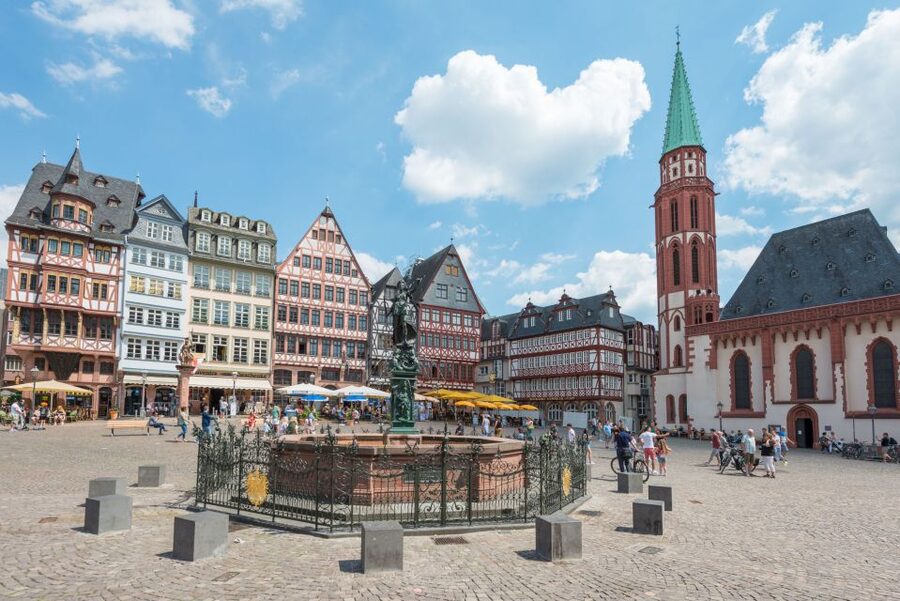
- The New Old Town is the heart of the walk: See Frankfurt’s reconstructed historic quarter and its colorful half-timbered facades.
- Römerberg gives you the classic Frankfurt image: The square is home to the city hall, the Römer, and about 700 years of civic history.
- St. Paul’s Church adds a democratic chapter: The tour explains why this church matters to Germany’s political story.
- Eiserner Steg is the best photo stop: The distinctive iron footbridge frames the Main River and Frankfurt’s skyline.
- The route lasts 1.5 hours: It offers a useful introduction without demanding a full morning or afternoon.
- English delivery is a strong point: The certified guide speaks English, and the tour is wheelchair accessible.
Starting at the Römer, Frankfurt’s civic front door
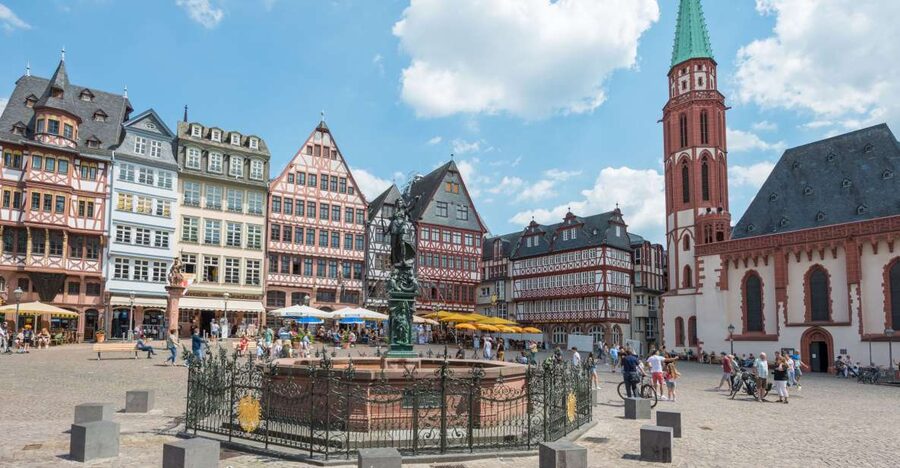
Meet your English-speaking guide in front of the Tourist Information Office Römer, on Römerberg. This is an easy place to identify, since the Römer itself forms the square’s best-known backdrop and the tourist office provides a clear landmark.
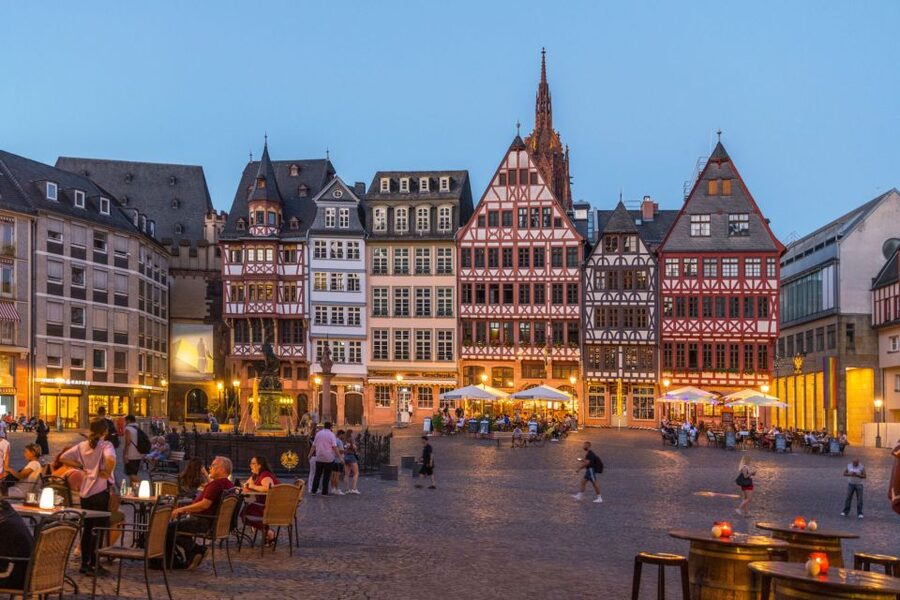
The tour begins with Frankfurt’s public face: a grand city hall, an old square, and the sense that this was once the center of a powerful medieval town. The Römer is often described as Frankfurt’s medieval city hall, and its long civic history gives the opening stop real weight. You are not simply looking at pretty buildings. You are starting in a place where Frankfurt’s government, commerce, and public life came together.
The guide also helps you separate old from new. Frankfurt’s central historic district was badly damaged during the Second World War, and much of what you see in the New Old Town is reconstructed. That distinction matters. The buildings are designed to bring back the appearance and character of the former quarter, but they are not all untouched survivors from the Middle Ages.
That tension is one of the most interesting parts of the walk. You get the visual pleasure of steep roofs, narrow facades, and half-timbered decoration, while the guide explains how the city chose to recreate part of its past. If you value historical accuracy, listen carefully to those explanations. If you mainly want an attractive center with strong photo opportunities, the result is easy to enjoy.
More Old Town Walks in Frankfurt
- Frankfurt: New Old Town and Highlights German-Language Tour
★ 4.7 · 1,316 reviews - Heidelberg Castle and Old Town Tour from Frankfurt
★ 4.0 · 587 reviews - Guided Axe Throwing Experience in Frankfurt Altstadt
★ 5.0 · 93 reviews
Walking the reconstructed New Old Town
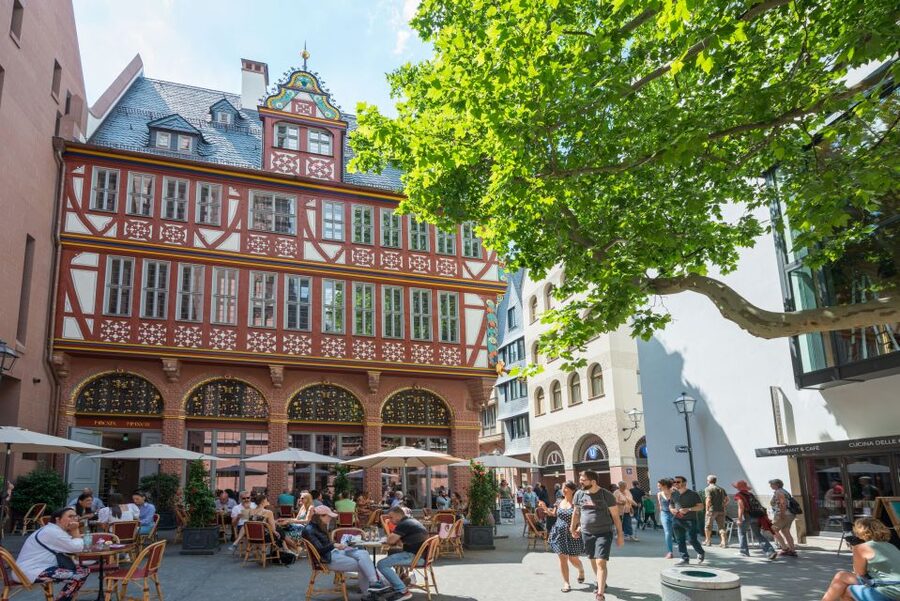
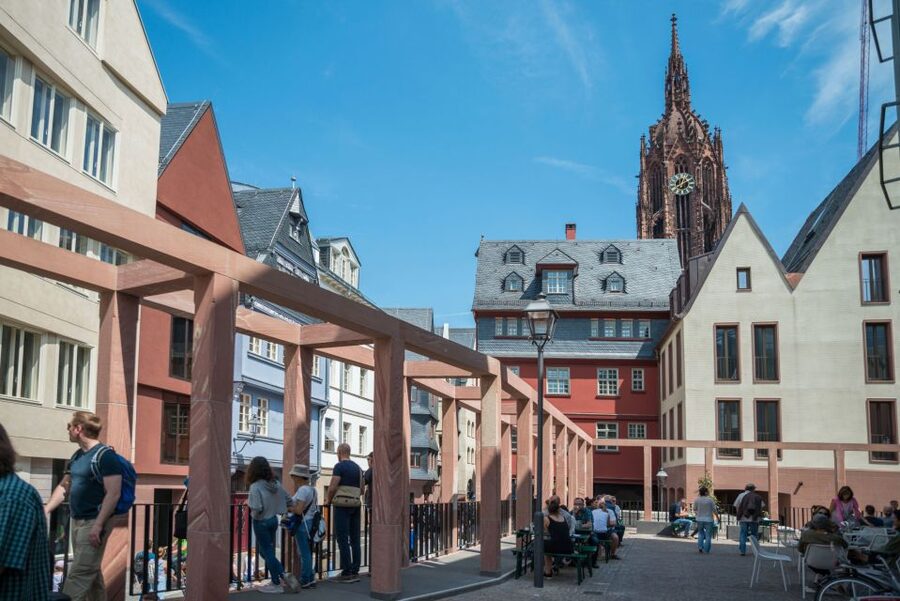
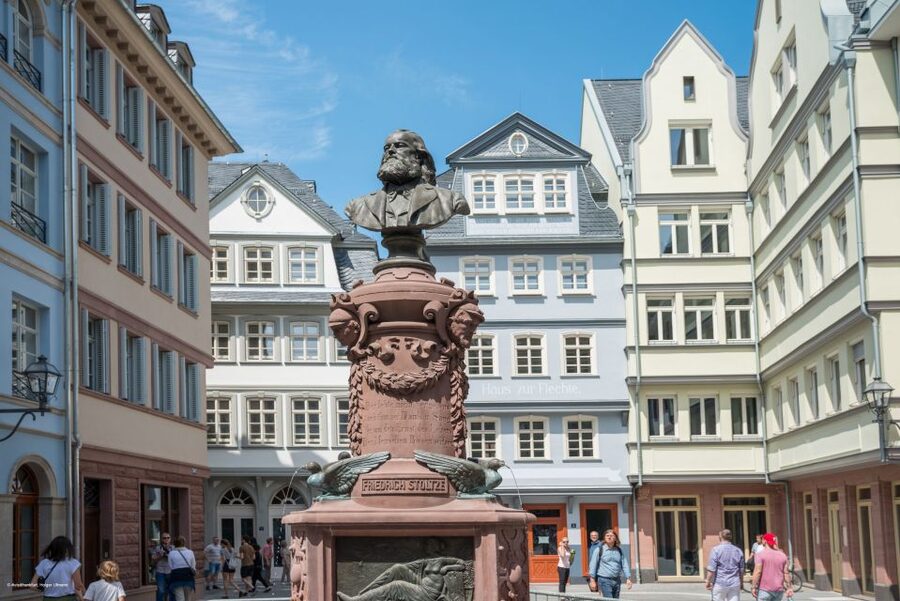
The New Old Town is a compact district of winding lanes and restored or newly rebuilt facades. Here, the tour slows down enough for you to notice the details: timber framing, varied colors, decorated fronts, and the close spacing of the buildings. It feels different from Frankfurt’s modern banking quarter, even though the high-rise skyline is never far away.
This contrast gives the walk its main appeal. Frankfurt is often introduced through finance, trains, airports, and skyscrapers. The New Old Town offers another side of the city, one tied to medieval streets and civic traditions. You can look from an old-style facade toward a modern tower and understand, in a single view, how strongly Frankfurt mixes eras.
A guide is particularly useful here because the buildings alone cannot tell you which elements are historic, which are reconstructed, and why the project mattered to the city. The tour explains how Frankfurt brought part of its colorful past back into the center. Pictorial comparisons showing the area before and after reconstruction have also helped make the changes easier to grasp.
Do not expect a large open-air museum or a maze that takes hours to explore. The area is manageable, and the tour moves through it in a focused way. That makes it a good first stop after arriving in Frankfurt, especially if you want orientation before choosing museums, restaurants, or a longer independent walk.
The chief limitation is that reconstruction can feel less spontaneous than an untouched old quarter. Some people may find the rebuilt setting attractive but slightly polished. I would approach it as a modern attempt to recover a historic city center, not as a perfectly preserved medieval neighborhood.
Römerberg and the 700-year-old city story
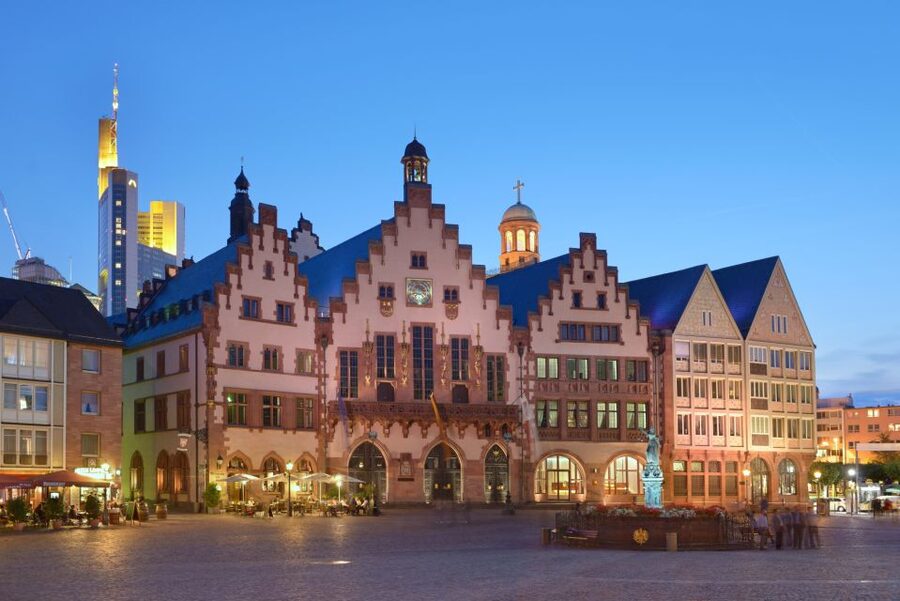
Römerberg is the visual centerpiece of old Frankfurt. The square has been tied to the city’s public life for roughly 700 years, and the Römer gives it a memorable architectural anchor. Your guide uses the square to explain Frankfurt’s place in German history and how the city changed across the centuries.
The value here is not just the view. A good explanation turns a photograph into a place with meaning. The facades, the city hall, and the square’s position in the old center all help you understand why Frankfurt grew as an important urban and commercial center.
Expect some standing while the guide talks, followed by short stretches of walking. That rhythm has worked well for families and mixed-age groups. One family specifically appreciated the balance between facts and humor, noting that even teenagers stayed interested. Another participant liked that the tour did not involve a great deal of walking.
That does not mean you will be moving nonstop or covering every corner of central Frankfurt. It means the route is paced for explanation rather than exercise. On a hot day, this can be a real advantage. A group walking in temperatures near 30 degrees Celsius found the 90-minute length comfortable, while another person found the tour less engaging for children during a day around 38 degrees Celsius.
The practical lesson is simple: weather affects this experience. On a warm day, bring water and prepare for sun while standing in open squares. The short duration helps, but it does not remove the need for sensible clothing.
St. Paul’s Church and Germany’s democratic beginnings
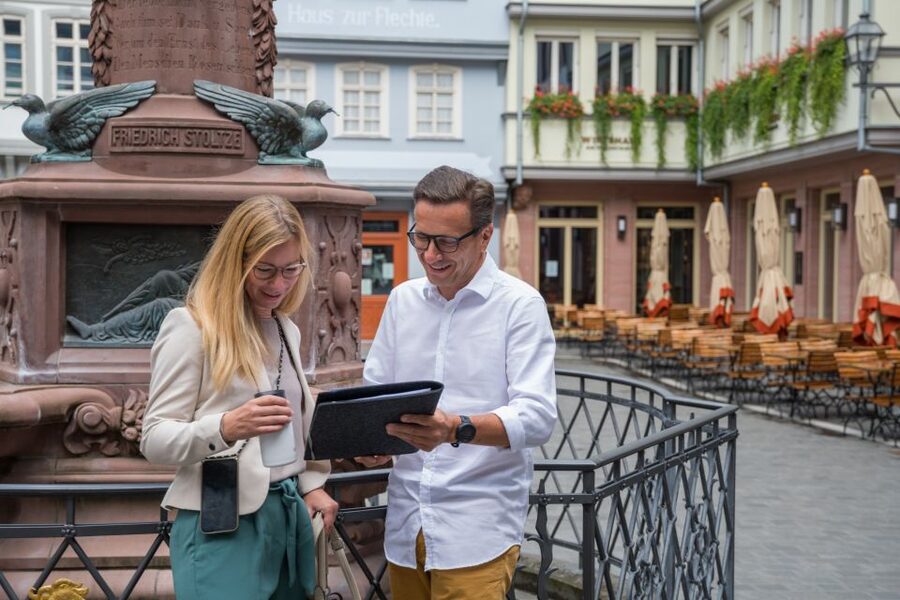
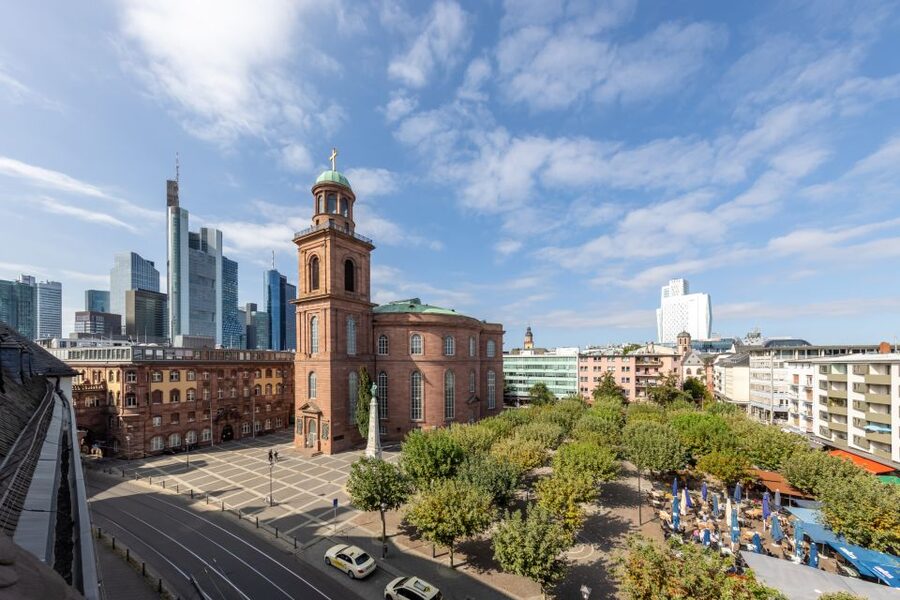
St. Paul’s Church, or Paulskirche, adds a political dimension to the tour. The guide explains why this building is associated with the early development of democracy in Germany. That gives the route more substance than a simple architecture walk.
For many visitors, this is the stop that changes the tone. The New Old Town is mainly about buildings, streets, and reconstruction. St. Paul’s Church connects Frankfurt to debates about representation, national unity, and constitutional government. You begin to see the city not only as a place that rebuilt its facades, but also as a place linked to important political ideas.
The tour’s format means you should not expect an extended interior visit or a detailed seminar on German constitutional history. The guide gives you the essential context in a short, accessible explanation. That is enough to make the church worth seeing and gives you a useful subject to explore later if it catches your interest.
This stop also shows why a live guide is more useful than a self-guided photo walk. A phone can identify a building, but it cannot easily give you the short chain of events that explains why the building matters. Guides have been praised for mixing historical facts with personal stories, humor, and answers to questions, which suits this kind of stop.
Something different for another day:
- Frankfurt: River Main Sightseeing Cruise with Commentary
★ 4.3 · 5,127 reviews - Frankfurt: Hop-On, Hop-Off Grand or Express Bus Ticket
★ 3.9 · 2,088 reviews - Frankfurt: 1-Hour Panorama Boat Cruise on the river Main
★ 4.4 · 1,822 reviews - Rhine Valley Castles: 1.5-Hour Boat Tour from Rüdesheim
★ 4.2 · 1,390 reviews
Frankfurt Cathedral and the changing skyline
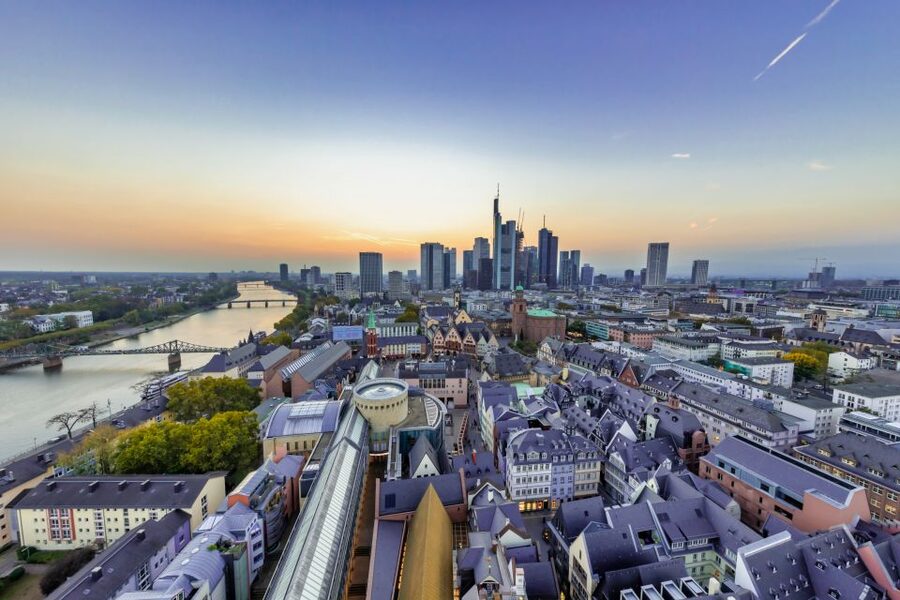
Frankfurt Cathedral is another major sight included in the route. Its presence helps widen the tour beyond the New Old Town, even though the walk remains concentrated in the historic center. The cathedral gives you a strong example of Frankfurt’s religious and architectural past.
From here, you can also sense the city’s unusual scale. Frankfurt has a compact old center, a busy financial identity, and a skyline that often appears behind historic buildings. That contrast is one of the city’s best visual features. The tour gives you a quick way to connect these parts instead of treating the old town and modern city as separate destinations.
The cathedral stop is likely to be brief. This is a walking introduction, not an architectural study, so anyone wanting to examine the interior, art, or religious details should allow separate time. Still, seeing the cathedral in context helps you understand how close Frankfurt’s central landmarks are to one another.
Crossing Eiserner Steg for the best city view
Eiserner Steg, the distinctive iron footbridge over the Main, is the tour’s most obvious photo stop. From the bridge, you can look back toward the old center and see Frankfurt’s skyline rising beyond it. The view neatly combines the city’s past and present in one frame.
The bridge is popular for good reason. The structure itself has a recognizable design, and the river setting gives you a change of pace after the tighter lanes and squares. If you want a photograph that says Frankfurt rather than simply Germany, this is one of the strongest locations on the route.
The bridge can also be a useful orientation point. It helps you understand the relationship between the old center on one side of the Main and the Museum Embankment on the other. The tour does not turn this into a long river walk, but the crossing gives you a quick sense of the city’s geography.
Because the bridge is a public footbridge and a popular photo spot, the experience may feel less quiet than the New Old Town. Your guide’s commentary is still important here, but you should expect the stop to be about views, position, and context rather than a long historical talk.
A glimpse of the Museum Embankment
The tour finishes or passes through the area around the Museum Embankment, with views toward a group of 39 museums. That number gives you a useful idea of Frankfurt’s cultural range. The city is not only about business towers and medieval streets. It also has a major concentration of museums along the river.
You will get a glimpse rather than a museum visit. No admission to museum interiors is included, and the 90-minute schedule does not allow time for serious exploration inside the collections. I see this as helpful planning information: the guide can show you where the museums are, then you can return later to choose the one that suits your interests.
This final section also reinforces the tour’s value as an introduction. In a short period, you see the old town, the cathedral, a major church, the river, the skyline, and the museum district. You will not master Frankfurt, but you will have a clear map in your head and several good ideas for the rest of your stay.
How the guide shapes the experience
The guide makes a large difference on a short city walk. Several guides have been praised for giving lively explanations, handling questions, and keeping the group involved. Lili was singled out for making the experience enjoyable, Alexander for finding a good balance between humor and facts, and Lutz for providing an energetic narrative.
Other guides, including Gabriella, David, Frank, and Robert, have also been praised for their English and presentation. David’s route once covered Frankfurt from Roman times to the present, while Frank was described as especially strong at sharing historical information. Robert’s clear English was helpful on a hot day.
You should not expect the exact same personality or delivery each time. That is normal with a live city tour. The consistent strength is the format: a certified English-speaking guide explains the places as you see them, rather than leaving you to read signs after the group has moved on.
The humor matters, too. History delivered as a list of dates can lose a family quickly. Stories, comparisons, and a few jokes help keep the walk moving. One guide also handled a larger-than-usual group well and remained easy to hear, which is worth considering if you dislike crowded tours.
Price, pace, and who gets the best value
At $21 per person, this is reasonably priced for a 1.5-hour guided walk in a major German city. You are paying for a certified English-speaking guide, not for museum entry or transportation. The price works best if you want orientation and context rather than a full day of sightseeing.
I would consider it good value for:
- First-time visitors with limited time in Frankfurt
- People arriving for a short stopover
- Families who want a manageable walk
- Visitors interested in reconstruction and city history
- Anyone who prefers explanation over a self-guided route
- People who want a quick introduction before visiting museums independently
You may want another option if you need a broad tour of every major Frankfurt district, extensive time inside buildings, or a highly detailed specialist history walk. The tour touches several highlights, but it does not linger long at each one.
The booking terms add flexibility. You can cancel up to 24 hours before the start for a full refund, and you can reserve now and pay later. Starting times vary, so you need to check availability for your date. The route is listed as wheelchair accessible, and the walking distance has been described as moderate rather than strenuous.
Should you book the Frankfurt New Old Town tour?
I would book this tour if you want a short, friendly introduction to Frankfurt’s historic center and enjoy learning why the rebuilt buildings matter. The combination of Römerberg, the Römer, St. Paul’s Church, Frankfurt Cathedral, Eiserner Steg, and the Museum Embankment gives you a strong first orientation for $21.
I would be more cautious if the title makes you expect a full highlights tour across the whole city. The New Old Town receives the most attention, and several other sights are brief exterior stops. Book it for context, photos, and efficient orientation, then add your own museum or neighborhood visits afterward.
FAQ
Where does the tour meet?
Meet your guide in front of the Tourist Information Office Römer on Römerberg.
How long does the walking tour last?
The tour lasts 1.5 hours.
Is the tour conducted in English?
Yes. The tour has a live English-speaking guide, and English is the listed language.
What is the price?
The price is $21 per person.
Is the tour wheelchair accessible?
Yes, the activity is listed as wheelchair accessible.
Which Frankfurt sights are included?
The route includes the New Old Town, Römerberg, the Römer city hall, Frankfurt Cathedral, St. Paul’s Church, Eiserner Steg footbridge, and a glimpse of the Museum Embankment.
Does the tour visit museums?
The tour provides views and information about the Museum Embankment and its 39 museums. Museum admission and an interior museum visit are not included.
Can I cancel for a refund?
Yes. You can cancel up to 24 hours in advance for a full refund.
Can I reserve the tour and pay later?
Yes. You can reserve your place and pay later, subject to the available booking terms.
Just added around Frankfurt
- Wiesbaden Biebrich: Outdoor Escape Game★ 4.7 · 13 reviews
- from Frankfurt – romantic Black Forest & brewery, private tour★ 5.0 · 13 reviews
- Frankfurt : Highlights & hidden Gems Private Walking Tour★ 4.6 · 13 reviews
- Discover the Heart of Frankfurt – City Tour in German★ 5.0 · 13 reviews
- From Frankfurt: Heidelberg and Rothenburg Guided Day Trip★ 5.0 · 14 reviews
- Private German Beer Tasting Experience in Frankfurt Old Town★ 5.0 · 14 reviews
- Frankfurt: Old Town Crime Mystery Game★ 4.3 · 14 reviews
- Mainz Highlights, private walking tour★ 4.9 · 15 reviews
Old Town Walks, compared.
Old Town & Viktualienmarkt City Walk in German
Read our review →
The Night Watchman Old Town Walking Tour in German
Read our review →
Browse the lists this tour appears in