
Reviewed · LEIPZIG TOURS
Federal Administrative Court Leipzig: A journey into the heart of German justice
Justice wears a crimson robe here. This 90-minute tour gives you two things I especially like: access to historic courtrooms and a rare look inside the former presidential apartment. The main consideration is language, since the tour is conducted in German, with English available only on request.
You meet at Simsonplatz 1, outside the Federal Administrative Court, and should arrive 10 to 15 minutes early. I also like the price: at $14 per person, this is an unusually affordable way to see a working seat of German justice, though children under 14 cannot join and some historical material is presented in its original language.
In This Review
- Key points at a glance
- Why this court matters to Leipzig
- Meeting the guide at Simsonplatz 1
- The 1879 Imperial Court of Justice
- Courtrooms where major cases unfolded
- A visit to the former presidential apartment
- The building’s years as an art museum
- Is $14 a fair price?
- What the high rating tells you about the experience
- Who should book this court tour?
- Practical advice before you go
- My verdict: book it for substance, not spectacle
- FAQ
- Where does the Federal Administrative Court tour begin?
- How long does the tour last?
- What language is the tour conducted in?
- What does the tour include?
- Can children join the tour?
- Is the building wheelchair accessible?
- Are pets allowed?
- Can I cancel my booking?
Key points at a glance
- A court with imperial roots: The building opened in 1879 as the Imperial Court of Justice during the Wilhelmine era.
- Historic rooms are part of the route: You enter grand meeting rooms and courtrooms decorated with national coats of arms and imperial paintings.
- The presidential apartment adds a personal touch: The former home of the court president shows a less formal side of the building.
- The stories reach beyond architecture: The tour covers the 1933 Reichstag fire trial and Karl Liebknecht’s 1907 trial.
- German is the normal tour language: English tours can be arranged on request, but you should confirm before booking.
- Strong value for a short visit: The tour lasts 1.5 hours, costs $14, and has a 4.8 rating from 189 reviews.
Why this court matters to Leipzig

The Federal Administrative Court is Germany’s highest administrative court. Its 14 senates handle disputes in administrative law, the part of the legal system that deals with the relationship between individuals, institutions, and public authorities.
That gives this tour more weight than a simple architecture walk. You are not just looking at a handsome old building. You are entering a place connected with the development and interpretation of German public law.
The present court also links several chapters of German history. It began life in 1879 as the Imperial Court of Justice, a grand institution built during the Wilhelmine period. Later, during the GDR era, the building served as an art museum. In 2002, it returned to use as a court and became the seat of the Federal Administrative Court.
I like that the tour follows these changes instead of treating the building as a frozen monument. You get the original imperial setting, the interruption caused by political change, and the building’s modern judicial role in one visit.
Other Leipzig trips people book alongside this one:
- Leipzig: City History Canal Sightseeing Tour on a Motorboat
★ 4.7 · 6,232 reviews - Leipzig: 1.5-Hour Public Tour with Night Watchman Bremme
★ 4.6 · 3,116 reviews - Combo Tour in Leipzig: Guided City Tour & City Sightseeing
★ 4.7 · 2,317 reviews
Meeting the guide at Simsonplatz 1
The meeting point is in front of the court at Simsonplatz 1. I would plan to arrive 10 to 15 minutes before the start, especially if you are unfamiliar with Leipzig or are fitting the tour into a busy sightseeing day.
The tour is provided by Leipzig Food Tours, though the experience itself focuses on the court rather than food. A live guide leads the visit, and the strongest feedback points to a friendly, well-organized presentation that keeps the material moving.
That matters here. Legal history can become dry very quickly, particularly when a tour moves between court procedures, political events, and architectural details. The guides are praised for explaining these subjects in an approachable and lively way. You should expect a guided interpretation rather than a silent walk through grand rooms.
German is the standard language. English is available on request, but I would not assume it is guaranteed for every departure. If you are not comfortable following German, contact the provider before booking.
The 1879 Imperial Court of Justice

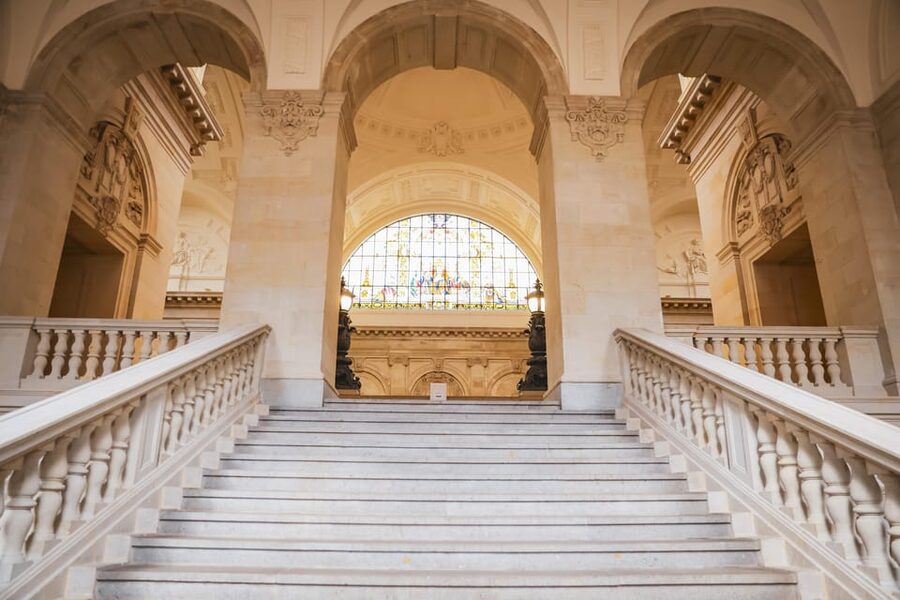
The building itself is the opening argument for taking this tour. Built in 1879, it expresses the confidence and ceremony of the Wilhelmine era through monumental architecture and formal decoration.
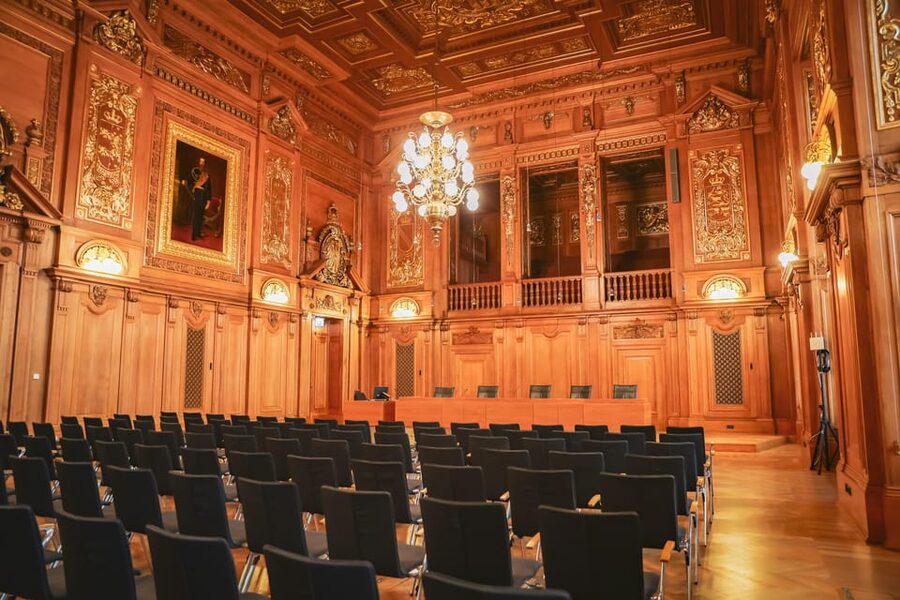
You can expect impressive national coats of arms and imperial paintings in the large courtroom. These details help explain how the court wanted to present itself: serious, official, and closely tied to the institutions of the German Empire.
I find court buildings most interesting when their design tells you how justice was meant to appear. Here, scale and decoration create a sense of authority before a word is spoken. You are looking at architecture designed not merely to house legal work, but also to give that work public weight.
The tour explains the building’s architectural features as well as its past. That combination is important. If you only hear dates, the rooms can feel like old scenery. If you only study the design, you miss why the building mattered. The guide connects the two.
You may also learn about the official clothing still associated with federal judges: a crimson robe and beret. It is a small detail, but a memorable one. After seeing the formal rooms, the clothing helps you picture how the court functions as an institution, not just as a historic shell.
Courtrooms where major cases unfolded
The historic courtrooms are the heart of the visit. You get to see the rooms where judicial work took place, while the guide explains important judgments and decisions tied to German legal history.
Two cases receive special attention. The first is the Reichstag fire trial of 1933, one of the most infamous legal episodes of the Nazi period. The second is the trial of October 1907, when Karl Liebknecht defended himself against charges connected with the publication of his writings.
These are not minor footnotes. They show how courts can be caught inside major political conflicts. A visit like this is valuable because it places legal decisions in the rooms and institutions where they happened, rather than presenting them as detached textbook events.
The tour does not appear to focus only on one period. It moves between the imperial era, the political crises of the twentieth century, the GDR period, and the court’s current function. That range gives you a clearer sense of how German justice changed over time.
I would pay close attention to the guide’s explanation of the difference between architecture, judicial procedure, and political context. Those subjects overlap, but they are not the same. The best part of the experience is seeing how a court building can reflect all three.
Something different for another day:
- Leipzig: 1.5-Hour Historical Walking Tour in German
★ 4.7 · 2,217 reviews - Leipzig: 2-Hour Guided Walking Tour in German
★ 4.8 · 1,612 reviews - Leipzig: 13-Stop Hop-on/Hop-off Bus Ticket
★ 4.6 · 1,468 reviews - Gruseltour Leipzig: A Haunted Guided Tour
★ 4.5 · 1,385 reviews
A visit to the former presidential apartment
The former presidential apartment gives the tour a welcome change of scale. Courtrooms are designed for ceremony and public authority. A private residence suggests the daily life of the person who once led the institution.
The available information does not specify how many rooms are open or how they are furnished, so you should not expect a full domestic museum tour. Still, the apartment is an unusual inclusion and helps break up the formal sequence of courtrooms and meeting rooms.
I like this stop because it makes the building feel inhabited. A court can seem remote, even intimidating, when you see only official chambers. The former home of the president adds a human layer to the story.
It is also a good reason to choose this tour over simply viewing the exterior. You get access to parts of the building that are not obvious from the square, including spaces connected with both public duty and private life.
The building’s years as an art museum
The building’s changing use during the GDR era is one of the most useful parts of the historical story. For a period, this former court was used as an art museum rather than as the country’s top administrative court.
That change tells you something about the unsettled political life of the building. Its identity was not fixed. The same grand rooms could serve different public purposes under different systems of government.
The return to judicial use in 2002 adds a final chapter. Today, the building again houses the Federal Administrative Court, tying its original function to its present one after a long interruption.
I would listen for details about what changed and what survived. The building’s decoration and structure may recall the imperial court, while its current role belongs to modern federal Germany. That contrast is likely to be one of the most thought-provoking parts of the visit.
Is $14 a fair price?
At $14 per person, I consider this excellent value if you have an interest in history, architecture, law, or modern Germany. A 1.5-hour guided visit gives you more context than you would get from looking at the exterior or reading a short plaque.
The value comes from access as much as duration. Historic courtrooms and the former presidential apartment are not ordinary public sightseeing stops. You are paying for entry, interpretation, and a structured route through an important institution.
The tour also works well as a focused Leipzig activity. It does not consume an entire day, and the 90-minute length leaves room for other plans. If your schedule is tight, that balance is useful.
There are limits. This is not a broad city tour, and it is not designed as a casual family attraction. The subject matter can be serious, and children under 14 are not permitted. You should also confirm the language before paying, since German is the regular option.
What the high rating tells you about the experience
The experience has a 4.8 rating from 189 reviews, with repeated praise for organization, historical detail, and the guide’s manner.
The strongest pattern is the quality of the explanation. The guide is described as friendly, entertaining, and able to make history, architecture, and current legal work feel connected. One especially useful point is that the material does not become long-winded or dull, even though the subject is formal.
Several comments also praise the tour’s organization. That fits the format: a clear meeting point, a set 1.5-hour duration, and a defined route through the building.
A practical warning comes from the fact that one person wanted more time to hear and see additional material. I take that as a compliment to the content, but it also tells you something about the pace. The tour has a lot to cover, so you may leave with unanswered questions.
If you like to linger over architecture, you might wish for extra time in the rooms. If you prefer a concise, well-planned visit, the fixed length should suit you.
Who should book this court tour?
I would recommend it most strongly to:
- Adults interested in German political and legal history
- Architecture fans who enjoy grand public buildings
- Visitors who want a serious cultural stop beyond Leipzig’s main attractions
- German speakers, or people who can arrange an English tour in advance
- Anyone looking for a low-cost activity lasting about 90 minutes
It is less suitable for young children, since those under 14 cannot attend. It may also disappoint anyone expecting an interactive museum, a relaxed social outing, or a tour in English without prior arrangement.
You do not need to be a legal expert. The guide’s job is to explain why the building and its cases matter. Still, I would get more from the visit if I had at least a passing interest in Germany’s political past and public institutions.
Practical advice before you go
Wear something suitable for a formal public building, although no specific dress code is provided. The key rule is simple: arrive early at the court entrance and be ready for security or entry procedures if they are required.
Pets are not allowed, except for assistance dogs. Alcohol, drugs, party groups, and bachelor or bachelorette groups are also prohibited. This is an active federal court, not a party venue, so the tone is appropriately serious.
The building is wheelchair accessible, which makes the tour possible for many visitors with mobility needs. If you have specific access requirements, I would still confirm the details before arrival.
Some content is shown in its original language. That is worth remembering if you are relying on translated explanations or have limited German. English is available on request, but arranging it ahead of time is the sensible choice.
You can cancel up to 24 hours in advance for a full refund, and the reserve-now, pay-later option allows you to hold a place without paying immediately. Those terms are helpful if your Leipzig schedule is still changing.
My verdict: book it for substance, not spectacle
Book this tour if you want to understand how German justice, politics, and architecture meet in one building. The combination of historic courtrooms, the presidential apartment, imperial decoration, and major legal cases gives the visit real substance.
I would especially choose it on a rainy day or when you want a break from standard sightseeing. At $14, the cost is modest, and the 1.5-hour format is easy to fit into a Leipzig itinerary.
Skip it if you need an English tour without advance planning, are visiting with children under 14, or prefer light entertainment over serious historical material. For everyone else, this is a smart, inexpensive look inside one of Germany’s most important judicial buildings.
FAQ
Where does the Federal Administrative Court tour begin?
The meeting point is in front of the Federal Administrative Court at Simsonplatz 1 in Leipzig.
How long does the tour last?
The guided tour lasts 1.5 hours.
What language is the tour conducted in?
The regular tour language is German. English is available on request, so you should arrange this before booking.
What does the tour include?
It includes a guided tour of the Federal Administrative Court, visits to historic courtrooms, and a visit to the former presidential apartment.
Can children join the tour?
Children under 14 are not permitted to take part.
Is the building wheelchair accessible?
Yes, the activity is listed as wheelchair accessible.
Are pets allowed?
Pets are not allowed, but assistance dogs are permitted.
Can I cancel my booking?
Yes. You can cancel up to 24 hours in advance for a full refund. You can also reserve now and pay later.
Just added around Leipzig
- The classic – experience Leipzig’s city centre★ 5.0 · 13 reviews
- Leipzig’s Communist Past: A Self-Guided Audio Tour★ 5.0 · 16 reviews
- Corpses, Leprosy, Lucifer 75-minute Tour at the Old Cemetery★ 5.0 · 16 reviews
- first electrical carriage in town – guided City Tours – Leipzig★ 5.0 · 17 reviews
- Leipzig : Guided tour with Panorama Tower for a private group★ 5.0 · 19 reviews
- Motorboat tour ”Little Venice Tour” Gustav★ 4.5 · 19 reviews
- Leipzig’s Courtyards and Passages – Guided Tour for a Private Group★ 5.0 · 20 reviews
- Leipzig: “SoKO Leipzig”, unique Escape Room, 60 minutes★ 4.6 · 20 reviews
Leipzig Tours, compared.

City History Canal Sightseeing Tour on a Motorboat
Read our review →
1.5-Hour Public Tour with Night Watchman Bremme
Read our review →
Combo Tour in Leipzig: Guided City Tour & City Sightseeing
Read our review →


Browse the lists this tour appears in