
Reviewed · SELF-GUIDED TOURS
Leipzig’s Communist Past: A Self-Guided Audio Tour
Leipzig remembers its past in plain sight. This self-guided audio tour links city-center streets, churches, shopping arcades, and protest sites with stories from life under East Germany’s communist regime. You begin at Hauptbahnhof and finish near Moritzbastei, covering much of central Leipzig in about an hour to an hour and 15 minutes.
I like the freedom to pause, restart, or take the route at your own speed. I also like the local angle, especially the attention given to the Monday demonstrations that helped change East Germany in 1989. The main drawback is simple: you need your own smartphone and headphones, and an audio tour cannot answer questions or adjust its pace for you.
In This Review
- Key points to know before you go
- Why Leipzig is a powerful setting for this audio walk
- Starting at Hauptbahnhof and walking down the Brühl
- Höfe am Brühl and the Museum der Bildenden Künste
- Reformierte Kirche and Richard Wagner Platz
- St. Thomas Church and the story of public opposition
- Naschmarkt and Leipzig’s old commercial center
- Mädler Passage and Speck’s Hof
- St. Nicholas Church and the Monday demonstrations
- Augustusplatz and the Gewandhaus
- Finishing at Moritzbastei
- What $9.99 gets you
- Timing, technology, and practical limits
- Who should choose this Leipzig tour?
- Should you book it?
- FAQ
- Where does the Leipzig communist-history audio tour start?
- Where does the tour end?
- How long does the audio tour take?
- What language is the tour offered in?
- Can I pause the tour?
- Does the tour work offline?
- Is transportation included?
- What happens if I cancel?
Key points to know before you go
- The route connects major central sights: You’ll pass St. Thomas Church, St. Nicholas Church, Augustusplatz, the Naschmarkt, and several historic shopping passages.
- The 1989 Monday protests receive special attention: The stories are tied to real locations along the walk, which gives the political history a strong sense of place.
- You control the schedule: Start, pause, and finish when you wish, with no group waiting and no fixed departure time.
- Offline access is included: Download the VoiceMap app, audio, maps, and route data before setting out.
- The tour costs $9.99 per person: That is a reasonable price for a private audio walk with lifetime English access, especially if you want a short introduction to Leipzig.
- The walk ends at Moritzbastei: You finish near a well-known student culture venue and within easy reach of central Leipzig.
Why Leipzig is a powerful setting for this audio walk
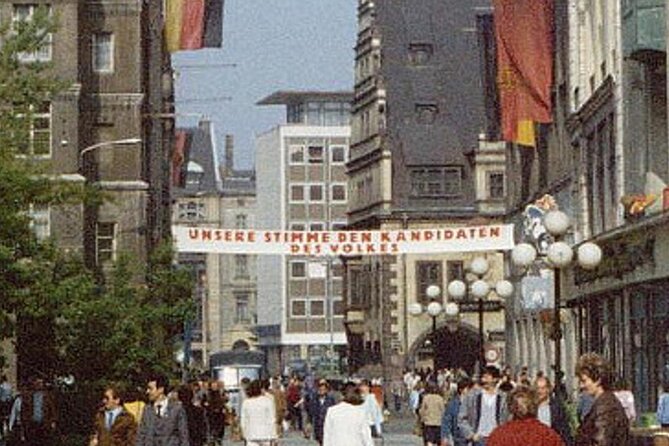
Leipzig is one of the best places in Germany to learn about the final years of East Germany. The city’s center is compact, and the route moves through places you might otherwise treat as ordinary shopping streets or grand public squares.
That is the useful idea behind this tour. Instead of placing the communist period in a distant museum, it attaches the story to the Hauptbahnhof, the churches, the plazas, and the passages you are walking through. You get a city orientation lesson and a political history lesson at the same time.
The tour focuses on daily life under the East German regime, not only on famous dates and government leaders. That makes the experience suitable if you want a short, human-scale introduction to Leipzig’s past. The audio also appears to draw on a former local’s perspective, adding a more personal tone than a bare list of facts.
The strongest subject is the Monday protest movement. The stories about those demonstrations have been especially affecting, in part because the route takes you to places connected with them. That direct connection between spoken account and physical location is the tour’s best feature.
A few more tours and experiences worth a look
- Leipzig City Centre: Scavenger Hunt Self-Guided Tour
★ 4.4 · 114 reviews - Leipzig: Scavenger Hunt Self-Guided Tour for Children
★ 4.4 · 105 reviews - BVB Signal Iduna Park: Stadium Access and Self-Guided Tour
★ 4.4 · 2,332 reviews
Starting at Hauptbahnhof and walking down the Brühl
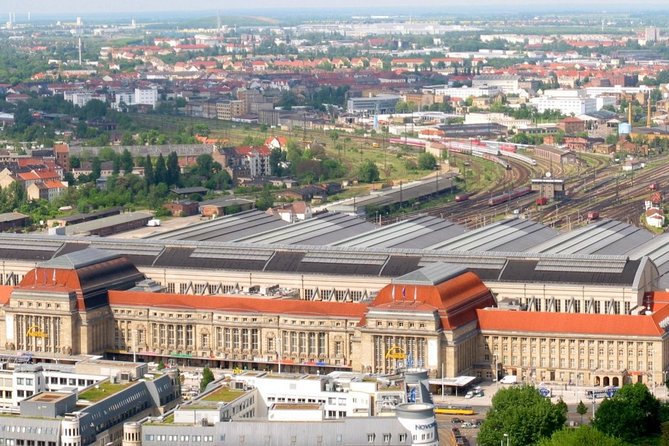
The tour begins outside Leipzig Hauptbahnhof, the city’s main railway station. This is a practical starting point because it is easy to reach by public transport and gives you an immediate sense of Leipzig’s central layout.
From there, you walk along the Brühl. The route uses this opening section to orient you in the city and introduce the setting for the stories ahead. The Brühl is also a useful reminder that Leipzig’s center is not arranged as a museum zone. Modern shops, old buildings, busy transport links, and political memory all sit close together.
You should allow a few extra minutes at the start to find the correct place outside the station and open the app. The directions to the starting point are included, and the tour begins when you reach the right location. Since the route is GPS based, keep your phone charged and download everything before leaving your hotel.
Höfe am Brühl and the Museum der Bildenden Künste
The next section passes through Höfe am Brühl, a modern shopping complex in the central city. It may seem like an unusual stop on a communist-history walk, but that contrast is useful. You can see how Leipzig’s commercial center has changed while listening to an account of the city under a very different economic and political system.
The tour then passes the Museum der Bildenden Künste, Leipzig’s major fine-arts museum. You are not paying for museum admission as part of this experience, so treat the stop as an exterior orientation point unless you choose to return later.
This is one of the tour’s advantages for a first visit. It helps you mark your position among central Leipzig’s major institutions without sending you inside every building. The tradeoff is that the route offers context rather than detailed museum interpretation.
Reformierte Kirche and Richard Wagner Platz
The walk continues by the Reformierte Kirche and then toward Richard Wagner Platz. These stops help fill in the city map between the station and the older core around St. Thomas Church.
You should not expect a long pause at each location. The full route has many points packed into roughly 60 to 75 minutes, so the experience works best when you keep moving while listening. If a place catches your eye, pause the tour and look around. That flexibility is built into the format.
Richard Wagner Platz is also a good example of how the tour combines cultural and political reference points. Leipzig is strongly associated with music and the arts, but its public spaces also carry memories of state power, public gatherings, and civic protest. The audio route places those threads side by side.
Something different for another day:
- Leipzig: City History Canal Sightseeing Tour on a Motorboat
★ 4.7 · 6,232 reviews - Leipzig: 1.5-Hour Public Tour with Night Watchman Bremme
★ 4.6 · 3,116 reviews - Combo Tour in Leipzig: Guided City Tour & City Sightseeing
★ 4.7 · 2,317 reviews - Leipzig: 1.5-Hour Historical Walking Tour in German
★ 4.7 · 2,217 reviews
St. Thomas Church and the story of public opposition
St. Thomas Church, or Thomaskirche, is one of the essential stops in central Leipzig. It is closely associated with Johann Sebastian Bach, but this audio walk is interested in another part of its importance: its connection to public life and the events that helped make Leipzig a center of opposition in the late East German period.
The church stop is likely to be one of the most meaningful parts of the route because it links a familiar historic building with the more recent political story. The account of the Monday demonstrations gains force when you are standing at or near places connected to those gatherings.
You may want to pause here longer than the standard audio segment allows. The app lets you do that, so you do not have to choose between listening and looking. Check the church’s opening arrangements separately if you hope to go inside, since admission and personal expenses are not included in the tour.
Naschmarkt and Leipzig’s old commercial center
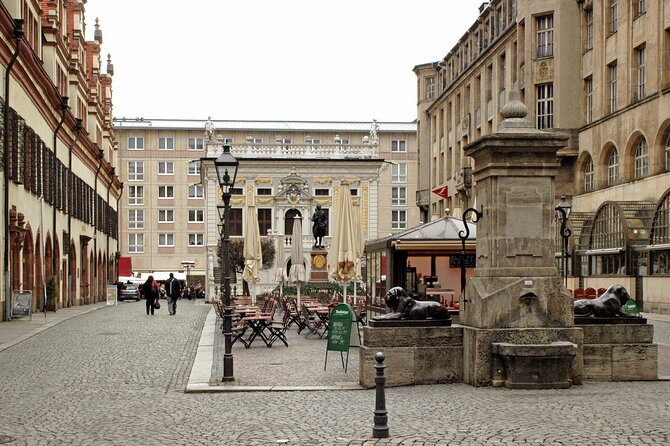
From St. Thomas Church, the route reaches the Naschmarkt. This square sits in the heart of Leipzig’s historic center and offers a change of mood from the church setting.
The Naschmarkt is useful for orientation because it places you among several layers of Leipzig’s past. The audio keeps the focus on the communist period, but the surrounding architecture gives you a broader sense of the city’s older commercial identity.
This part of the route also reinforces the tour’s practical value. You are not being led far out into the suburbs or asked to spend half a day crossing the city. The stops are close together, and you can fit the walk into a morning or afternoon alongside other Leipzig plans.
Mädler Passage and Speck’s Hof
The route then passes through or alongside two of Leipzig’s celebrated shopping passages, Mädler Passage and Speck’s Hof. These elegant arcades are among the city center’s most distinctive spaces, and they make a strong contrast with the political subject of the audio.
Mädler Passage is especially useful as a pause point. You can step inside, look around, and continue when ready. The passage also helps explain why Leipzig’s center has long been a place of trade, movement, and public meeting.
Speck’s Hof continues that architectural theme. These locations are not simply decorative stops. In a tour about a city divided between official ideology and everyday life, commercial spaces help show the ordinary urban setting in which people worked, shopped, met, and moved through the city.
The limitation is that the audio does not replace a full architectural tour. If your main interest is the passages themselves, you may want extra time afterward. The route introduces them, but its main subject remains East Germany and Leipzig’s political change.
St. Nicholas Church and the Monday demonstrations
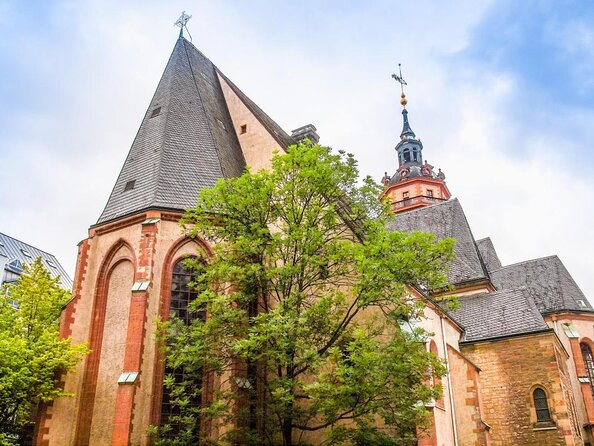
St. Nicholas Church, or Nikolaikirche, is the emotional center of the tour. It is strongly linked with the Monday demonstrations, the peaceful protests that became a major force in the collapse of East Germany’s political system.
The audio’s treatment of these demonstrations is one of the clearest reasons to choose this experience. The story is not floating above the city. It is tied to the church and nearby streets, allowing you to picture how public gatherings developed in a real setting.
I would slow down here and give the stop your full attention. The route may be designed to take about an hour, but you are free to pause and reflect. The ability to stop matters more at Nikolaikirche than at a simple orientation point because this is where the tour’s political subject becomes most immediate.
The walk does not appear to be a substitute for a detailed museum visit or a specialist lecture. Instead, it gives you a focused account of a crucial moment and shows you where that moment happened. For many people, that is enough to make the history easier to grasp.
Augustusplatz and the Gewandhaus
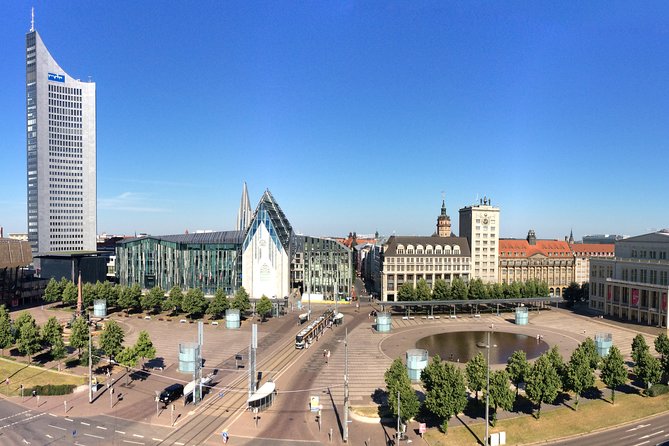
After St. Nicholas Church, the route continues to Augustusplatz. This broad square is one of Leipzig’s main civic spaces and gives the walk a more open feel after the narrower streets and passages.
You pass the Gewandhaus, Leipzig’s major concert hall. Again, the tour places music and politics in the same city view. Leipzig’s cultural identity is impossible to miss, but the audio asks you to consider how public life worked under the East German state and how that public life later changed.
Augustusplatz is also a useful point for understanding scale. Earlier stops take place in enclosed or tightly framed spaces. Here, you can imagine larger gatherings and the role that open public areas play in civic protest.
Traffic, pedestrians, and city noise may make listening less easy in open public areas. Headphones help, but you should keep the volume low enough to stay aware of your surroundings. You can always pause the audio and restart once you have crossed a busy section.
Finishing at Moritzbastei
The tour ends at Moritzbastei, at Kurt-Masur-Platz 1. Ending here gives you a practical transition back into Leipzig’s present-day cultural life.
Moritzbastei is a former fortification that now functions as a student-oriented cultural venue. The tour does not include admission or food and drinks, but the location gives you options after the walk. You can finish the audio, continue exploring the center, or make your own plans nearby.
A route that ends rather than loops is convenient if you arrive by train and want to continue sightseeing from another part of the center. It is less convenient if you need to return immediately to Hauptbahnhof, though the tour remains within central Leipzig and public transport is nearby.
What $9.99 gets you
At $9.99 per person, this is priced as a low-cost introduction rather than a full guided excursion. You receive lifetime access to the English tour, the VoiceMap app for Android and iOS, GPS directions, offline audio, offline maps, and route data.
That package offers good value if you already have a smartphone and headphones. You can use the tour at your own pace, and lifetime access means you are not limited to one attempt. You could pause for lunch, stop at a church or museum, and return to the route later.
The price is less attractive if you want personal interaction. There is no guide walking beside you, no chance to ask questions, and no included transportation, food, drinks, or admission fees. You are paying for structure, narration, and navigation.
The rating is 4.8 out of 5 from 16 ratings, and 94 percent of people who rated it recommend it. The most praised qualities are the clear timing, accurate route information, and the emotional connection to the Monday demonstrations. Those are precisely the areas where a self-guided tour needs to work well.
Timing, technology, and practical limits
Plan on 60 to 75 minutes for the basic route. If you pause at St. Thomas Church, St. Nicholas Church, the passages, or Augustusplatz, your outing will take longer. That is not a problem, but it is worth allowing extra time if you want to look around rather than simply follow the audio.
Download the app and tour material before you start. Offline access is included for the audio, maps, and geodata, which is helpful if your mobile connection is unreliable. You still need a compatible smartphone and headphones, and those are not provided.
The experience is private in the sense that only your group participates. You do not need to keep pace with strangers, and you can begin any time within the stated operating period. It is available every day around the clock from July 21, 2020 through February 16, 2027.
Most people can take part, and the route begins near public transportation. The supplied information does not specify a detailed accessibility assessment, so if you have particular mobility needs, check the route conditions before booking rather than assuming every section will suit you.
Free cancellation is available if you cancel at least 24 hours before the local start time. Inside that 24-hour window, the payment is not refunded and changes are not accepted.
Who should choose this Leipzig tour?
I would recommend it most strongly if you want a short, affordable introduction to Leipzig’s communist past and prefer to explore without a group schedule.
It suits you if:
- You want an English-language tour.
- You are staying near central Leipzig or arriving at Hauptbahnhof.
- You like moving at your own pace.
- You want the 1989 Monday demonstrations explained at the places connected with them.
- You plan to combine history with churches, shopping passages, music venues, and public squares.
- You are comfortable using a smartphone and headphones.
You may prefer a live guide if you want detailed discussion, personal recommendations, or the chance to ask questions. You may also want a separate museum visit if you are looking for documents, objects, or a longer account of East German daily life.
Should you book it?
Book this tour if you want to understand Leipzig’s communist past while getting your bearings in the city center. The route is compact, inexpensive, and flexible, and the sections about the Monday demonstrations give it a stronger emotional focus than a basic sightseeing walk.
Skip it if you dislike phone-based tours or want a guide-led conversation. For $9.99, though, it offers a useful first look at Leipzig’s recent past, especially if you slow down at St. Nicholas Church and give the audio room to connect the city streets with the people who changed them.
FAQ
Where does the Leipzig communist-history audio tour start?
It starts outside Hauptbahnhof in Leipzig, Germany.
Where does the tour end?
The tour ends at Moritzbastei, Kurt-Masur-Platz 1, 04109 Leipzig.
How long does the audio tour take?
The route takes approximately one hour to one hour and 15 minutes.
What language is the tour offered in?
The tour is offered in English.
Can I pause the tour?
Yes. You can start, pause, and finish the tour at your own pace.
Does the tour work offline?
Yes. You can download the audio, maps, and geodata for offline access through the VoiceMap app.
Is transportation included?
No. Transportation is not included.
What happens if I cancel?
You receive a full refund if you cancel at least 24 hours before the experience start time. Cancellations or changes made within 24 hours are not refunded or accepted.
Just added around Leipzig
- The classic – experience Leipzig’s city centre★ 5.0 · 13 reviews
- Corpses, Leprosy, Lucifer 75-minute Tour at the Old Cemetery★ 5.0 · 16 reviews
- first electrical carriage in town – guided City Tours – Leipzig★ 5.0 · 17 reviews
- Leipzig : Guided tour with Panorama Tower for a private group★ 5.0 · 19 reviews
- Motorboat tour ”Little Venice Tour” Gustav★ 4.5 · 19 reviews
- Leipzig’s Courtyards and Passages – Guided Tour for a Private Group★ 5.0 · 20 reviews
- Leipzig: “SoKO Leipzig”, unique Escape Room, 60 minutes★ 4.6 · 20 reviews
- Leipzig exclusive : Old Town tour for a private group★ 5.0 · 21 reviews
Self-Guided Tours, compared.

BVB Signal Iduna Park: Stadium Access and Self-Guided Tour
Read our review →
Solar Powered Sunset Catamaran Cruise & Audio Guide
Read our review →
Neuschwanstein Castle Entry Ticket and Audio Guide
Read our review →
Neuschwanstein Castle Ticket With Audio Guided Tour
Read our review →

Self-Guided Family and School Class Scavenger Hunt
Read our review →Browse the lists this tour appears in