
Reviewed · OLD TOWN WALKS
Dresden Old Town – Guided Walking Tour in English
Dresden rewards a closer look. This 2.5-hour walk links grand baroque buildings, wartime destruction, careful reconstruction, and the city’s Slavic roots into one clear story. I especially like the route’s strong historical sweep, from a small settlement beside the Elbe to a royal capital, and the way guides such as Nicolo, Nikolai, James, and Dominica bring that story to life with humor and local detail. I also like that you see the main Old Town sights on foot, without wasting time on transport.
The main consideration is the pace. The tour can run longer than two hours, and one recent participant wished for a toilet stop. The Frauenkirche appears on the route, but an interior visit is not included, so you may want to arrange that separately if the church is high on your list.
In This Review
- Key points to know before you book
- Meeting Martin Luther in Neumarkt
- Neumarkt and the Frauenkirche
- The Fürstenzug and Saxon power
- Dresden Castle and the rise of a royal capital
- Altmarkt, Kreuzkirche, and the modern city
- Brühl’s Terrace beside the Elbe
- Hofkirche and the Semperoper
- Zwinger Palace near the Elbe bridge
- Dresden’s destruction and careful reconstruction
- How much history fits into 2.5 hours?
- Is $35 a fair price?
- Who will get the most from this walk?
- Should you book Dresden Old Town Guided Walking Tour?
- FAQ
- Where does the Dresden Old Town walking tour meet?
- How long does the walking tour last?
- What language is the tour offered in?
- What sights are included on the route?
- Is the Frauenkirche interior visit included?
- Is transportation included?
- Is the tour wheelchair accessible?
- What does the $35 price cover?
- Do I need to arrive early?
- Can I cancel the booking?
Key points to know before you book
- Meet beside Martin Luther: Find the guide with the yellow umbrella at the statue in Neumarkt, next to the Frauenkirche.
- See Dresden’s essential Old Town: The route includes the Fürstenzug, Dresden Castle, Brühl’s Terrace, Hofkirche, Semperoper, Zwinger Palace, and more.
- Get the full story: The walk connects Dresden’s Slavic beginnings, Saxon royal power, baroque glory, World War II destruction, and reconstruction.
- Expect a lively guide: Nicolo, Nikolai, Dominica, James, and other guides have been praised for clear explanations, humor, and strong storytelling.
- Plan for a long walking stretch: The stated duration is 2.5 hours, though some walks have lasted close to three hours.
- Understand the price: The $35 fee covers your reservation and the guide’s payment within a pay-as-you-wish tour format.
Meeting Martin Luther in Neumarkt
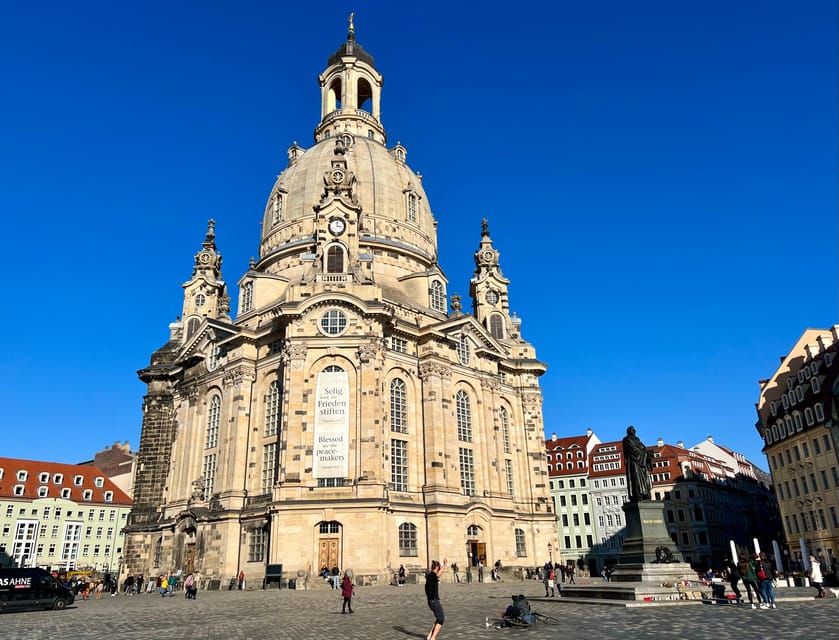
Your starting point is easy to recognize. Meet beside the Martin Luther statue in Neumarkt, next to the Frauenkirche, and look for the yellow umbrella carried by the Walkative Tours guide.
This is a useful place to begin because Neumarkt gives you Dresden in one glance. The square is framed by restored historic façades, while the Frauenkirche rises at its center. It feels old, but much of what you see was rebuilt after World War II. That fact is not a footnote here. It is one of the central questions of Dresden: how can a city recover its appearance, memory, and public life after near-total destruction?
Your guide should set up that question before the walk gets moving. The tour presents Dresden as a meeting point between Germanic and Slavic cultures, rather than treating the Elbe as a hard border between them. Dresden began as a small Slavic settlement, and the city’s name still sounds familiar to people who speak Czech, Slovak, Polish, or Sorbian.
Arrive at least 10 minutes early. Neumarkt can be busy, and finding a specific person in a large square takes longer than you might expect. The yellow umbrella is the detail to remember.
More Old Town Walks in Dresden
- Dresden: Semperoper and Old Town Tour
★ 4.8 · 5,735 reviews - Dresden: Night Watchman Tour Through The Old Town
★ 4.8 · 1,758 reviews - Görlitz: Old Town Guided Walking Tour
★ 4.7 · 723 reviews
Neumarkt and the Frauenkirche
The Frauenkirche is the emotional center of the opening section. Its broad stone dome and carefully restored exterior make it one of Europe’s most recognizable church buildings, but the real story is below the surface.
The church was destroyed during the bombing of Dresden in World War II and remained a huge pile of stones for decades. After reunification, it was rebuilt with historic design methods and, where possible, original fragments. The result is not a surviving medieval or baroque church. It is a modern reconstruction that lets you see how Dresden chose to remember its past.
That distinction matters. You are not simply admiring a pretty square. You are looking at a city center rebuilt with old plans, old techniques, and salvaged pieces of masonry. From ground level, the work can be almost impossible to spot.
The walking tour explains the building from the outside. If you want to see the interior, arrange a separate visit. One family on the walk specifically wished it had booked time inside the Frauenkirche. That is a useful warning for anyone who considers the church a main reason to visit Dresden.
The Fürstenzug and Saxon power
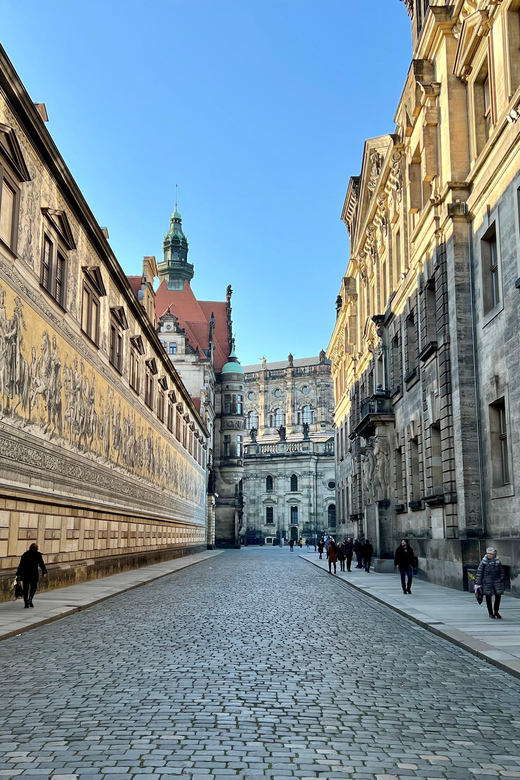
From Neumarkt, the route continues to the Fürstenzug, or Procession of Princes. This long gallery of mounted rulers is one of Dresden’s most memorable public artworks.
The mural presents the rulers of Saxony in a grand procession, linking the city to the Wettin dynasty and the political world of Central Europe. It is not just decoration. It shows how rulers wanted their authority to be seen, remembered, and connected across generations.
Look closely at the material. The work was transferred onto porcelain tiles, a practical choice given Saxony’s strong porcelain tradition. The gallery stretches along the side of Dresden Castle, so the setting adds another layer to the story.
This is where a good guide earns the walking-tour fee. A quick photograph tells you very little. A clear explanation can connect the rulers in the mural to Dresden’s growth, Saxony’s wealth, and the city’s later royal ambitions.
Dresden Castle and the rise of a royal capital
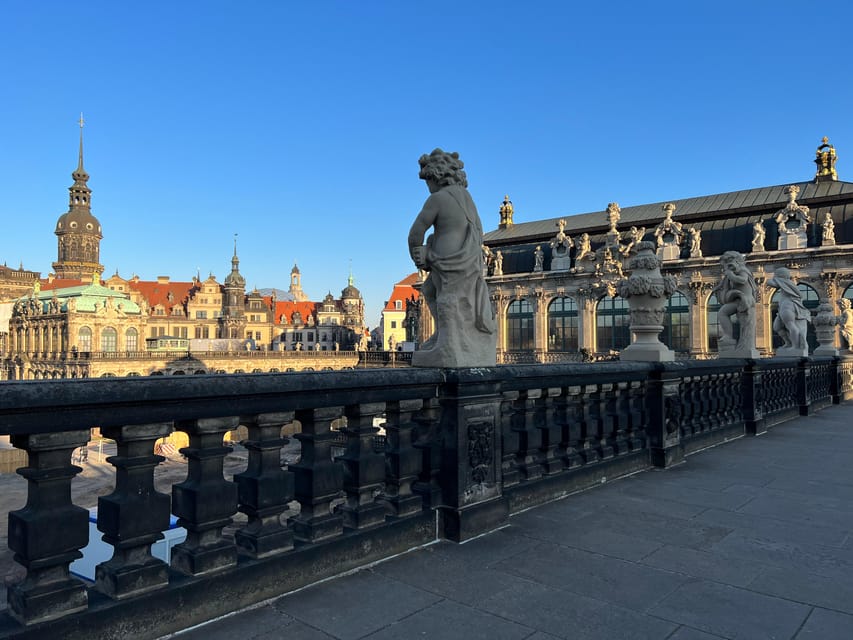
Dresden Castle began as a medieval stronghold and grew into a major residence for Saxon rulers. The building changed over time, which makes it a useful stop for understanding Dresden’s long development.
The city grew around a castle in the 13th century and became an important trading center by the end of the Middle Ages. Silver and lead from the nearby Rudavy mountains helped fund that growth. Dresden was also made the seat of the prince-electors of the Holy Roman Empire at the end of the 15th century.
Its greatest transformation came in the early 1700s. Saxon princes of the Wettin dynasty were elected Kings of Poland and Grand Dukes of Lithuania, giving Dresden new political weight and a taste for courtly display. The city’s baroque buildings date in large part from this period.
The redesigned castle is not a single-style monument. It carries medieval, Renaissance, baroque, wartime, and postwar layers. That makes it more interesting than a perfect palace preserved in one moment. Dresden is a city of revisions.
More Walking Tours in Dresden
- Dresden: City & Semperoper Guided Walking Tour
★ 4.8 · 2,293 reviews - Dresden: Guided City Walk with a Cup of Coffee
★ 4.7 · 1,568 reviews - Dresden: Complete Walking Tour with Frauenkirche Visit
★ 4.8 · 700 reviews - Dresden: Walking Tour with a Night Watchman and Meal
★ 4.4 · 487 reviews
Altmarkt, Kreuzkirche, and the modern city
Altmarkt offers a change of mood. The square is connected to Dresden’s older civic life, while the nearby Kreuzkirche represents the religious and musical traditions that remain important to the city.
The Palace of Culture adds a later chapter. Its presence helps you see that Dresden is not only a collection of baroque monuments. The city center includes postwar architecture and public buildings shaped by East Germany’s political period.
This part of the walk is especially helpful if you are tempted to treat Dresden as an open-air museum. The guide brings the story into the 20th century and the present day, showing how the city changed under Nazi rule, suffered during World War II, and rebuilt under a different political system.
Several guides have been praised for making these transitions easy to follow. One participant valued the way the tour connected Dresden’s story with wider European history. That is the right approach here. The city makes more sense when you see local events as part of changing empires, wars, royal alliances, and national borders.
Brühl’s Terrace beside the Elbe
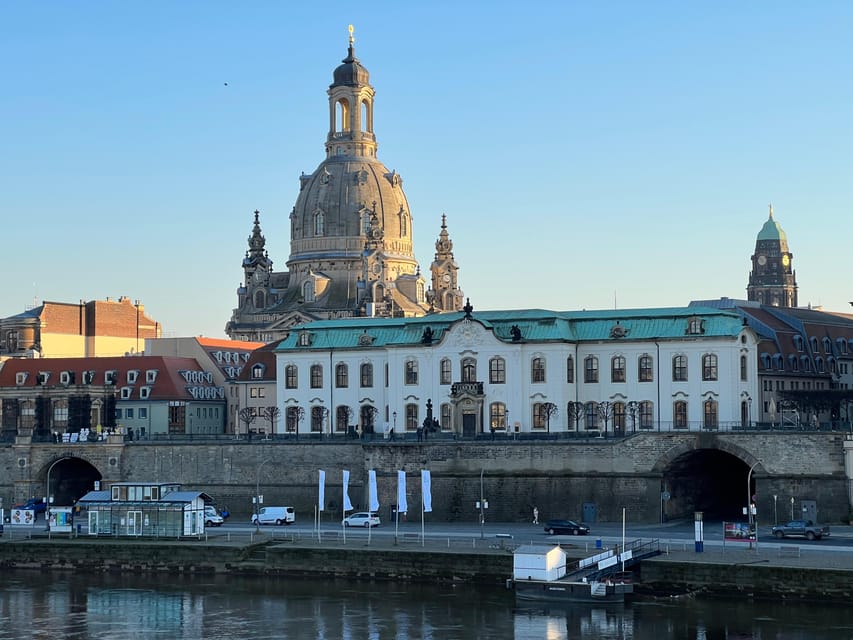
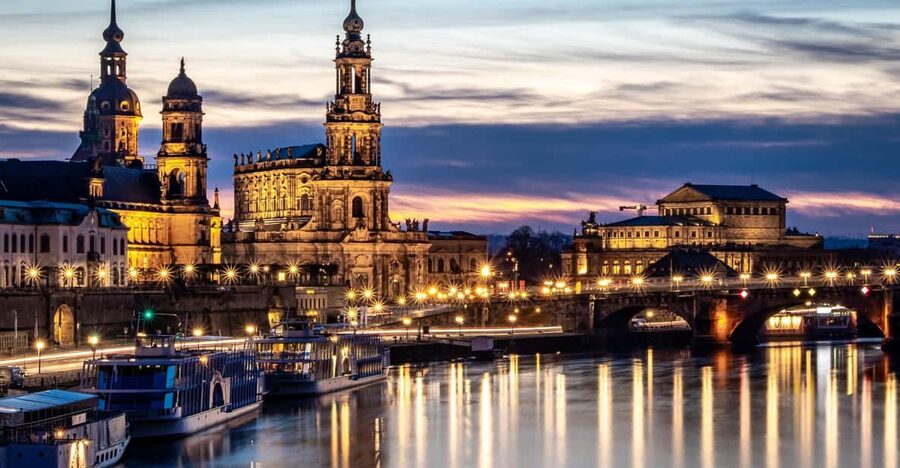
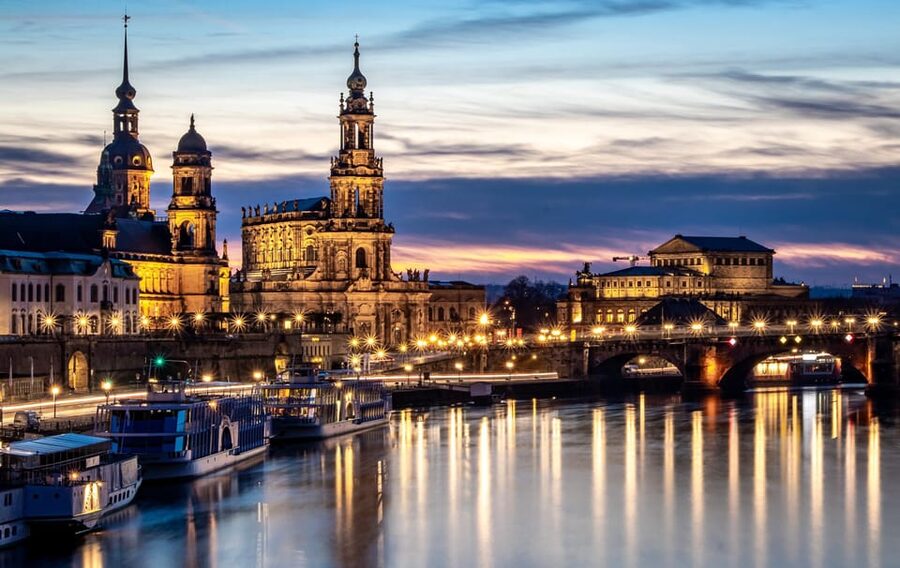
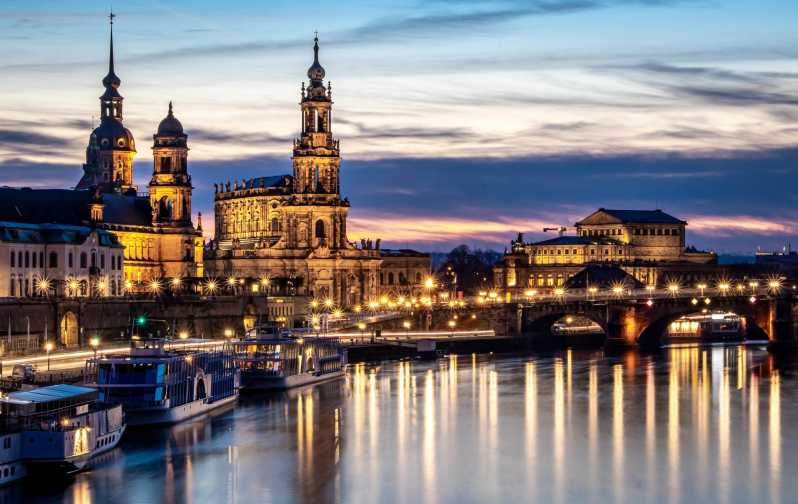
Brühl’s Terrace gives you one of the route’s best changes in viewpoint. Often called the Balcony of Europe, it runs along the Elbe and offers room to pause after the tighter streets around the castle and churches.
The river helps explain Dresden’s location. Trade, politics, and culture all benefited from the city’s position beside the Elbe. The waterway also supports the tour’s larger idea that Germanic and Slavic worlds were connected through movement and exchange.
This is a good point to listen rather than rush. The buildings along the terrace show Dresden’s royal ambitions, while the river keeps the city from feeling like a sealed court complex. You can look back toward the Old Town and see how the rebuilt center joins together churches, palaces, theaters, and public squares.
The terrace is still a walking route, not a long rest stop. Wear comfortable shoes and be ready to keep moving. The route is wheelchair accessible, but cobbled surfaces and the length of the walk are still practical factors to consider.
Hofkirche and the Semperoper
The Hofkirche, or Catholic Court Church, is one of Dresden’s most striking baroque buildings. Its presence reflects the unusual religious and political setting of Saxony, where the ruling family’s public identity did not always match the faith of the surrounding population.
The church’s position near the river and the royal buildings makes the political story visible in the architecture. Dresden’s rulers were using monumental buildings to express status, power, and connection to European courts.
The Semperoper brings music and theater into the route. Its name is tied to architect Gottfried Semper, and the building forms part of the city’s grand ceremonial center. From outside, you get the architectural setting and the guide’s explanation. This is not an opera performance or an interior tour, so plan separately if you want to attend a show or look inside.
I like this part of the walk because the buildings are close together but do not tell the same story. The Hofkirche points to dynastic and religious power. The Semperoper points to artistic ambition. Together they show why Dresden became known as a cultural capital.
Zwinger Palace near the Elbe bridge
The Zwinger Palace is the tour’s grandest baroque flourish. Its courtyards, pavilions, sculpture, and formal design reflect the confidence of the Wettin court during Dresden’s early 18th-century golden age.
The palace was built for court life and display rather than defense. Its open arrangement and decorative detail make a sharp contrast with the medieval origins of Dresden Castle. This is where the city’s royal story becomes almost theatrical.
The route reaches the Zwinger near the Elbe bridge, giving you a useful final connection between palace, river, and Old Town. You see how Dresden’s major sights are arranged within a compact center, which makes this tour valuable on a first visit. Afterward, you can return to the buildings that caught your attention instead of trying to locate everything from a map.
The walk does not include museum admission or a detailed indoor tour of each monument. Think of it as an orientation and interpretation walk. It gives you the structure you need for later visits.
Dresden’s destruction and careful reconstruction
The 20th-century section is essential. Dresden was heavily bombed during World War II, and the historic center was damaged to a degree that left it almost unrecognizable.
The tour does not stop at the destruction. It also looks at what happened afterward. Dresden was rebuilt using older design elements and historic methods, creating a city center that can look centuries old even though much of it is new.
Warsaw is another major European example of this kind of reconstruction, but Dresden’s version has its own character. The rebuilt center is not simply a copy of the past. It reflects decisions made after the war, during East Germany’s period, and after reunification.
I find this historical honesty one of the tour’s best features. You learn to look at the façades with two thoughts at once: admiration for the older design and respect for the modern effort that brought the center back.
The best guides keep this from becoming a dry lecture. Nicolo has been praised for using jokes and small facts at the right moments. Dominica has been described as a passionate storyteller, while Nikolai has received strong praise for clear English and broad knowledge of the city. Guide assignments can change, but the experience appears to depend heavily on the individual guide’s style.
How much history fits into 2.5 hours?
The advertised duration is 2.5 hours, but you should allow extra time. One walk lasted about three hours, and another participant felt the route was long enough to require a toilet stop.
That length is partly the point. Dresden has too many layers for a quick circuit of postcard sights. You move from Slavic beginnings to medieval trade, Saxon electors, Polish and Lithuanian connections, baroque court culture, Nazi rule, wartime bombing, East Germany, and modern reconstruction.
The risk is information overload. If you prefer a brief introduction with plenty of time for photographs, this may feel too long. If you want a strong first orientation and enjoy historical context, the extra time is useful.
I would visit a toilet before meeting the group and carry water, especially if you are walking in warm weather. The route is wheelchair accessible, but ask yourself how comfortable you are with 2.5 hours or more on foot across historic paving.
Is $35 a fair price?
The listed cost is $35 per person. The tour uses a pay-as-you-wish format, but in this case the amount you pay covers both the reservation fee and the guide’s payment.
That makes the pricing clearer than a classic free walking tour, where the guide’s income depends almost entirely on tips. You are paying for a reserved place and for the guide’s work, while keeping the flexibility associated with the pay-as-you-wish model.
For $35, the value is strongest if this is your first time in Dresden. You get the city’s central sights, a chronological explanation, and practical orientation in one walk. The route can save you from visiting the buildings as disconnected monuments.
The value is less certain if you already know the Old Town well or want long interior visits. Admission fees are not included, transportation is not included, and the tour mainly explains the sights from outside. The guide’s storytelling is a large part of what you are buying.
Free cancellation up to 24 hours before the start and the option to reserve now and pay later also make it easier to fit into a changing itinerary.
Who will get the most from this walk?
I would recommend it to first-time visitors, history fans, architecture lovers, and anyone who wants a clear introduction before exploring Dresden alone. Families can benefit too, particularly when the guide uses humor and short anecdotes to break up the heavier subjects.
The tour also suits repeat visitors. A participant returning to Dresden after visiting in 1993 found the contrast especially meaningful, since the Frauenkirche was still a mound of stones during that earlier trip.
English is the only listed language. Several guides have been praised for speaking English clearly, though one participant noted that a guide who spoke quickly took a few minutes to become easy to follow. If you need a slower pace, say so early.
I would skip this tour if you dislike group walks, need frequent breaks, or want a detailed interior visit to the Frauenkirche, castle, or Zwinger. It is also not a substitute for a museum visit. Its job is to make the whole Old Town make sense.
Should you book Dresden Old Town Guided Walking Tour?
Book it if you want Dresden’s major sights tied together by one strong story. The route covers the essential center, and the best guides make difficult subjects, especially wartime destruction and reconstruction, clear without turning the walk into a lecture.
Before you go, use the toilet, wear comfortable shoes, arrive 10 minutes early, and keep the Frauenkirche interior on your separate plan. At $35, this is a solid choice for a first visit, especially if you value explanation more than simply checking monuments off a list.
FAQ
Where does the Dresden Old Town walking tour meet?
Meet next to the Martin Luther statue at Neumarkt, beside the Frauenkirche. Look for the guide carrying a yellow umbrella.
How long does the walking tour last?
The stated duration is 2.5 hours. Some walks may last longer, with one reported walk lasting close to three hours.
What language is the tour offered in?
The tour is offered in English with a live English-speaking guide.
What sights are included on the route?
The route includes Neumarkt, the Frauenkirche exterior, the Fürstenzug, Dresden Castle, Altmarkt, Kreuzkirche, the Palace of Culture, Brühl’s Terrace, Hofkirche, Semperoper, and Zwinger Palace near the Elbe bridge.
Is the Frauenkirche interior visit included?
No. The route visits the Frauenkirche area, but an interior tour is not included in the listed experience.
Is transportation included?
No. Transportation is not included. The experience is a walking tour.
Is the tour wheelchair accessible?
Yes. The tour is listed as wheelchair accessible.
What does the $35 price cover?
The price covers the reservation fee and the guide’s payment within the pay-as-you-wish tour format.
Do I need to arrive early?
Yes. Arrive at the meeting point 10 minutes before the tour begins.
Can I cancel the booking?
Yes. You can cancel up to 24 hours in advance for a full refund. You can also reserve your place and pay later.
Just added around Dresden
- From Dresden: Guided Day Tour by Bus of Seiffen Toy Village★ 4.0 · 13 reviews
- Dresden: Christmas Sightseeing Tour with a ‘Pflaumentoffel’★ 4.5 · 13 reviews
- Dresden: Bike Rental – City Bike with Option Children Seat★ 4.5 · 13 reviews
- Sightseeing tour by ConferenceBike★ 5.0 · 14 reviews
- Dresden Neustadt: Scavenger Hunt for Children★ 4.8 · 15 reviews
- Dresden: Scavenger Hunt to Elbe River & Castles★ 4.7 · 15 reviews
- Street Art Tour Dresden Neustadt★ 4.0 · 15 reviews
- Dresden: 150-minute Trabi tour as a guided city tour★ 4.9 · 15 reviews
Old Town Walks, compared.
Old Town & Viktualienmarkt City Walk in German
Read our review →

The Night Watchman Old Town Walking Tour in German
Read our review →
Browse the lists this tour appears in