
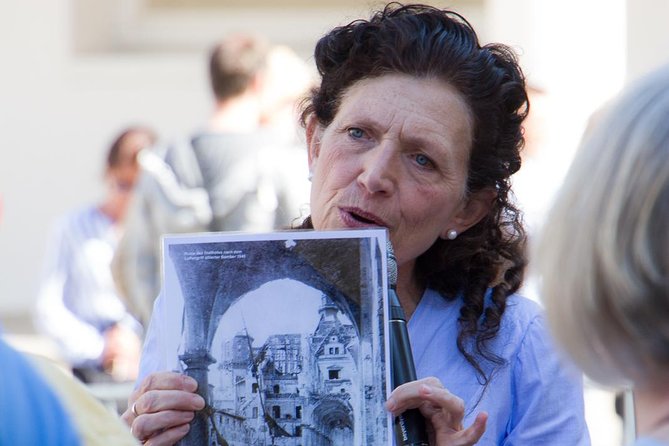
Reviewed · OLD TOWN WALKS
Public guided tour of the old town including a tour of the Frauenkirche
Dresden tells its story in layers. This two-hour walk links the rebuilt old town with the Frauenkirche, royal palace, Zwinger, and Elbe views, giving you a useful first look at the city without asking for a full day. I especially like the inside visit to the Frauenkirche and the guide’s focus on Dresden’s destruction, rebuilding, and return to a living city. I also like the clever audio guidance system, which lets you take photos or pause under an umbrella without losing the commentary.
The main consideration is language: this is a public tour in German, and the group can include up to 25 people. The tour runs on selected days from February through December, so check the date carefully. One complaint describes a cancellation and a changed program, though the strong overall rating and repeated praise for guide Frau Renger suggest that most departures run well.
In This Review
- Key points to know before booking
- Why this is a smart first look at Dresden
- Stallhof opens with medieval Dresden
- Neumarkt shows the old town rebuilt
- The Frauenkirche is the heart of the walk
- The Fürstenzug turns royal history into a picture
- Dresden Castle connects the city to its royal collections
- The Zwinger is Dresden’s grand outdoor stage
- Semper Opera House brings culture into the route
- Brühl’s Terrace ends with the best broad view
- A guide style that makes the history stick
- How the group size and sound system affect the walk
- Who gets the most from this Dresden tour
- Booking timing, cancellations, and a small caution
- Should you book it?
- FAQ
- How long does the Dresden old-town tour last?
- Where does the tour start?
- What time does the tour begin?
- Is the Frauenkirche visited inside?
- What language is the public tour conducted in?
- How much does the tour cost?
- Which days does the tour operate?
Key points to know before booking
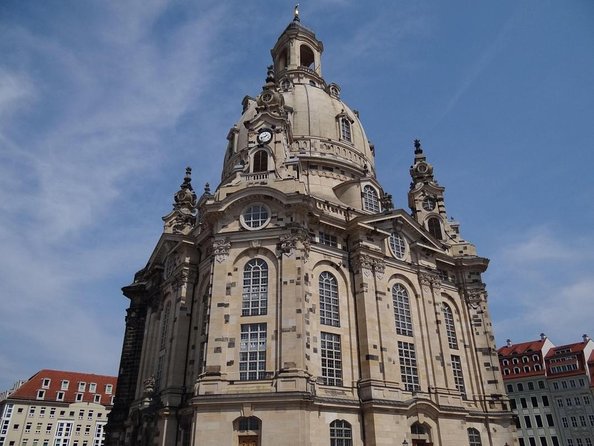
- Frauenkirche interior included: The visit covers the altar, paintings, lower church, and details of the reconstruction.
- Dresden’s postwar story gets real attention: Guides explain the city’s path from wartime destruction through rebuilding and reunification.
- Eight central sights in about two hours: The route includes Stallhof, Neumarkt, the Fürstenzug, Dresden Castle, the Zwinger, Semper Opera House, and Brühl’s Terrace.
- Live commentary stays audible: A guidance system helps you hear while walking, taking pictures, or stepping aside.
- Excellent value at $16.59: Children up to age 16 are free, making this a low-cost orientation for families.
- German only for the public departure: Private tours can be arranged in English or another language by contacting the provider directly.
Why this is a smart first look at Dresden
Dresden’s center is compact, but the sights come with a lot of names, dates, and royal connections. A good walking tour saves you from seeing a grand façade and wondering what it is. This route gives each major stop a place in the city’s larger story.
You meet at 10:30 a.m. at Neumarkt 2, right beside the Frauenkirche area. The end point is on Taschenberg, near the city center and often close to the Residenzschloss. That makes the tour easy to pair with a museum visit afterward.
At $16.59 per person, the price is modest for two hours of live guiding and an interior visit to one of Dresden’s key landmarks. The value is strongest if this is your first time in Dresden, since you get orientation, historical context, and a list of places to return to later.
This is not a museum-heavy tour. You are mainly walking outdoors, stopping for explanations, and entering the Frauenkirche. If you want long time inside the Royal Palace museums or a detailed architectural lecture at every building, you will need a separate visit.
More Old Town Walks in Dresden
- Dresden: Semperoper and Old Town Tour
★ 4.8 · 5,735 reviews - Dresden: Night Watchman Tour Through The Old Town
★ 4.8 · 1,758 reviews - Görlitz: Old Town Guided Walking Tour
★ 4.7 · 723 reviews
Stallhof opens with medieval Dresden
The first stop is Stallhof, the oldest fairground in Dresden. It was used for knight tournaments, which gives you an immediate sense of the city as a courtly capital rather than simply a collection of baroque buildings.
The stop lasts about 10 minutes and admission is free. I like this opening because it starts with a clear, visual idea: horses, contests, and royal display. The space also prepares you for the way Dresden repeatedly used architecture as a stage for power.
You will not spend long here, so keep your camera ready. The guide’s role is to explain why the courtyard mattered, not to provide an extended building-by-building tour.
Neumarkt shows the old town rebuilt
From Stallhof, the walk continues to Neumarkt. This is Dresden’s reconstructed historic center, lined with patrician palaces and dominated by the Frauenkirche.
The word reconstructed matters here. Dresden’s central district was heavily damaged during the Second World War, and the tour repeatedly returns to the difficult question of how a historic city should be rebuilt. The German-language guide explains not only what you see now, but also how the city changed after the war and through reunification.
This is one of the strongest parts of the experience for anyone interested in urban history. You get to compare the polished present with the story of what disappeared and what was brought back. The stop lasts around 10 minutes, enough for orientation without turning the tour into a long architecture class.
The Frauenkirche is the heart of the walk
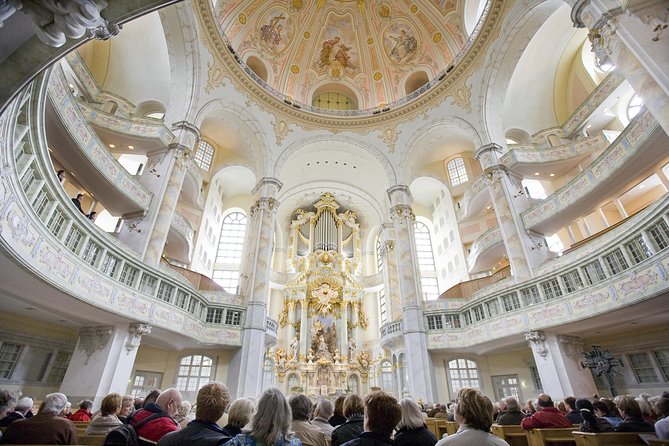
The Frauenkirche visit is the main reason to choose this tour over a basic outside walking route. You receive exterior explanations, then go inside for a look at the altar, paintings, interior design, and lower church.
The guide also explains the church’s historical reconstruction. That subject is central to Dresden, and it gives the building more meaning than its impressive stone dome alone. The Frauenkirche is not treated as a pretty photo stop. It becomes a way to understand the city’s wartime loss, postwar neglect, and later rebuilding.
The interior portion lasts about 20 minutes. That is enough for a guided introduction, but not enough for a slow private examination of every detail. If the church is your main interest, plan to return on your own after the tour and spend more time looking upward and around the interior.
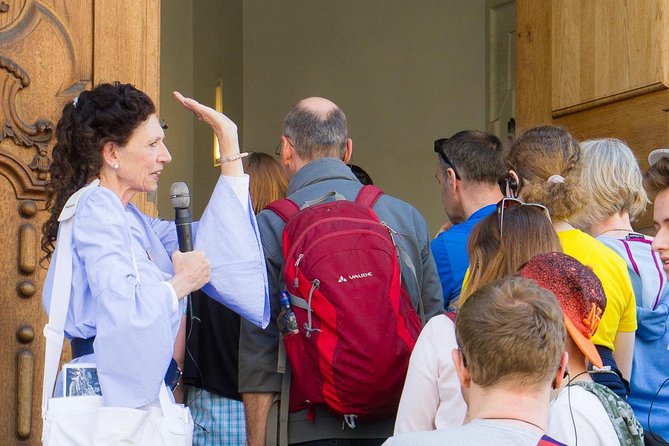
The experience is also helped by the audio system. You can hear the live explanation while standing slightly apart, taking a photograph, or finding a bit of shade. That small feature matters in a church where a crowded group can otherwise make it hard to follow the guide.
Something different for another day:
- Dresden: Semperoper Tickets and Guided Tour
★ 4.7 · 12,102 reviews - Dresden: The Original Night Watchman Tour in Lantern Light
★ 4.6 · 6,653 reviews - Dresden: River Sightseeing Boat Cruise
★ 4.3 · 5,323 reviews - Dresden: Tour of VW’s Transparent Factory
★ 4.5 · 4,058 reviews
The Fürstenzug turns royal history into a picture
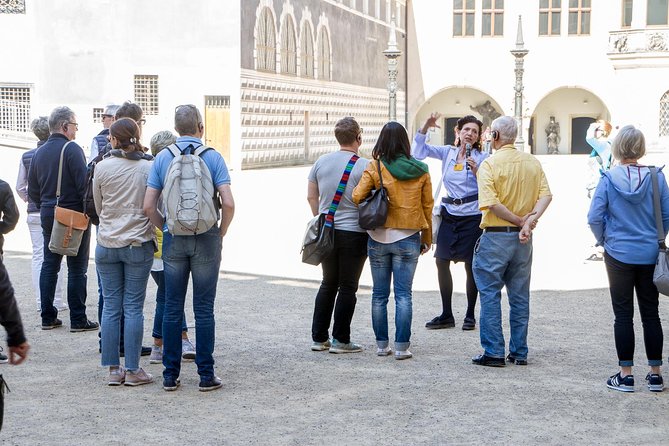
Next comes the Fürstenzug, a huge image of the Saxon princely family made from about 25,000 Meissen porcelain tiles. The display is both a work of art and a roll call of Saxon rulers.
The guide uses roughly 10 minutes here to explain what you are looking at and why the image is so unusual. This stop works well after the Frauenkirche because the focus shifts from religious rebuilding to dynastic power.
Look closely rather than simply walking past. The long wall is easy to treat as background scenery, but its scale and material are the point. Meissen porcelain is associated with Saxony, and using thousands of tiles for a historical procession gives the wall a distinctly local character.
Dresden Castle connects the city to its royal collections
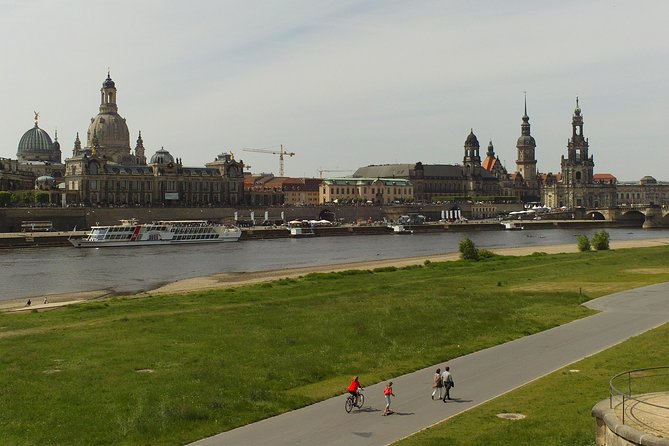
Dresden Castle, or Residenzschloss, was the residence of Saxony’s rulers and is now being rebuilt as a major museum complex, sometimes described as the Saxon Louvre. The tour gives you about 10 minutes of exterior explanation.
That short stop is useful for getting your bearings, but it is not a substitute for entering the collections. The castle contains enough material for a separate visit, and the provider offers an additional castle tour in the exhibitions at 1:30 p.m. on the same Monday, Wednesday, Friday, and Saturday schedule.
This creates a practical option. Take the 10:30 old-town tour, finish around the city center, and consider the 1:30 castle program if you want more royal art and history. The information supplied here does not specify the price or length of that extra tour, so check those details separately before planning your afternoon around it.
The Zwinger is Dresden’s grand outdoor stage
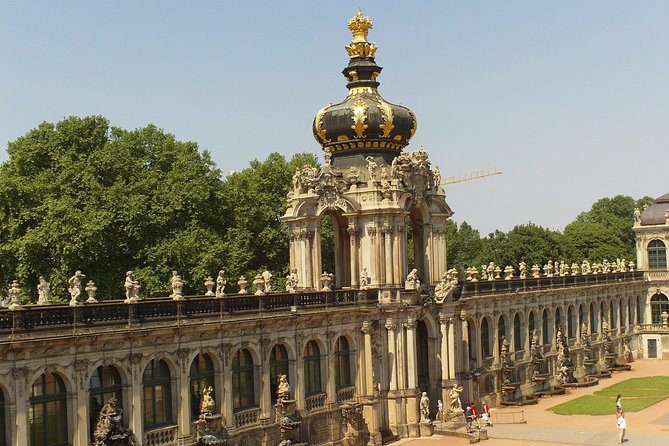
The walk then reaches the Dresden Zwinger, the city’s most famous former fairground. Its open courtyards and ornate baroque design were made for ceremony, spectacle, and court entertainment.
The stop lasts about 15 minutes, making it one of the longer outdoor stops. That gives the guide time to explain how the complex was used and why it remains one of Dresden’s defining sights.
I like seeing the Zwinger as part of a route rather than as an isolated monument. Stallhof shows an earlier tournament tradition, while the Zwinger presents a later, more elaborate version of royal display. You can see Dresden’s rulers using public space to project wealth and authority.
Still, 15 minutes passes quickly here. You will get a strong introduction and good orientation, but you should return if you want to explore the courtyards or nearby exhibitions at a relaxed pace.
Semper Opera House brings culture into the route
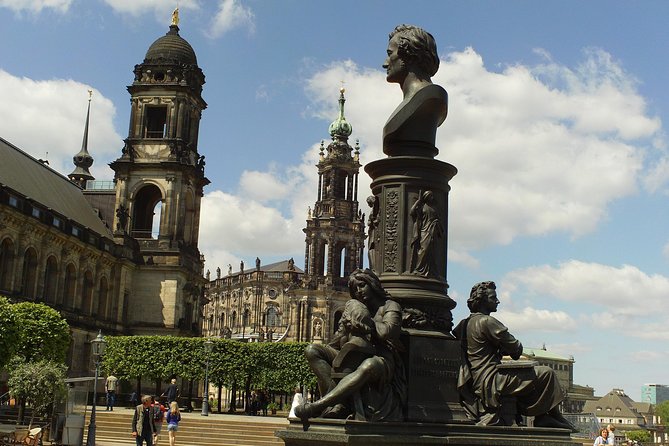
The Semper Opera House is described as one of Germany’s most beautiful opera houses, and the walking tour gives it around 10 minutes. The guide explains the building from outside, while a separate Semperoper tour can be combined with the city walk.
That option is worth considering if opera architecture is high on your list. The standard walk will help you understand where the opera house fits within Dresden’s royal center, but it does not turn into a full theater visit.
The short stop also keeps the pace moving. By this point, you have seen religious, dynastic, military, and courtly sides of the city. The opera house adds Dresden’s performing arts tradition without making the tour too specialized.
Brühl’s Terrace ends with the best broad view
The final stop is Brühl’s Terrace, a former fortress wall now used as a promenade. From here, you get views toward the Elbe floodplains, the river, and Dresden’s Neustadt, or new town.
This is a fitting ending because it pulls the camera back. Earlier stops focus on courtyards, façades, tiles, and church interiors. Brühl’s Terrace lets you see how the old center sits beside the river and across from the newer part of Dresden.
The walk ends around Taschenberg 2, often near the Residenzschloss, so the stated route and end point are close to the main historic sights. The exact stopping place may vary, but you finish in a useful part of central Dresden rather than at an inconvenient edge of town.
A guide style that makes the history stick
The strongest praise centers on the guiding. Several comments describe the tour as lively, clear, and full of well-informed details. One guide, Frau Renger, is singled out for telling Dresden’s story with unusual passion, as if she had been present centuries ago.
That enthusiasm matters in Dresden. The city’s story includes destruction, reconstruction, political change, and reunification. A dry list of dates would make the walk feel heavy. The comments point instead to a guide who uses humor, energy, and specific background details to keep the two hours moving.
The postwar period receives particular attention. The guides return to the destruction of Dresden and the rebuilding that followed, including the period leading to reunification. If you want a tour that treats the modern city as seriously as its royal past, this is a strong match.
The information is delivered live and with visual material designed to help you picture earlier stages of the city. The exact format may vary by guide, but the aim is clear: you should not just hear names and dates. You should be able to imagine how Dresden looked and changed over time.
How the group size and sound system affect the walk
The public tour is for individual visitors and small groups, with a maximum of 25 people. That is not a private experience, and you should expect to move at the pace of the group.
The guidance system is a useful touch. It is designed so you can understand the guide while walking, taking pictures, relaxing briefly, or using an umbrella. In practical terms, this means you do not have to stand shoulder to shoulder with the guide at every stop.
The route has several 10-minute stops and two longer pauses at the Frauenkirche and Zwinger. Wear comfortable shoes and expect a steady city walk. The tour information says most people can participate, and service animals are allowed. It also says the meeting point is near public transportation.
Who gets the most from this Dresden tour
I would recommend this for a first visit, especially if you have only one or two days in the city. You will see the major old-town sights quickly, learn the basic story behind them, and know where to return for a longer visit.
Families should note the generous age policy: children up to 16 years old are free. That makes the $16.59 adult price especially appealing for a family that wants a guided introduction without paying museum-level costs for every person.
German speakers will get the full benefit of the public departure. If you need English or another language, the provider says private tours can be arranged directly. Do not assume the regular public walk will switch languages for your group.
You should choose something else if you want a quiet, private pace or extensive time inside each sight. The tour is designed as an orientation, not a series of long visits. It also runs only on Monday, Wednesday, Friday, and Saturday from February through December.
Booking timing, cancellations, and a small caution
The experience is booked an average of 38 days ahead, which suggests that popular dates can fill well before arrival. If your Dresden schedule is fixed, I would reserve early, especially for a weekend departure.
Free cancellation is available until 24 hours before the 10:30 a.m. start. Cancellations or changes inside that window are not accepted for a refund, and the cut-off uses Dresden local time.
One French-language complaint reports a cancellation with a refund but no explanation, along with a program change on two September dates. That is a single negative account among an otherwise very high rating of 4.9 from 59 ratings and a 97 percent recommendation rate. Still, check your confirmation and meeting details before setting out.
Should you book it?
Book this tour if you want a lively German-language introduction to central Dresden, with the Frauenkirche interior and the city’s rebuilding story at its center. The price is low, the route covers the essential old town, and the guiding style appears to be the real strength.
Skip it if you need English on a public departure, dislike group walks, or want long museum visits. For everyone else, it is a sensible first morning in Dresden: short enough to leave your afternoon free, but substantial enough to give the city a clear shape.
FAQ
How long does the Dresden old-town tour last?
The tour lasts approximately two hours.
Where does the tour start?
It starts at Neumarkt 2, 01067 Dresden, Germany.
What time does the tour begin?
The scheduled start time is 10:30 a.m.
Is the Frauenkirche visited inside?
Yes. The tour includes an interior visit with explanations of the altar, paintings, interior design, lower church, and historical reconstruction.
What language is the public tour conducted in?
The public tour is conducted in German. Private tours may be available in English or another language by contacting the provider directly.
How much does the tour cost?
The listed price is $16.59 per person. Children up to and including age 16 are free.
Which days does the tour operate?
It operates from February through December on Monday, Wednesday, Friday, and Saturday.
Just added around Dresden
- From Dresden: Guided Day Tour by Bus of Seiffen Toy Village★ 4.0 · 13 reviews
- Dresden: Christmas Sightseeing Tour with a ‘Pflaumentoffel’★ 4.5 · 13 reviews
- Dresden: Bike Rental – City Bike with Option Children Seat★ 4.5 · 13 reviews
- Sightseeing tour by ConferenceBike★ 5.0 · 14 reviews
- Dresden Neustadt: Scavenger Hunt for Children★ 4.8 · 15 reviews
- Dresden: Scavenger Hunt to Elbe River & Castles★ 4.7 · 15 reviews
- Street Art Tour Dresden Neustadt★ 4.0 · 15 reviews
- Dresden: 150-minute Trabi tour as a guided city tour★ 4.9 · 15 reviews
Old Town Walks, compared.


Old Town & Viktualienmarkt City Walk in German
Read our review →

The Night Watchman Old Town Walking Tour in German
Read our review →
Browse the lists this tour appears in