
Reviewed · OLD TOWN WALKS
Dresden: Classic Old Town Tour
Dresden’s center packs centuries into a short walk. I like the way this private two-hour tour brings the Zwinger, Semperoper, Frauenkirche, and other major sights into one clear route, and I like the choice of a live guide who can explain Saxon culture as well as architecture. The main tradeoff is that entry fees are not included, so the price covers the guide and walking experience rather than museum admission.
The fixed price of $212 covers a group of up to 20 people, which can be good value for a family or group of friends. You can choose from English, French, Italian, or German, and centrally located hotel pickup is possible. If Frau Tröster leads your walk, her very deep knowledge of Dresden’s past is a particular reason to look forward to the tour.
In This Review
- Key points to know before booking
- Why this two-hour Dresden walk works well
- Starting with the Zwinger and Kronentor Gate
- Theaterplatz and the Semperoper
- Taschenbergpalais, Cathedral, and Dresden Castle
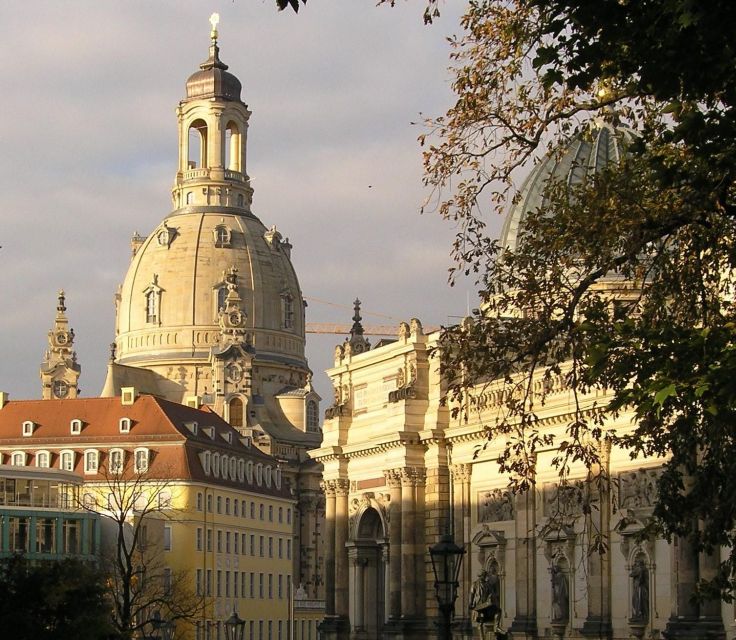
- The Fürstenzug and the rebuilt Frauenkirche
- Brühl’s Terrace and the New Synagogue
- Altmarkt and the Kulturpalast
- Price, group size, and what the fee covers
- Guide quality and language choices
- Practical details for your visit
- Who should book this Dresden tour?
- Should you book the Classic Old Town Tour?
- FAQ
- How long does the Dresden Classic Old Town Tour last?
- What landmarks are included?
- Is the Frauenkirche interior included?
- Are entry fees included in the price?
- How many people can join the private group?
- What languages are available?
Key points to know before booking
- A private route through Dresden’s historic center: Your group sees the main Old Town sights without joining a large public walk.
- Major landmarks in only two hours: The route includes the Zwinger, Semperoper, Frauenkirche, Dresden Castle, Fürstenzug, and Brühl’s Terrace.
- The Frauenkirche includes an interior visit: This gives the walk a closer look at one of Dresden’s most important buildings.
- A useful view from Brühl’s Terrace: You can look toward the state ministries and connect Dresden’s past with its present civic center.
- Four guide languages are available: Tours can be conducted in English, French, Italian, or German.
- Entry fees are separate: The tour itself includes the guide, but admissions are not part of the $212 price.
Why this two-hour Dresden walk works well
Dresden’s Old Town is compact enough to explore on foot, but its buildings do not explain themselves. A grand palace, an opera house, a cathedral, a rebuilt church, and a long mural can appear within a few minutes of one another. Without context, the center can feel like a parade of handsome facades. With a good guide, the route becomes a story about power, art, war, rebuilding, religion, and modern Saxony.
I like that this experience is not limited to architecture. The tour also covers Saxon lifestyle and culture, with a spirited and humorous approach. That matters on a walking tour. Two hours can feel dry if every stop becomes a list of dates and names. A lighter tone helps you keep the details in your head.
The private format also changes the pace. Your group can ask questions, stay together, and focus on the sights that matter most to you. The listed maximum is 20 people, so the experience is not automatically a tiny walk, but the format still gives you more control than a large scheduled group tour.
More Old Town Walks in Dresden
- Dresden: Semperoper and Old Town Tour
★ 4.8 · 5,735 reviews - Dresden: Night Watchman Tour Through The Old Town
★ 4.8 · 1,758 reviews - Görlitz: Old Town Guided Walking Tour
★ 4.7 · 723 reviews
Starting with the Zwinger and Kronentor Gate
The Baroque Zwinger is one of the strongest opening sights on the route. Its courtyards, formal architecture, and famous Kronentor gate give you an immediate sense of Dresden’s royal ambitions. This is the sort of place that deserves more than a quick photograph, since the proportions and decoration are easier to appreciate when a guide points out what you are seeing.
The Zwinger also sets up an important theme of the tour: Dresden was shaped by rulers who wanted to project culture and status. I would pay close attention here to the guide’s explanation of how the building fits into the city’s wider story. You may not have time to explore every corner, and the tour is not presented as a full museum visit, but the exterior gives you a strong first look.
Since admission fees are not included, you should treat this stop primarily as part of the walking route unless you arrange and pay for any separate entry yourself. The advantage is that the tour keeps moving and covers much more of the center in its two-hour window.
Theaterplatz and the Semperoper
From the Zwinger, the route continues to Theaterplatz and the Semperoper. This is one of Dresden’s most impressive public spaces, with several major buildings gathered close together. The opera house is the visual anchor, but the square works best as a whole.
A guide can help you understand why the Semperoper matters beyond its ornate exterior. Its place in Dresden’s cultural life connects naturally with the Zwinger’s art and courtly setting. You also get a chance to see how the city arranged its grand buildings around open civic spaces.
I would not book this tour expecting an opera performance or an extended interior visit at the Semperoper. The information provided describes a guided city walk, not a performance or a full building tour. Its value here is the setting, the exterior, and the story that ties the building to Dresden.
Taschenbergpalais, Cathedral, and Dresden Castle
The route then takes in the Taschenbergpalais, Dresden Cathedral, and Dresden Castle. These stops broaden the picture beyond a single style or period. You move from court architecture to religious architecture and then to the former seat of Saxon rulers.
The Taschenbergpalais is a useful stop because it can be easy to overlook when you are concentrating on the larger landmarks. The guide gives it a place in the route, helping you notice how much of Dresden’s political and royal story is concentrated in this small section of the center.
Dresden Cathedral adds a different mood. Its presence near the castle and the other royal buildings shows how religion and government once occupied the same powerful center. The tour includes the city’s major symbols without requiring you to spend the entire day inside one museum.
Dresden Castle is another landmark where an introduction is valuable. You see it as part of the Old Town’s connected group of buildings, rather than as an isolated attraction. Since general entry fees are not included, check your priorities before booking. If you want long indoor visits, you may need additional time and money beyond this walk.
Something different for another day:
- Dresden: Semperoper Tickets and Guided Tour
★ 4.7 · 12,102 reviews - Dresden: The Original Night Watchman Tour in Lantern Light
★ 4.6 · 6,653 reviews - Dresden: River Sightseeing Boat Cruise
★ 4.3 · 5,323 reviews - Dresden: Tour of VW’s Transparent Factory
★ 4.5 · 4,058 reviews
The Fürstenzug and the rebuilt Frauenkirche
The Fürstenzug is one of Dresden’s most memorable outdoor sights. This long mural presents the rulers of Saxony in a format that is easy to view during a walking route. It is also a good place to hear about the connection between Saxon power, public art, and the city’s royal past.
The Frauenkirche is the emotional center of the experience for many people. The church was destroyed during the Second World War and later rebuilt, making it a powerful symbol of Dresden’s destruction and recovery. The supplied details specifically include an interior visit, so you are not limited to seeing the famous dome from outside.
I like that the church is treated as more than a postcard view. Its restored interior gives you a chance to pause and consider what rebuilding means in a city marked by wartime loss. At the same time, keep the tour’s two-hour limit in mind. The visit is part of a broader route, not a long, quiet church exploration.
The newly rebuilt Neumarkt around the Frauenkirche adds another layer. The square shows how Dresden has chosen to reconstruct parts of its historic center. A guide can help you think about the difference between preserving old buildings and recreating a historic appearance.
Brühl’s Terrace and the New Synagogue
Brühl’s Terrace provides one of the tour’s best changes of pace. Often called the balcony of Europe, it gives you a view toward the state ministries and lets you look beyond the immediate facades of the Old Town. The stop is useful because it connects Dresden’s historic core with the city’s working government center.
I would especially value this part if you want more than a checklist of buildings. A view helps you understand how the riverfront and civic buildings relate to the Old Town. It also gives your feet a short break from close-up sightseeing, though the tour remains a walking experience throughout.
The New Synagogue adds a modern and deeply significant point to the route. Its inclusion keeps the story of Dresden from becoming only a royal Baroque tale. You see a place connected to the city’s Jewish life and to the rebuilding of Dresden in the modern era.
The tour does not promise a detailed interior visit at the synagogue, so expect an exterior stop and explanation unless your guide tells you otherwise. As with other buildings on the route, admissions are not included.
Altmarkt and the Kulturpalast
The route reaches Altmarkt and the Kulturpalast before covering much more of the center. Altmarkt helps complete the picture of Dresden as a living city rather than a collection of restored monuments. The Kulturpalast, with its modern character, provides a useful contrast to the Baroque buildings seen earlier.
This final part of the route can be especially helpful if you want to understand the city’s changing appearance. Dresden’s center includes old buildings, reconstructed spaces, government offices, cultural venues, and newer structures. The mix may not satisfy anyone looking for a perfectly uniform historic quarter, but it gives you a more honest look at the city.
Because the itinerary covers so many landmarks, you should expect an overview rather than a detailed lecture at every stop. The strength is breadth. In two hours, you get a reliable orientation to the center and can decide where to return later.
Price, group size, and what the fee covers
The price is $212 for a private group of up to 20 people. At the maximum group size, that works out to about $10.60 per person, which is strong value if you are traveling with a larger family, school group, or group of friends. For two people, the same fixed price feels much less economical.
The fee includes the tour guide. It does not include entry fees, so you should not compare the price directly with a museum ticket or assume that all interiors are covered. The Frauenkirche interior visit is included in the stated route, but other admissions remain your responsibility.
The private format is the main reason to choose this experience over a cheaper public walk. You are paying for a dedicated guide, a flexible group setting, and a route that covers the city’s most important sights in a short period. If you are comfortable exploring independently and only want a few facts, the price may be hard to justify for a small party.
Guide quality and language choices
The tour is offered in English, French, Italian, and German. That makes it easier to choose the language in which you will best follow details about Dresden’s politics, religion, architecture, and wartime past.
The tone is described as spirited and humorous, which should appeal to you if you prefer a lively explanation over a formal lecture. One named guide, Frau Tröster, has received particular praise for her very deep knowledge of Dresden’s history. That detail is worth noting because the quality of a walking tour depends heavily on the person leading it.
You should ask questions during the walk. A private group gives you a better chance to clarify names, dates, and architectural details as they arise. With a route this full, questions can also help the guide adjust the emphasis to your interests.
Practical details for your visit
The experience lasts two hours, and starting times depend on availability. I would book a time that leaves room afterward if you want to enter museums or spend longer at the Frauenkirche, castle, or other sights. The walk itself is the main event, not a substitute for a full day of indoor sightseeing.
Centrally located hotel pickup is possible, which can make the beginning easier if your accommodation is in the center. Confirm the pickup arrangement when booking, since the information only specifies centrally located hotels.
The tour is wheelchair accessible. It is also available as a private group, which can make movement and questions simpler for people who need a little more control over the pace. Still, this is a historic-center walking tour, so you should confirm any personal mobility concerns before booking.
Free cancellation is available up to 24 hours before the tour for a full refund. You can also reserve now and pay later, useful if your Dresden schedule is still changing.
Who should book this Dresden tour?
I would recommend it to first-time visitors who want a clear introduction to Dresden’s central sights. It is also a good fit for families, groups with limited time, and anyone who prefers a guide who can combine facts with humor.
The tour suits you best if you want to see many major landmarks from the outside, enter the Frauenkirche, and understand how the buildings fit together. The private setup is particularly useful for a group that wants its own language and pace.
I would hesitate if you are traveling alone or as a couple on a tight budget. The fixed $212 price is much easier to justify when shared by several people. I would also choose another format if your main goal is extensive museum time, a Semperoper performance, or long visits inside Dresden Castle and other buildings.
Should you book the Classic Old Town Tour?
Book it if you want a polished overview of Dresden in two hours, especially with a group large enough to share the cost. The route covers the city’s essential sights, includes the Frauenkirche interior, adds useful views from Brühl’s Terrace, and brings in the New Synagogue and Kulturpalast rather than stopping at the usual royal monuments.
Before you commit, remember that admissions are extra and the schedule is brisk. For a first orientation, though, this is a sensible way to get your bearings and learn which parts of Dresden deserve a longer return visit.
FAQ
How long does the Dresden Classic Old Town Tour last?
The walking tour lasts two hours.
What landmarks are included?
The route includes the Zwinger and Kronentor gate, Semperoper, Taschenbergpalais, Dresden Cathedral, Dresden Castle, the Fürstenzug, Frauenkirche, Neumarkt, Brühl’s Terrace, the New Synagogue, Altmarkt, and the Kulturpalast.
Is the Frauenkirche interior included?
Yes. The stated route includes an interior visit to the Frauenkirche.
Are entry fees included in the price?
No. Entry fees are not included.
How many people can join the private group?
The price covers a private group of up to 20 people.
What languages are available?
The tour can be conducted in English, French, Italian, or German.
Just added around Dresden
- From Dresden: Guided Day Tour by Bus of Seiffen Toy Village★ 4.0 · 13 reviews
- Dresden: Christmas Sightseeing Tour with a ‘Pflaumentoffel’★ 4.5 · 13 reviews
- Dresden: Bike Rental – City Bike with Option Children Seat★ 4.5 · 13 reviews
- Sightseeing tour by ConferenceBike★ 5.0 · 14 reviews
- Dresden Neustadt: Scavenger Hunt for Children★ 4.8 · 15 reviews
- Dresden: Scavenger Hunt to Elbe River & Castles★ 4.7 · 15 reviews
- Street Art Tour Dresden Neustadt★ 4.0 · 15 reviews
- Dresden: 150-minute Trabi tour as a guided city tour★ 4.9 · 15 reviews
Old Town Walks, compared.
Old Town & Viktualienmarkt City Walk in German
Read our review →
The Night Watchman Old Town Walking Tour in German
Read our review →
Browse the lists this tour appears in