
Reviewed · HAMBURG TOURS
Down Town to Speicherstadt, HafenCity and Elbphilharmonie
Hamburg’s story unfolds one street at a time. This two-hour English walking tour links the old city center with Speicherstadt, HafenCity, and the Elbphilharmonie, giving you a useful introduction to Hamburg’s trade, wartime destruction, port life, and modern growth. I like the clear route from Rathausmarkt to the riverfront, and I like that the tour mixes major sights with smaller details, such as the Hygieia fountain and Deichstrasse’s old merchant houses.
The main consideration is pace. You cover a lot of ground in two hours, with short stops at eight locations. The tour does not include transportation or admission to attractions, and you need at least eight people for the booking to operate. Still, at $30.04 per person, the small-group format, professional guide, and strong focus on Hamburg’s central districts make it a solid orientation walk.
In This Review
- Key Things to Know Before You Book
- Starting at Hamburg Town Hall and Hygieia Fountain
- Trostbrücke and the Birth of Hamburg’s Port
- Deichstrasse’s Merchant Houses
- St. Nikolai Memorial and Operation Gomorrha
- HafenCity and Hamburg’s Modern Rebuilding
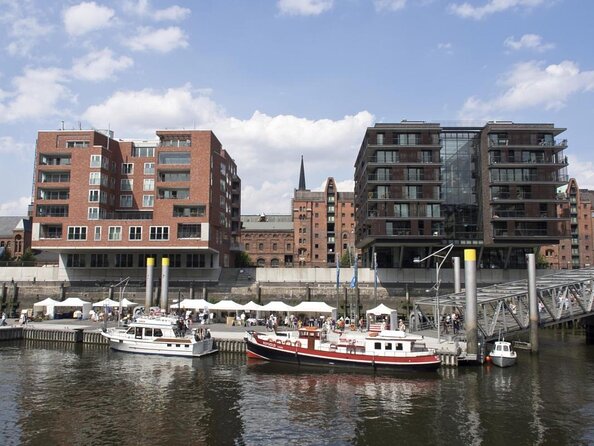
- Speicherstadt’s Red-Brick Warehouses
- Ending at the Elbphilharmonie
- Guide Quality and Group Size
- Is $30.04 Good Value?
- Practical Details for a Two-Hour Walk
- Who Will Enjoy This Hamburg Walk?
- Should You Book It?
- FAQ
- How long does the Hamburg walking tour last?
- Where does the tour begin?
- Where does the tour end?
- Is the tour offered in English?
- Are transportation and attraction admission included?
- Does the tour operate in bad weather?
- What is the cancellation policy?
Key Things to Know Before You Book
- Eight major stops in two hours: The route covers Rathausmarkt, Trostbrücke, Deichstrasse, St. Nikolai, HafenCity, Speicherstadt, and the Elbphilharmonie.
- A useful old-to-new city story: You move from the medieval trading center to a rebuilt warehouse district and then into Hamburg’s modern harbor development.
- Speicherstadt is the centerpiece: The red-brick warehouse district was built on wooden piles, opened in 1888, and is part of Hamburg’s UNESCO World Heritage site.
- The tour ends at the Elbphilharmonie: You finish outside Hamburg’s famous concert hall, with the chance to visit its viewing platform afterward.
- Small groups matter: The maximum is 15 people, which should make it easier to hear the guide and ask questions.
- Come ready for the weather: The tour runs in all weather, so comfortable shoes and suitable clothing are important.
Starting at Hamburg Town Hall and Hygieia Fountain
The walk begins at Rathausmarkt, in front of Hamburg’s grand Town Hall. The building dates from 1897 and uses a Neorenaissance design that reflects the wealth and confidence of Hamburg’s merchant class.
This is a good starting point because the square places you close to the old center, while the building itself offers an immediate lesson in civic pride. Your guide can point out details in the facade and explain how Hamburg’s identity grew from trade, shipping, and local government.
You spend about 10 minutes here, enough to take in the exterior without turning the tour into an architecture lecture. Admission is free, and this part of the walk is easy for most people.
Behind the Town Hall, the Hygieia-Brunnen offers a smaller but worthwhile pause. The fountain represents the importance of fresh water. It is an easy detail to overlook when the large Town Hall is nearby, so having a guide draw attention to it adds value.
I appreciate stops like this because they help you read the city at street level. Hamburg is not only about impressive buildings and ships. Everyday needs, including clean water, shaped urban life too.
Other Hamburg trips people book alongside this one:
- Hamburg: Sex and Crime in St. Pauli Tour for Ages 18+
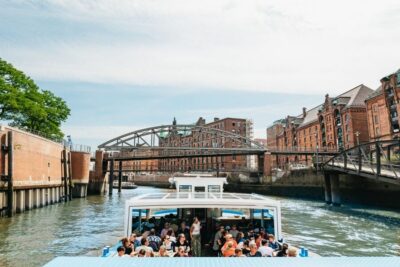
★ 4.7 · 15,447 reviews - Hamburg: 1.5-Hour Harbor and Speicherstadt Day Cruise
★ 4.6 · 14,200 reviews - Hamburg: 90-Minute Evening Lights Harbor Cruise
★ 4.5 · 7,728 reviews
Trostbrücke and the Birth of Hamburg’s Port
The next stop is Trostbrücke, or Consolation Bridge. This is presented as the starting point of Hamburg’s port, when sailing ships brought goods into the city center and merchants waited to buy and sell them.
The location helps explain why Hamburg developed where it did. Before today’s container terminals and industrial port areas, ships came much closer to the center. Trade was part of daily city life, not something separated from it by miles of docks and roads.
You spend about five minutes here, so expect a concise explanation rather than a long port history. That brevity works well in a walking tour. You get the basic idea, then continue through streets shaped by the same commercial past.
The guide also connects this older port to later changes. Steamships and container vessels altered Hamburg’s waterfront completely. This transition prepares you for HafenCity, where former industrial land has been given a new purpose.
Deichstrasse’s Merchant Houses
Deichstrasse is one of the more atmospheric sections of the route. Its historic houses date back to the 17th century and show how merchants once combined home, workplace, and storage under one roof.
This is a useful place to understand the practical side of trade. Goods did not simply arrive at a distant terminal and disappear into a supply chain. In the old city, merchants lived close to their stock, their business, and the water.
The street survived the fire of 1842 and the destruction of World War II, making its survival especially notable. You spend about 10 minutes here, enough to look at the facades and picture how these buildings functioned.
I would pay attention to the building layout rather than simply taking photographs. The real interest lies in how tightly work and home were joined. Deichstrasse gives you a more human sense of Hamburg’s past than a grand public building can.
St. Nikolai Memorial and Operation Gomorrha
The Mahnmal St. Nikolai is one of the most serious stops. Its steeple dates from 1874, while the surviving ruin now serves as a memorial to victims of World War II.
Below the ruin, an exhibition covers Operation Gomorrha. The subject is difficult, and the stop changes the mood of the walk. Up to this point, the route has focused heavily on trade and urban development. St. Nikolai reminds you that Hamburg’s modern appearance was also shaped by war and destruction.
The guide allows about 10 minutes here. That is enough time for an introduction and some quiet observation, though you should not expect a full museum visit within the tour. The exhibition is mentioned as being beneath the ruin, but admission to attractions is not included in the walking tour.
This stop is important because it prevents Hamburg’s story from becoming too polished. The city’s rebuilding and economic success came after enormous loss. Even a short explanation here gives the rest of the route more weight.
Something different for another day:
- Hamburg: 2-Hour XXL Port of Hamburg Cruise Tour
★ 4.7 · 6,979 reviews - Hamburg: Line A Sightseeing Hop-On Hop-Off Bus Tour
★ 4.6 · 6,958 reviews - Hamburg: Elbphilharmonie Plaza Guided Tour
★ 4.7 · 5,882 reviews - Hamburg: Hamburg Dungeon Admission Ticket
★ 4.7 · 5,745 reviews
HafenCity and Hamburg’s Modern Rebuilding
After the older streets and wartime memorial, the tour moves into HafenCity. This district is described as Europe’s largest city-planning project, covering 157 hectares of former industrial land.
HafenCity is not simply a collection of new buildings. It represents Hamburg’s effort to bring life back to former port areas while keeping the city connected to the Elbe. The guide explains how the transformation took place, giving you context for the new streets, public spaces, and construction.
You spend around 10 minutes here. That is enough to grasp the scale of the project, but not enough to inspect the district in detail. If modern architecture and city planning interest you, you may want to return after the tour and explore at your own pace.
I like this part of the walk because it gives Hamburg a clear before-and-after story. Trostbrücke shows the old port entering the city center. HafenCity shows the city reshaping former industrial land for a new era.
The contrast is also practical for orientation. Once you have seen HafenCity with an explanation, the area makes more sense than it would if you simply wandered among large new buildings without context.
Speicherstadt’s Red-Brick Warehouses
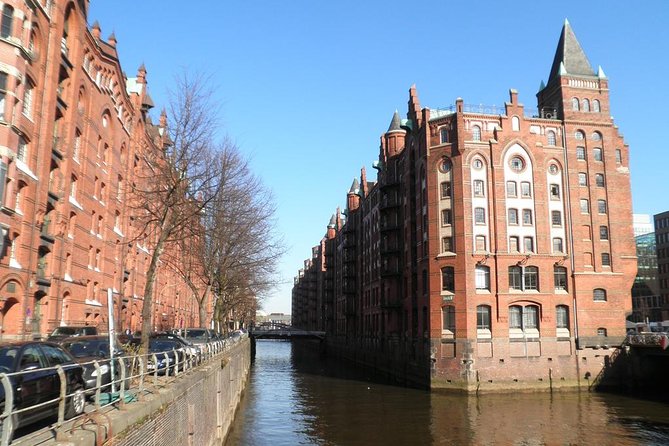
Speicherstadt is the visual heart of the experience. It is described as the world’s largest red-brick warehouse district built on wooden piles. The complex opened in 1888 and was restored after World War II.
The warehouses were designed for storage and trade, not for homes. Their tall brick walls, narrow waterways, and repeated facades create a strong sense of purpose. The district once handled goods moving through Hamburg’s port, and its design reflects the needs of a major trading city.
The tour allows about 15 minutes here, the longest stop on the route. That feels appropriate. You need time to look up at the brickwork, notice the canals, and understand how the warehouses fit into Hamburg’s commercial system.
Speicherstadt is also part of Hamburg’s UNESCO World Heritage site. That status confirms its cultural importance, but you do not need a formal designation to appreciate the place. Its character comes from the combination of scale, materials, water, and working-port history.
This is where a guide adds real value. Without context, you might see an attractive old district and move on. With an explanation, you can read the warehouses as evidence of Hamburg’s trading system and its changing relationship with the harbor.
Ending at the Elbphilharmonie
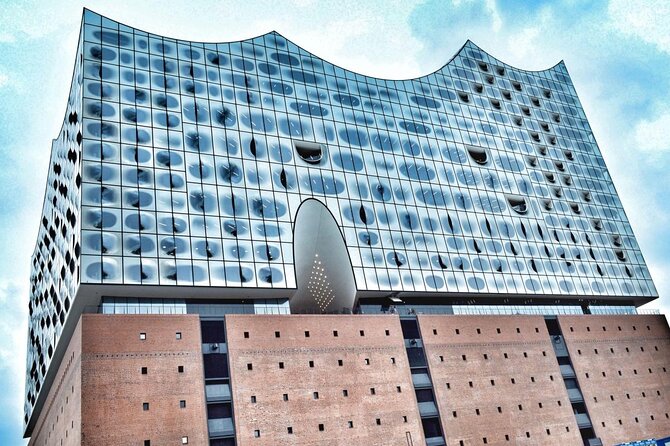
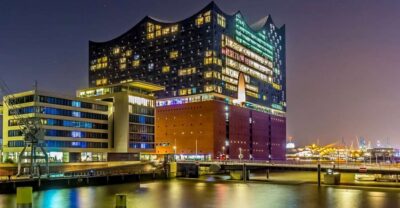
The route ends in front of the Elbphilharmonie at Platz der Deutschen Einheit. The concert hall was inaugurated in 2016, and its first concert took place on January 11, 2017.
The building represents Hamburg’s modern cultural ambitions. It also gives the tour a fitting final chapter. You begin with the 1897 Town Hall, pass through old trading streets and 19th-century warehouses, and finish at a 21st-century concert hall built in the redeveloped harbor district.
The guide explains the building’s story and its nearly perfect acoustics. The walk ends outside, so you should not assume that a concert or interior tour is included. However, you have the opportunity afterward to visit the platform and enjoy views over the port.
That extra option is useful. The walking tour gives you the setting and background, then lets you decide if you want to spend more time at the building. Since the tour does not include transportation between attractions, ending here is also convenient if you plan to continue exploring HafenCity on foot.
Guide Quality and Group Size
The professional guide is the main reason to choose a guided walk instead of following a map. The route itself is easy to identify, but the meaning behind the places is not always obvious.
Jutta receives especially strong praise for her humor, historical explanations, random facts, and friendly manner. Those details matter. A guide who can move between serious subjects, such as Operation Gomorrha, and lighter city stories can keep a mixed group engaged.
The feedback also highlights a guide who made the district interesting for everyone. That is a valuable skill on a tour covering architecture, trade, war, and city planning in quick succession.
The group maximum is 15 people. That is small enough to make a personal explanation possible, though the actual group size can vary. A minimum of eight people is required, so the tour may be canceled if that number is not met. If that happens, you are offered another date or experience, or a full refund.
Is $30.04 Good Value?
At $30.04, you are paying mainly for interpretation and organization, not entrance tickets. All listed stops are viewed from public areas, and transportation is not included.
I think the price is fair if you want a compact introduction to Hamburg and prefer learning as you walk. In two hours, you connect the Town Hall, old merchant streets, a wartime memorial, a major redevelopment project, the warehouse district, and the Elbphilharmonie. Hiring separate guides or building that route yourself would take more planning.
The value is lower if you already know central Hamburg well or want long visits inside museums and buildings. The schedule gives each stop only a few minutes, with Speicherstadt receiving the most time at about 15 minutes.
For a first visit, I would treat this as an orientation tour rather than a complete sightseeing day. It helps you decide where to return, especially Deichstrasse, Speicherstadt, HafenCity, or the Elbphilharmonie platform.
Practical Details for a Two-Hour Walk
The meeting point is Rathausmarkt, 20095 Hamburg. The tour ends at the Elbphilharmonie, Platz der Deutschen Einheit 4, 20457 Hamburg.
You receive a mobile ticket, and confirmation is provided when you book. The experience is offered in English and operates in all weather, so bring clothing suited to Hamburg’s conditions. Comfortable shoes are a sensible choice because the route includes several districts and no transportation is provided.
Most people can take part, and service animals are allowed. The meeting point is near public transportation, which helps you reach the start and continue from the end.
Free cancellation is available up to 24 hours before the start time. If you cancel later, the payment is not refunded, and changes made within that period are not accepted. Cut-off times use Hamburg’s local time.
The tour is frequently booked well ahead, with an average booking lead time of 89 days. That does not guarantee that you need to reserve that early, but it is a useful warning if your Hamburg dates are fixed.
Who Will Enjoy This Hamburg Walk?
I would recommend this tour to a first-time visitor who wants a fast but meaningful introduction to central Hamburg. It suits people who enjoy learning how streets, buildings, and port development connect.
It is also a good choice if you have only a short stay and want to cover several key areas without spending time planning a route. The endpoint at the Elbphilharmonie makes it easy to continue with your own visit afterward.
History-minded visitors will appreciate the contrast between old trade, wartime destruction, and modern rebuilding. Architecture fans will enjoy the Town Hall, Speicherstadt, HafenCity, and the concert hall.
You may want something else if you prefer a slow walk, long museum visits, or a tour devoted only to the port. The eight-stop route moves at a steady pace, and some explanations are necessarily brief.
Should You Book It?
Book this walk if you want a clear story of Hamburg in two hours, from merchant wealth and old port trade to wartime loss and harbor renewal. The route is well chosen, the small-group limit is helpful, and guides such as Jutta can add humor and memorable detail.
Skip it if you already know the central districts or want included admission to museums and attractions. For most first-time visitors, though, $30.04 is a reasonable price for a well-structured introduction, especially if you use the final stop at the Elbphilharmonie as a starting point for further exploring.
FAQ
How long does the Hamburg walking tour last?
The tour lasts approximately two hours.
Where does the tour begin?
It begins at Rathausmarkt, 20095 Hamburg, Germany.
Where does the tour end?
The tour ends in front of the Elbphilharmonie at Platz der Deutschen Einheit 4, 20457 Hamburg.
Is the tour offered in English?
Yes. The experience is offered in English.
Are transportation and attraction admission included?
No. Transportation to and from attractions is not included, and the tour information lists admission tickets as free at the stops.
Does the tour operate in bad weather?
Yes. It operates in all weather conditions, so you should dress appropriately.
What is the cancellation policy?
You can cancel up to 24 hours before the experience start time for a full refund. Cancellations or changes made less than 24 hours before the start time are not accepted for a refund.
Just added around Hamburg
- Mister X Hamburg 2h city tour, hunting & games for all ages★ 5.0 · 13 reviews
- Hamburg: Private 1.5-Hour Walking Tour of St. Pauli★ 4.9 · 13 reviews
- Yacht Sailing After Work Tour of Hamburg Harbor★ 5.0 · 13 reviews
- Free Tour: Port, Red Light District and Beatles. You decide how much to pay at the end★ 3.9 · 13 reviews
- Private 5-Hour Hamburg Countryside Tour with a former policeman★ 5.0 · 14 reviews
- Hamburg: After work Millerntor stadium tour with drinks★ 4.8 · 14 reviews
- Hamburg: Guided Walking Tour★ 4.2 · 14 reviews
- Hamburg: Tour of Blankenese on the Banks of the Elbe★ 4.5 · 14 reviews
Hamburg Tours, compared.
Sex and Crime in St. Pauli Tour for Ages 18+
Read our review →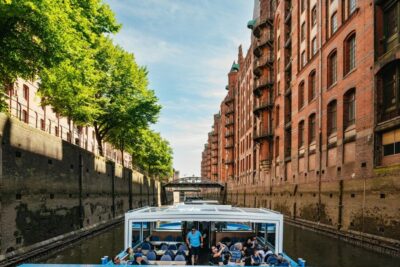
1.5-Hour Harbor and Speicherstadt Day Cruise
Read our review →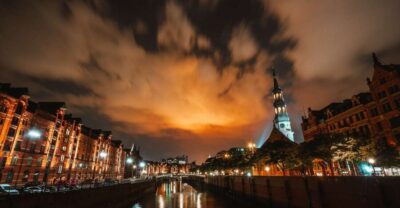
Reeperbahn Lust & Laster Tour for Adults Only
Read our review →Browse the lists this tour appears in